
Apollo as a Prospecting Tool: What It Does and How to Use It
Most teams evaluate a prospecting tool by database size. That's the wrong test.
The better question is whether a platform can find the right buying committee, verify the data before you spend a sequence step on it, and hand off clean records to your CRM without manual cleanup.
This field guide treats Apollo Prospecting as a system to pilot, not a database to trust blindly. You'll build an ICP, validate a sample, map a buying group, launch a controlled sequence, and score the results before you commit budget at scale.

Skip The Research, Apollo Verifies Instantly
Still burning 3-4 hours a day chasing contact info that turns out wrong? Apollo verifies emails and numbers instantly with 98% accuracy, so reps spend time selling instead of Googling. Stop researching. Start closing.
Start Free with Apollo →Key Takeaways
- Run a 100-contact validation test before scaling any Apollo list, using bounce rate as your go/no-go signal.
- B2B deals involve an average buying committee, so single-contact prospecting undercounts your real total addressable market per account.
- AI-assisted research and signal-based timing (new hires, funding, hiring surges) consistently outperform static list-building.
- Deliverability and compliance guardrails now matter as much as data volume for sustainable outbound.
- A 30-day pilot with clear scorecards protects your sender reputation while you test fit.
What Is Apollo As A Prospecting Tool?
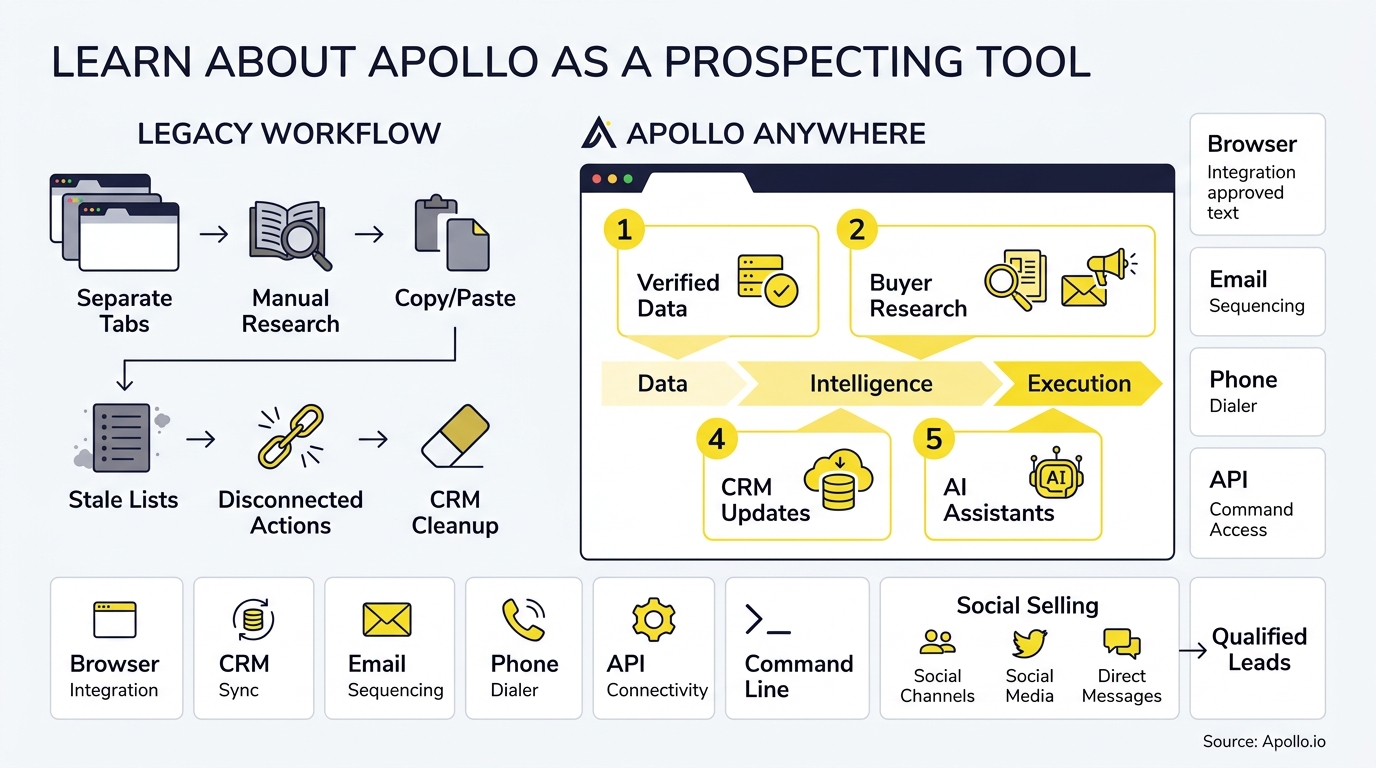
Apollo is a go-to-market platform that combines contact search, data enrichment, buying signals, sequencing, and CRM sync in one workspace, so prospecting doesn't require stitching together separate vendors. Instead of exporting a static list from one tool and importing it into another for outreach, teams search, verify, and engage from the same system. Apollo's own documentation describes this as a workflow of search, enrichment, scoring, and sequencing rather than a flat contact export.
Apollo works best for SDRs and BDRs building daily call and email lists, Account Executives researching accounts before a meeting, RevOps teams standardizing data hygiene, and founders running early outbound without a dedicated prospecting stack. Marketing teams also use it to build ICP-matched lists for account-based campaigns.
Collin Stewart of Predictable Revenue put it simply: "We reduced the complexity of three tools into one." That's the consolidation case in one sentence: one login, one data source, one sequence engine.
How Do You Build An ICP Before Prospecting In Apollo?
You build an ICP in Apollo by defining firmographic filters (industry, headcount, revenue, technology stack) and layering in buying signals before you run a single search. Skipping this step is the most common reason lists underperform.
- Firmographics: industry, employee count, revenue band, geography
- Technographics: tools in the existing stack that signal fit or conflict
- Signals: recent funding, leadership changes, hiring surges, website visits
- Persona layer: job titles and seniority across the buying group, not just one title
Document this in a simple ICP matrix (fit criteria in rows, weight in columns) so every rep prospects against the same definition. Struggling to find qualified leads? Search Apollo's database with 65+ filtering attributes to turn this matrix into a live list.

Why Should You Validate Data Before Scaling A List?
You should validate data before scaling because bounce rate is the fastest way to catch a bad list before it damages your sender reputation. Pull a sample of 100 contacts from any new Apollo list and run it through your outreach platform's verification step before enrolling the full list in a sequence.
Use an 8% bounce rate as your action threshold. Below that, proceed to full-scale outreach.
Above it, tighten your filters, re-verify emails, or narrow the ICP before you send more volume. This single check prevents a bad segment from tanking deliverability for your whole domain.
Tired of dirty data eating into your sending reputation? Start free with Apollo's data enrichment tools and verify records before every send.
How Do You Map A Buying Committee Instead Of A Single Contact?
You map a buying committee by identifying every functional role involved in the purchase decision, not just the first title that matches your persona. Forrester reported that an average B2B purchase involves 13 people and that most purchases span at least two departments.
For Account Executives, this means building a stakeholder map per account: economic buyer, technical evaluator, end user, and at least one internal champion.
Use Apollo's account and contact search together to pull every relevant title at a target company in one pass, then sequence them with role-specific messaging instead of one generic template.
Multithreading this way also reduces single-point-of-failure risk. If your primary contact goes quiet, a parallel thread with another stakeholder keeps the deal moving.
RevOps leaders should build this into CRM fields so reps can't skip the mapping step.
Spot Sales-Ready Buyers With Apollo
Watching good-fit leads stall out before they ever become real opportunities? Apollo surfaces buying signals so reps know exactly who's ready to talk now. Built-In improved win rates using Apollo's scoring.
Start Free with Apollo →How Do SDRs Use Signals To Time Outreach Better Than Static Lists?
SDRs use signals to time outreach by triggering sequences off events like new leadership hires, funding announcements, or hiring surges instead of prospecting from a static, unchanging list. professional networks's research found that decision-makers starting a new role were substantially more likely to respond to outreach within their first 90 days.
This is also where Apollo's Pocus acquisition becomes relevant: combining firmographic fit with behavioral and buying signals tells reps not just who matches the ICP, but who is likely ready to engage now. SDRs report that layering signals on top of filters shifts conversations from cold to warm before the first email even sends.
Apollo's newer AI Assistant and connectors into ChatGPT and Perplexity extend this further, letting reps use natural-language prompts to research a signal-triggered account and draft a first-touch sequence in one session, per Apollo's product announcement.
How Do You Launch A Controlled 30-Day Apollo Pilot?
You launch a controlled pilot by capping volume, running the 100-contact validation check, and scoring results against a fixed scorecard before scaling. This protects deliverability while you test fit.
| Week | Action | Success Signal |
|---|---|---|
| Week 1 | Build ICP matrix, pull 100-contact sample, validate bounce rate | Bounce rate at or below 8% |
| Week 2 | Map buying committee for top 20 target accounts | 2+ stakeholders identified per account |
| Week 3 | Launch signal-triggered sequence to validated list | Open rate and reply rate tracked daily |
| Week 4 | Review scorecard, decide scale or adjust | Meetings booked vs. target |
A month-long, Apollo-commissioned study conducted by the Tolly Group and reported via PR Newswire found a 384-contact campaign achieved a 2.37% cold-to-meeting conversion rate against a cited industry benchmark of 0.5%–1.5%. Treat this as a directional benchmark, not a guarantee, since the sample size is small and the study was vendor-commissioned. Use your own pilot scorecard as the real proof point.
What Compliance And Deliverability Steps Should You Follow Before Scaling?
You should confirm sender authentication, list hygiene, and opt-out handling before scaling any outbound sequence past your pilot. Gmail's sender guidelines recommend keeping spam complaint rates below 0.3% and require SPF, DKIM, and DMARC authentication for higher-volume senders.
- Authenticate your sending domain (SPF, DKIM, DMARC) before increasing volume
- Maintain a suppression list and honor opt-outs immediately
- Retain call records where required and document consent for phone outreach
- Users control who they call and how they use dialer tools; Apollo's system means the customer selects the numbers to call
- Re-verify data quarterly rather than assuming a list stays clean indefinitely
Spending hours stitching outreach steps across separate tools? Automate sequences with Apollo's multi-channel engagement platform instead of managing separate deliverability tools.
How Does Apollo Compare To Running Prospecting Across Multiple Tools?
Apollo compares favorably on workflow consolidation: one login for search, enrichment, sequencing, and CRM sync instead of licensing and maintaining separate vendors for each step. Yasmin Young of Cyera said, "Having everything in one system was a game changer."
| Workflow Need | Multi-Tool Stack | Apollo |
|---|---|---|
| Contact search + enrichment | Separate data vendor + enrichment tool | Built into one search |
| Sequencing + dialer | Separate engagement platform | Native sequences and dialer |
| Signal tracking | Separate intent tool | Native buying signals |
| CRM sync | Manual export/import or middleware | Direct integrations |
This consolidation matters most for RevOps leaders managing integrations and Founders watching tool spend. Review how Apollo credits work to understand usage limits before committing to a plan tier, and see Apollo best practices from power user Gabi Sayah for workflow tips beyond this guide.

Conclusion: Start With A Pilot, Not A Full Rollout
Apollo's value as a prospecting tool comes from combining data, signals, and execution in one workspace, but that value only shows up when you validate before you scale. Run the 100-contact bounce test, map your buying committee, layer in signals, and score your 30-day pilot before expanding to your full pipeline.
Ready to see how this workflow performs on your own ICP? Start a Trial and run your first validated list this week.
Justify Spend With Apollo's Real Numbers
Struggling to prove ROI before the next budget review? Apollo replaces scattered tools with one platform teams can measure from day one. Leadium tripled annual revenue after consolidating with Apollo.
Start Free with Apollo →Don't miss these
Sales
Inbound vs Outbound Marketing: Which Strategy Wins?
Sales
What Is a Sales Funnel? The Non-Linear Revenue Framework for 2026
Sales
What Is a Go-to-Market Strategy? The 2026 GTM Playbook
See Apollo in action
We'd love to show how Apollo can help you sell better.
By submitting this form, you will receive information, tips, and promotions from Apollo. To learn more, see our Privacy Statement.
4.7/5 based on 9,690 reviews
