
The best MSP prospects rarely go looking for an MSP. Think of the manufacturer or retailer with no in-house IT lead, where the owner is quietly hoping nothing breaks.
Most providers wait for a search or a referral. The better motion is to reach the owner before the outage, using the B2B lead generation tools that make a targeted list easy to build.
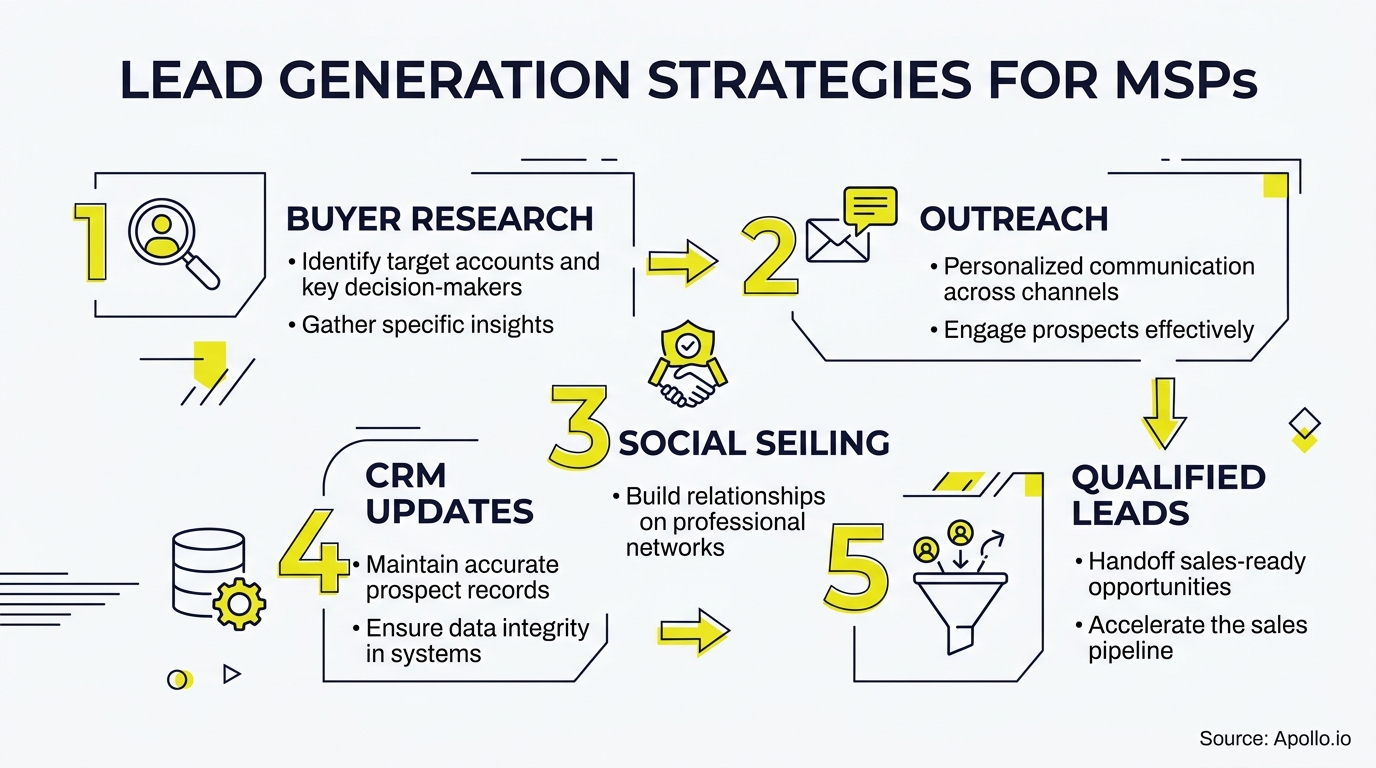
This guide shows how to define your ICP, run non-outbound channels, and handle a long sales cycle. It also covers how to reach IT decision makers at manufacturers and how to build an Apollo workflow for MSP lead generation.

Skip Manual Research With Apollo
Tired of spending hours researching leads and verifying contact info? Apollo puts business emails and phone numbers at your fingertips, with 98% email accuracy. More time selling, less time digging. Start free today.
Start Free with Apollo →Key Takeaways
- Target owners and CEOs at 10 to 200 person manufacturers and retailers before you target IT titles.
- Our data shows MSP teams concentrate on owners at manufacturers and retailers, many with no in-house IT lead.
- Count sales-accepted opportunities, not raw leads, so you know what is working.
- Build a formal referral program instead of waiting for word of mouth.
- Keep your book of business current by enriching CRM records ahead of every renewal.
Who Should MSPs Target First?
Start with owners, CEOs, and IT managers at companies with 10 to 200 employees. Manufacturers and retailers are the sweet spot because they depend on uptime but often have nobody dedicated to IT.
Across IT services and software sellers, owners, CEOs, and founders are searched for more than any technical title. CTOs and CIOs come next, so the economic buyer usually gets the first touch, not IT.
Separate your buyers into two paths. Fully managed buyers have no internal IT and need a complete outsourcer, while co-managed buyers have a small team and need capacity relief.
Write both down in a one-page ICP worksheet: industry, headcount, metro, IT staffing, and trigger events. Then define a lead as a name that fits the worksheet and an opportunity as a conversation your sales team has accepted.
Your next step: build a list of every manufacturer and retailer in your metro, sized 10 to 200 employees, with an owner or IT manager contact attached.
What Is MSP Lead Generation?
MSP lead generation is the repeatable process of finding businesses that need managed IT and turning them into sales-accepted opportunities. The goal is not traffic, it is qualified conversations.
The need is documented. Kaseya's 2025 benchmark infographic reports that 1 in 3 MSPs cited slower customer acquisition as their primary economic drag.
Pick channels using three questions: how much capacity you have, how much buyer intent exists, and how much budget you can spend. Use this matrix as a starting point.
| Channel | Best When | Capacity Needed | Budget |
|---|---|---|---|
| Referral program | You have happy clients | Low | Low |
| Outbound to owners | Buyers have low search intent | Medium | Low to medium |
| Local events and associations | Your metro is concentrated | Medium | Low |
| Website and search content | Buyers already search | High | Medium |
Your next step: pick two channels from the table and commit to them for 90 days.

How Do MSPs Reach IT Decision Makers at Manufacturers?
At a 50-person manufacturer, the person who signs for IT is often the owner, the operations lead, or a lone IT manager. Start with whoever controls the budget.
Follow these steps:
- Filter for manufacturing companies in your metro with 10 to 200 employees.
- Add owner, CEO, president, and IT manager titles, and flag accounts with no IT department.
- Lead with uptime on the production floor, not technology jargon.
- Offer a free, no-obligation IT risk assessment as the first conversation.
Many manufacturers have a lone IT person stretched thin. Offer co-managed support for that contact and a full-service pitch for the owner.
Cybersecurity is a strong angle. Kaseya's research shows security is a top revenue driver for MSPs, so tie your offer to a specific business problem like ransomware downtime.
Relevance beats personalization here. Reaching the owner with the right signal at the right moment, such as a new plant, a system upgrade, or a compliance deadline, beats a hundred generic touches.
Struggling to find qualified leads? Search Apollo's 240M+ contacts with 65+ filters.
Your next step: write two short messages, one for owners about downtime and one for IT managers about capacity.
Fill Your Funnel With Leads That Convert
Top of the funnel full of leads that never turn into opportunities? Apollo puts verified business contacts and buying signals in one workspace, so you work the right accounts and see where every deal stands. Start free and forecast with confidence.
Start Free with Apollo →How Can MSPs Generate Leads Without Outbound?
Outbound is not the only motion. Several channels work with a small budget and a lean team.
Referrals come first. ConnectWise's MSP Marketing Report notes that referrals remain a key source of business, yet many MSPs have no formal program.
Build a simple one:
- List your five happiest clients and ask each for two introductions.
- Partner with accountants, insurance brokers, and equipment vendors who see IT problems first.
- Track the source of every new opportunity in your CRM.
Local networks matter in this industry. Join chambers of commerce, manufacturing associations, and retail groups, then host a short security briefing for members.
Publish self-service content as well. Explain your service scope, your pricing logic, and who you are a good fit for, so buyers can qualify themselves before they ever call.
Your next step: send your first five referral requests this week.
How Do MSPs Earn Trust and Shorten a Long Sales Cycle?
Managed IT is a recurring commitment, so buyers move carefully. They want proof, a low-risk way to start, and a clear reason to switch now.
Build trust with these steps:
- Show proof: client stories, response-time commitments, and a transition plan.
- Answer the migration-risk objection directly with a documented onboarding timeline.
- Offer a paid or free assessment as a pilot before a full contract.
- Watch for timing triggers: contract renewals, an outage, a new location, or a cyber insurance requirement.
Many of your buyers already have a provider and are unhappy but reluctant to move. Your content should make switching feel safe.
Track results by what matters. Measure sales-accepted opportunities, cost per new client, and months to payback on monthly recurring gross profit, not just cost per lead.
Your next step: write down your onboarding timeline and put it in your first sales email.
How Does Apollo Help MSPs Win More Managed IT Clients?
If you are an MSP, here is how Apollo solves three problems: finding businesses with no IT lead, reaching the owner, and keeping a large book of accounts current. Here is an example workflow.
- Filter and build the list. Use Apollo's database of 240M+ people and 30M+ companies to filter by industry, headcount, location, and title. An MSP can build a list of every manufacturer and retailer in its metro, then keep the ones with no in-house IT lead.
- Prospect where you already work. The Chrome extension lets you pull contact data from a company website or Gmail without opening another tab. With Apollo MCP, Apollo's Model Context Protocol, you can run the same searches from inside ChatGPT or Claude.
- Sequence the owner. Use sales engagement to launch a multichannel sequence on uptime and security across email, phone, and social.
- Keep the book current. Use CRM enrichment to refresh contact and company data, so a 400-account book stays accurate at renewal.
Spending hours on manual outreach? Automate your sequences with Apollo.
Apollo brings data, intelligence, and execution together in one connected system, so you do not stitch together separate tools for research, outreach, and CRM hygiene.
Your next step: run one 30/60/90-day pilot. In days 1 to 30, build the list and send the first sequence.
In days 31 to 60, review replies and sales-accepted opportunities. In days 61 to 90, double down on what worked.
How Do You Sell To MSPs And IT Service Providers?
If you are prospecting MSP and IT services executives instead, target founders, CEOs, and operations or sales leaders at those firms. Use Apollo's industry, title, and seniority filters to build the list.
Lead with their own pain: slower acquisition, smaller contracts, and the need to show proof of value. For a related playbook, see Lead Generation for Cybersecurity Companies.

Frequently Asked Questions About MSP Lead Generation
What Is The Difference Between A Lead And An Opportunity For An MSP?
A lead is a business that matches your ICP. An opportunity is a lead your sales team has accepted after a real conversation. Count opportunities to judge performance.
How Do I Target Co-Managed Versus Fully Managed Buyers?
Fully managed buyers have no internal IT and need a complete outsourcer. Co-managed buyers have a small team and need capacity relief. Build separate messages and discovery questions for each.
Should MSPs Use A Lead Generation Agency Or Do It In House?
Choose an agency if you lack capacity and can define your ICP clearly. Choose in-house if you have a clear offer and someone to own follow-up. Either way, hold the work to qualified opportunities.
How Do I Know What My Cost To Acquire A Client Is?
Divide your total acquisition spend by the number of new clients won in the same period. Then compare it to monthly recurring gross profit to find your payback period.
Ready to build a steady pipeline of managed IT clients? Get Started Free with Apollo and bring prospecting, engagement, and CRM enrichment into one connected workflow.
Prove Pipeline ROI Fast With Apollo
Budget approval stuck on unclear metrics? Apollo puts data, outreach, and analytics in one workspace so you can show real pipeline impact fast. Leadium tripled annual revenue by automating follow-up. Start free and show results sooner.
Start Free with Apollo →Don't miss these
Sales
Inbound vs Outbound Marketing: Which Strategy Wins?
Sales
What Is a Sales Funnel? The Non-Linear Revenue Framework for 2026
Sales
What Is a Go-to-Market Strategy? The 2026 GTM Playbook
See Apollo in action
We'd love to show how Apollo can help you sell better.
By submitting this form, you will receive information, tips, and promotions from Apollo. To learn more, see our Privacy Statement.
4.7/5 based on 9,690 reviews
