
Most ecommerce agencies chase leads the way merchants chase traffic: more volume, less fit. The better motion is to pick the brands you can actually move the needle for, reach the founder or head of growth with a specific diagnosis, and measure qualified pipeline instead of form fills.
This guide shows how to win merchant clients, starting with a Shopify store owner list built on real signals. Teams can build and work these lists with Apollo's B2B lead generation tools.
By the end, you will know who to target, how to reach each buyer, and what to run in your first 30 days.

Skip Manual Research - Apollo Finds Contacts
Tired of spending hours researching leads and verifying contact info? Apollo puts business contact details at your fingertips with 98% email accuracy, so your reps get back to selling. Start finding the right buyers today.
Start Free with Apollo →Key Takeaways
- Target by fit and observable signals, not by raw list size.
- Reach the founder or head of growth, not a generic marketing contact.
- Lead with a short diagnostic, not a retainer pitch.
- Track qualified opportunities and acquisition cost, not lead volume.
- Run a 30-day pilot before you scale any channel.
Who Should Ecommerce Agencies Target?
Your best prospects are founders and marketing and growth leads at DTC and retail ecommerce brands, plus retail buyers where your service touches wholesale. These are the people who own revenue outcomes and can approve a scoped engagement.
Not every merchant is a fit. Our data shows ecommerce sellers filter by retail and ecommerce keywords and storefront technology, so build your list the same way and add exclusion criteria.
Score each account before you contact anyone:
| Signal | What to look for | Keep or exclude |
|---|---|---|
| Storefront stack | Shopify plus an email platform such as Klaviyo | Keep established stacks; exclude brands with no store |
| Company size | SMB to mid-market headcount range | Exclude brands too small to fund a retainer |
| Team gaps | Hiring for growth, CRO, or lifecycle roles | Keep; exclude brands with a full in-house team |
| Service match | Your specialty maps to an observable problem | Exclude if you cannot name the problem |
Next step: write your top three exclusion rules before you build a single list.
How Do You Build a Shopify Store Owner List?
Start from the stack, then work toward the person. Filter for companies in retail and ecommerce, add keywords and technologies that signal a live storefront, and narrow by headcount to match your sweet spot.
Apollo's B2B database covers 240M+ people and 30M+ companies with 65+ filters, including technologies used and hiring activity. Struggling to find qualified leads? Search Apollo's 240M+ contacts with 65+ filters.
Build the list in this order:
- Filter companies by industry, headcount, and storefront technology.
- Add a hiring filter for growth or lifecycle roles as a timing signal.
- Pull the founder or head of growth at each account.
- Save the list and tag each account with its score.
Next step: build a 50-account list this week and score every row.

How Do You Find DTC Brand Contacts That Actually Reply?
Reach the decision-maker, not the inbox that routes to a junior coordinator. For DTC brands, that is usually the founder, the head of growth, or the head of ecommerce.
Approved data helps, but research decides relevance. A merchant's own storefront tells you what to say, so open the site, check the checkout, and note one specific gap before you write.
Apollo's Chrome extension lets you pull verified contact data while you browse a brand's site, so research and prospecting happen in one pass. Use human review on any AI-assisted research before it reaches a prospect.
Relevance beats personalization here. A first name at volume is table stakes; the right signal at the right moment is what earns a reply.
Next step: pick 10 DTC brands and write one verified, specific observation for each.
How Can Ecommerce Agencies Generate Leads Without Outbound?
Outbound works best alongside channels that build trust before the first message. Buyers research before they talk to you, so make your evidence easy to find.
Research from 6sense found that 81% of surveyed B2B buyers selected a preferred vendor before speaking with sales. That makes pre-contact credibility part of your pipeline.
Tactics an agency can run on a small budget:
- Publish two detailed case studies with baselines and methods, not just results.
- Join platform partner programs and track partner-sourced opportunities separately.
- Host a short teardown session for a niche, such as skincare or outdoor gear.
- Ask three happy clients for one introduction each.
Next step: pick one channel, set a four-week target, and review results against qualified opportunities.
Forecast With Confidence Using Apollo
Pipeline forecasting a guessing game because lead quality is thin and deal data is stale? Apollo helps you find quality leads, track real buying signals, and see where every deal stands. Top-of-funnel confidence starts here.
Start Free with Apollo →How Do You Earn Trust and Handle the Ecommerce Sales Cycle?
Merchants hire agencies they can verify. Replace promises with proof: relevant case studies, clear methodology, and a way to test fit before a long commitment.
Common objections are cost, past agency disappointment, and fear of lock-in. Answer them with a scoped pilot that has a baseline, a success metric, and an expansion decision.
Timing triggers worth watching:
- A new growth hire, which signals budget and priority.
- A replatform or theme change, which exposes conversion risk.
- A seasonal peak approaching, when a fast audit has urgency.
Market context supports this approach. AgencyAnalytics reports that 34% of agency leaders cite bringing in new clients as their single most difficult operational challenge, so a repeatable process is a real advantage.
Next step: draft a one-page pilot offer with a baseline, a metric, and an end date.
How Does Apollo Help Ecommerce Enablement Firms Win Brands?
If you are an ecommerce agency, here is how Apollo solves three problems: finding the right brands, reaching the right person, and keeping your pipeline clean. For example, a firm can filter for established Shopify and Klaviyo brands, pull the founder and head of growth, and sequence on conversion lift.
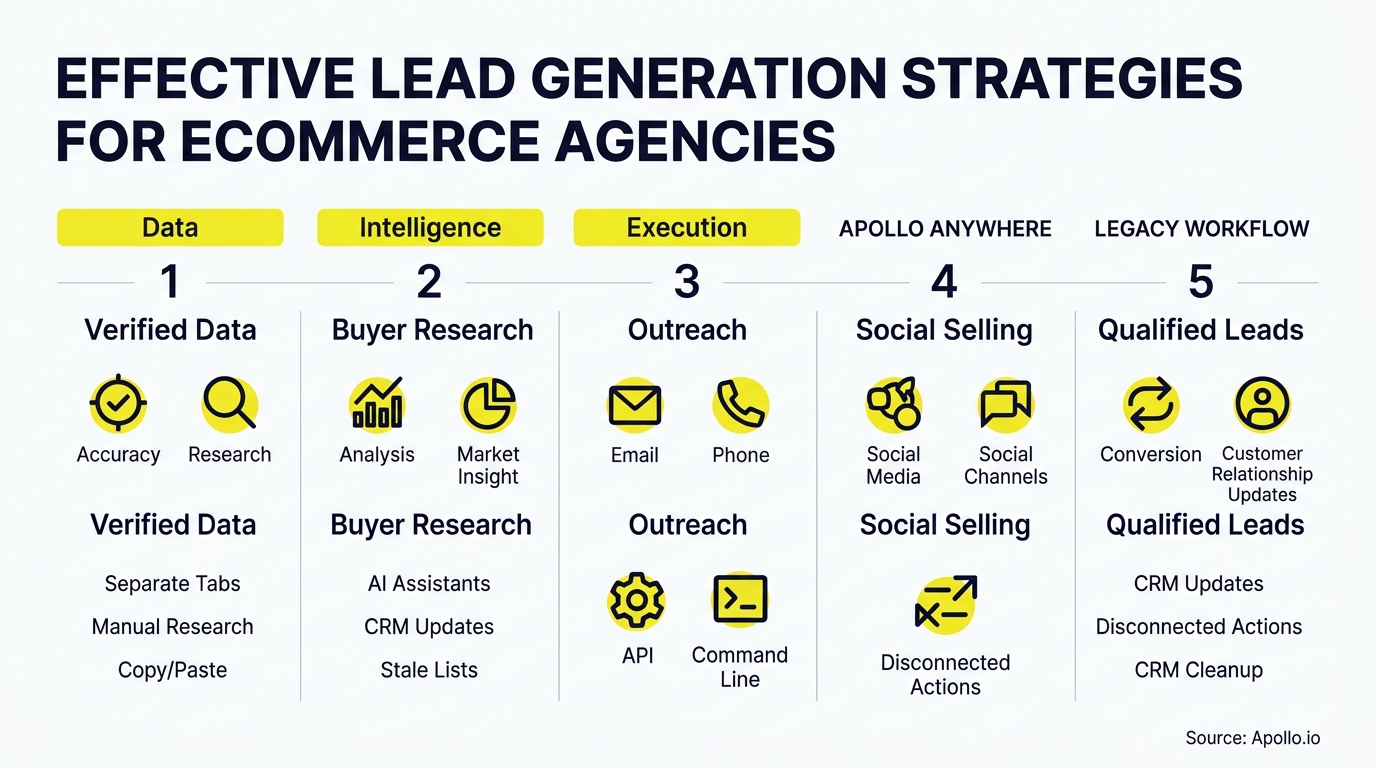
Apollo brings data, intelligence, and execution together in one connected go-to-market system, so you are not stitching separate tools together. Walk through it step by step:
- Filter and signal. Set storefront technology, headcount, and hiring filters to isolate your ideal brands.
- Build and prioritize. Save the list and use Apollo's AI Assistant to research accounts and prioritize by fit.
- Reach out where you work. Use Apollo MCP to prospect and draft inside ChatGPT or Claude, without opening another tab.
- Sequence the outreach. Launch a multichannel plan with sales engagement sequences across email, phone, and social.
- Keep the CRM current. Sync contacts and outcomes so records stay accurate. Tired of dirty data? Start free with Apollo's 240M+ verified contacts.
Measure what matters in your CRM. Define clear stages and track cost per qualified opportunity, not cost per lead.
| CRM stage | Definition | What to measure |
|---|---|---|
| Researched | Account scored and one specific gap noted | Accounts per week |
| Engaged | Prospect replied or booked a diagnostic | Reply rate by segment |
| Qualified | Budget, need, and decision-maker confirmed | Cost per qualified opportunity |
| Pilot | Scoped paid or trial engagement signed | Pilot-to-retainer rate |
Next step: run a 30-day pilot on one segment, review the dashboard weekly, and cut anything that does not produce qualified opportunities.
Who Should You Prospect When Selling to Other Ecommerce Firms?
If you sell to ecommerce enablement firms and internet companies, target the owners and founders first. Across IT services and software sellers, owners, CEOs, and founders are searched for more than any technical title, so the economic buyer usually gets the first touch.
Use industry, title, and seniority filters to find them, then add a department filter to reach heads of partnerships or growth. Keep the message short and specific to their service line.
Next step: save one search for founders at firms in your target size band.

Frequently Asked Questions
How Do Ecommerce Agencies Find New Clients?
They combine signal-based outbound, partner programs, and proof-led content. Start with one segment, build a scored list, and track qualified opportunities for 30 days before adding channels.
How Do You Qualify Merchant Prospects?
Score each account on storefront stack, company size, team gaps, and service match. Exclude brands you cannot help, then confirm budget and authority in the first conversation.
Should an Agency Run Lead Generation In-House or Outsource It?
Keep it in-house if you have a clear niche and someone owning the process. Outsource only the parts you cannot staff, and hold any partner to qualified-opportunity targets rather than lead counts.
How Do You Measure Acquisition Cost?
Divide total spend on tools, time, and campaigns by qualified opportunities, then by signed clients. Compare channels on cost per qualified opportunity and pilot-to-retainer rate.
Ready to win more merchant clients with focused, signal-based prospecting? Get Started Free with Apollo's platform and bring data, intelligence, and execution into one connected workflow.
Prove Pipeline ROI Faster With Apollo
ROI questions stalling your next budget approval? Apollo puts prospecting, outreach, and AI-powered execution in one place, so wins show up sooner. Teams actively using Apollo's AI Assistant are up 2,156% since December 2025. Start proving value this quarter.
Start Free with Apollo →Don't miss these
Sales
Inbound vs Outbound Marketing: Which Strategy Wins?
Sales
What Is a Sales Funnel? The Non-Linear Revenue Framework for 2026
Sales
What Is a Go-to-Market Strategy? The 2026 GTM Playbook
See Apollo in action
We'd love to show how Apollo can help you sell better.
By submitting this form, you will receive information, tips, and promotions from Apollo. To learn more, see our Privacy Statement.
4.7/5 based on 9,690 reviews
