
Most cloud consultancies chase "cloud" as one big market, and that is why their outreach sounds like everyone else's. The better motion is to find the accounts that are mid-migration right now, reach the person who owns the budget, and lead with a scoped assessment instead of a generic call.
This guide shows how to do that with Apollo's B2B lead generation tools, from the first list to a sales-accepted opportunity. You will also see how to build an IT director email list and a legacy-technology target account list you can use this week.

Skip Lead Research. Apollo Fills Your Day
Hours lost researching leads and verifying contact info while quota clock ticks? Apollo puts business info with 98% email accuracy at your fingertips, so reps spend the day selling. Start free and take back your selling time.
Start Free with Apollo →Key Takeaways
- Target CIOs, IT directors, and DevOps leads at Mid-Market and Enterprise companies still on legacy or on-prem stacks.
- Lead with a scoped assessment, not a generic cloud consultation.
- Qualify on workload, timeline, budget owner, and migration trigger before handing off to sales.
- Use tech-stack signals to time outreach instead of sending more touches.
- Run a 30-day pilot with a clear definition of a sales-accepted opportunity.
Who Should Cloud Service Providers Target First?
Our data shows that cloud sellers go after CIOs and IT directors rather than developers, and that tech-stack signals such as on-prem or legacy tooling decide who is in market. Start there, then add DevOps leads as the technical validator.
Across IT services and software sellers more broadly, owners, CEOs, and founders are searched for more than any technical title, with CTOs and CIOs close behind. At smaller Mid-Market companies, the economic buyer may get the first touch, not IT.
Match each service to a buyer and an offer before you write a single email.
| Service | Primary Buyer | Technical Validator | First Offer |
|---|---|---|---|
| Cloud migration | CIO or IT director | DevOps lead | Migration readiness assessment |
| Managed cloud | IT director | Infrastructure manager | Operations and cost review |
| Cost optimization | CIO or finance partner | Platform engineer | Scoped optimization assessment |
| Security and compliance | CIO or security lead | Cloud architect | Configuration assessment |
Next step: pick one row, then build a list of 100 accounts and 2 to 3 contacts each. Use Apollo's 240M+ contacts with 65+ filters to filter by title, headcount, and industry.
How Do You Build an IT Director Email List?
Start from accounts, then add people. A list of titles with no account logic produces volume without relevance.
Follow these steps:
- Filter companies by headcount for the Mid-Market and Enterprise segment you serve.
- Filter people by title: IT Director, Director of Infrastructure, VP of IT, CIO, and Head of DevOps.
- Add seniority and department filters to remove irrelevant matches.
- Prioritize industries your team has delivered for. Manufacturing, software, fintech, and retail are common filters for IT and software sellers.
- Enrich missing emails and phone numbers, then save the list as a named segment.
Build two or three contacts per account so you can reach both the buyer and the validator. For gaps, Waterfall Enrichment fills in records from 20+ data partners.
Next step: save your first list with a clear name, such as "IT Directors, Mid-Market Manufacturing, On-Prem."

How Do You Find Companies Using Legacy Technology?
Legacy tooling is the clearest signal that a migration is coming. Apollo's technology filters let you search for companies by the tools they use, so you can target accounts still running on-prem or older stacks.
Build the list like this:
- Choose three to five technologies that signal an aging environment, such as on-prem virtualization, legacy databases, or older backup tooling.
- Combine them with headcount and industry filters.
- Add hiring signals, since open infrastructure or DevOps roles often point to a project in motion.
- Score the list so the best-fit accounts rise to the top. Apollo's intelligence layer supports scoring and prioritization.
Relevance beats personalization here. A message that references the specific stack an account still runs lands better than a first-name merge on a generic pitch.
Next step: re-run this search monthly, since accounts leave and enter the legacy pool as their stacks change.
What Does a Worked Cloud Assessment Campaign Look Like?
The strongest lead offer is a scoped assessment with clear boundaries. Cost is a reliable theme: Flexera's 2026 State of the Cloud Report found that 85% of respondents consider managing cloud spend a top challenge.
Here is a worked example for a migration-cost assessment:
| Step | What To Do |
|---|---|
| Audience | IT directors at Mid-Market companies on legacy stacks |
| Offer | A two-week migration cost assessment for one workload |
| Outreach angle | Migration cost and risk for the specific legacy tool they run |
| Discovery questions | Which workload moves first? What is the timeline? Who signs off on budget? |
| Assessment boundary | One workload, fixed duration, written findings, no implementation commitment |
| Handoff | Passed to sales only after the qualification criteria below are met |
A short first email might read: "Saw your team still runs [legacy tool]. We scope a two-week assessment of one workload so you know the migration cost before committing. Worth a quick look?"
Qualify before handoff on four points: a named workload, a target timeline, an identified budget owner, and a trigger such as a contract renewal or end-of-support date. Disqualify accounts with no timeline or no budget owner.
Next step: write your own boundary statement in one sentence so every rep describes the assessment the same way.
Turn Forecast Guesswork Into Pipeline Clarity
Forecasts feel like guesses because deal data is stale? Apollo brings prospecting, engagement, and deal activity into one workspace, so you see where every opportunity stands. Teams actively using Apollo's AI Assistant are up 2,156% since December 2025.
Start Free with Apollo →How Can Cloud Providers Generate Leads Without Outbound?
Buyers research before they talk to you. Gartner describes sellers as "validation and sounding-board partners" rather than basic information conduits, so your public material has to do real work.
Run these channels alongside outbound:
- Marketplace listings. Eligible partner services on cloud marketplaces can connect discovery to a sales conversation, so measure marketplace-assisted deals, not just leads.
- Technical content. Publish migration checklists, cost breakdowns, and implementation write-ups that show how you scope work.
- Partner referrals. Build relationships with software vendors and hyperscaler account teams who see customers mid-project.
- AI visibility. Many buyers now start research in AI tools, so test how those tools describe your services and fix thin or vague pages.
Next step: ask three recent clients where they researched you first, then double down on that channel.
How Do You Earn Trust and Handle the Cloud Sales Cycle?
Cloud migrations carry risk, so buyers want proof before they commit. Give them evidence in layers.
- Share a redacted scope document so buyers see how you work.
- Offer a paid or fixed-scope pilot on one workload to limit risk.
- Prepare answers for common objections: downtime, cost overruns, security, and vendor lock-in.
- Watch timing triggers such as renewals, end-of-support dates, funding events, and new infrastructure hires.
Keep follow-up tied to those triggers. Automate your sequences with Apollo so a trigger sends the right message at the right moment.
Next step: map your last five closed projects to the trigger that started each one.
How Does Apollo Help Cloud Service Providers Win More Migration Projects?
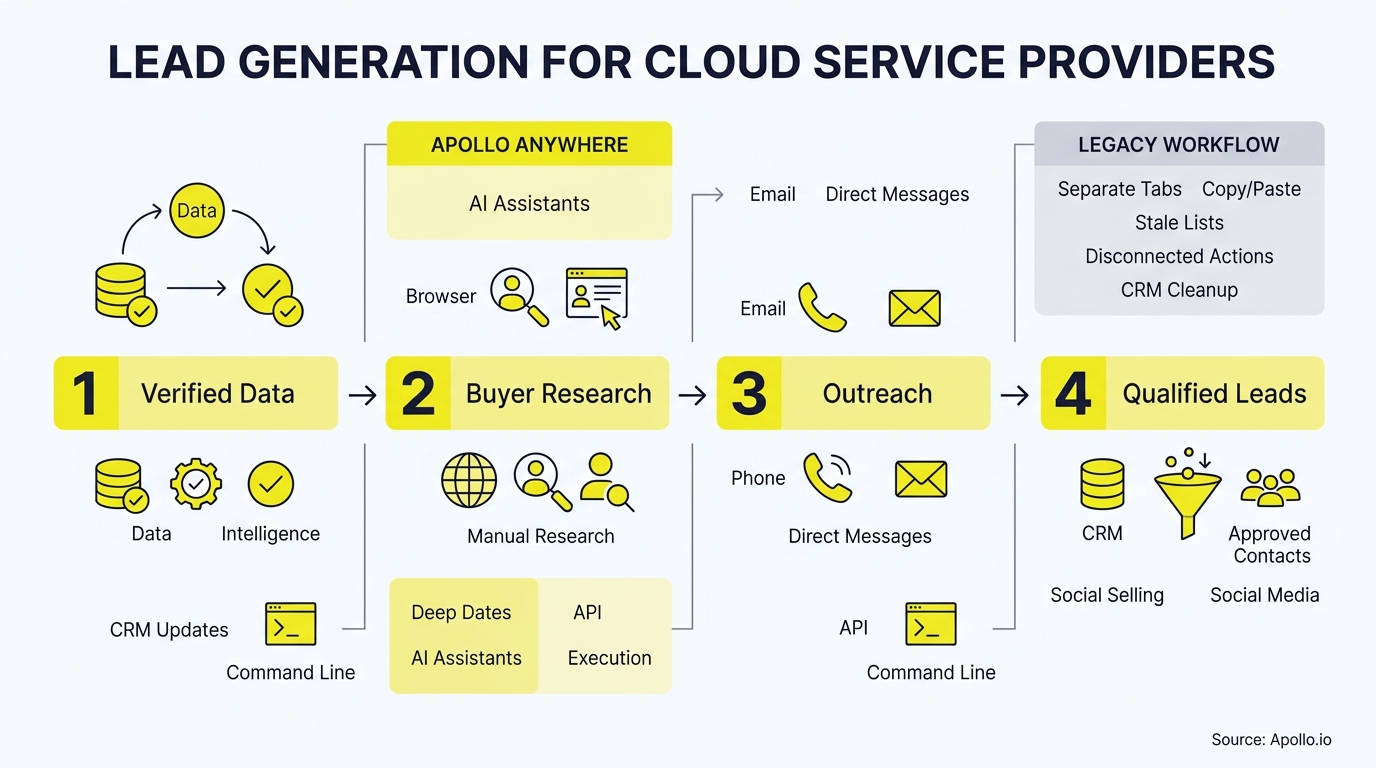
If you're a cloud consultancy, here is how Apollo solves three problems: finding accounts that are actually in market, reaching the right IT leader, and keeping reply data connected to account changes. Apollo brings data, intelligence, and execution together in one connected system, and it meets you in the tools you already use.
For example, a cloud consultancy can run this workflow:
- Filter for IT directors at companies still running on-prem or legacy stacks, using technology and headcount filters.
- Score the list so the highest-fit accounts get attention first.
- Launch a sequence built around migration cost, mixing email, phone, and social touches in one Apollo workspace.
- Track replies against changes in each account's tech stack, so you know when an account moves from legacy to in-market.
- Sync results to Salesforce or HubSpot so sales sees the full history.
You can do part of this where you already work. Apollo MCP, Apollo's Model Context Protocol, lets you prospect and enrich inside ChatGPT or Claude, and the Chrome extension surfaces contacts from any company website.
Struggling to find qualified leads? Search Apollo's 240M+ contacts with 65+ filters and build your first migration list today.
What If You Want to Sell to Cloud and Infrastructure Companies?
If you're prospecting cloud and infrastructure firms instead, target the same decision-makers from the other side. Filter by industry, then by title and seniority: owners and founders at smaller firms, CTOs and CIOs at larger ones, and heads of delivery or partnerships for channel plays.
Use department and headcount filters to separate consultancies from vendors, then enrich the list before outreach. Next step: save one segment per company size so your message matches who reads it.
FAQ
How Do I Qualify Cloud Leads Before Passing Them To Sales?
Require a named workload, a target timeline, an identified budget owner, and a migration trigger. If any of the four is missing, keep the lead in nurture.
What Is The Best Lead Offer For A Cloud Consultancy?
A scoped assessment tied to one workload, with a fixed duration and written findings. It lowers risk for the buyer and gives your team a natural next step.
How Should I Measure Cloud Lead Generation?
Track lead-to-opportunity progression by service line, not raw lead counts. Tag the source on each opportunity, and note that attribution across many channels is imperfect.
Who Should I Contact First At A Target Account?
Start with the IT director or CIO as the buyer, and add a DevOps lead as the validator. Reach both within the same week so the project has an internal champion.

Win The Next Migration Project
The cloud providers that win are not sending more messages. They find accounts on legacy stacks, reach the IT leader who owns the budget, and open with a scoped assessment that makes the next step easy.
Ready to build your first migration list? Get Started Free with Apollo and bring prospecting, engagement, and analytics together in one workflow.
Prove Pipeline ROI Fast With Apollo
Budget approval stuck on unclear metrics? Apollo puts prospecting, engagement, and pipeline activity in one workspace, so you can show leaders real results quickly. Leadium 3x'd annual revenue by automating inbound and speeding follow-up.
Start Free with Apollo →Don't miss these
Sales
Inbound vs Outbound Marketing: Which Strategy Wins?
Sales
What Is a Sales Funnel? The Non-Linear Revenue Framework for 2026
Sales
What Is a Go-to-Market Strategy? The 2026 GTM Playbook
See Apollo in action
We'd love to show how Apollo can help you sell better.
By submitting this form, you will receive information, tips, and promotions from Apollo. To learn more, see our Privacy Statement.
4.7/5 based on 9,690 reviews
