
Best Jeeva AI Alternatives for SDR Teams: 5 Options in 2026
Jeeva AI positions itself as an agentic platform that deploys autonomous digital workers across revenue, customer service, IT operations, security, and finance functions. The platform, which Jeeva AI reports is used by 35,000+ users, offers production-ready workers for tasks like lead enrichment, ticket resolution, and invoice processing on a credit-based pricing model. For teams focused specifically on sales prospecting and outbound execution, this broad cross-functional scope can mean paying for capabilities like IT operations or finance automation that a sales team never touches.
As sales organizations scale, many find they need deeper sales intelligence data, more flexible multi-channel sequencing, and tighter CRM synchronization than a generalist agentic platform provides. Teams evaluating Jeeva AI alternatives are typically looking for stronger prospecting databases, transparent per-seat pricing, built-in dialers, and workflow automation purpose-built for revenue teams rather than spread across finance and IT use cases.
This guide compares five alternatives, starting with Apollo, an AI GTM system built specifically for go-to-market execution, alongside four other platforms in the AI sales agent and outbound automation space. We'll break down features, pricing, and ideal use cases so you can find the right fit for your team.

Skip The Research Grind, Apollo Delivers
Spending hours manually verifying emails and phone numbers before you can even start selling. Apollo hands you 240M+ verified contacts with 98% accuracy, so your reps prospect instead of playing detective. Start Free with Apollo →.
Start Free with Apollo →Key Takeaways
- Sales intelligence depth: Apollo combines a large verified contact database with built-in engagement tools, while most alternatives on this list focus narrowly on outreach automation without their own proprietary data layer.
- AI features: Apollo's AI Research Agent, AI Sequence Builder, and AI Dialer sit alongside platforms like 11x and Lindy that focus on autonomous digital workers for specific workflows like outbound calling or inbox management.
- Customer base: Apollo serves B2B GTM teams, GTM Engineers, and AI Builders building headless GTM workflows with the Apollo API, CLI, and MCP, alongside Sales Professionals, SDRs/BDRs, AEs, RevOps, Marketing, and Revenue Leaders, spanning startups to enterprise teams.
- Platform scope: Some alternatives specialize in a single function (personalization, inbound qualification, or general assistant tasks), while Apollo covers prospecting, enrichment, multi-channel engagement, and dialing.
- Pricing model: Apollo publishes transparent per-seat pricing starting at $49/user/month, while several alternatives rely on requested quotes or credit-based consumption pricing that scales with usage.
Apollo

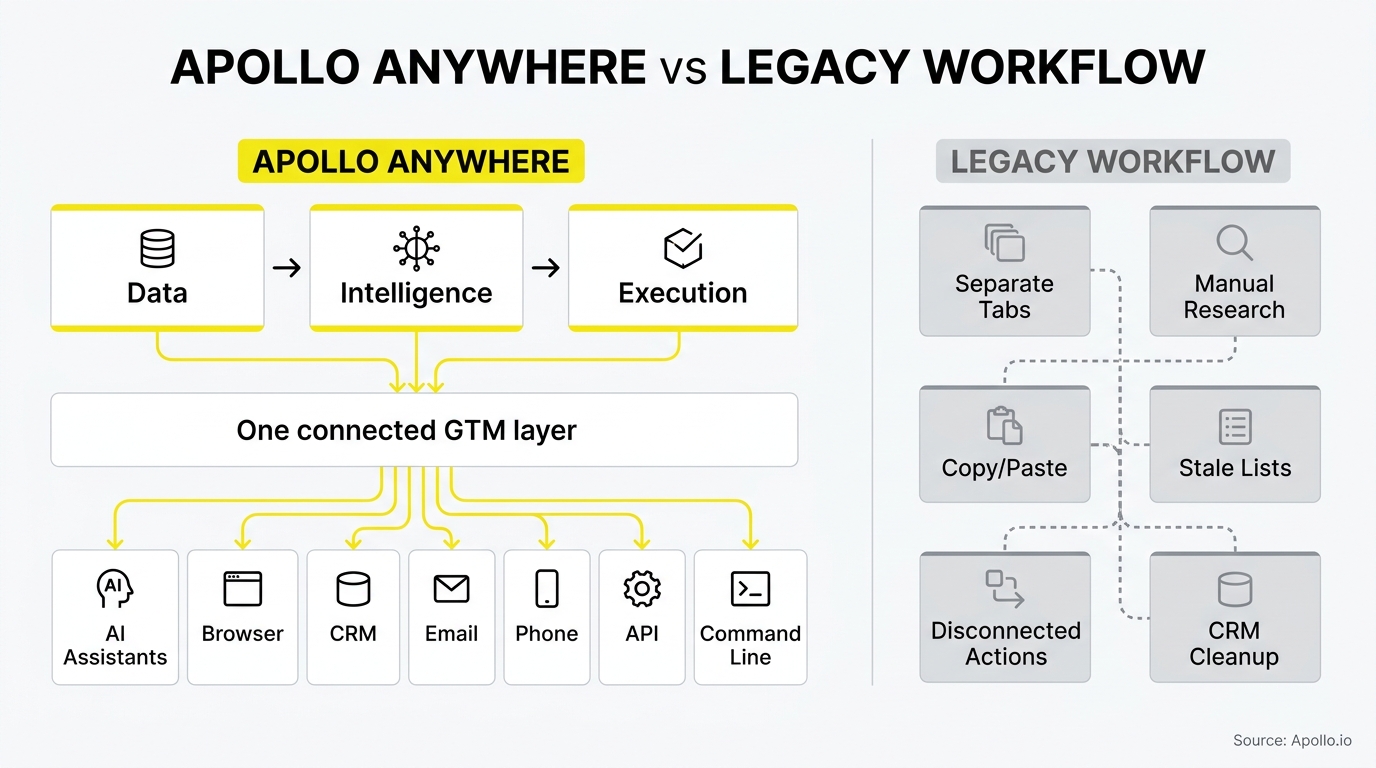
Apollo is an AI GTM system that unifies data, intelligence, and execution. Built open by design, Apollo meets sellers inside the tools they already use, from AI assistants like ChatGPT, Codex, Claude, and Perplexity via Apollo MCP, Apollo's Model Context Protocol, to the Chrome extension and Salesforce, rather than asking teams to switch contexts to get value. For technical and advanced users, Apollo CLI provides terminal-native access for headless GTM workflows.
Apollo's database includes 240M+ people and 30M+ companies, with 98% email accuracy, and contacts are continuously validated and refreshed by Apollo's Living Data Network rather than sitting static. On the outbound side, teams can define an ICP and let the AI Assistant find, research, and rank accounts and contacts, then run multi-channel sequences across email, calls, and social with the Power Dialer and Parallel Dialer for efficient calling. The AI Sequence Builder creates sequences from natural language, and outbound analytics dashboards with AI sentiment analysis help teams refine what's working. On the inbound side, Apollo captures website visitors, enriches and shortens forms automatically, and routes leads through AI-assisted round-robin and criteria-based booking, all backed by 65+ filters for precise targeting (source: Apollo Product Page). Apollo's B2B data and waterfall enrichment keep CRM records complete through scheduled, real-time, and bulk enrichment jobs with bi-directional sync to Salesforce and HubSpot.
Apollo's pricing is available on four tiers with annual billing savings of 20%: Free at $0 with 900 credits/year and 2 sequences; Basic at $49/user/month with 30,000 credits/year, unlimited sequences, and CRM integrations; Professional at $79/user/month adding the US dialer, 5 mailboxes, and AI research; and Organization at $119/user/month (minimum 3 users) with international dialer, 15 mailboxes, SSO, and advanced security.
Customer feedback reflects this breadth. Kevin Warner, CEO at Leadium, said
"Apollo became the single source of truth for uswhere everything originates from and where all the data returns to.", Kevin Warner, LeadiumCollin Stewart, CEO at Predictable Revenue, noted
"We reduced the complexity of three tools into one.", Collin Stewart, Predictable RevenueAnd Mark Turner, VP of Revenue Operations at Built In, said
"Apollo enriches everything we have: contacts, leads, accounts...And we don't really have to touch it, it just works.", Mark Turner, Built In
According to Ramp's vendor data, drawn from real spend across American businesses, Apollo is the fastest-growing vendor in the Sales Data Providers category, with adoption up 5 percentage points year-over-year to 39% as of August 2026, and a 22% competitor switch rate, more than double the next closest data provider tracked. Apollo's open-by-design approach connects to the tools teams already use, including AI assistants via Apollo MCP, the Chrome extension, and Salesforce.
Looking at the broader market, Ramp's Sales Data Providers category data shows Apollo tied for the highest share of first-time category adopters, at 30%, as of August 2026, reflecting how many teams are choosing Apollo as their first sales intelligence investment rather than switching into it later.
Apollo holds a 4.7/5 G2 rating and is recognized as a G2 Leader across multiple categories, plus the 2026 MarTech Breakthrough Award for "Best AI-Powered Sales Solution". Apollo serves B2B GTM teams, GTM Engineers, and AI Builders building headless GTM workflows with the Apollo API, CLI, and MCP, alongside Sales Professionals, SDRs/BDRs, AEs, RevOps, Marketing, and Revenue Leaders, making it a fit across company sizes and functions in one workspace.
11x

11x offers AI-assisted digital workers for sales operations, with Alice handling autonomous outbound prospecting and Julian managing inbound lead qualification across voice, chat, SMS, and WhatsApp. The platform operates continuously and integrates with existing tech stacks, charging per lead rather than per send.
Key features include multi-channel engagement across email, phone, and social networks, automated prospect research from 50+ data sources, and multilingual support across 105+ languages for Julian's voice and chat agents.
According to 11x's pricing page, Alice Growth starts at $3,750/month billed annually ($36,000/year) for up to 5 end users and 2,000 new prospects per month. Julian Voice Growth costs $5,333/month billed annually for 2,000 calls, while Julian Chat Growth runs $2,417/month for 3,000 chats. Pro and Enterprise tiers for both products use requested pricing based on volume and features.
- Pros: Per-lead pricing model for Alice avoids charging for unopened or bounced sends; Julian covers voice, chat, SMS, and WhatsApp in one inbound qualification tool.
- Pros: Managed email deliverability, including domain setup and inbox warmup, is bundled into the Alice plans.
- Cons: Entry pricing starts in the thousands per month, which may be a stretch for smaller teams testing AI-driven outbound.
- Cons: Pro and Enterprise tiers require requested quotes, making exact cost planning difficult without a sales conversation.
Explore the Apollo vs 11x breakdown.
Turn Deal Guesswork Into Forecasts You Trust
Can't tell which deals are actually real this quarter? Apollo surfaces buying signals and intent data so you know who's ready before your forecast falls apart. Built-In improved win rates using Apollo's scoring.
Schedule a Demo →SalesAPE.ai

SalesAPE.ai is an AI-assisted sales assistant focused on qualifying inbound leads and booking appointments around the clock. The AI agent engages prospects across email, SMS, chat, WhatsApp, and Facebook Messenger, aiming to respond to inbound leads in under 60 seconds.
The platform integrates with HubSpot, Salesforce, Zoho, Zapier, and 100+ other tools, and offers custom AI training tailored to a business's specific sales process, along with real-time insights into lead quality.
SalesAPE.ai's pricing is not publicly displayed. Teams interested in the platform would need to contact SalesAPE.ai directly for pricing details.
- Pros: Fast response times to inbound leads across multiple messaging channels.
- Pros: Broad CRM and workflow tool integration list supports existing tech stacks.
- Cons: Pricing is not publicly displayed, making upfront budget comparison difficult.
- Cons: Focus is narrow, centered on inbound qualification and booking rather than full-funnel prospecting or outbound sequencing.
Lyne AI

Lyne AI is an AI-assisted sales personalization platform built to automate prospect research and generate personalized cold email intro lines at scale. The platform uses AI and machine learning for account and contact research, aiming to help teams increase reply and open rates through hyper-personalized outreach.
Features include a LinkedIn scraping tool, contextual account intelligence, and a credit-based system where each credit produces one personalized row of output, which can contain multiple intro lines.
According to Lyne AI's pricing page, the Free tier is pay-as-you-go at $0/month with no upfront credits, charged at $6 per 20 credits. The Custom (Lyne) plan runs $120/month with unlimited Lynes, 2,000 emails/month, and credits that roll over. A separate LinkedIn Scraper plan is priced at $39/month.
- Pros: Pay-per-credit model on the free tier lets teams test personalization without a monthly commitment.
- Pros: Rollover credits on the Custom plan mean unused capacity isn't lost month to month.
- Cons: Functionality is narrowly scoped to personalization and intro-line generation rather than full sequence execution or dialing.
- Cons: Higher-volume needs require contacting the company about an "Unlimited" plan rather than a published tier.
Want the full picture? See how Apollo compares to Lyne AI.
Lindy

Lindy is an AI assistant that connects to a wide range of tools and handles work across email, meetings, calendar, and follow-ups. It learns a user's communication style, drafts messages for review, manages inboxes, takes meeting notes, and automates recurring tasks through scheduled routines and 40+ built-in skills.
Lindy connects to 1,000+ apps including Gmail, Slack, Notion, and HubSpot, and offers computer use and model selection on higher tiers, along with a customizable memory system.
According to Lindy's pricing page, the Plus tier is $49.99/month with standard usage and up to 2 inboxes. Pro is $99.99/month with 3x the usage of Plus and up to 3 inboxes. Max is $199.99/month with 7x the usage of Plus and up to 5 inboxes. Enterprise uses requested pricing and adds HIPAA compliance, SSO/SCIM, and dedicated support.
- Pros: Broad app connectivity (1,000+ apps) supports a wide range of workflow automations beyond sales.
- Pros: A 7-day free trial is available on the Plus tier for teams wanting to test the assistant first.
- Cons: Lindy is a general-purpose AI assistant rather than a sales-specific tool, so it does not currently include a dedicated prospecting database or dialer.
- Cons: Usage-based tiers mean cost can climb quickly for teams with heavy daily assistant use.
Learn more about Apollo vs Lindy.

Comparison Table
| Platform | Starting Price | Sales Intelligence Data | AI Features | Dialer Included |
|---|---|---|---|---|
| Apollo | $49/user/month (Basic) | 240M+ people, 30M+ companies | AI Research Agent, AI Sequence Builder, AI Dialer | Yes (Power/Parallel Dialer) |
| 11x | $3,750/month (Alice Growth, annual) | 50+ third-party data sources | Autonomous outbound (Alice) & inbound (Julian) workers | Yes (Julian Voice) |
| SalesAPE.ai | Not publicly displayed | Not specified | 24/7 inbound qualification agent | No (chat/voice via channels) |
| Lyne AI | $0 (pay-per-credit) / $120/month | Prospect/account research via AI | Personalization engine for cold email intros | No |
| Lindy | $49.99/month (Plus) | N/A (general assistant) | Inbox management, meeting notes, 40+ skills | No |
| Jeeva AI (reference) | $0 Free / $95/month (Growth, annual) | Credit-based email/phone finder | Autonomous digital workers across revenue, IT, service | No native dialer specified |
How to Choose the Right Alternative
Start by mapping your primary use case. Teams needing a full prospecting-to-close workflow, combining a verified contact database, multi-channel sequencing, and a built-in dialer, will want a platform with broad data coverage and execution tools built on the same record, backed by continuous validation like Apollo's Living Data Network.
If your priority is autonomous outbound or inbound calling specifically, platforms like 11x or SalesAPE.ai focus on that narrower workflow. If personalization at the top of the funnel is your bottleneck, a tool like Lyne AI addresses that specific step without expanding into full sequence execution.
And if you need a general-purpose assistant for email and calendar management across your whole role, not just prospecting, Lindy fits that broader productivity use case.
Budget structure matters too. Compare per-seat published pricing (as detailed in the Apollo section above) against credit-based or requested-quote models, and factor in whether your usage (emails, calls, prospects) will scale predictably or spike, since consumption-based pricing can become harder to forecast at scale.
Frequently Asked Questions
What makes Apollo the best Jeeva AI alternative?
As detailed in the Apollo section above, Apollo serves B2B GTM teams, GTM Engineers, and AI Builders building headless GTM workflows with the Apollo API, CLI, and MCP, alongside Sales Professionals, SDRs/BDRs, AEs, RevOps, Marketing, and Revenue Leaders, combining sales intelligence data with engagement and dialing tools in one workspace.
Is Jeeva AI's pricing comparable to Apollo's?
Jeeva AI uses a credit-based model with a Free tier at $0/month, Growth at $95/month billed annually, and Scale at $239/month billed annually, plus custom Enterprise pricing, according to Jeeva AI's pricing page. Apollo publishes transparent per-seat tiers starting at $49/user/month, as covered above.
Which alternative is best for inbound lead qualification?
SalesAPE.ai and 11x's Julian agent both focus specifically on inbound qualification across chat, voice, and messaging channels. Apollo also supports inbound through website visitor identification, form enrichment, and AI-assisted routing, as noted in the Apollo section.
Do these alternatives include a phone dialer?
Apollo includes Power Dialer and Parallel Dialer functionality within its platform, as covered above. 11x's Julian product handles voice calls as part of its inbound qualification workflow. Lyne AI, SalesAPE.ai, and Lindy do not include a dedicated dialer.

Conclusion
Each Jeeva AI alternative in this guide serves a different slice of the sales workflow, from autonomous digital workers and cold email personalization to general-purpose AI assistants. But for teams that need sales intelligence data, multi-channel engagement, and dialing working together rather than as separate purchases, Apollo stands out as the most complete option.
With a verified contact database, transparent per-seat pricing starting at $49/user/month, and recognition including a 4.7/5 G2 rating, Apollo gives B2B GTM teams, GTM Engineers, AI Builders, SDRs, AEs, RevOps, and Revenue Leaders a single workspace to prospect, enrich, engage, and close. If you're ready to move beyond Jeeva AI's cross-functional credit model to a platform purpose-built for go-to-market execution, Apollo is worth a closer look.
Prove ROI Fast With Apollo's Full Pipeline
Struggling to justify the spend before leadership asks for numbers? Apollo replaces scattered tools with one platform, so wins show up in your pipeline within weeks, not quarters. Leadium tripled annual revenue after consolidating into Apollo.
Start Free with Apollo →Don't miss these
Sales
Inbound vs Outbound Marketing: Which Strategy Wins?
Sales
What Is a Sales Funnel? The Non-Linear Revenue Framework for 2026
Sales
What Is a Go-to-Market Strategy? The 2026 GTM Playbook
See Apollo in action
We'd love to show how Apollo can help you sell better.
By submitting this form, you will receive information, tips, and promotions from Apollo. To learn more, see our Privacy Statement.
4.7/5 based on 9,690 reviews
