
How to Create Personalized Email Templates for Prospect Outreach in 2026
A single cold email template blasted to thousands of prospects no longer works.
Buyers now expect relevance, not just recognition.
According to Forbes, personalized emails deliver six times higher transaction rates compared to generic messages.
The problem? Most teams treat personalization as a copywriting task instead of a scalable system.
This guide shows you how to use content in prospecting emails that consistently drives replies, by building a repeatable personalization operating system.

Research Less, Close More With Apollo
Tired of your reps burning hours on manual lead research instead of selling? Apollo surfaces verified contacts instantly so your team spends time closing, not digging. Join 600K+ companies building pipeline faster.
Start Free with Apollo →Key Takeaways
- Personalization works best as a system of modular content blocks and data signals, not one-off custom emails.
- Deliverability is a gating constraint: authentication, list hygiene, and complaint-rate control must be built into every template program.
- Trigger-based relevance (funding, hiring, competitor signals) outperforms deep individual research at scale.
- SDRs and AEs who pair AI with structured templates and governed prompts book measurably more meetings.
- Measuring reply rate and positive reply rate beats open rate as the true signal of personalization quality.
What Is a Personalized Email Template System?
A personalized email template system is a structured framework of modular content blocks, data signal inputs, and governance rules that lets teams send contextually relevant outreach at scale.
It is not a single static script.
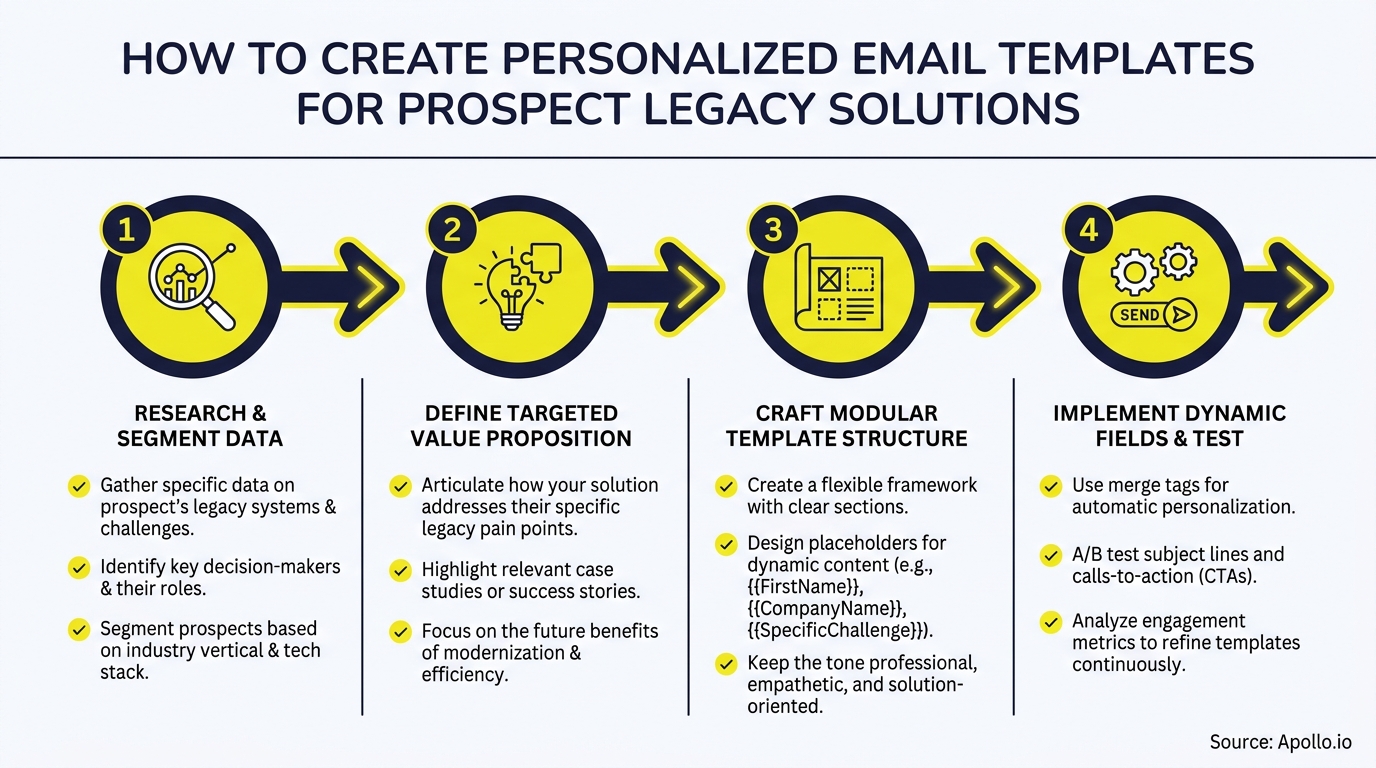
Instead, each email is assembled from interchangeable parts: an opener tied to a trigger signal, a value prop matched to a persona, and a CTA appropriate to the buying stage.
Research from Mailmend shows that personalized and segmented campaigns generate 58% of all email-driven revenue and can increase revenue by up to 760%. That kind of lift does not come from swapping in a first name. It comes from matching message to context at every layer.
The three core components of a personalization system:
- Inputs: Firmographic data, intent signals, hiring activity, funding events, and tech stack signals
- Blocks: Modular openers, value propositions, proof points, and CTAs stored as reusable snippets
- Governance: Approved claims, fallback copy, and QA rules that keep AI-drafted messages accurate and on-brand
How Do SDRs Build Modular Templates That Scale?
SDRs build scalable templates by grouping prospects around shared triggers rather than writing individual emails for each contact.
A sales professional wrote on Redditthat batching research by problem type works better than crafting bespoke messages: "I batch research 50 companies Monday morning and find they usually have like 3-4 common problems.
Write one good email for each problem, swap the company name.
Done.
The real hack? Only reach out when something happens — new VP hired, funding round, competitor news."
This trigger-based approach is more efficient and more effective. Job postings are a particularly underused signal: if a company is actively hiring SDRs to do outbound prospecting, that hiring intent is your opening line.
Modular template structure for SDRs:
| Block | Trigger Example | Sample Copy |
|---|---|---|
| Opener | Funding round | "Saw you raised $X — congrats on the Series B." |
| Opener | Hiring signal | "Noticed you're scaling your SDR team — that usually means outbound is a priority." |
| Value Prop | Pipeline gap | "We help [persona] at [industry] companies build pipeline without adding headcount." |
| Proof Point | Peer company | "[Similar company] cut their research time in half after switching to us." |
| CTA | Low-commitment | "Worth a 15-min call this week?" |
Spending hours on manual outreach for every prospect? Automate your sequences with Apollo's multi-channel engagement platform and keep personalization without the manual grind.
Turn Funnel Guesswork Into Closed Deals
Pipeline forecasting a guessing game because quality leads never make it past the top of the funnel? Apollo surfaces in-market buyers with precision so every stage moves with confidence. 600K+ companies trust Apollo to build pipeline that actually converts.
Start Free with Apollo →Why Does Deliverability Matter for Personalized Templates?
Deliverability is a gating constraint on personalization: a perfectly crafted email that lands in spam has zero impact. Google and Yahoo introduced stricter authentication requirements in early 2024, and Microsoft followed with updated expectations in 2025.
Every template program must be paired with SPF, DKIM, and DMARC configuration, controlled sending volumes, and clean lists.
Key deliverability rules to build into your template system:
- Authentication: Confirm SPF, DKIM, and DMARC are configured before launching any sequence
- List hygiene: Verify contacts before sending. Verifying email addresses reduces bounce rates and protects sender reputation
- Complaint rate control: Keep spam complaint rates below 0.1%. Highly personalized, relevant emails drive fewer complaints than generic blasts
- Volume ramp: Warm new sending domains gradually — do not launch at full volume on day one
- Plain text preference: For cold outreach, plain text or minimal HTML performs better across most mailbox providers
For a deeper playbook on staying out of the spam folder, see Apollo's guide on email deliverability and dodging spam filters.

How Do AEs and RevOps Use AI to Personalize Outreach at Scale?
Account Executives and RevOps teams use AI to generate personalized email variants from a governed prompt library, not by writing each email from scratch.
The shift in 2026 is from a static template library to a prompt library: stored value props, approved proof points, tone guidelines, and fallback copy that AI assembles per account.
A Reddit commenter shared a firsthand perspectivethat resonates with this approach: "What's worked for me is shifting my mindset from 'make every email unique' to 'make every email relevant.' My lightly personalized but relevant emails get more replies than the 30-minute masterpieces."
Governance checklist for AI-assisted outreach:
- Maintain an approved claims list (no fabricated metrics, no unverified competitor comparisons)
- Store fallback copy for when signal data is missing or low-confidence
- Add a human review step for high-value accounts before sending
- Audit AI-generated drafts weekly against brand and legal standards
For AEs managing multiple accounts simultaneously, writing sales emails that get responses requires matching proof points to specific persona pain points, not generic industry claims.
What Data Signals Should You Use for Personalization?
The strongest personalization signals are contextual events, not static attributes. Generic tokens like first name and company name are table stakes; contextual signals drive replies.
| Signal Type | Example | Template Use |
|---|---|---|
| Funding event | Series B announcement | Opener referencing growth stage and scaling challenges |
| Hiring signal | Active SDR/BDR job postings | Opener tied to outbound or pipeline initiative |
| Tech stack | CRM or sales tool in use | Integration-focused value prop |
| Leadership change | New VP of Sales hired | Opener acknowledging new priorities and fresh mandates |
| Intent signal | Research on competitor category | Timing-based outreach with category-relevant proof point |
| Firmographic | Company size, industry, revenue | Persona-matched value prop and case study selection |
Need richer signal data to fuel these templates? Enrich your contact records with Apollo's 230M+ verified business contacts and 65+ filters to surface the right signals for every account.
Research from Allegrow confirms that personalized B2B experiences, including email, deliver 40% more revenue than non-personalized approaches. The gap widens when personalization is signal-driven rather than token-based.
How Do You Measure Whether Your Templates Are Working?
Template performance is best measured by reply rate and positive reply rate, not open rate.
Open rate is unreliable due to Apple Mail Privacy Protection and other tracking limitations.
The metrics that matter for personalized outreach:
- Reply rate: Target 5–10% for cold outreach as a healthy benchmark to aim toward
- Positive reply rate: Replies expressing interest, not just opt-outs or objections
- Meeting booked rate: The conversion from reply to calendar invite
- Bounce rate: Above 2% signals list quality or deliverability issues
- Unsubscribe and complaint rate: Rising rates signal relevance problems, not just volume problems
Run A/B tests on individual blocks, not full emails. Testing one opener variant against another gives you actionable signal. Testing a completely different email tells you nothing about which element drove the difference. Review your sequence diagnostics to improve deliverability alongside engagement metrics for a complete picture.

Start Building Your Personalization System Today
Personalized prospect outreach in 2026 is not about writing better emails. It is about building a system: signal inputs that feed modular content blocks, governed by QA rules that keep AI-generated copy accurate and on-brand, all sitting on a deliverability-safe foundation.
SDRs, AEs, and RevOps teams that operationalize this approach consistently outperform teams relying on static templates.
The data signals are available, the AI tools exist, and the framework is straightforward.
What most teams lack is the system to tie it all together.
Apollo consolidates prospecting data, sales email templates, multi-channel sequences, and enrichment into one platform, so your team spends less time switching tools and more time booking meetings.
As Cyera put it: "Having everything in one system was a game changer."
Start Prospecting with Apollo for free and put your personalization system into action today.
Get ROI Sales Leaders Can't Ignore
Budget approval stuck on unclear pipeline metrics? Apollo delivers measurable results from day one — more meetings, faster deals, undeniable numbers. Join 600K+ companies making the business case effortlessly.
Start Free with Apollo →Don't miss these
Sales
Inbound vs Outbound Marketing: Which Strategy Wins?
Sales
What Is a Sales Funnel? The Non-Linear Revenue Framework for 2026
Sales
What Is a Go-to-Market Strategy? The 2026 GTM Playbook
See Apollo in action
We'd love to show how Apollo can help you sell better.
By submitting this form, you will receive information, tips, and promotions from Apollo. To learn more, see our Privacy Statement.
4.7/5 based on 9,690 reviews
