
How to Choose an Outbound Sales Platform That Prioritizes Email Deliverability
Your outbound emails can only generate pipeline if they actually reach inboxes. Yet according to Insight Market Research, while overall delivery rates hover near 98%, effective inbox placement can be as low as 84.3% in B2B datasets — meaning roughly one in six legitimate emails never reaches the primary inbox. The platform you choose determines which side of that gap your team lands on. Before picking a tool, read our guide on email deliverability and how to dodge spam filters to understand what you're actually evaluating.

Accurate Contacts, More Deals Closed
Tired of hours lost chasing bad emails and dead-end numbers? Apollo delivers verified business contacts so your team spends time selling, not searching. Nearly 100K paying customers trust Apollo to keep their pipeline moving.
Start Free with Apollo →Key Takeaways
- Delivery rate and inbox placement are different metrics — a platform that only tracks the former is hiding your real risk.
- Gmail and Yahoo bulk-sender enforcement means complaint-rate monitoring and one-click unsubscribe are now non-negotiable platform features, not ops best practices.
- Aggressive AI automation without guardrails (rate limits, QA gates, throttling) can damage sender reputation quickly and take months to recover.
- SDRs and RevOps leaders should evaluate platforms on authentication support (SPF/DKIM/DMARC), bounce control, and provider-level reporting — not just sequence volume.
- Consolidating prospecting, engagement, and deliverability monitoring into one platform reduces risk and cost versus stitching together multiple tools.
Why Does Email Deliverability Matter More Than Ever in 2026?
Email deliverability directly determines whether your outbound effort generates revenue or gets silently discarded. Unify GTM notes that approximately one in six legitimate emails never reaches the primary inbox — a pipeline leak most teams never measure. The problem is worsening: spam placement rates nearly doubled across 2024 as mailbox providers tightened filters in response to bulk-sender abuse.
The Sinch Mailgun Email Impact Report 2026, analyzing 400+ billion emails sent in 2025, frames deliverability as a measurable revenue leak — not a technical footnote. For SDRs running high-volume sequences, even a modest drop in inbox placement compounds across hundreds of contacts per week into significant lost pipeline. Improving deliverability through sequence diagnostics is now a core revenue-protection discipline.
What Is the Difference Between Delivery Rate and Inbox Placement?
Delivery rate measures whether a server accepted your email; inbox placement measures whether it landed in the primary inbox versus spam or promotions. These are not the same thing, and confusing them is the most common evaluation mistake buyers make.
| Metric | What It Measures | Why It Matters |
|---|---|---|
| Delivery Rate | Email accepted by receiving server | Baseline hygiene indicator only |
| Inbox Placement Rate | Email landed in primary inbox (not spam/promotions) | True predictor of prospect visibility |
| Spam Complaint Rate | Recipients marking email as spam | Must stay below 0.1% (Gmail threshold) |
| Bounce Rate | Undeliverable addresses | High bounces damage sender reputation |
According to Oneshot.ai, Gmail's enforced spam complaint threshold for bulk senders is 0.1%, with a commonly cited danger threshold of 0.3%. A platform that doesn't surface complaint-rate data leaves RevOps flying blind on the metric that triggers Gmail penalties.
What Deliverability Features Should SDRs and RevOps Demand from a Platform?
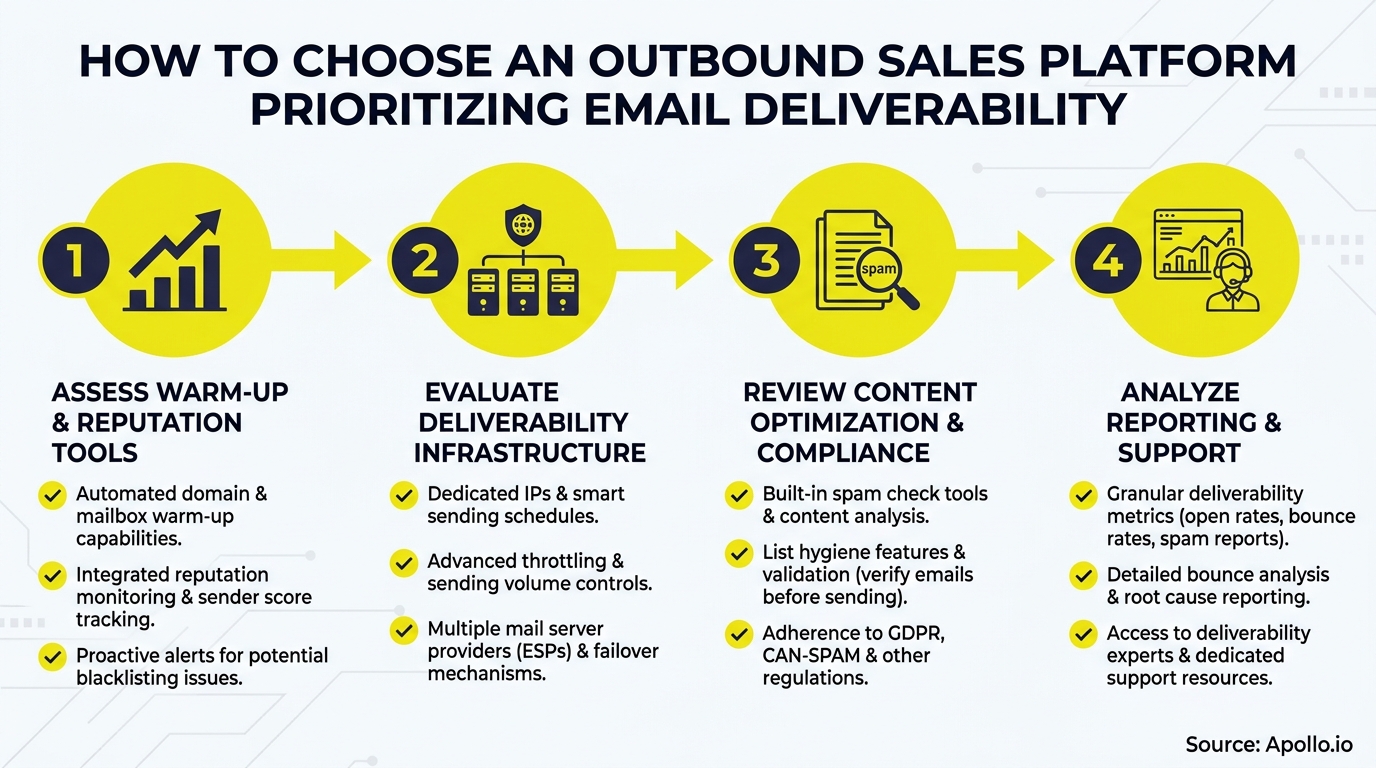
SDRs and RevOps leaders should evaluate outbound platforms on deliverability instrumentation, not just sequence-building features. The right platform enforces safe defaults and surfaces leading indicators before reputation damage occurs.
Non-negotiable platform capabilities:
- Authentication setup support: SPF, DKIM, and DMARC configuration guidance built into onboarding — not left to your IT team after purchase.
- Inbox placement monitoring: Not just bounce tracking. The platform should show where email is landing by mailbox provider (Gmail vs. Outlook behave very differently).
- Complaint-rate dashboards: Visibility into spam complaint signals, ideally with Gmail Postmaster Tools integration or equivalent alerting.
- One-click unsubscribe: Required for Gmail/Yahoo bulk senders. Platforms that make unsubscribe friction-heavy increase complaint rates.
- Sending throttles and rate limits: Guardrails that prevent aggressive AI automation from spiking volume and destroying reputation. A TechRadar Pro warning in April 2026 highlighted that over-automating outreach can damage sender reputation quickly — and recovery takes months.
- List hygiene and bounce control: Automated suppression of invalid addresses. As Martal.ca reports, cold emails bounce at 7–8% on average — far above the sub-2% bounce rate for opt-in campaigns — making pre-send verification essential.
- Email verification: Built-in address validation before sending, not a separate tool purchase.
Struggling with bounce rates eroding your sender score? Apollo's contact enrichment and verification tools help keep your lists clean before a single email sends.
Turn Funnel Guesswork Into Pipeline Clarity
Pipeline forecasting a guessing game while leads stall before they ever become opportunities? Apollo surfaces high-intent prospects and keeps your funnel moving with precision. Nearly 100K paying customers stopped guessing and started closing.
Schedule a Demo →How Do You Build a Deliverability-First RFP Scorecard?
Build your vendor evaluation around these questions — and require evidence, not just claims. Any platform that deflects with vague answers on deliverability instrumentation is not a deliverability-first platform.
| Evaluation Category | Questions to Ask | Evidence to Require |
|---|---|---|
| Inbox Placement Visibility | Do you show inbox vs. spam placement by mailbox provider? | Live dashboard screenshot |
| Authentication | Do you assist with SPF/DKIM/DMARC setup and flag misconfigurations? | Onboarding checklist or in-app validation |
| Complaint Rate Monitoring | Can I see spam complaint rates per campaign or domain? | |
| Sending Controls | What throttling, warmup, and rate-limit features exist? | Feature documentation + default settings |
| Bounce Handling | How are hard bounces suppressed automatically? | Suppression list behavior walkthrough |
| Unsubscribe Compliance | Is one-click unsubscribe enforced by default? | Confirmation that it's on by default, not optional |
Also check how the platform handles email address verification before sending. Platforms that separate verification into a paid add-on create friction that teams skip under quota pressure.

Why Does AI Automation Require Extra Deliverability Scrutiny?
AI-powered outreach features accelerate sequence volume — which is only beneficial if the platform enforces guardrails that protect sender reputation at scale. Without QA gates and throttling, AI automation can spike complaint rates faster than manual sending ever could, triggering mailbox provider penalties that take months to reverse.
The shift in 2026 is toward human-in-the-loop AI: tools that handle research, personalization, and drafting while humans control targeting decisions and escalation. For Account Executives managing deal-stage follow-up, AI personalization that improves message relevance actually reduces spam complaints by improving engagement signals.
For SDRs running top-of-funnel sequences, volume controls and contact quality matter as much as copy quality.
Evaluate AI outbound features on these guardrail criteria:
- Does the platform enforce daily/weekly sending limits per mailbox?
- Does AI-generated copy go through a quality check before sending?
- Are high-risk sending patterns (rapid volume spikes, identical subject lines at scale) flagged automatically?
- Can you review AI-drafted messages before they send?
Ready to run outreach that reaches inboxes and converts? Apollo's sales engagement platform combines multi-channel sequences with built-in deliverability controls, keeping your reputation protected as you scale.
How Does Platform Consolidation Improve Deliverability Outcomes?
Using separate tools for prospecting, email verification, sequencing, and deliverability monitoring creates gaps where data doesn't sync, suppressions get missed, and bounce signals arrive too late to prevent reputation damage. A unified platform closes those gaps by design.
When prospecting, verification, sequencing, and monitoring live in one workspace, suppression lists update automatically, bounce data informs future sends immediately, and RevOps teams have a single source of truth for sender health. As Predictable Revenue described after consolidating their stack: "We reduced the complexity of three tools into one." See their full story in the Predictable Revenue cost-reduction case study.
For teams comparing options, the Apollo vs. Outreach vs. Salesloft comparison breaks down how these platforms differ on engagement features, data quality, and overall stack fit.

How Do You Choose the Right Outbound Sales Platform for Email Deliverability in 2026?
Choose a platform that treats deliverability as instrumentation, not a marketing claim. The checklist below gives you a clear decision framework.
- Reject vague promises: Ask for live dashboards showing inbox placement by provider, complaint-rate alerts, and bounce suppression workflows — not slide decks.
- Prioritize built-in verification: Platforms that include email verification natively reduce bounce risk without adding a separate tool or budget line.
- Check authentication support: SPF/DKIM/DMARC setup should be part of onboarding, with in-app validation that flags misconfigurations.
- Demand provider-level reporting: Gmail and Outlook filter email differently. A platform that can't break down performance by provider leaves you guessing when inbox rates drop.
- Evaluate AI guardrails: Volume controls, warmup features, and human review gates are as important as AI copy quality.
- Value consolidation: Every tool handoff is a potential gap in suppression sync, bounce handling, or compliance enforcement.
For a deeper look at writing emails that earn replies once they reach inboxes, see the guide to writing sales emails that get responses. And if you're building or auditing your full outbound motion, the sales tech stack playbook covers how to structure a stack that scales without adding complexity.
Apollo brings prospecting, email verification, sequencing, deliverability monitoring, and AI-powered personalization into a single platform used by nearly 100K paying customers — consolidating the tools that, when fragmented, create the deliverability gaps that cost pipeline. Start Your Free Trial and see how a unified GTM platform protects your sender reputation while scaling your outbound results.
Prove ROI Before Budget Talks Stall
ROI pressure killing your next tool approval? Apollo delivers measurable pipeline impact fast — so you walk into budget reviews with wins, not estimates. Nearly 100K paying customers made the case. You can too.
Start Free with Apollo →Don't miss these
Sales
Inbound vs Outbound Marketing: Which Strategy Wins?
Sales
What Is a Sales Funnel? The Non-Linear Revenue Framework for 2026
Sales
What Is a Go-to-Market Strategy? The 2026 GTM Playbook
See Apollo in action
We'd love to show how Apollo can help you sell better.
By submitting this form, you will receive information, tips, and promotions from Apollo. To learn more, see our Privacy Statement.
4.7/5 based on 9,690 reviews
