
How AI-Powered Sales Automation Features Boost Rep Productivity
Sales reps spend just 28% of their time actually selling, according to Salesforce research on 7,700+ sales professionals. The other 72% goes to admin tasks: CRM updates, note-taking, follow-up scheduling, and prospect research. AI-powered sales automation directly attacks that 72% by handling the work that doesn't require a human, freeing reps to focus on conversations that close deals.
This article breaks down exactly how AI features inside sales automation platforms reclaim rep time, accelerate pipeline velocity, and translate into measurable revenue outcomes in 2026.

Let Apollo Find Your Next Buyer
Tired of burning hours verifying contact info that goes nowhere? Apollo surfaces accurate, ready-to-engage prospects so your team sells instead of searches. Join 600K+ companies building pipeline faster.
Start Free with Apollo →Key Takeaways
- AI automation targets the ~72% of rep time lost to non-selling tasks, creating meaningful capacity for high-value selling activities.
- Top-performing B2B sales organizations using automation free up seller capacity and see measurable productivity gains within weeks of implementation.
- Agentic AI is shifting the productivity story from "help me write" to "handle the workflow" — routing, enrichment, CRM updates, and follow-ups happen automatically.
- Teams that consolidate prospecting, engagement, and data into one unified platform remove the friction that kills adoption and compounds productivity losses.
- Gartner predicts AI-driven enablement will deliver 40% faster sales stage velocity by 2029 compared to traditional methods.
How Do AI-Powered Features in Sales Automation Platforms Improve Rep Productivity?
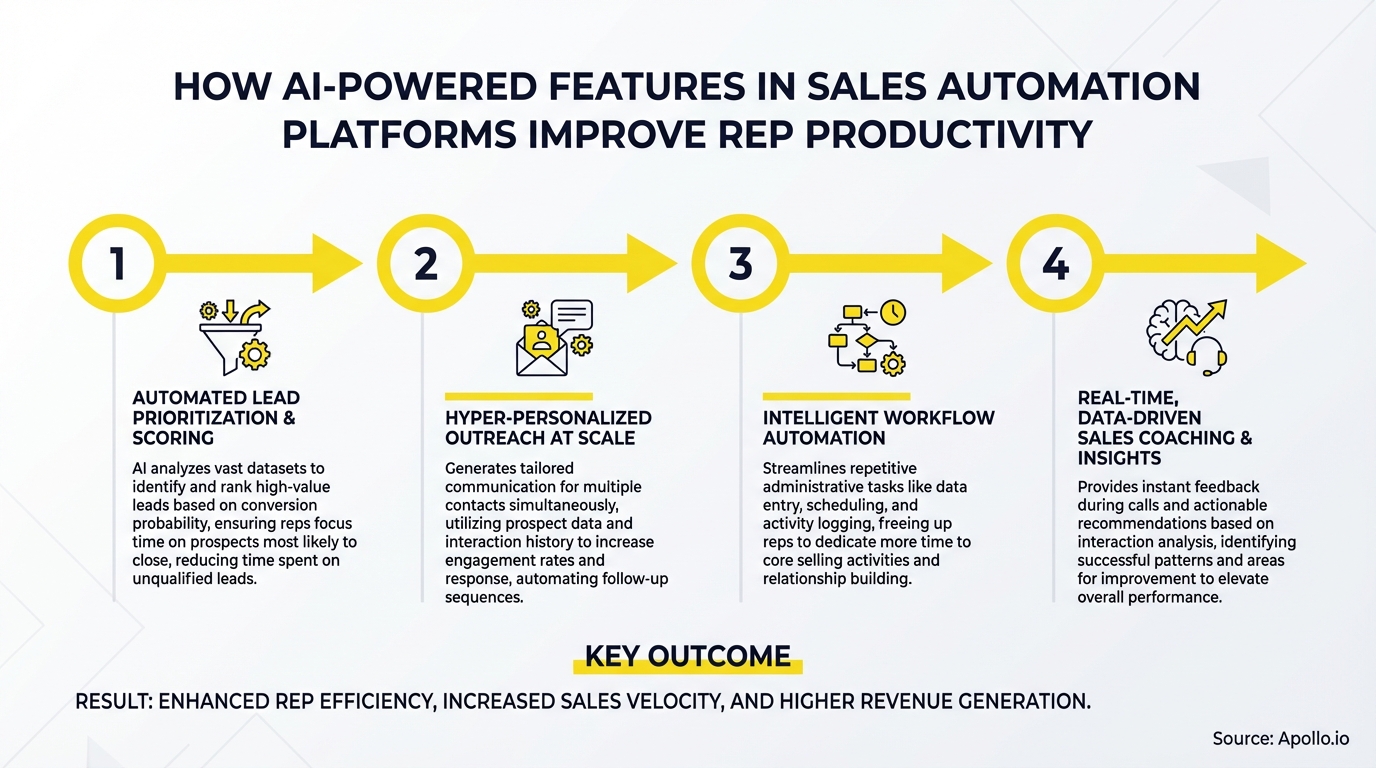
AI-powered features improve rep productivity by automating repetitive tasks, eliminating manual data entry, and surfacing the right actions at the right moment — all without requiring reps to switch tools or change their workflow. The result is more selling time from the same headcount.
According to Everstage, automation has helped top-performing B2B sales organizations free up about 20% of sellers' capacity and improve productivity by up to 30%. That freed capacity compounds quickly: a rep who reclaims two hours daily can add dozens of additional prospecting touches or follow-ups per week.
Research from Trykondo found that 83% of sales teams using AI saw revenue growth versus 66% of teams not using AI. The gap is widening as AI moves from optional add-on to core infrastructure.
What Are the Core AI Features Driving Productivity Gains?
The AI features with the clearest productivity impact fall into five categories, each targeting a specific drain on rep time.
| AI Feature | What It Automates | Productivity Outcome |
|---|---|---|
| AI Research Agent | Prospect research, company intel gathering | Eliminates hours of manual pre-call prep |
| AI-Powered Messaging | Email drafting, personalization at scale | Higher reply rates with less writing time |
| CRM Hygiene Automation | Field updates, meeting notes, activity logging | Returns significant admin time to reps daily |
| Workflow Orchestration | Routing, follow-up triggers, task sequencing | Ensures no lead falls through the cracks |
| AI Call Assistant | Call recording, transcription, next-step summaries | Reps stay focused on the conversation, not notes |
The shift in 2026 is from assistive AI (suggesting what to write) to agentic AI that executes multi-step workflows autonomously. Platforms that embed AI directly into the rep's flow of work — rather than requiring a separate tool — drive the strongest adoption and the fastest productivity returns.
Spending hours on manual outreach? Automate your sequences and workflows with Apollo's AI sales automation platform.
How Do SDRs and AEs Specifically Benefit from AI Automation?
SDRs and AEs each face different productivity bottlenecks, and AI addresses both in distinct ways.
For SDRs: The biggest time drain is prospect research and sequencing. AI Research Agents automatically surface firmographic data, buying signals, and contact details before outreach begins. Apollo's AI Research Agent has been shown to generate 46% more meetings by delivering richer, more relevant context for each touchpoint. SDRs using AI-driven sales productivity tools report being able to run significantly larger prospect lists with the same effort.
For AEs: Admin after calls is the core drain. AI call assistants transcribe conversations, generate summaries, and log structured updates to CRM automatically. Apollo's AI-powered messaging has shown a 35% increase in bookings when reps use AI-generated, context-aware outreach. For Account Executives managing active pipelines, AI-assisted deal management keeps every opportunity current without manual updates after every call.
Data from SalesHQ shows companies adopting AI see an average 10-15% increase in sales productivity immediately after implementation, with gains building over time as workflows stabilize.
Turn Funnel Guesswork Into Closed Deals
Pipeline forecasting a guessing game because leads stall before they ever become opportunities? Apollo surfaces in-market buyers with precision so your pipeline reflects reality, not hope. Top revenue teams trust Apollo to call their number with confidence.
Schedule a Demo →How Does AI Automation Translate Time Savings into Pipeline Velocity?
Time savings only matter if they convert into more selling activity and faster deal movement. The link between individual productivity and team-level pipeline velocity is where AI automation creates compounding returns.
Gartner predicts that by 2029, sales organizations with AI-driven enablement will achieve 40% faster sales stage velocity than those using traditional methods. The mechanism is straightforward: when reps spend less time on admin and more time on buyer engagement, deals advance faster and with less friction.
The multiplier effect works at the team level too. RevOps leaders using AI-powered sales analytics can identify where deals stall, which sequences drive replies, and which reps need coaching — all from a single data layer. That visibility converts into targeted interventions that move pipeline metrics rather than just individual rep habits.
According to Cirrus Insight, sales teams save 2-3 hours daily when using AI-driven automation, with efficiency gains compounding as AI systems adapt to individual rep patterns over 30-60 days.

What Does a Consolidated AI GTM system Look Like in Practice?
A consolidated AI GTM system replaces the fragmented stack of separate prospecting, sequencing, CRM, and analytics tools with one unified workspace. Tool fragmentation is itself a productivity tax: reps lose time context-switching, data falls out of sync, and adoption suffers when workflows span multiple logins.
Apollo's all-in-one GTM platform combines a 230M+ person contact database, AI-powered sequencing, workflow automation, call intelligence, and deal management in a single workspace. Customers consistently report that consolidation is as impactful as the individual features:
- "We reduced the complexity of three tools into one" — Collin Stewart, Predictable Revenue
- "We cut our costs in half" — Census
- "Having everything in one system was a game changer" — Cyera
For RevOps and sales leaders evaluating how to build a sales tech stack that scales, consolidation onto an AI-native platform removes the integration burden and creates a single source of truth for performance data.
Struggling to find qualified leads without juggling five different tools? Search Apollo's 230M+ contacts with 65+ filters — all in one platform.
What Are the Risks and How Do You Avoid the Productivity Paradox?
AI automation creates a productivity paradox when adoption is low, data quality is poor, or workflows aren't redesigned to match new capabilities. Adding AI to a broken process produces faster broken results.
The most common failure modes and their mitigations:
- Poor data quality: AI recommendations are only as good as the underlying contact and account data. Start with data enrichment and validation before layering automation on top.
- Low rep adoption: AI tools embedded in existing workflows (email, calendar, meeting recaps) outperform standalone apps that require behavior change. Choose platforms that meet reps where they work.
- No governance model: Without defined owners for AI outputs (who reviews, who corrects, who updates), CRM hygiene degrades quickly. Assign RevOps responsibility for AI output quality.
- Measuring the wrong metrics: Track leading indicators (touches per rep, meetings booked, stage velocity) alongside lagging indicators (revenue, win rate) to catch productivity gains before they show up in quota attainment.
Buyers are also adopting AI-powered search and conversational tools in 2026, per Forrester's B2B predictions. GTM teams that instrument their own AI productivity now will be better positioned to respond at the speed buyers expect.
How Do You Get Started with AI Sales Automation?
The fastest path to measurable productivity gains is to start with the highest-volume, lowest-complexity tasks and expand from there. A practical sequencing for B2B GTM teams:
- Automate CRM hygiene first. Log calls, meetings, and email activity automatically. This returns immediate time to every rep and improves data quality for downstream AI features.
- Add AI-powered sequencing. Use AI to personalize outreach at scale — subject lines, opening lines, and CTAs tailored to prospect context without manual research for each contact.
- Deploy workflow orchestration. Set triggers for follow-ups, lead routing, and task creation based on prospect behavior and deal signals. See how Apollo Workflows handles this end-to-end.
- Instrument and iterate. Review AI-generated outputs weekly in the first 60 days. Adjust prompts, sequences, and routing logic based on what's working.
Teams that follow this sequencing typically see adoption stabilize within 30 days and productivity metrics improve within 60. The AI and automation resources from Apollo provide detailed playbooks for each stage.

Conclusion: AI Automation Is a Capacity Multiplier, Not a Rep Replacement
AI-powered features in sales automation platforms improve rep productivity by reclaiming time from low-value admin, enabling reps to run more outreach with higher personalization, and giving revenue leaders the visibility to coach and optimize at scale. The productivity gains are real and measurable — but they require the right platform, clean data, and a governance model to stick.
Apollo brings prospecting, AI sequencing, workflow automation, call intelligence, and deal management into one unified platform — so SDRs, AEs, and RevOps teams stop losing time to tool fragmentation and start spending it on revenue. Trusted by nearly 100K paying customers including Anthropic, Smartling, and DocuSign.
Schedule a Demo and see how Apollo's AI platform can put more selling hours back into every rep's day.
Prove Pipeline ROI With Apollo
ROI pressure killing your tool budget? Apollo delivers measurable pipeline impact from day one — no guesswork, no waiting quarters to see results. Leadium 3x'd annual revenue. Your CFO will thank you.
Start Free with Apollo →Don't miss these
Sales
Inbound vs Outbound Marketing: Which Strategy Wins?
Sales
What Is a Sales Funnel? The Non-Linear Revenue Framework for 2026
Sales
What Is a Go-to-Market Strategy? The 2026 GTM Playbook
See Apollo in action
We'd love to show how Apollo can help you sell better.
By submitting this form, you will receive information, tips, and promotions from Apollo. To learn more, see our Privacy Statement.
4.7/5 based on 9,690 reviews
