
To expand a restaurant and hospitality prospect list from 216 to 1,000 contacts, run a segmented people search, deduplicate against your existing records, enrich only the shortlisted buyers, and count only accepted contacts. That means 784 net-new, qualified additions, not 784 search results.
Moving from 216 to 1,000 is 363.0% growth, calculated from your own figures. Start with a sales prospecting list framework, then apply the workflow below.

Skip Manual Research. Apollo Finds Contacts Fast
Tired of spending hours researching leads and verifying contact info? Apollo puts business contact info for 240M+ people at your fingertips, with 98% email accuracy. Spend your day selling, not copying data into spreadsheets.
Start Free with Apollo →Key Takeaways
- Success means 784 accepted, net-new contacts. Search volume is a means, not the goal.
- Search first and enrich second, so you spend credits only on contacts that already passed your filters.
- Build separate searches for restaurants and hotels, because their buyers and problems differ.
- Use Apollo MCP when you need to prospect, enrich, and queue outreach from inside ChatGPT, Claude, Perplexity, or Codex without switching tabs.
- Use Apollo MCP when you need to expand a seed list of 216 contacts by describing your ideal buyer in plain language and reviewing results in one conversation.
What Does 784 Net-New Contacts Actually Require?
It requires roughly 980 candidate records at an 80% net-new qualification and contactability yield. That yield is a hypothetical planning assumption, so replace it with your own pilot results.
| Input | Value |
|---|---|
| Current list | 216 contacts |
| Target list | 1,000 contacts |
| Net-new needed | 784 contacts |
| Candidates at 80% yield (hypothetical) | 980 records |
Apollo's current People API Search allows 1 to 100 results per page, so 980 candidates is about ten pages per segment. Track cost per accepted, net-new contact, not cost per API request.
How Does a People-Search API Differ From Contact Enrichment?
A people-search API returns candidate profiles that match your filters, while enrichment returns full contact details such as business email for selected people. Apollo's People API Search consumes zero credits and does not return emails or phone numbers.
Enrichment is a separate step and is where credits are spent, with standard people enrichment documented at 1 to 9 credits per person.
This split is the core economic lever. You can cast a wide net for free, qualify candidates, and pay only for the ones worth contacting. Struggling to find qualified leads? Search Apollo's 240M+ contacts with 65+ filters.
How Do You Build a Hospitality-Specific Search?
Build separate searches for independent restaurants, multi-unit groups, and hotel businesses, then define which roles qualify in each segment. One broad hospitality filter returns noise and inflates rejection rates.
Start with your existing 216 contacts. Identify the companies they represent, then look for similar accounts.
Apollo announced company lookalikes, company keywords, and NAICS/SIC filters in beta in August 2025. Confirm which filters are available through the API before you depend on them.
This segmentation is a proposed strategy, not a guaranteed match-rate improvement.
| Segment | Target roles | Message angle |
|---|---|---|
| Independent restaurants | Owner, General Manager | Guest acquisition and margin |
| Multi-unit groups | Operations, Marketing, Purchasing leads | Consistency across locations |
| Hotels | HR, Operations, Finance, Ownership | Labor efficiency and retention |
Why Segment by Operational Need?
Segmenting by need matches outreach to a problem the buyer already feels. The National Restaurant Association's 2024 technology research found that 76% of operators expected technology to provide a competitive edge.
It also found 60% planned investments to improve customer experience, 55% to improve service-area productivity, and 52% to improve kitchen productivity. Build separate role searches for marketing, operations, and kitchen purchasing.

How Should SDRs Run the Search, Enrich, and Dedupe Workflow?
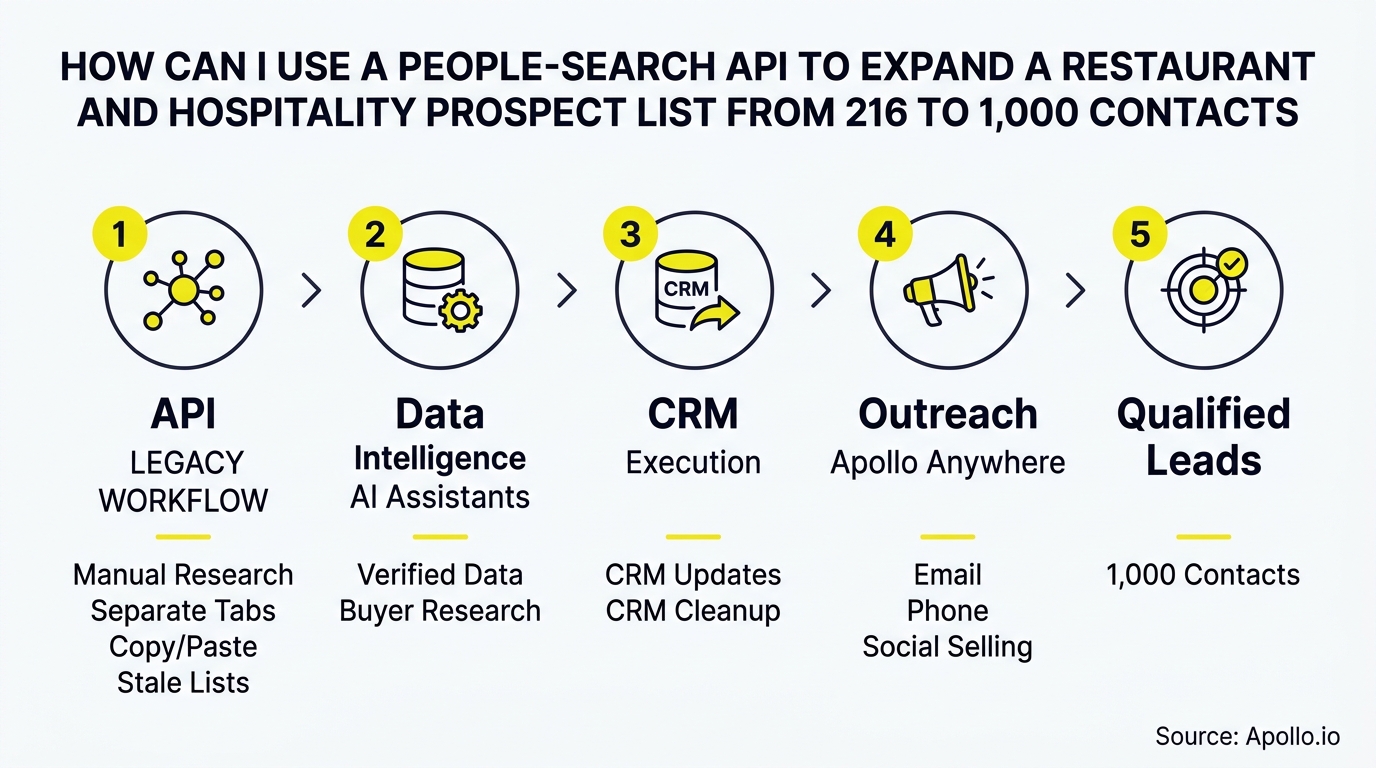
SDRs should run it as a five-step funnel: search, deduplicate, qualify, enrich, and validate. Each step removes records before you spend credits.
- Search: Page through each segment at up to 100 records per page.
- Deduplicate: Remove anyone already in your 216 contacts or CRM.
- Qualify: Keep only roles and companies that fit the segment matrix.
- Enrich: Request business email for shortlisted records only. Skip mobile numbers if the campaign only needs email.
- Validate: Verify business contact details and apply suppression lists.
For pagination, loop through pages until a segment is exhausted. Add retries with backoff for failed requests, and key records on a stable identifier so duplicates are dropped across segments. For deeper list-building mechanics, see how to build a lead list that converts.
How Can You Run This Inside ChatGPT, Claude, Perplexity, or Codex?
You can run it through Apollo MCP, which brings Apollo into the AI tools you already use. Connect Apollo inside your AI tool's connectors via OAuth on any plan, including free. No code is required for GTM users. Developers who prefer the terminal can use the Apollo command-line interface (CLI) instead.
From one conversation, you can describe your ideal restaurant or hotel buyer, search for matching people, enrich shortlisted contacts, and add them to a sequence. Your best prospecting session shouldn't require opening a new tab.
Data and action limits mirror your Apollo account.
Fill Your Funnel With Buyers Ready To Talk
Struggling to fill the top of the funnel with leads that actually convert? Apollo pairs 98% email accuracy with 240M+ contacts, so your team reaches in-market buyers before competitors do. Spend your day on real conversations, not guesswork.
Start Free with Apollo →Why Is Data Freshness Critical in Hospitality?
Hospitality contact data decays quickly because the sector has high staff turnover. Escoffier notes that hospitality suffers from higher staff turnover than almost any other sector, which makes an API-driven enrichment and verification strategy essential.
Management roles are not immune. A Deloitte analysis found restaurant management turnover remains elevated between 35% and 47%, spiking to 55% in limited-service operators. Schedule refreshes rather than treating the 1,000-contact list as a one-time export. Tired of dirty data? Start free with Apollo's verified business contacts.
How Do RevOps Teams Keep the Expanded List Compliant?
RevOps teams keep it compliant by maintaining suppression records before activating the list. The FTC states that CAN-SPAM has no B2B exemption and requires honoring opt-out requests within 10 business days.
Opt-out mechanisms must remain operational for at least 30 days after sending.
These rules are not a full assessment of every applicable privacy and outreach law. Confirm your obligations with your legal team.
Remember that Apollo users control who they contact and how they use the product.
What Does a Hypothetical 216-to-1,000 Funnel Look Like?
A hypothetical funnel starts near 980 candidates and ends at 784 accepted additions. These numbers are an illustrative model, not measured results.
| Stage | Hypothetical count |
|---|---|
| Candidates from search | 980 |
| Net-new after deduplication and qualification | 784 accepted at 80% yield |
| Final list | 216 + 784 = 1,000 |
Run a pilot of 100 to 150 candidates first. Record rejection counts and credits per accepted contact, then scale. Once your list is built, Apollo's sales engagement platform keeps research, outreach, and tracking in one workspace, cutting the tools you maintain.

What Should You Do Next?
Define your acceptance criteria, run a small pilot, and measure cost per accepted, net-new contact before scaling to 784. Treat the list as a maintained asset, with scheduled refreshes and suppression checks.
Search broadly, enrich selectively, and let accepted contacts, not raw results, define success. Ready to build your list? Start Free with Apollo.
Prove Pipeline ROI Fast With Apollo
Budget approval stuck on unclear ROI? Apollo puts prospecting, outreach, and pipeline tracking in one place, so wins show up faster. Built-In saw +10% win rate and +10% ACV, and Leadium tripled annual revenue. Show your CFO numbers worth renewing.
Start Free with Apollo →Don't miss these
Sales
Inbound vs Outbound Marketing: Which Strategy Wins?
Sales
What Is a Sales Funnel? The Non-Linear Revenue Framework for 2026
Sales
What Is a Go-to-Market Strategy? The 2026 GTM Playbook
See Apollo in action
We'd love to show how Apollo can help you sell better.
By submitting this form, you will receive information, tips, and promotions from Apollo. To learn more, see our Privacy Statement.
4.7/5 based on 9,690 reviews
