
You can research biotech and pharmaceutical leadership without scraping company websites by using structured public sources: SEC filings, open government APIs, clinical trial registries, and licensed intelligence feeds. Each method gives you a dated, citable record instead of a brittle page copy. This guide shows market intelligence teams how to build that workflow in 2026.

Skip Manual Research, Apollo Finds Contacts
Tired of burning hours researching leads and verifying contact info by hand? Apollo puts business info at your fingertips with 98% email accuracy, so your reps spend their day selling. Nearly 5M users already prospect faster. Start today.
Start Free with Apollo →Key Takeaways
- Public filings and registries answer "who leads this company" with a source and a date, which scraped pages rarely provide.
- Public and non-reporting companies need different research paths, so pick the source before you pick the tool.
- Log every role with its event, effective, filing, and retrieval dates so stale titles never reach outreach.
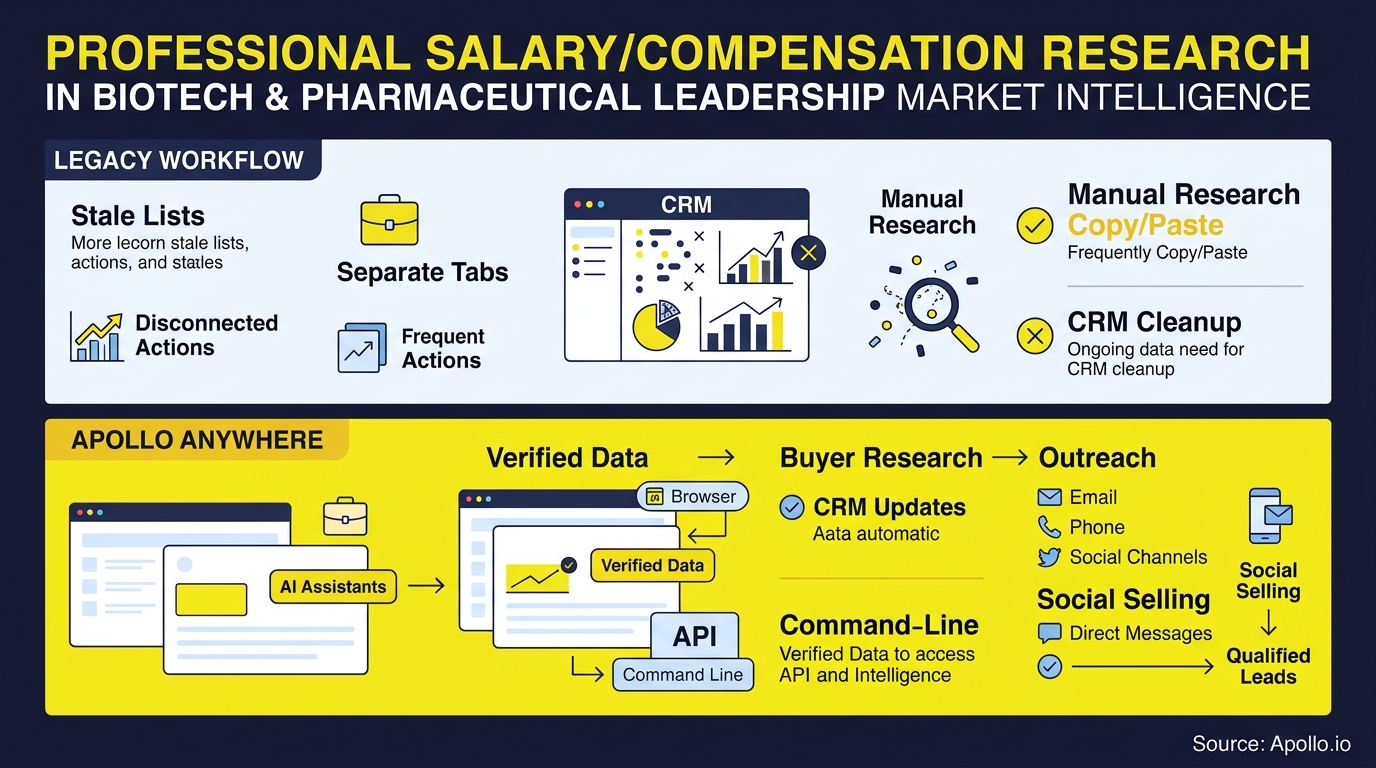
- Use Apollo MCP when you need to turn a verified leadership change into enriched contacts and a queued sequence inside ChatGPT, Claude, Perplexity, or Codex, without switching tabs.
- Pair every new leader with a pipeline, financing, or partnership signal before you act.
Which Sources Should You Use Instead of Scraping Company Websites?
Use SEC filings for public companies, ClinicalTrials.gov for pipeline context, and a licensed intelligence vendor for private companies. Match the source to the company type before you start.
| Company Type | Primary Source | What You Get | Main Limit |
|---|---|---|---|
| Public biotech or pharma | SEC EDGAR (Form 8-K Item 5.02) | Dated officer and director changes | Covers specified roles only |
| Clinical-stage, any status | ClinicalTrials.gov API | Sponsor, investigator, and study data | Not a corporate executive directory |
| Private or non-reporting | Licensed vendors, trade press | Funding, partnerships, leadership news | Coverage and recency vary by vendor |
| Event-driven monitoring | Daily briefs and alerts | Early account signals | Needs verification before outreach |
According to Market Intelligence Tools, researching biotech and pharmaceutical leadership without scraping relies on structured public registries, regulatory filings, open government APIs, and specialized life sciences intelligence networks.
How Does SEC Executive-Change Monitoring Work?
SEC executive-change monitoring works by tracking Form 8-K Item 5.02, which covers specified director and officer appointments and departures. The general filing deadline is four business days, subject to exceptions.
Follow this sequence:
- Watch new 8-K filings for Item 5.02 through EDGAR's submissions API.
- Read the filing itself to confirm the role, the person, and the dates.
- Record the announcement date and the effective date separately, since a filing does not always mean the change is already live.
The SEC's documentation, updated April 8, 2025, states that its submissions API requires no API key and typically updates less than one second after dissemination. This is filing-discovery infrastructure, not a ready-made executive directory.
How Do You Research Leadership at Private or Non-Reporting Biotechs?
Research private biotech leadership by combining trial registries, financing news, and licensed intelligence feeds, then verifying each role against a dated source. No single public filing covers these companies.
The universe is large and growing. BIO and Norstella's June 2025 report counted 6,823 drug-development companies, up 11.4% year over year, and emerging companies accounted for 55% of clinical programs in its April 2025 analysis.
A large-pharma-only research list misses most of the market.
For private companies, treat unresolved roles as unresolved. Mark them "unverified" in your log rather than guessing from an old press release.
How Can Clinical Trial Data Add Context to Leadership Profiles?
Clinical trial data adds pipeline context by linking a company to its active studies, sponsors, and program stages. It tells you what a leader is likely focused on, not who the corporate decision-maker is.
Per the National Library of Medicine, ClinicalTrials.gov reached a half-million registered studies. The modernized API v2 exposes structured sponsor and investigator metadata, as described by IntuitionLabs, so you can pull it programmatically without touching individual pharma domains.
Keep trial investigators and study contacts separate from corporate executives in your records. They serve different buying roles.

How Do You Verify a Leadership Change Step by Step?
Verify a leadership change in four steps: resolve the company identity, review the disclosure, capture every date, and enrich with pipeline context.
- Resolve identity. Confirm the legal entity, parent, and ticker so you do not mix up similarly named biotechs.
- Review the disclosure. Read the 8-K text. Note the exact title and whether it is an appointment, departure, or interim role.
- Capture dates. Log the event date, effective date, filing date, and your retrieval date.
- Enrich with pipeline. Attach active trials, recent financing, or partnership news to the account.
Tired of stitching these steps across tabs? Start free with Apollo's 240M+ People and 30M+ Companies database to enrich verified leaders with business contact details.
What Should an Evidence Log Include?
An evidence log should include the role, entity, source, four dates, and a verification status for every leader you track. This is what makes your intelligence auditable.
| Field | Example Entry |
|---|---|
| Person and role | Name, exact title |
| Entity | Legal name, parent, ticker |
| Source | Filing, registry, or vendor link |
| Event date | When the change was announced |
| Effective date | When the role actually starts |
| Filing and retrieval dates | When filed, when you pulled it |
| Verification status | Verified, pending, or unresolved |
Dated records matter because executive data ages quickly. GTM Only reports that web scraping in life sciences often introduces compliance and rate-limiting issues, high data decay, and poor organizational context.
Apollo Turns Forecast Guesswork Into Pipeline
Forecasts feel like guesswork because deal data is stale? Apollo brings prospecting, outreach, and deal activity into one workspace, so your team works real signals, not hunches. Teams actively using Apollo's AI Assistant are up 2,156% since December 2025.
Start Free with Apollo →How Do SDRs and RevOps Teams Turn Leadership Signals Into Pipeline?
SDRs turn leadership signals into pipeline by pairing a new leader with a relevant financing, partnership, or development milestone before reaching out. A job change alone is a weak trigger.
For SDRs, that means a short list of accounts where a new executive and a fresh milestone overlap. For RevOps leaders, it means storing source and verification dates in the CRM so reps see how current each title is.
Recent news shows why this matters. A July 2026 Egon Zehnder study of 125 public healthcare companies documented 139 departures and 151 appointments from 2016 to 2025, which points to heightened CEO turnover.
Treat executive maps as perishable, not permanent. Note that the study spans biopharma, MedTech, and B2B pharma services, not biotech alone.
Use Apollo MCP when you need to move from a verified leadership change to enriched contacts and a queued sequence without leaving your AI tool. Apollo MCP connects Apollo to ChatGPT, Claude, Perplexity, and Codex, so you can search for people and companies that match your ICP, enrich contacts, and add prospects to sequences from one conversation. Your best prospecting session shouldn't require opening a new tab.
Struggling to find qualified leads once the signal is confirmed? Search Apollo's 240M+ People with 65+ filters to find the right contacts at each account.
How Should You Monitor Leadership Changes Over Time?
Monitor leadership changes by setting change-triggered reviews instead of relying on periodic list refreshes. Review an account when a filing, financing, or milestone appears.
- Public companies: Watch 8-K Item 5.02 filings and re-verify roles when one appears.
- Private companies: Track financing and partnership news, then confirm roles against a dated source.
- All accounts: Re-check the verification status on a fixed cadence and flag anything older than your threshold.
When you evaluate vendors, score them on source provenance, identity matching, update recency, and private-company coverage. Be cautious with vendor-reported results.
MethodsSignals, launched in August 2026, cites a pilot customer reporting a greater than 90% reduction in insight-to-first-contact time, but that figure is vendor and customer reported and does not prove all upstream data is scrape-free.

What Is the Best Way to Start Researching Biotech Leadership Without Scraping?
The best way to start is to pick one public account, run it through the four-step verification workflow, and log it in your evidence template.
Then repeat for your priority list.
Approach this as a repeatable system, not a one-off project. Official filings and registries give you sourced, dated facts.
Licensed feeds and trade press fill the gaps for private companies. A clean evidence log keeps every title honest.
Ready to turn verified leadership intelligence into outreach? Request a Demo and see how Apollo unifies data, intelligence, and execution in one workspace.
Prove Your Sales Stack's ROI With Apollo
Budget approval stuck because nobody can quantify time saved or pipeline impact? Apollo puts prospecting, outreach, and deal activity in one workspace, so wins show up faster. Teams actively using Apollo's AI Assistant are up 2,156% since December 2025.
Start Free with Apollo →Don't miss these
Sales
Inbound vs Outbound Marketing: Which Strategy Wins?
Sales
What Is a Sales Funnel? The Non-Linear Revenue Framework for 2026
Sales
What Is a Go-to-Market Strategy? The 2026 GTM Playbook
See Apollo in action
We'd love to show how Apollo can help you sell better.
By submitting this form, you will receive information, tips, and promotions from Apollo. To learn more, see our Privacy Statement.
4.7/5 based on 9,690 reviews
