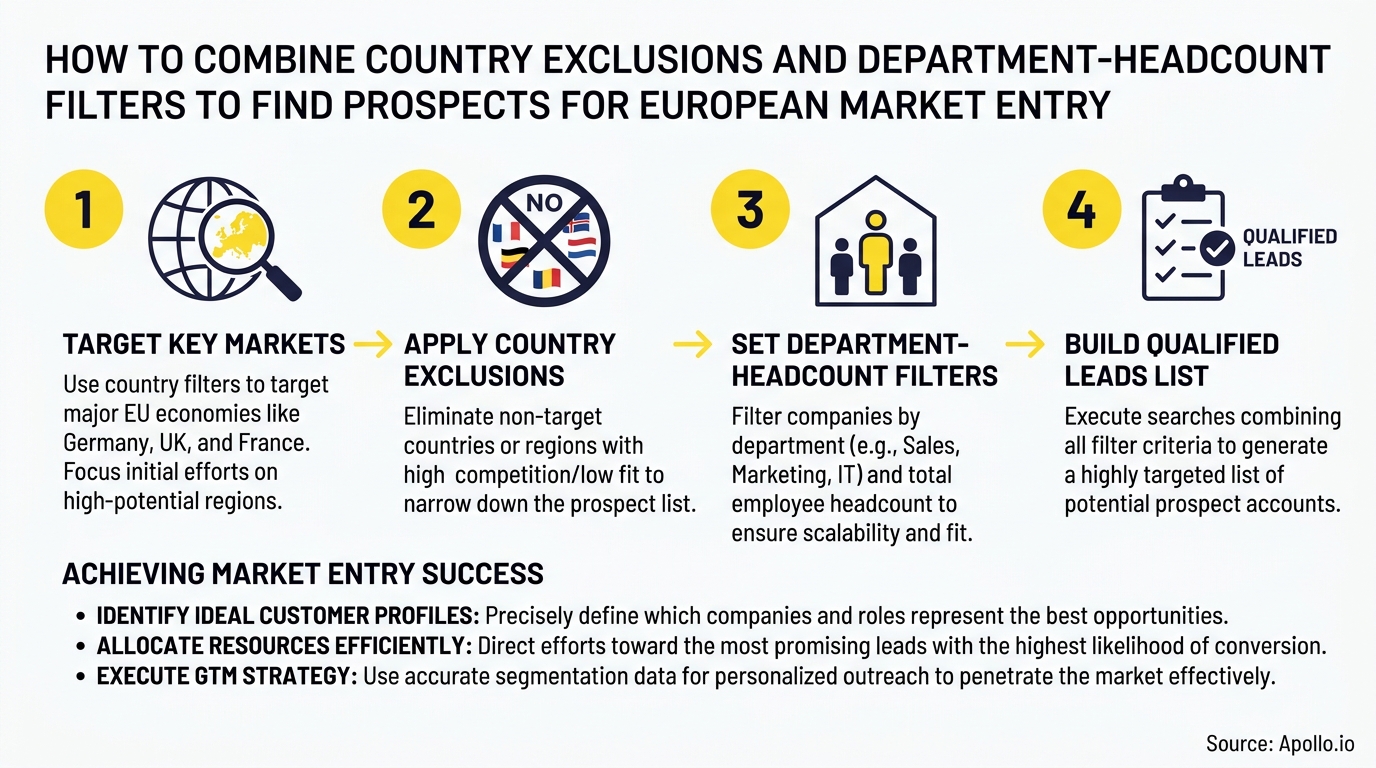
To combine country exclusions and department-headcount filters, first set the countries you can legally and operationally serve, exclude the rest, then add a department-size band and a buyer title. Run those filters together so every result meets all of them.
The steps below walk through that recipe and show how to test it before you commit budget to a new European market.

Skip Manual Research With Apollo's Verified Data
Tired of spending hours researching leads and double-checking contact info? Apollo puts verified business contacts at your fingertips with 98% email accuracy, so your reps spend less time hunting and more time selling. Start free today.
Start Free with Apollo →Key Takeaways
- Qualify markets first, then size departments. Country exclusions and department headcount do different jobs, so apply them in that order.
- Decide whether you are filtering the buyer's location or the company's headquarters before you exclude anything. The two paths return very different lists.
- Treat department thresholds as hypotheses to test per country, not fixed European minimums.
- Use Apollo MCP when you need to build this filtered list from a single prompt inside ChatGPT, Claude, Perplexity, or Codex without switching tabs.
- Measure results by qualified opportunities, not by how many contacts the filters return.
What Is the Filter Recipe for European Prospecting?
The recipe is eligible countries, then exclusions, then industry, then a department-headcount band, then buyer titles. Here is a worked example for a software vendor testing Germany, France, and the Netherlands but not ready to support French customers yet.
| Step | Filter | Example Setting |
|---|---|---|
| 1 | Location (include) | Germany, Netherlands |
| 2 | Location (exclude) | France |
| 3 | Industry | Computer software |
| 4 | Department headcount | Information technology: 5 to 20 |
| 5 | Job title | Head of IT, IT Director, VP Engineering |
Treat the 5 to 20 band as an illustrative starting point, not a benchmark. Filters stack with AND logic, so every added filter narrows the pool. Start broad and tighten one filter at a time.
Struggling to find qualified leads? Search Apollo's 240M+ contacts with 65+ filters and save this exact stack as a reusable search.
Why Use Country Exclusions Before Headcount?
Country exclusions come first because they decide whether a prospect is serviceable at all. Regulatory and operating differences across member states make Europe a poor fit for a single blanket search.
In the EIB Investment Survey 2025, 62% of EU exporters reported differing regulatory requirements, standards, or consumer-protection rules across member states. That finding supports defining your eligible countries first, then excluding markets you cannot support.
It is a strategic rationale, not a proven conversion-lift formula.
Sales leaders face added pressure to prove results. BCG surveyed 398 sales and revenue leaders and found 91% expected higher quotas or productivity requirements, while only 14% reported improved conversion from AI.
Better-qualified lists give your team a testable way to respond.
How Do HQ Location and Contact Location Differ?
Headquarters location filters by where the company is registered, while contact location filters by where the individual buyer sits. Choosing the wrong one is the most common source of bad European lists.
| Approach | Best For | Watch Out For |
|---|---|---|
| HQ-first | Territory plans tied to legal entities | Misses European buyers at US-headquartered companies |
| Contact-location-first | Reaching in-market buyers wherever the parent sits | May include buyers whose entity you cannot contract with |
If you exclude by headquarters, a Paris-based buyer at a US parent could still appear or disappear unexpectedly. Decide your goal first: serving a legal entity, or reaching a person.
For a market-entry test, many teams run both paths and compare the lists.
On social selling platforms, the usual approach is to qualify accounts first and target leads second. That is a sequential workflow and does not offer the same controls as a single combined filter stack, so verify current options before you build a process around it.
How Does Department Headcount Differ From Company Size?
Department headcount counts employees in one function, such as IT or marketing, while company size counts everyone. The distinction matters because total headcount says little about the team that will buy or implement your product.
According to Omentir, a 1,000-person logistics company may have only 3 IT engineers, while a 50-person SaaS firm may have 30. A company-size filter alone would rank those two accounts backwards for a technical product. Swell makes a similar point, noting that filtering by department headcount isolates accounts with the internal capacity and budget to implement a specific solution.
Department size is also not buying-committee size. Forrester's 2026 European buying report describes European buying groups as smaller and potentially nimbler than those elsewhere, so use headcount to qualify fit and use titles to find who actually decides.

How Should You Calibrate Department Thresholds by Country?
Set a separate threshold for each country and industry rather than one European minimum. Digital maturity and staffing patterns vary widely across the continent.
Eurostat data shows that in 2024, 30.94% of surveyed enterprises in Denmark employed ICT specialists, compared with 29.73% in the Netherlands and 13.16% in Romania. In the same year, 76.24% of EU information-and-communication enterprises employed ICT specialists, versus 7.66% in accommodation and food services.
These figures measure whether specialists exist, not department size or purchase intent, and they apply to ICT roles, not to sales or finance teams.
Eurostat's December 2025 release also showed AI adoption among EU enterprises with 10 or more employees rising from 13.5% in 2024 to 20.0% in 2025, with Denmark at 42.0%, Finland at 37.8%, and Sweden at 35.0%. For AI-related products, those country gaps can help you pick which markets to test first, but a national average says nothing about an individual account's budget.
Do not auto-exclude small teams. OECD's 2024 D4SME survey found 46% of respondents addressed digital-skills needs internally, while 42% used external consultants or new hires.
A small IT team may signal outsourcing potential. Build two hypotheses: implementation-ready accounts and capacity-constrained accounts.
Fill Your Funnel With Leads That Convert
Marketing leads going nowhere while your forecast keeps missing? Apollo finds in-market buyers with 98% email accuracy, so your pipeline stays full and forecasts stay honest. Start free and see which deals are real.
Start Free with Apollo →How Can SDRs and RevOps Teams Run This Inside an AI Tool?
SDRs and RevOps leaders can run this entire stack in one prompt by connecting Apollo to the AI tool they already use. Apollo MCP works inside ChatGPT, Claude, Perplexity, and Codex, and setup is no-code through the tool's connectors using OAuth on any Apollo plan.
A sample prompt: "Find IT directors at software companies in Germany and the Netherlands, exclude France, with 5 to 20 people in the IT department, then enrich emails and add them to my European test sequence." Your best prospecting session shouldn't require opening a new tab.
Tired of dirty data after export and import? Enrich contacts with verified business emails in Apollo before they enter a sequence.
What Should You Do When the Filters Return Too Few Results?
Loosen one filter at a time, starting with the department band, then the industry. Because filters combine with AND logic, an over-restrictive stack is the usual cause of empty results.
- Unknown department counts: some accounts have no department figure. Run a version without the headcount filter, then review those accounts manually.
- Location scope mismatch: if results look wrong, confirm whether the filter targets contact location or headquarters.
- Too many exclusions: exclude only markets you truly cannot serve. Each extra exclusion shrinks the pool.
- Stale interfaces: filter labels change, so verify the current options in Apollo's filter documentation before you build a process around them.
Keep lists clean over time. Cleanlist reports that B2B data decays at 22.5% annually, so refresh saved European searches on a schedule.
How Do You Measure Whether the Filters Work?
Measure each country and department-size combination against qualified opportunities, cost per opportunity, and pipeline generated. List volume is not a success metric.
Build a simple matrix: countries down one side, department-size bands across the top. Run each cell for the same period with the same message, then compare.
Make no assumption about which cell will win before you have data.
Share the filtered account list with marketing too. A 6sense analysis of European buying found that 92.4% of winning vendors were on the buyer's initial shortlist, and buyers chose their eventual vendor before talking to sales roughly 75% of the time.
A list that powers localized awareness content can matter before outreach starts.
For deeper context on connecting prospecting to revenue strategy, see what sales transformation means for RevOps, and tune outreach timing with the best time to email and call prospects.

What Is the Next Step for a European Market-Entry Test?
Pick two countries and two department-size bands, run all four combinations for one cycle, and let the results decide where to expand. Revenue Leaders get a defensible answer, and SDRs and AEs get a list built around real fit.
Keep the process simple: define eligible countries, apply exclusions, set a department band, add buyer titles, then measure qualified opportunities. Apollo brings data, intelligence, and execution together in one connected go-to-market system, so you can build, enrich, and sequence the list without stitching together separate tools.
Ready to build your European list? Request a Demo and start free with Apollo today.
Prove Pipeline ROI Fast With Apollo
Budget approval stuck on unclear ROI? Apollo puts prospecting, outreach, and tracking in one place, so wins show up sooner. Built-In saw a 10% lift in win rate and 10% higher ACV with Apollo. Start free and bring real numbers to your next review.
Start Free with Apollo →Don't miss these
Sales
Inbound vs Outbound Marketing: Which Strategy Wins?
Sales
What Is a Sales Funnel? The Non-Linear Revenue Framework for 2026
Sales
What Is a Go-to-Market Strategy? The 2026 GTM Playbook
See Apollo in action
We'd love to show how Apollo can help you sell better.
By submitting this form, you will receive information, tips, and promotions from Apollo. To learn more, see our Privacy Statement.
4.7/5 based on 9,690 reviews
