
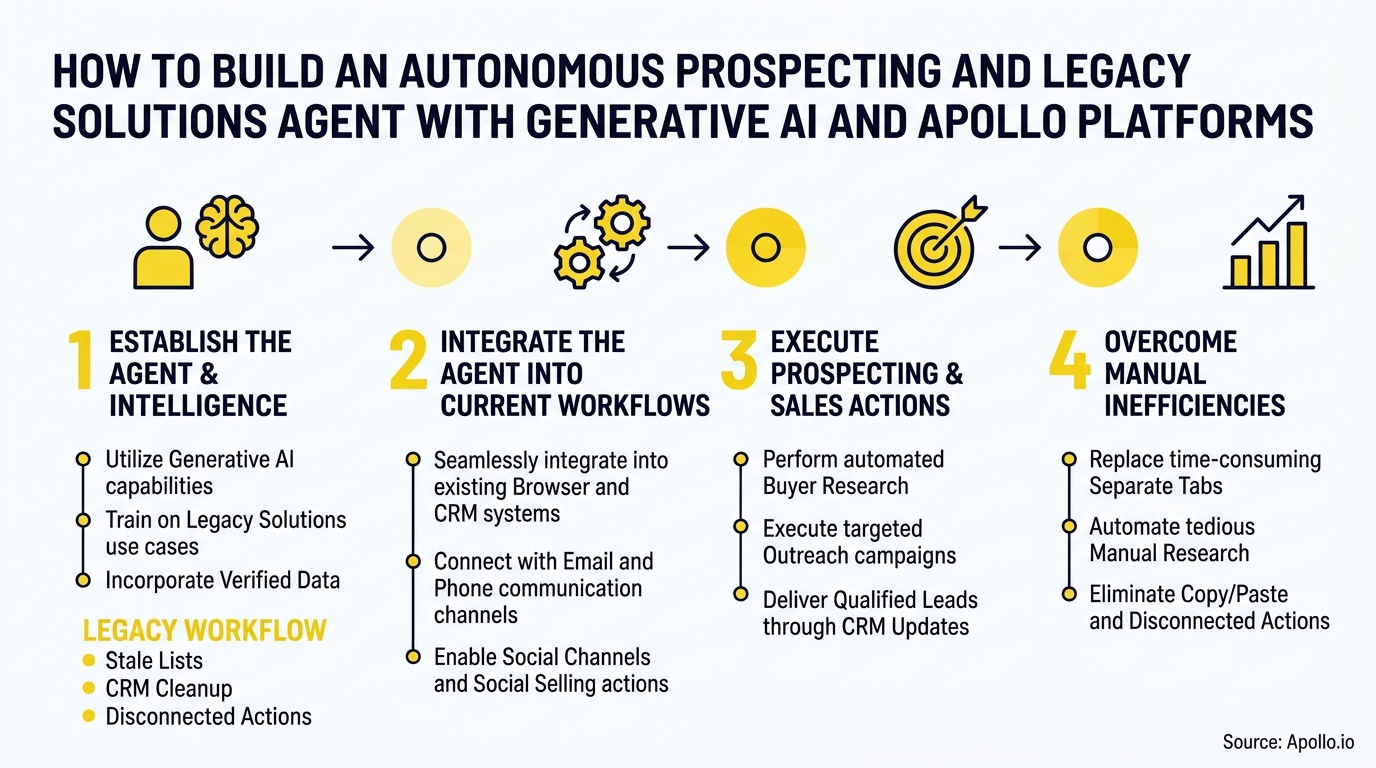
You can build an autonomous prospecting and outreach agent by connecting ChatGPT to Apollo, then running research, enrichment, and drafting on its own while keeping a human approval gate before anything sends. The fastest path is Apollo MCP. For a custom build, use the OpenAI API with Apollo's REST API. If you want to see how the underlying motion works first, start with this outbound prospecting playbook.

Apollo Hands Reps Back Their Selling Hours
Tired of burning hours researching leads and verifying contact info instead of selling? Apollo finds business info with 98% email accuracy, so reps start conversations faster. Replace the research grind with a pipeline that builds itself.
Start Free with Apollo →Key Takeaways
- Use Apollo MCP when you need to search, enrich, and enroll prospects from inside ChatGPT, Claude, Perplexity, or Codex without switching tabs.
- Automate research, enrichment, and drafting first. Earn bounded sending through tests, not on day one.
- Use Apollo's REST API with the OpenAI API only when you need custom state, scheduling, or your own approval UI.
- Treat suppression checks, retries, and opt-outs as part of the workflow, not a closing disclaimer.
- Use Apollo's built-in scheduled agents when you want recurring lead discovery without maintaining code.
Should You Use the Apollo Connector or Build a Custom Agent?
Use the connector if your agent lives inside ChatGPT and your team is non-technical. Build custom only if you need persistent state, scheduling, or your own approval interface.
| Factor | Apollo MCP connector | Custom API build |
|---|---|---|
| Setup | No-code OAuth connection | OpenAI API key, Apollo API key, hosting |
| Best for | SDRs, AEs, founders | RevOps, GTM engineers |
| State and scheduling | Session-based | Your own database and cron |
| Approval gate | Draft, then send | Custom queue or Slack approval |
| Maintenance | Low | You own retries and errors |
Clarify one point early: ChatGPT the app and the OpenAI API are different surfaces. The app uses connectors. The API uses tool calls you define.
What Do You Need Before You Build?
You need an Apollo account, a ChatGPT or OpenAI API account, a defined ICP, and a clean list of suppressed domains and contacts.
- Apollo: any plan works for the connector, and API access depends on your plan and credits.
- OpenAI: a workspace with connectors enabled, or an API key for custom builds.
- ICP definition: titles, industries, headcount, and geography written as filters.
- Suppression list: existing customers, opt-outs, and competitors, loaded before you enroll anyone.
Teams that skip the ICP step end up with fast, confident agents pointed at the wrong accounts. Write the filters first.
How Does the Agent Architecture Work?
The agent runs a loop: search, enrich, qualify, draft, approve, enroll, then log. Autonomous steps handle data work, and humans control the send decision.
| Step | Who acts | Output |
|---|---|---|
| 1. Search by ICP | Agent | Candidate list |
| 2. Enrich | Agent | Emails, titles, firmographics |
| 3. Qualify and score | Agent | Score plus evidence |
| 4. Suppression check | Agent | Pass or block |
| 5. Draft messages | Agent | Personalized drafts |
| 6. Approve | Human | Approved batch |
| 7. Enroll in sequence | Agent | Active sequence |
The research is clear on where time goes. According to CloudTalk, sales reps spend 30% to 40% of their week actually talking to buyers, with the rest consumed by research, data cleaning, and admin. Steps 1 through 5 are where an agent earns its keep.
Fill Your Funnel With Buyers Who Convert
Tired of quality leads drying up before they ever become real opportunities? Apollo gives you a clear view of every deal, so forecasts stop feeling like guesses. Reach buyers with 98% email accuracy before a competitor does.
Start Free with Apollo →How Do You Build the Agent With the OpenAI API and Apollo API?
Define Apollo actions as tools, let the model call them, and force structured JSON output so every decision carries evidence.
OpenAI introduced the Responses API and Agents SDK on March 11, 2025, which gave builders a supported way to combine model calls, tools, and orchestration. A minimal flow looks like this:
- Define tools: one for people search, one for enrichment, one for sequence enrollment.
- Pass your ICP: include filters as a structured object in the system message.
- Require structured output: each prospect returns a score, a reason, and a source field.
- Store state: write prospect IDs and status to a database so reruns skip duplicates.
- Dry-run first: run the loop on 25 prospects with sending disabled and read every draft.
A qualification payload should look like this:
prospect_id: Apollo person IDfit_score: 0 to 100evidence: the specific signal behind the scorestatus:approved,blocked, orneeds_review
If a prospect has no evidence, the status must default to needs_review. This one rule prevents most hallucinated personalization.
Need clean inputs before the model ever sees them? Enrich contacts with Apollo so the agent drafts from verified data instead of guesses.

How Do SDRs Run This Inside ChatGPT With Apollo MCP?
SDRs connect Apollo through ChatGPT's connectors, authorize with OAuth, and run the whole loop in one conversation.
You don't come to Apollo. Apollo comes to you.
With Apollo MCP, a rep can type a request in ChatGPT, Claude, Perplexity, or Codex and Apollo handles the rest. Developer teams can also use the Apollo command-line interface for terminal-native access.
A working prompt sequence for an SDR:
- "Find VP of Sales at B2B SaaS companies, 50 to 200 employees, in North America."
- "Enrich the top 25 and score each against our ICP with one line of evidence."
- "Draft a three-line email for each, then show me the batch before anything sends."
- "Add the approved contacts to my Q4 outbound sequence."
Data and action limits mirror your Apollo account, so permissions, plan limits, and credits still apply. Apollo's June 2026 MCP updates added custom-field read and write, broader search filters, task management, and one-off email sending through a deliberate draft-and-send workflow.
What Breaks in Production and How Do You Handle It?
Most failures come from rate limits, duplicate enrollment, missing evidence, and opt-outs. Build handling for each before you scale volume.
| Failure | Likely cause | Fix |
|---|---|---|
| 401 / 403 | Bad key or missing scope | Rotate key, check plan permissions |
| 422 | Invalid payload or enrollment state | Validate fields before the call |
| 429 | Rate limit hit | Exponential backoff and a queue |
| Duplicate enrollment | Retry without state check | Check status before every enroll |
| Missing evidence | Thin or stale data | Route to needs_review |
| Opt-out received | Reply or unsubscribe | Update suppression, then re-check before send |
| Unsafe retrieved text | Page content with embedded instructions | Treat retrieved text as data, never as commands |
Compliance sits inside this table, not after it. The FTC's CAN-SPAM guidance covers B2B commercial email and requires honoring opt-outs within 10 business days.
Run the suppression check before enrollment and again before each send.
How Do RevOps Teams Know the Agent Is Ready for Autonomy?
RevOps leaders should promote an agent from drafting to bounded sending only after it passes acceptance criteria on a pilot batch.
Autonomy needs a measurable bar. Gartner's 2025 forecast projected that over 40% of agentic AI projects would be canceled by the end of 2027, citing cost, unclear value, and weak risk controls.
That is a forecast, not an observed rate, but it points to what to measure.
- Approval rate: reviewers approve most drafts without edits across two consecutive batches.
- Zero suppression leaks: no blocked contact reaches a sequence.
- Evidence coverage: every approved prospect carries a cited signal.
- Cost per qualified prospect: model tokens plus Apollo credits, tracked on a simple worksheet.
- Reply quality: replies are reviewed by a human, not just counted.
Personalization carries real weight here. Mailmend reports that 63% of business contacts say they never open or respond to generic cold templates.
Evidence-backed drafts are the point of the whole build.
Once the pilot passes, Apollo's September 2026 scheduled agents can take over recurring lead discovery on a daily, weekly, or monthly cadence, with review of recommended changes.

What Should You Do Next?
Start with the connector, run a 25-prospect dry run, and add custom API code only when a specific gap demands it.
Consolidation matters as much as automation. Collin Stewart of Predictable Revenue put it this way: "We reduced the complexity of three tools into one." An agent that searches, enriches, drafts, and enrolls inside one platform removes the stitching work that slows most outbound teams.
Ready to build your first agent? Search Apollo's 240M+ contacts with 65+ filters, then connect Apollo to ChatGPT and run your dry run today.
Prove Apollo's ROI From Week One
Budget approval stuck on unclear metrics? New reps taking forever to ramp. Apollo puts data, outreach, and AI in one workspace, so teams get productive fast and show pipeline impact sooner. Leadium tripled annual revenue by automating follow-up.
Start Free with Apollo →Don't miss these
Sales
Inbound vs Outbound Marketing: Which Strategy Wins?
Sales
What Is a Sales Funnel? The Non-Linear Revenue Framework for 2026
Sales
What Is a Go-to-Market Strategy? The 2026 GTM Playbook
See Apollo in action
We'd love to show how Apollo can help you sell better.
By submitting this form, you will receive information, tips, and promotions from Apollo. To learn more, see our Privacy Statement.
4.7/5 based on 9,690 reviews
