
You can build a list of 500 accurate micro-influencer and founder leads by sourcing each contact from a documented public or verified source, logging where the email came from, and rejecting any address that was inferred from a domain pattern. This playbook gives you the acceptance rubric, two sourcing tracks, and the verification gates to get there. If you want the broader foundation first, start with how to build a lead list that converts.

Skip Manual Research With Apollo
Tired of burning hours researching leads and verifying contact info instead of selling? Apollo puts verified business info at your fingertips, with 98% email accuracy. Start spending your day in conversations, not spreadsheets.
Start Free with Apollo →Key Takeaways
- An accepted lead is a qualified person with a documented email source and a recent verification result, not just an exported address.
- Use Apollo MCP when you need to search, enrich, and build a 500-person founder and creator list inside ChatGPT, Claude, Perplexity, or Codex without switching tabs.
- Run two separate sourcing tracks, one for creators and one for founders, then merge and deduplicate.
- Treat contact sourcing, verification, and sender readiness as three separate checks.
- Track exclusions and cost per accepted lead so the list stays auditable over time.
What Counts as an Accurate Lead When You Refuse to Guess Emails?
An accurate lead is a person who fits your criteria, whose email has a recorded source, and whose address passed verification within a recent window. That definition matters because accuracy, not database size, drives results. A Salesforce 2024 State of Sales survey of 5,500 sales professionals found only 35% completely trusted their organization's data accuracy.
"Verified" and "not guessed" are not the same thing. A verification badge can sit on an address that was inferred from a domain pattern.
If your rule is literal, require a published source or direct confirmation, and exclude inferred-only results.
| Email status | Source evidence | Accept? |
|---|---|---|
| Published | Media kit, bio, or company page lists it | Yes |
| Directly confirmed | Contact replied or confirmed it | Yes |
| Verified from a provider with a source | Source recorded plus passing check | Yes |
| Inferred from domain pattern | No public source | No |
| Accept-all or catch-all | Server accepts everything, result uncertain | Hold out |
How Do SDRs and Founders Define Acceptance Criteria Before Sourcing?
SDRs and founders should write the acceptance rubric before pulling a single name, so every row is judged against the same gates. A simple rubric has five fields: topic fit, audience fit, email provenance, verification status, and a "why this person, why now" note.
Qualify creators on expertise and relevance first. professional networks and Ipsos research found B2B marketers prioritized authenticity and credibility (58%), industry relevance (49%), and subject-matter expertise (47%) when choosing creators. Score fit before you spend any effort on contact data.

- Fit: Does their content match your category?
- Provenance: Where did the email come from?
- Status: Valid, accept-all, or unresolved?
- Timing: What recent activity makes outreach relevant?
How Do You Source Micro-Influencer Leads Without Inferred Emails?
Source micro-influencers from profiles and media kits, then record the exact page where each contact detail appears. Start from the creator's own channels, since business contact details are often listed in bios, link pages, or press kits.
- Pull candidates by topic from creator profiles and niche communities.
- Open each profile and look for a listed business email or media kit.
- Paste the source URL into your ledger next to the address.
- Reject any address you cannot trace to a published or confirmed source.
Smaller creators are worth the effort. A 2024 Journal of Marketing study summarized by the American Marketing Association found nano-influencers generated more than 3 times the return on influencer spend of macro-influencers. That research covers DTC Instagram campaigns, so treat it as directional for B2B.
Apollo Turns Pipeline Guesswork Into Clarity
Forecasts feel like a coin flip when your top-of-funnel is thin and deal data is stale? Apollo fills your pipeline with qualified leads and keeps every deal stage in view. Reach buyers at the right moment with 98% email accuracy.
Start Free with Apollo →How Do You Source Founder Leads From Official Company Pages?
Source founder leads from official bios, company "about" and press pages, and published contact details, then confirm the person still holds the role. Founders are easier to find than creators, but roles change quickly, so a documented role check protects accuracy.
For RevOps and growth teams, this is where structured search helps. Struggling to find qualified founders at scale? Search Apollo's 240M+ contacts with 65+ filters to narrow by title, company size, and industry before you verify each record. Founders also respond best when you add a timely angle, so log a signal like a funding round, launch, or new hire in your "why now" field.
How Can Apollo MCP Speed Up a 500-Lead Build?
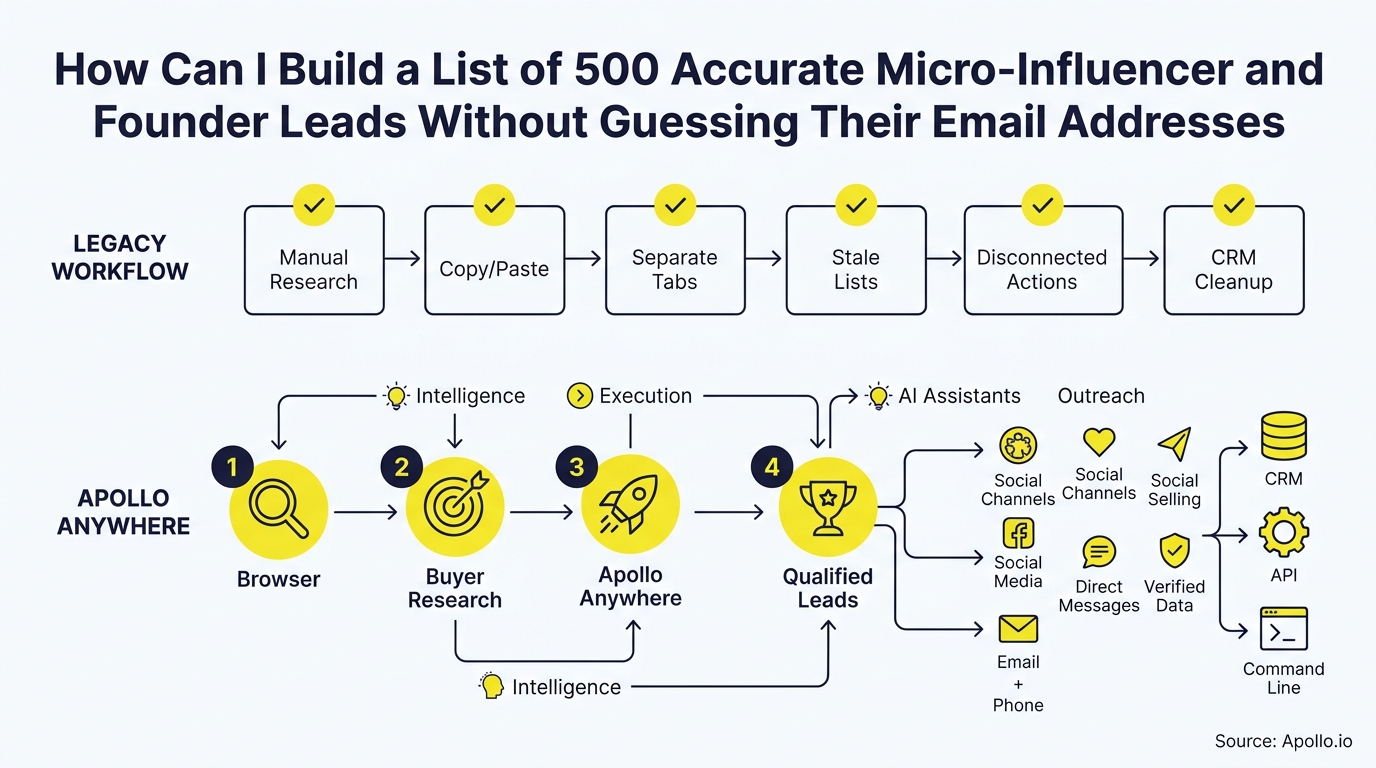
You can run the search, enrichment, and list-building steps inside the AI tool you already use by connecting Apollo MCP to ChatGPT, Claude, Perplexity, or Codex. Setup is no-code through the tool's connectors via OAuth, and data limits mirror your Apollo account. Your best prospecting session shouldn't require opening a new tab.
From one conversation, you can search for people and companies that match your criteria, enrich contacts with verified emails and phone numbers, create or update records, and add prospects to sequences. Ask for founders in a niche, then keep only rows that meet your provenance rule.
For technical teams, the Apollo command-line interface offers terminal-native access.
How Do You Deduplicate and Verify the List Before Outreach?
Deduplicate by email and profile URL first, then verify what remains and hold out anything uncertain. Run the merge after both tracks finish so a founder who is also a creator appears once.
Verification protects your sender reputation. According to The Digital Bloom, a bounce rate consistently above 2% to 3% flags sending domains as spam and can cut inbox placement by 20 to 30 percentage points. Guessing permutations makes that outcome more likely, as Verified Email notes about unverified static lists.
Walk through the check in order, and see how to verify email addresses for B2B sales for the mechanics:
- Remove exact duplicates.
- Run each address through verification.
- Move accept-all results to a holdout tab.
- Count only valid, sourced rows toward your 500.
What Should You Track to Keep the List Auditable?
Track funnel counts, research minutes, and cost per accepted lead so you know what your 500 actually cost. Without these numbers, you cannot tell whether a tool or workflow is paying off.
| Ledger field | Why it matters |
|---|---|
| Source URL | Proves the email was not guessed |
| Verification status | Separates valid from accept-all |
| Exclusion reason | Shows what you rejected and why |
| Research minutes | Feeds cost per accepted lead |
| Why now | Prioritizes timely outreach |
Expect a large share of raw candidates to fail your gates, so plan to source well beyond 500 names. For tool comparisons, ask each provider whether it can disable domain-pattern inference and return only sourced results.
What Do You Do When No Public Email Exists?
When no sourced email exists, switch channels rather than guess. Use a contact form, a direct message, a booking link, or a mutual introduction, and log the reason the email was excluded.
Sender readiness is a separate check from list accuracy. A valid address does not guarantee inbox placement, so confirm your authentication and review email deliverability basics before you send. Microsoft's May 2025 requirements for senders above 5,000 messages daily and Google's authentication rules both reinforce this, though a 500-lead campaign sits below the high-volume threshold.

How Do You Turn 500 Verified Leads Into a Working Pipeline?
Load your accepted rows into a sequence, personalize each opening with the "why now" note, and review replies and bounces weekly. Tired of rebuilding the same list by hand? Automate your sequences with Apollo so research, enrichment, and outreach live in one workspace, in line with the tech stack consolidation many teams are after. Predictable Revenue described the payoff as reducing the complexity of three tools into one.
Refresh the list on a schedule, since roles and contact details change. Treat the 500 as a living pipeline, not a one-time export. To start building your list with sourced, verified contacts, Schedule a Demo with Apollo today.
Prove Pipeline ROI Fast With Apollo
Budget approval stuck because nobody can quantify the time saved or pipeline impact? Apollo puts prospecting, outreach, and tracking in one platform, so reps book meetings from day one. Leadium tripled annual revenue by speeding up follow-up.
Start Free with Apollo →Don't miss these
Sales
Inbound vs Outbound Marketing: Which Strategy Wins?
Sales
What Is a Sales Funnel? The Non-Linear Revenue Framework for 2026
Sales
What Is a Go-to-Market Strategy? The 2026 GTM Playbook
See Apollo in action
We'd love to show how Apollo can help you sell better.
By submitting this form, you will receive information, tips, and promotions from Apollo. To learn more, see our Privacy Statement.
4.7/5 based on 9,690 reviews
