
ChatGPT can organize, normalize and match prospect names, companies and emails in bulk, but it cannot verify that a mailbox exists or belongs to the right person on its own. Medium notes that LLMs excel at parsing unstructured web data into structured tables of names, roles and companies, but carry significant error rates when matching specific identities without external database lookups.
So the reliable workflow splits the job: ChatGPT handles structure and matching logic, while a verification source handles mailbox status. This guide shows the exact steps, plus how to verify email addresses for B2B sales without trusting a plausible guess.

Skip Manual Research, Reach Real Buyers
Tired of burning hours researching leads and verifying contact info instead of selling? Apollo finds business contacts for you with 98% email accuracy, so your reps spend their day in conversations, not spreadsheets. Start free and see the difference today.
Start Free with Apollo →Key Takeaways
- ChatGPT is strong at cleaning and matching rows, but mailbox verification needs an external data source.
- Treat identity (is this the right person at the right company?) and deliverability (will the email land?) as two separate checks.
- Route namesakes, accept-all domains and unknown results to human review instead of auto-approving them.
- Use Apollo MCP when you need to search, enrich and verify prospects inside ChatGPT, Claude, Perplexity or Codex without switching tabs.
- Prove the workflow on a labeled 500-record sample before scaling it to your full list.
Can ChatGPT Verify Email Ownership?
No, ChatGPT cannot verify email ownership by itself, because it has no live access to mail servers or contact databases. It can structure data you supply and flag inconsistencies, but a verification tool must confirm the mailbox status.
Here is how the work divides across the workflow:
| Task | Can ChatGPT do it alone? | What else is needed |
|---|---|---|
| Normalize names and company strings | Yes | Your source spreadsheet |
| Deduplicate and standardize records | Yes | A stable row ID |
| Infer a company domain | Partially | A sourced domain list |
| Confirm a current employer | No | A contact database or live source |
| Verify a mailbox is deliverable | No | A verification tool or data provider |
You can start from three inputs: a list of target companies, a list of named prospects, or an existing email list that needs checking.
How Does a Bulk Prospect-Matching Workflow Work?
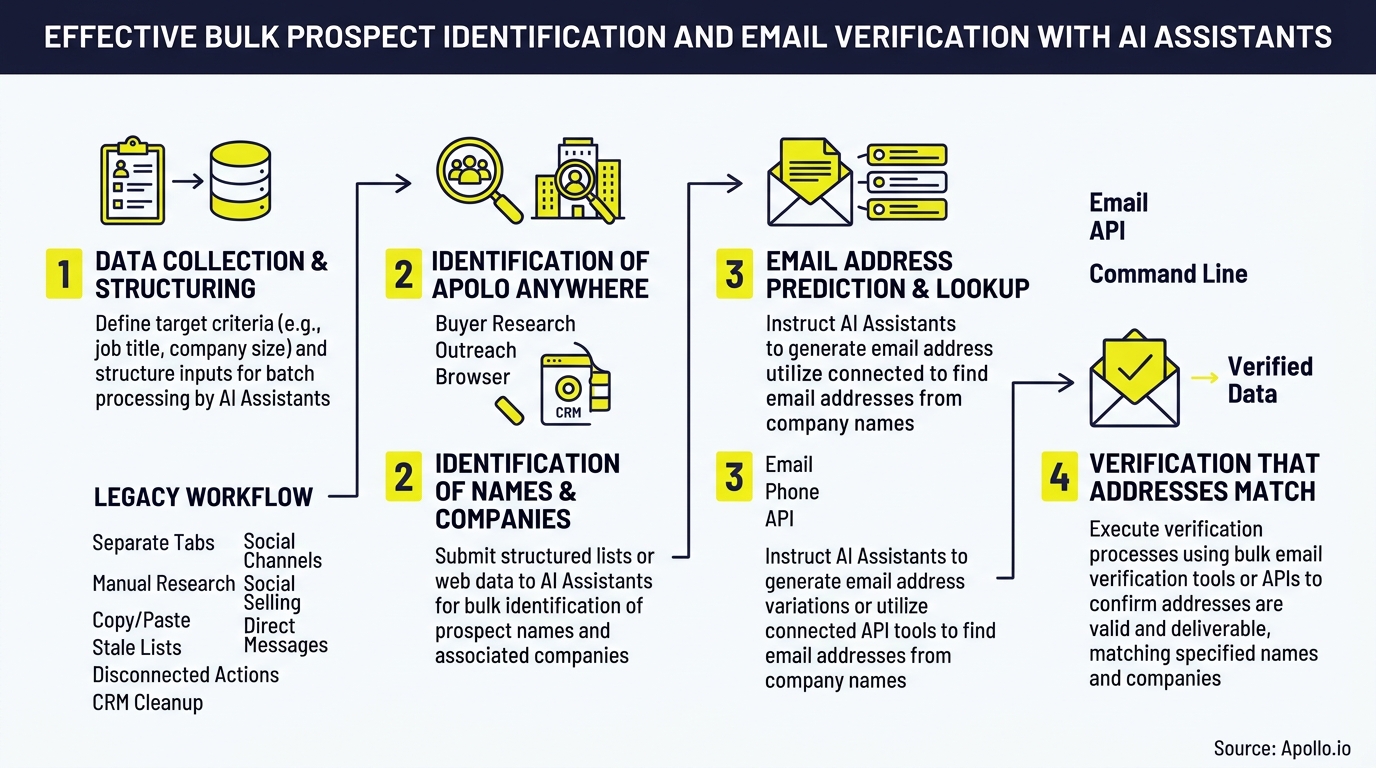
A bulk workflow runs in five steps: normalize, enrich externally, verify, join by ID and export. ChatGPT drives steps one, four and five, while external tools supply the facts in steps two and three.
Start with a simple CSV that carries a unique ID for every row:
row_id,first_name,last_name,company,company_domain,email,source
1,Dana,Whitfield,Northwind Logistics,northwind.example,dana.whitfield@northwind.example,list_a
2,Marcus,Lee,Brightpath Health,brightpath.example,m.lee@brightpath.example,list_a
Then use a constrained matching prompt so ChatGPT does not invent evidence:
You will receive a CSV of prospects. For each row:
- Standardize first_name, last_name and company (title case, no titles).
- Flag rows where the email domain does not match company_domain.
- Flag likely duplicates by name + company.
- Do NOT guess employers, domains or emails. If a value is missing, write "UNKNOWN".
- Return the same row_id with a status column: OK, REVIEW or DUPLICATE.
The no-code path looks like this:
- Normalize: Upload the CSV and run the prompt above to clean formatting and flag mismatches.
- Enrich externally: Pull current employer, title and email from a contact data source, not from the model's memory.
- Verify: Run each email through a verification service and record the result.
- Join by ID: Merge the verification output back onto your cleaned file using
row_id. - Export: Send clean rows onward and set exceptions aside for review.
The same research notes that when RevOps teams use ChatGPT for workflow orchestration, such as extracting records and generating scripts to call verification APIs like NeverBounce, ZeroBounce and Hunter, the productivity gains are real, which reinforces keeping verification outside the model. See Overloop's AI prospecting statistics for more.
Why Do Identity and Deliverability Need Separate Checks?
A valid mailbox does not prove it belongs to the person you intended to reach, so identity and deliverability must be tested separately. An email can be technically deliverable while still pointing to a former employee, a namesake or a shared inbox.
Data trust is the underlying problem. Salesforce's 2024 State of Sales survey of 5,500 sales professionals found that only 35% completely trusted their organization's data accuracy.
Record the evidence for each prospect rather than presenting a plausible match as a verified fact.
Store these fields on every row:
- Source of the name and company
- Company domain and how it was confirmed
- Verification status and check date
- Identity-match note (confirmed, uncertain or conflicting)
Freshness matters too. Landbase reports that B2B contact databases decay at a baseline of 2.1% to 3.6% per month, compounding to 22.5% to 30%+ annually. A person's current employer deserves rechecking alongside their email.
Tired of dirty data? Start free with Apollo's 240M+ People and 30M+ Companies database.
Turn Forecast Guesswork Into Pipeline Clarity
Forecasts feeling like a coin flip because the funnel starts with weak leads? Apollo fills your top of funnel with verified business contacts at 98% email accuracy, so every deal you track is worth tracking. Start free and see where your quarter really stands.
Start Free with Apollo →How Do You Handle Exceptions and Uncertain Matches?
Handle exceptions with a decision table that sends every uncertain row to review instead of auto-approving it. Verification is a graded decision, not a binary badge, so a single "valid" label should never end the check.
| Exception | What it means | Recommended action |
|---|---|---|
| Namesake | Two people share a name at similar firms | Confirm with title and company before use |
| Former employer | Email or company is outdated | Re-enrich the current employer |
| Accept-all domain | Server accepts any address, so status is uncertain | Route to review or low-volume testing |
| Unknown result | Verifier could not confirm the mailbox | Hold; do not send at scale |
| Duplicate record | Same person appears more than once | Keep the freshest row, merge the rest |
Also separate list quality from sender health. Google's 2024 sender requirements call for keeping reported spam rates below 0.3%, and recommend staying under 0.1%. Clean data helps, but it does not replace proper authentication. For follow-up reading, see bulk email best practices.

How Can SDRs and RevOps Teams Run This Inside Their AI Tool?
SDRs and RevOps leaders can run this workflow without leaving their AI tool by connecting a data source that returns real contact records. Instead of asking a model to suggest leads, you retrieve and enrich actual records through a connected service.
Apollo MCP brings Apollo into ChatGPT, Claude, Perplexity and Codex, so one conversation can search for people and companies that match your ICP, enrich contacts with verified emails and phone numbers, and add prospects to sequences. Setup is no-code through the tool's connectors using OAuth, and data and action limits mirror your Apollo account. Technical teams can also reach Apollo through the command-line interface.
For an SDR with a spreadsheet of 500 named prospects, that means pasting the list, asking the connected tool to match each person to a current employer, and returning verified results keyed to your row_id. RevOps leaders can apply the same pattern to clean an inherited list before it reaches the CRM. Your best prospecting session shouldn't require opening a new tab.
Struggling to find qualified leads? Search Apollo's 240M+ People with 65+ filters.
How Do You Prove the Workflow Works Before Scaling It?
Prove it with a labeled 500-record benchmark, and report identity precision separately from verifier results. A small sample shows whether the workflow earns trust before you commit a full list to it.
Follow these reconciliation checks:
- Hand-label 500 records as correct or incorrect person-company matches.
- Measure identity precision: of the rows marked OK, how many are truly the right person?
- Record verifier outcomes (valid, invalid, accept-all, unknown) as a separate metric.
- Track bounce rate and cost per usable contact after a small test send.
- Confirm every row in the output joins back to a unique
row_id.
This matters because data quality has real cost. Landbase cites Gartner research that poor data quality costs organizations an average of $12.9 million per year. A controlled pilot protects you before inaccurate records reach your sequences. Once your list is clean, email deliverability practices keep it working.

What Should You Do Next?
Start with a 500-record sample, keep identity and deliverability as separate checks, and let a connected data source supply the facts while ChatGPT handles the structure. That division of labor gives you speed without presenting guesses as verified contacts.
Apollo brings B2B data, sales engagement and AI-powered execution together in one connected go-to-market system, so teams don't have to stitch together separate vendors for research, verification and outreach. To run this workflow end to end, Schedule a Demo with Apollo.
Prove Pipeline ROI Fast With Apollo
Budget approval stuck on unclear ROI? Apollo puts verified business contacts, outreach, and pipeline reporting in one place, so you see results fast. Built-In saw +10% win rate and +10% ACV. Start free and show leadership real numbers.
Start Free with Apollo →Don't miss these
Sales
Inbound vs Outbound Marketing: Which Strategy Wins?
Sales
What Is a Sales Funnel? The Non-Linear Revenue Framework for 2026
Sales
What Is a Go-to-Market Strategy? The 2026 GTM Playbook
See Apollo in action
We'd love to show how Apollo can help you sell better.
By submitting this form, you will receive information, tips, and promotions from Apollo. To learn more, see our Privacy Statement.
4.7/5 based on 9,690 reviews
