
Apollo Quote for 10 Users: IT Requirements vs Overloop Compared
Need a 10-user Apollo quote today, plus proof it meets IT's mailbox-scoped access and approve-before-send requirements? Here's the executive verdict: Apollo's Professional tier lists at $9,480/year for 10 seats and satisfies the Microsoft 365 mailbox-scope requirement out of the box.
Approve-before-send, however, is only a partial match, and you'll want written confirmation before you sign.
This breakdown gives you the dated quote table, a pass/partial/fail requirements matrix, and the exact questions to ask Apollo sales before committing budget. For teams also evaluating multi-channel sequencing, Apollo's multichannel sales engagement platform is the relevant product to scope against Overloop.
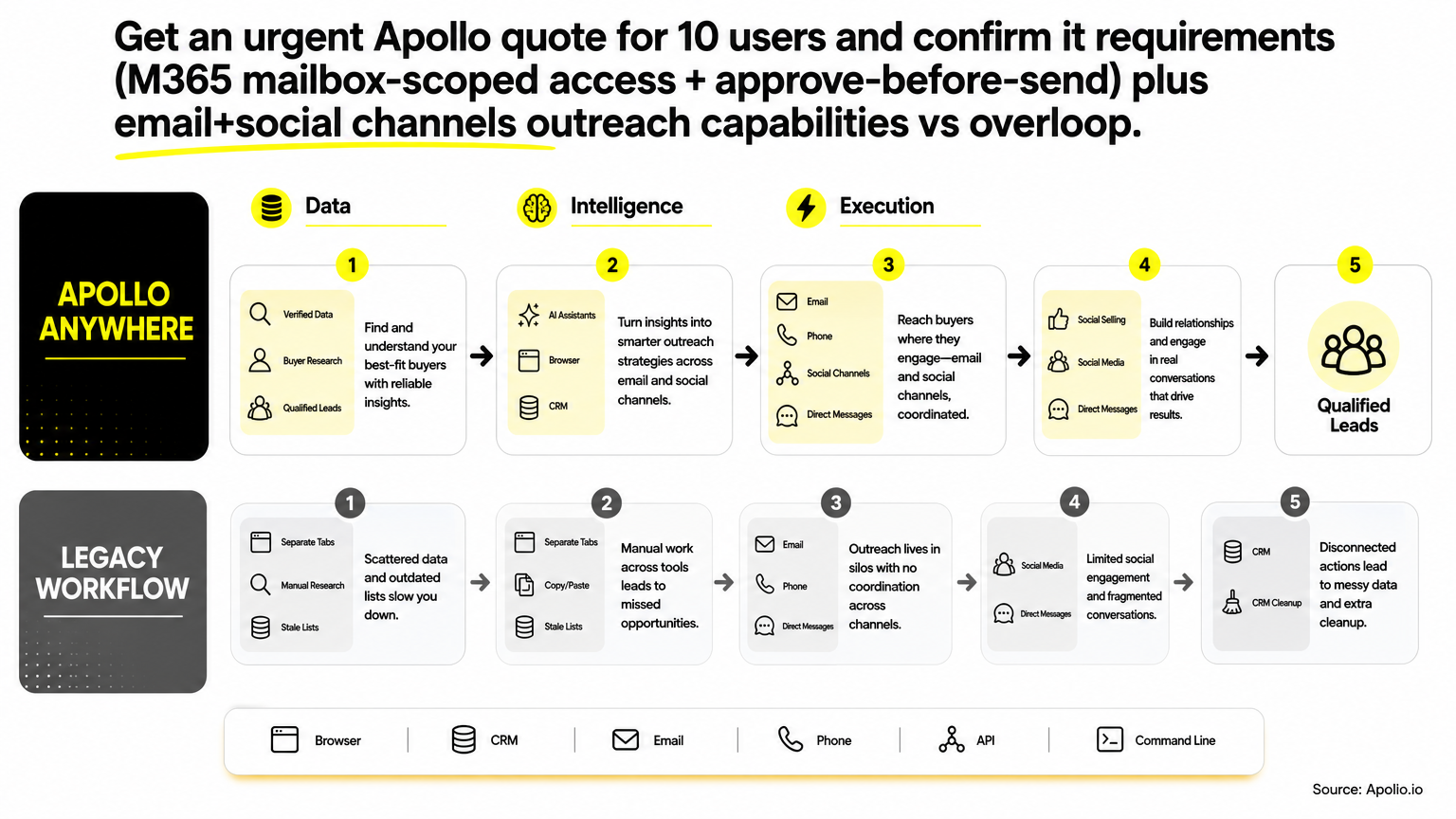

Skip The Manual Hunt, Apollo Finds Buyers
Still burning hours a day chasing down emails and phone numbers that bounce anyway? Apollo hands your reps verified contact data instantly, so selling time stays selling time. 98% email accuracy means fewer dead ends, more real conversations.
Start Free with Apollo →Key Takeaways
- Apollo Professional runs $9,480/year for 10 users; Organization runs $14,280/year if you need SSO and advanced governance.
- Apollo's M365 mailbox access is delegated and scoped per user, not tenant-wide, which should satisfy most IT security reviews.
- Approve-before-send is a partial match: Apollo supports manual email tasks and workflow enrollment approval, but not a documented two-person reviewer/sender gate like Overloop's.
- Apollo treats professional networks actions as manual tasks completed by a human; Overloop automates them, which carries platform policy risk.
- Get every requirement confirmed in writing from Apollo sales before purchase, especially approval workflow and mailbox scope details specific to your tenant.
What Does A 10-User Apollo Quote Cost In 2026?
A 10-user Apollo quote ranges from $5,880 to $14,280 per year depending on tier, based on Apollo's official pricing page. For a 10-person outbound team needing both email automation and M365 connectivity, Professional is the practical baseline.
| Tier | Price/User/Month (Annual) | 10-User Annual Cost | Credits/User/Year |
|---|---|---|---|
| Basic | $49 | $5,880 | 30,000 |
| Professional | $79 | $9,480 | 48,000 |
| Organization | $119 (min 3 users) | $14,280 | 72,000 |
Apollo saves 20% with annual billing versus month-to-month, per the official pricing page. Basic supports one connected mailbox per user; Professional and Organization support unlimited M365 mailbox connections per user, which matters if reps manage multiple sending identities.
Choose Organization if you need custom permission profiles, SSO, or advanced admin governance across 10+ seats.
None of these numbers are a binding quote. Confirm final pricing, any negotiated discount, and add-on costs directly with Apollo sales or at checkout.
Does Apollo Meet The M365 Mailbox-Scoped Access Requirement?
Yes, Apollo meets this requirement using delegated Microsoft 365 permissions scoped to each individual mailbox, not application-level access across the tenant. Each of your 10 users connects and authenticates their own mailbox; Apollo cannot read or send from mailboxes that haven't separately consented.
This matters for procurement because Meetingroom365's documentation on M365 role-based access control frames mailbox-scoped access as a distinct, auditable requirement separate from broader admin consent. Apollo's connection uses the Microsoft Graph API rather than legacy Exchange Web Services. Multiple technical sources confirm this architecture: RivaSync's EWS vs. Graph comparison and M365.fm's analysis of the EWS deprecation both list Apollo.io as supporting connection via Microsoft Graph API.
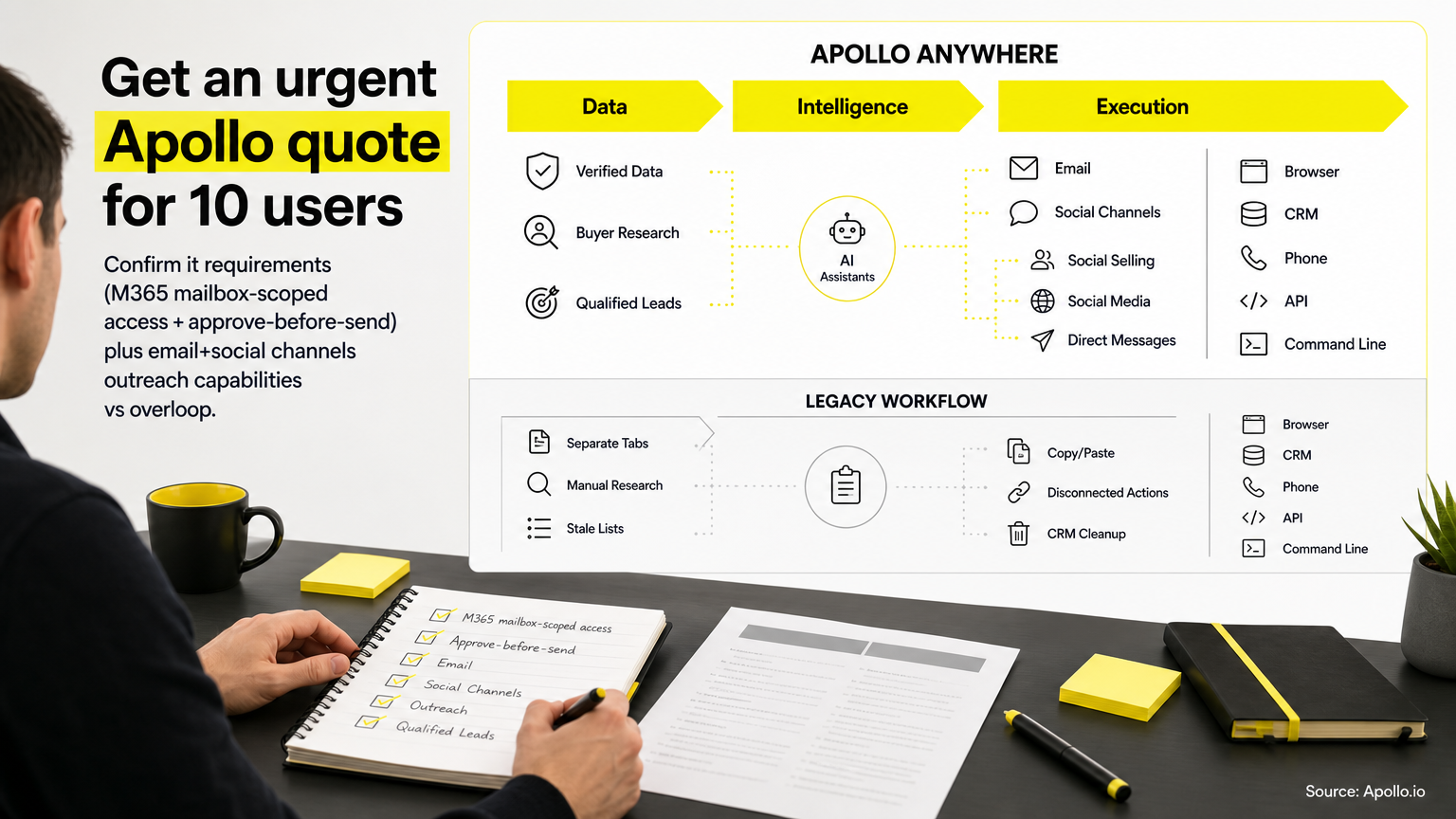
Apollo's full Outlook connection requests functional scopes covering email, mailbox settings, calendar, sending, contacts, and mailbox read/write. Ask Apollo's team for the exact Azure AD app registration and scope list before your security review, so RevOps and IT can sign off on the same document.
Does Apollo Support Approve-Before-Send For Every Outbound Email?
Partially. Apollo supports two human-control patterns: manual email steps that a rep reviews and sends individually, and workflow enrollment approval that gates contacts before they enter an automated sequence.
What Apollo does not publicly document is a dedicated two-person reviewer/sender workflow, where one person drafts and a separate manager or reviewer must approve before the message goes out. If your compliance policy requires that exact separation of duties on every single email, get this confirmed in writing from Apollo sales, since public documentation doesn't establish it as a named feature.
Overloop, by contrast, lets teams assign a specific reviewer to an email step and requires an explicit "Approve and Send" action before the message leaves the queue. If reviewer-based approval is a non-negotiable requirement, this is the clearest functional gap to raise directly in your Apollo demo.
For AI-assisted sequences specifically, this distinction is increasingly important. Apollo's AI sales automation platform drafts messages tailored to input and context, but a human still needs a clear approval checkpoint before anything sends. Confirm which approval mode applies to AI-drafted content in your specific plan.
See Deal Stages Before They Go Cold
Forecasting off gut feel because half your leads never turn into real opportunities? Apollo scores and routes prospects the moment buying intent shows up, so reps chase deals that actually close. Built-In saw a 10% lift in win rate using Apollo's signals.
Start Free with Apollo →How Do Apollo And Overloop Handle Email Plus social outreach?
Apollo treats professional networks actions as manual tasks a rep completes by hand; Overloop automates professional networks connection requests, messages, and profile views inside combined campaigns. This is the single biggest functional difference between the two platforms.
Apollo supports four professional networks task types (connection requests, messages, profile views, and post interactions) that appear on a rep's task list for manual completion across the web. Overloop's own content addresses this directly: Overloop's comparison of professional networks vs. email outreach frames combined email-plus-professional networks capability as a core requirement for modern B2B sequences, a point echoed by DanishLeadCo's analysis of email vs. professional networks conversion.
The tradeoff is risk versus hands-off execution. professional networks's platform terms restrict third-party tools that automate messaging, connections, or other account activity, and violations can lead to account restriction. Apollo's manual-task model avoids that exposure entirely; Overloop's automation trades some of that safety margin for speed.
Weigh this against your team's risk tolerance, not just feature checkboxes.
How Do SDRs And AEs Use Apollo's Approval Controls Day To Day?
SDRs use Apollo's manual email tasks to review AI-drafted copy before it sends, keeping personalization intact while still moving fast through a queue. Account Executives managing later-stage deals rely on the same task-based review when a sequence touches an active opportunity, so nothing goes out that contradicts a live conversation.
RevOps leaders configuring the workspace can require enrollment approval at the workflow level, meaning no contact enters an automated sequence without a defined check first. Founders and revenue leaders running lean 10-person teams often use this middle ground: automation for volume, manual review for anything sent to a named strategic account.
Struggling to keep review consistent across 10 reps? Apollo's workflow automation engine lets RevOps build enrollment gates once and apply them across the whole team, rather than trusting individual reps to self-police.
Why Does Message Governance Matter More Than Automation Volume?
Message governance matters more than raw send volume because buyers actively penalize irrelevant, inconsistent outreach. This is a revenue risk, not just a compliance checkbox.
Buyer behavior backs this up. Gartner's 2025 B2B buyer survey found that 73% of buyers actively avoid suppliers that send irrelevant outreach, while 69% report inconsistencies between what sellers say and what supplier websites show. Approve-before-send isn't friction, it's a filter against exactly this problem.
Channel mix compounds the stakes. Research from Martal's sales statistics report shows campaigns using three or more channels, such as email, and phone, achieve a 287% higher purchase rate than single-channel approaches. That's why the email-plus-professional networks requirement isn't cosmetic. It directly affects pipeline outcomes, which is why RevOps leaders should treat governance and channel breadth as one combined decision, not two separate line items.
What Questions Should You Ask Apollo Sales Before You Buy?
Ask Apollo sales to confirm, in writing, exactly which approval model applies to your account before signing. Verbal assurances during a demo aren't a substitute for a documented answer you can show your security and legal teams.
- Does our plan support a distinct reviewer-approval step (not just enrollment approval) for every outbound email?
- What exact Microsoft Graph API scopes will be requested per connected mailbox, and can we get the Azure AD app registration details?
- Can Basic's single-mailbox-per-user limit be upgraded within our 10-seat Professional or Organization quote if a rep needs multiple sending identities?
- What audit trail exists showing which emails were manually approved versus auto-sent?
- Are professional networks tasks fully manual in our plan, with no automated execution on our behalf?
Get these answers attached to your quote as a written addendum. It protects both your IT sign-off and your final purchase decision.
Should You Choose Apollo Or Overloop For A 10-User Team?
Choose based on whether you need a unified GTM data-plus-execution platform or a narrower, more explicit reviewable email-and-professional networks tool. Apollo pairs its sales intelligence and sequencing with a database, enrichment, and workflow automation in one workspace, while Overloop focuses more narrowly on reviewable email steps and automated professional networks actions.
Collin Stewart of Predictable Revenue put it simply: "We reduced the complexity of three tools into one." That's the tradeoff at the center of this decision: consolidating prospecting, enrichment, and engagement into a single subscription versus running a more specialized point solution alongside your data and CRM tools.
Tired of stitching together a database, a sequencer, and a professional networks tool separately? Search Apollo's 240M+ contact database with 65+ filters and build your target list in the same workspace where you'll run outreach and manage approval. For teams also comparing engagement platforms beyond these two, Apollo's comparison of Apollo, Outreach, and Salesloft covers additional context on sequencing capabilities across vendors.
Get Your Apollo Quote And Confirm Requirements Today
For a 10-user team, Apollo's Professional tier is the practical starting point, with Organization available if your governance needs grow. Mailbox-scoped M365 access is documented and should clear most IT reviews; approve-before-send needs a written confirmation specific to your reviewer-approval requirement before you sign anything.
Don't let procurement stall your outbound motion. Spending hours manually piecing together data, sequencing, and approval workflows across separate tools? automate your sequences with Apollo's multi-channel platform while keeping every send under human review.
New Reps Selling Faster With Apollo
Ramping new hires while leadership questions the spend? Apollo gets reps to full productivity fast with one platform instead of stitched-together tools, so pipeline impact shows up before the next budget review. Built-In saw a 10% lift in win rate using Apollo's signals.
Start Free with Apollo →Don't miss these
Sales
Inbound vs Outbound Marketing: Which Strategy Wins?
Sales
What Is a Sales Funnel? The Non-Linear Revenue Framework for 2026
Sales
What Is a Go-to-Market Strategy? The 2026 GTM Playbook
See Apollo in action
We'd love to show how Apollo can help you sell better.
By submitting this form, you will receive information, tips, and promotions from Apollo. To learn more, see our Privacy Statement.
4.7/5 based on 9,690 reviews
