
How to Find and Enrich Net-New Prospects Outside Your CRM
Your CRM already has 40,000 contacts, but your total addressable market has millions of companies you've never touched. Finding the net-new prospects hiding in that gap, without re-adding accounts you already own, requires more than a bigger list.
It requires a matching system that knows the difference between a genuinely new company and a subsidiary, rebrand, or duplicate of one you already have.
This is a data-quality problem before it's a volume problem. A 2025 Validity study of 600+ CRM users found that 76% of organizations report less than half their CRM data is accurate and complete. Build your net-new process on that shaky foundation and you'll flood your pipeline with duplicates instead of opportunities.

Skip The Research, Apollo Verifies Contacts
Spending hours manually researching leads just to verify a phone number or email. Apollo delivers 98% email accuracy so your team stops chasing dead ends and starts having real conversations. Nearly 5M users already ditched the guesswork.
Start Free with Apollo →Key Takeaways
- Net-new isn't binary. Companies fall into exact matches, fuzzy matches, subsidiaries, former names, and re-engagement cases, and each needs a different suppression rule.
- Use Apollo MCP when you need to search for companies matching your ICP, check them against CRM context, and enrich verified contacts without leaving ChatGPT, Claude, or Perplexity.
- Matching thresholds matter more than list size. A confidence-scored waterfall beats a single-source list every time duplicates cost reps hours of wasted outreach.
- RevOps teams should own the suppression logic; sales should own approval on borderline matches; nobody should own bulk CRM writeback without review.
- Use Apollo MCP inside your existing AI tools when a rep asks "who's new in my territory that I haven't touched," so discovery, matching, and enrichment happen in one motion instead of six manual steps.
What Counts As A Net-New Prospect?
A net-new prospect is a company or contact that has no existing record, active relationship, or recent history in your CRM, verified through domain, name, and contact-level matching, not just a missing account ID.
Teams get this wrong by treating "not in Salesforce" as the only test. That misses subsidiaries of current customers, contacts who left and rejoined under a new email domain, and companies that renamed after a merger.
Use this matrix before anything gets called net-new:
| Case | Is It Net-New? | Action |
|---|---|---|
| New domain, no existing account | Yes | Add and enrich |
| Subsidiary of an existing customer | No (flag as expansion) | Route to account owner |
| Company renamed or rebranded | No (update existing) | Merge, don't duplicate |
| Contact matches fuzzy name + same domain | Conditional | Human review |
| Open opportunity exists, new contact at account | No (new contact only) | Add contact, not account |
| Past customer, churned 18+ months ago | Conditional | Re-engagement review |
How Do You Match Prospects Against Existing CRM Records?
You match prospects against CRM records using a tiered approach: exact domain match first, then normalized company name, then fuzzy string matching with a confidence score, then human review for anything below your threshold.
Relying on company name alone creates false negatives (missing real duplicates) and false positives (blocking real net-new accounts). A tiered matching stack fixes both:
- Tier 1 - Domain match: Compare root domains, stripping subdomains and regional TLDs. Highest confidence, auto-suppress.
- Tier 2 - Normalized name match: Strip suffixes (Inc, LLC, Ltd), punctuation, and case sensitivity before comparing.
- Tier 3 - Fuzzy match: Use edit-distance scoring for near-matches like "Acme Corp" vs. "Acme Corporation."
- Tier 4 - Contact-level match: Cross-check email and phone against existing contact records, even if the account is new.
Set a confidence threshold (commonly 85-90% for auto-suppress, 60-84% for manual review, below 60% treated as net-new). Document the threshold so RevOps can audit it later.
What Data Fields Do You Need To Enrich A Net-New Prospect?
You need five categories of fields: account identity, contact identity, source provenance, consent status, and confidence score, captured together so every enriched record is auditable.
| Category | Fields |
|---|---|
| Account | Company name, domain, industry, employee count, revenue band, HQ location |
| Contact | Full name, title, verified email, verified phone, seniority, department |
| Source | Data provider, date pulled, match method used, matching tier |
| Consent | Opt-out status, suppression list check, applicable state privacy flag |
| Confidence | Match score, verification status, last-refreshed date |
Skipping the source and consent columns is how teams end up enriching records they can't legally use or can't explain when a prospect asks where their data came from. Build this schema once and require every enrichment source, whether it's a waterfall enrichment pass or a manual upload, to populate all five categories before a record moves to outreach.
Struggling to find qualified leads that aren't already sitting in your pipeline? Search Apollo's 240M+ contacts with 65+ filters to build a list your CRM has never seen.
Spot Sales-Ready Leads Before They Stall
Marketing leads piling up but not converting to opportunities. Apollo surfaces buying signals so reps chase prospects who are actually ready, not names sitting cold in your CRM. Built-In saw a 10% higher win rate using Apollo's scoring.
Start Free with Apollo →How Can SDRs And RevOps Automate Ongoing Net-New Discovery?
SDRs and RevOps automate net-new discovery by setting recurring searches against ICP filters, routing matches through the suppression logic above, and syncing only approved records back to the CRM on a schedule instead of a one-time import.
Treat this as continuous TAM monitoring, not a quarterly list-building project. The market moves fast enough to justify it: U.S. business applications grew from roughly 5.25 million in 2024 to 5.64 million in 2025, a 7.4% year-over-year increase reported by the Federal Reserve Bank of St. Louis. A static list from January is measurably incomplete by June.
For RevOps leaders, the operating model looks like this:
- Weekly: Run ICP-matched searches, apply suppression rules, route new accounts to reps.
- Biweekly: Refresh enrichment on active net-new records (title changes, job moves, funding events).
- Monthly: Audit match thresholds and duplicate rate; adjust confidence scoring as needed.
SDRs benefit directly here: instead of spending research time manually checking whether a company is already owned, they get a pre-cleared list. That matters because reps already lose a significant share of their week to non-prospecting work, and manual CRM checks are part of that drag.

How Do You Run This Workflow Inside ChatGPT, Claude, Or Perplexity?
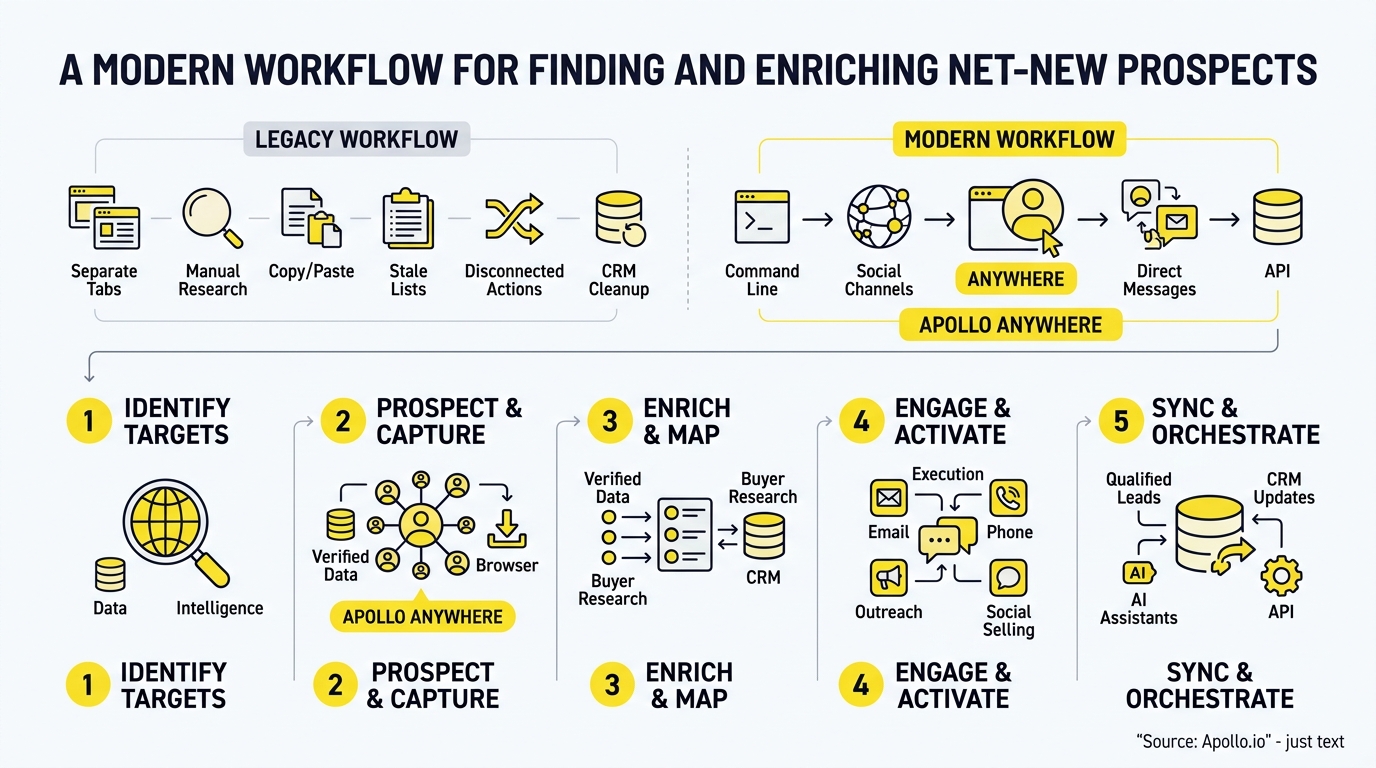
You run this workflow by connecting Apollo to your AI tool through its connectors or integrations menu, then asking in plain language for companies matching your ICP that aren't already in your CRM.
Setup is no-code: authenticate via OAuth inside ChatGPT, Claude, Perplexity, or Codex, and the connection respects your existing Apollo plan and data limits. From one conversation, you can search for companies and people matching an ICP, enrich contacts with verified emails and phone numbers, check them against CRM context, create or update records, and add qualified prospects to a sequence.
For developer and RevOps teams building custom workflows, the same functionality is available through the Apollo CLI for terminal-native access, or through the Apollo API for programmatic enrichment at scale. Apollo MCP is what makes the conversational version possible: it brings Apollo's data and actions directly into the AI tools your team already has open, so a rep asking "find companies like my top 10 accounts that aren't in Salesforce yet" gets a matched, enriched, CRM-safe list back in the same window.
Your best prospecting session shouldn't require opening a new tab. That's especially relevant now that Gartner predicts AI agents will outnumber sellers 10-to-1 by 2028, yet fewer than 40% of sellers expect productivity gains. More agents connected to messy CRM data just means more duplicates, faster, unless the matching logic underneath is solid.
What Does A 30/60/90-Day Rollout Look Like?
A 30/60/90-day rollout starts with matching logic and a pilot segment in the first month, expands to automated syncing in the second, and moves to full-scale, human-reviewed writeback by day 90.
- Days 1-30: Define matching thresholds, build the field schema, pilot on one territory or industry vertical. RevOps owns rule-building; sales reviews the first batch of flagged matches.
- Days 31-60: Automate enrichment on approved net-new records, connect CRM sync, expand to two or three more territories. Track duplicate rate weekly.
- Days 61-90: Scale to full pipeline coverage, add recurring refresh cadence, formalize human-review ownership for borderline matches (60-84% confidence).
Throughout, keep a human in the loop on anything below your auto-suppress threshold. That single control point is what keeps AI-assisted prospecting from becoming AI-assisted duplicate creation.
How Does Apollo Help Teams Consolidate This Into One Workflow?
Apollo consolidates net-new discovery, CRM matching, and enrichment into one workspace, so teams don't run separate tools for search, dedup logic, and data enrichment and then stitch the results together manually.
Collin Stewart at Predictable Revenue put it plainly: "We reduced the complexity of three tools into one." That's the practical payoff of unifying search, contact enrichment, and sequencing instead of bouncing prospect data between a data vendor, a dedup tool, and an outreach platform.
Apollo's data enrichment runs on a waterfall model by default, pulling from multiple sources to fill gaps rather than relying on one static database. Paired with native CRM integration for HubSpot and Salesforce, matched and enriched records sync back without a manual export-import cycle. For RevOps leaders managing CRM integration strategy, that's one less system to maintain and one less place for duplicates to creep back in.
Frequently Asked Questions
How Do You Handle Subsidiaries Of Existing Customers?
Flag subsidiaries as expansion opportunities, not net-new accounts, and route them to the existing account owner rather than adding them as a fresh lead. Matching on parent-company domain relationships or shared ownership records catches most of these before they create internal channel conflict.
What Happens If A Company Renamed Or Rebranded?
Update the existing CRM record instead of creating a new one, using domain history or firmographic data to confirm the entity is the same company under a new name. Merging prevents split activity history and duplicate outreach to the same buying committee.
Is It Safe To Auto-Sync Enriched Records Back Into My CRM?
Auto-sync is safe for high-confidence matches (typically above 85-90%) but risky for anything in the fuzzy-match range, where human review should approve the record before it writes back. Build the review step into your workflow rather than trusting confidence scores alone.
How Does Privacy Law Affect Net-New Enrichment?
Enrichment workflows need to track consent status, suppression-list checks, and source provenance for every record, since state privacy requirements increasingly expect data minimization and clear opt-out handling. Building consent and source fields into your schema from the start, as outlined above, makes this auditable instead of reactive.

Ready To Build A Living Net-New Prospecting System?
Static lists go stale the moment you pull them. A matching-first, continuously enriched approach keeps your pipeline full of genuinely new opportunities instead of recycled duplicates, and keeps your reps focused on selling instead of manually cross-checking CRM records.
Apollo brings B2B data, matching logic, and enrichment together in one workspace, whether you're working inside Apollo directly or calling it from ChatGPT, Claude, or Perplexity through Apollo MCP. To see why Apollo stands alone as the only fully agentic GTM platform, combining sales intelligence, outbound execution, and enrichment in one workspace, Request a Demo today.
Prove ROI Fast With Apollo's Full Platform
Struggling to justify tool spend when leadership wants numbers yesterday? Apollo replaces the guesswork with one platform that shows pipeline impact from week one. Leadium 3x'd annual revenue after consolidating with Apollo.
Start Free with Apollo →Don't miss these
Sales
Inbound vs Outbound Marketing: Which Strategy Wins?
Sales
What Is a Sales Funnel? The Non-Linear Revenue Framework for 2026
Sales
What Is a Go-to-Market Strategy? The 2026 GTM Playbook
See Apollo in action
We'd love to show how Apollo can help you sell better.
By submitting this form, you will receive information, tips, and promotions from Apollo. To learn more, see our Privacy Statement.
4.7/5 based on 9,690 reviews
