
How to Find Verified Lead Contact Information Fast
Finding a lead's email or phone number is easy. Finding one that's accurate, reachable, and safe to contact at scale is the actual job. Contact data decays fast: Unify GTM reports that email addresses decay at roughly 2.1% per month, with phone numbers eroding at close to 18% per year, so last quarter's clean list is already going stale.
This guide gives you a five-step system for finding, scoring, verifying, and refreshing lead contact information, not just a bigger list. You'll get a field-level scorecard, a vendor-testing protocol, and a compliance checklist you can put to work today. For the discovery side of this workflow, see our guide to outbound prospecting.

Apollo Ends Manual Lead Research
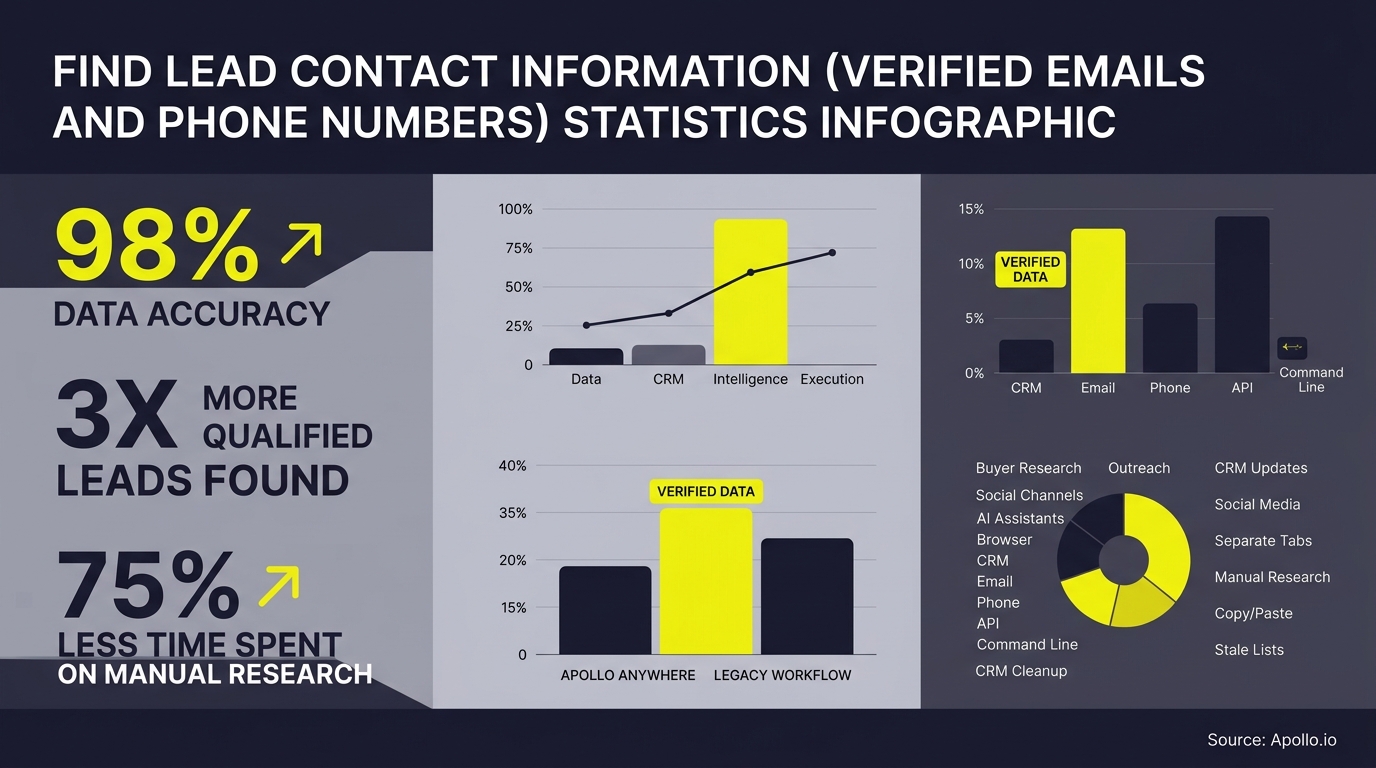
Spending hours a day verifying emails and phone numbers before you can even start selling? Apollo delivers 240M+ contacts at 98% email accuracy, so reps prospect instead of playing detective. Skip the busywork and get straight to selling.
Start Free with Apollo →Key Takeaways
- Treat contact data as a system with five stages: discover, score, verify, personalize, and re-verify, not a one-time list pull.
- Email and phone data decay at different rates and need separate accuracy checks with timestamps, not one blended "accuracy" score.
- Verified doesn't mean deliverable. Authentication, spam-rate limits, and sender reputation now determine whether a "verified" email reaches the inbox.
- Waterfall enrichment, querying multiple sources in sequence, closes more coverage gaps than relying on a single database.
- Compliance checks (opt-outs, data provenance, state-level deletion rules) are becoming as important as accuracy for contact-data buyers.
What Is a Five-Step Workflow for Finding Verified Lead Contact Information?
The five-step workflow is discover, score, verify, personalize, and re-verify, run as a continuous loop instead of a single export.
- Discover: Pull candidate contacts using firmographic and role-based filters (title, seniority, department, company size).
- Score: Rate each record against a contact-quality scorecard before it enters a sequence.
- Verify: Run email and phone checks against the verification tables below.
- Personalize: Match messaging to role and signal, since generic outreach gets ignored.
- Re-verify: Re-check records on a schedule tied to how fast that field type decays.
For Account Executives managing a full pipeline, this loop matters most right before a sequence launches. A contact that was accurate 90 days ago may already have a new employer.
What Should a Contact-Quality Scorecard Include?
A contact-quality scorecard should score each contact record field-by-field, not with a single blended accuracy percentage.
| Field | What to Check | Risk Signal | Re-Check Interval |
|---|---|---|---|
| Syntax, MX record, mailbox ping, catch-all status | Catch-all domain, role-based inbox (info@, sales@) | 30-45 days | |
| Employer | Current company match vs. last enrichment date | Job-change signal, funding/layoff news | 60-90 days |
| Title | Matches current corporate-style profile or press mention | Promotion or department change | 60-90 days |
| Phone (mobile) | Line type, carrier lookup, ownership match | Reassigned number, disconnected line | 45-60 days |
| Phone (direct dial) | Extension validity, company switchboard match | Number ported after department restructure | 60-90 days |
Nearly a quarter of CRM administrators say less than half their CRM data is accurate and complete, and 61% report incorrect data as a recurring issue, according to Validity's 2024 survey. A scorecard like this catches degradation before it reaches an SDR's sequence.
How Do You Verify an Email Address Before Sending?
You verify an email by checking syntax, domain health, and mailbox-level deliverability, not just whether the address "looks" valid.
| Verification Signal | What It Confirms | Action If Failed |
|---|---|---|
| MX record check | Domain accepts mail | Discard or flag for manual review |
| SMTP ping | Mailbox exists and accepts mail | Route to secondary source in waterfall |
| Catch-all detection | Domain accepts all addresses (can't confirm real inbox) | Lower confidence score, verify via phone instead |
| Role-based flag | Address is a shared inbox, not a person | Deprioritize for 1:1 outreach |
A verified address still has to land in the inbox. Gmail treats senders reaching about 5,000 personal Gmail accounts daily as bulk senders and recommends spam rates stay under 0.1%, per Google's sender guidelines. Deliverability by provider varies too: MailReach found Gmail inbox placement at 87.2%, while Microsoft inboxes placed cold outreach at a lower 75.6%. Verified and deliverable are two different checks.
Struggling to separate real inboxes from catch-alls at scale? Verify contacts automatically with Apollo's enrichment tools before they ever reach a sequence.
How Do You Verify a Phone Number and Assess Ownership Risk?
You verify a phone number by checking line type, carrier data, and reassignment risk, since numbers get recycled far more often than emails get deleted.
| Signal | What It Tells You | Recommended Action |
|---|---|---|
| Line type (mobile vs. landline) | Whether direct dial or switchboard routing applies | Mobile: prioritize for call sequences |
| Carrier/porting status | Number recently transferred to new owner | Suppress until re-verified |
| Reassignment risk | High risk if contact left company recently | Cross-check against employer field before dialing |
| Suppression list match | Number opted out or flagged do-not-call | Remove from all dialing queues immediately |
Derrick App's 2026 benchmark found phone-data accuracy ranges from 63% to 91% depending on provider, which is why single-source phone data creates real risk. The average B2B phone connect rate sits at just 9.9%, according to Belkins, so every reassigned or dead number directly cuts into an SDR's daily connect volume.
See Deal Stage Reality With Apollo
Forecasting off gut feel because your pipeline data is always a week behind? Apollo surfaces real-time buying signals so you know which deals are actually moving before they stall. Stop guessing and start closing on accurate timing.
Start Free with Apollo →How Should SDRs and RevOps Test a Contact-Data Vendor?
SDRs and RevOps teams should test a vendor with a sample-based protocol before committing to a contract, not just trust a published accuracy claim.
- Pull a random sample of 200-400 contacts across target segments (not just easy-to-find execs).
- Manually confirm a subset against corporate-style profiles, company websites, and direct outreach replies.
- Track separately: email bounce rate, phone connect rate, and employer/title match rate. Don't blend them into one score.
- Test waterfall coverage: how many records get filled after the primary source misses.
- Re-test in 60 days to see how fast that vendor's data decays for your specific ICP.
This is also where waterfall enrichment earns its keep: instead of one static database, the system queries multiple providers in sequence until it finds a working match. RevOps leaders find this approach recovers coverage a single vendor misses, especially for direct dials and mobile numbers. Explore how this fits into a broader data-driven prospecting strategy.

What Belongs on a Compliance Checklist for Contact Data?
A compliance checklist for contact data should cover consent basis, suppression handling, provenance, and deletion-request response time.
- Confirm data source and collection method are documented for every contact record.
- Maintain a suppression list synced across CRM, enrichment vendor, and sequencer, updated in real time.
- Track opt-outs and honor them across every connected tool, not just the outbound platform.
- Understand CAN-SPAM applies to B2B email; the FTC allows penalties per violating message.
- Watch state-level deletion frameworks (like California's data-broker deletion platform) that use email and phone as matching identifiers for removal requests.
Founders building outbound from scratch often underweight this step, but a messy compliance posture creates real legal exposure once volume scales past a few hundred contacts a month.
How Are AI Agents Changing Contact Discovery?
AI agents are increasingly acting on contact data automatically, which raises the stakes for accuracy since bad records now get acted on at machine speed. Salesforce's Hunter agent, launched with Apollo as a flagship data partner in September 2026, gives autonomous agents direct access to verified emails, mobile numbers, and buying signals for prospecting inside CRM workflows.
That shift means a stale phone number or reassigned email doesn't just waste one rep's time anymore, it can trigger an automated sequence to the wrong person entirely.
Tired of manually re-checking contacts before every campaign? Search Apollo's 240M+ contact database with 65+ filters and build lists that are current from the start.
How Does Apollo Help Teams Find and Verify Lead Contact Information?
Apollo combines a 240M+ person database, waterfall enrichment, and built-in verification in one workspace, so teams don't stitch together a separate finder tool, verifier, and sequencer. Collin Stewart of Predictable Revenue put it simply: "We reduced the complexity of three tools into one."
Apollo's database includes 98% email accuracy, and the platform's sales intelligence and lead database lets RevOps teams run discovery, scoring, and re-verification from a single source of truth instead of three disconnected subscriptions. For teams researching contacts on the web, the Chrome Extension pulls verified emails and phone numbers directly from any page you're browsing.
What Are Some FAQs on Finding Verified Contact Information?
What Is a Catch-All Email Domain?
A catch-all domain accepts mail sent to any address at that domain, even ones that don't belong to a real person, which makes it impossible to confirm a specific inbox exists through a standard SMTP ping. Teams should treat catch-all matches as lower-confidence and verify through a secondary channel like phone before sending.
How Do I Know If a Phone Number Still Belongs to My Contact?
Cross-check the number's porting and reassignment status against the contact's current employer record. If the employer field shows a recent job change but the phone number hasn't been re-verified, treat it as high risk until confirmed.
How Often Should Contact Data Be Refreshed?
Email addresses should be re-checked roughly every 30-45 days and phone numbers every 45-60 days, based on the decay rates cited above from Unify GTM and Derrick App. High-turnover industries or recently funded/acquired companies warrant more frequent re-checks.
Is It Legal to Cold Email or Cold Call B2B Contacts?
Cold email to business contacts is permitted under CAN-SPAM as long as senders include accurate headers, a working opt-out mechanism, and honor unsubscribes promptly. For calling, users control who they call and how they use the results; always check state and federal do-not-call rules before dialing.

Conclusion: Build a System, Not Just a List
A bigger contact list doesn't fix a broken process. The teams getting reliable email and phone data in 2026 are the ones running discovery, scoring, verification, and re-checks as one connected loop, not a one-time export from a single vendor.
Apollo brings that loop into one workspace: a 240M+ contact database, waterfall enrichment, built-in verification, and multi-channel sequencing, so SDRs, AEs, and RevOps teams stop juggling separate tools for finding, checking, and reaching prospects. Start free to see how Apollo's lead search by title, industry, or company fits into your existing workflow.
Prove Pipeline ROI Fast With Apollo
Can't justify the spend when leadership wants hard numbers by next quarter? Apollo consolidates your outreach into one platform so reps book more meetings without adding headcount. Leadium 3x'd revenue after automating outbound with Apollo.
Start Free with Apollo →Don't miss these
Sales
Inbound vs Outbound Marketing: Which Strategy Wins?
Sales
What Is a Sales Funnel? The Non-Linear Revenue Framework for 2026
Sales
What Is a Go-to-Market Strategy? The 2026 GTM Playbook
See Apollo in action
We'd love to show how Apollo can help you sell better.
By submitting this form, you will receive information, tips, and promotions from Apollo. To learn more, see our Privacy Statement.
4.7/5 based on 9,690 reviews
