
How to Find B2B Wholesale and Retail Contacts in the Supplements Industry
The global dietary supplement market is valued at $209.5 billion in 2025, growing at a projected 9.5% CAGR through 2033, according to Grand View Research. That growth means more wholesale distributors, retail buyers, and international importers actively looking for new supplement brands to carry. The problem isn't demand. It's finding the right verified contacts fast enough to capture it.
Most supplement brands waste weeks chasing generic NAICS-code lists that mix vitamin wholesalers with pharmaceutical and cosmetics distributors. This guide gives you a repeatable workflow for building a qualified B2B contact list across U.S. wholesale, U.S. retail, and international markets, plus the exact fields and buyer roles you need to prioritize outreach.

Ditch Manual Research, Apollo Verifies Contacts
Still spending hours chasing wrong emails and dead phone numbers for distributors and buyers? Apollo verifies contact data instantly, so your team spends time selling, not searching. 98% email accuracy means fewer bounces, more real conversations.
Start Free with Apollo →Key Takeaways
- The U.S. supplement wholesale and retail universe starts around 17,000 establishments, but most records need manual qualification to separate true supplement buyers from adjacent categories.
- 69% of independent supplement retailers have fewer than five employees, so owner-led outreach beats corporate procurement targeting for that segment.
- Retail contact strategy now needs mass retail, pharmacy, marketplace, and social-commerce buyers, not just specialty health stores.
- International expansion works best when you rank countries by demand, e-commerce access, and regulatory readiness before building contact lists.
- Quarterly contact refreshes matter because M&A activity and retail rollouts change decision-makers fast.
What Is A B2B Supplement Contact List?
A B2B supplement contact list is a qualified database of buyers, distributors, and retail decision-makers who purchase or place dietary supplements for resale. It differs from a general business contact list because it requires industry-specific qualification: job title, company channel (wholesale, mass retail, specialty, marketplace), product category fit, and often compliance credentials for international deals.
A raw NAICS pull is not a supplement contact list. It's a starting point. The U.S. Census Bureau identifies 8,267 food-supplement retail establishments and 8,919 drug-and-sundries wholesale establishments that include vitamin distributors, but that wholesale code also captures pharmaceutical and cosmetics companies. You still need to filter for actual supplement buyers before you can call it a usable list.
How Do You Build A U.S. Wholesale And Retail Contact Stack?
You build a U.S. supplement contact stack by combining trade show attendee data, distributor directories, retail buyer databases, and a B2B contact platform to enrich and verify each record. Follow this sequence:
- Pull the broad universe. Start with NAICS-coded wholesale and retail establishment lists, then flag records tagged with supplement, vitamin, or nutraceutical keywords.
- Add trade show attendee lists. Events like SupplySide West drew more than 19,000 registered attendees and 1,500+ exhibitors from 80+ countries in 2024, according to Informa Markets. Attendee rosters are a strong signal source because attendees are actively sourcing or selling supplements.
- Layer in owner and buyer titles. Since most independent stores are small, target owner, founder, and store manager titles, not just "buyer" or "procurement."
- Enrich and verify every record. Cross-check emails, phone numbers, and company firmographics before outreach.
Struggling to find qualified leads across fragmented supplement categories? Search Apollo's 240M+ contacts with 65+ filters to isolate supplement wholesalers and retail buyers by title, company size, and industry tag in one pass.
What Contact Schema Fields Do You Need To Qualify A Record?
A qualified supplement contact record needs more than name and email. Use this minimum schema for every prospect:
| Field | Why It Matters |
|---|---|
| Company channel | Wholesale, mass retail, specialty, marketplace, or DTC partnership |
| Employee count | Signals whether to target owner-level or department-level buyers |
| Product category fit | Matches your SKUs to their existing assortment (e.g., probiotics, sports nutrition, healthy aging) |
| Buyer role | Owner, category manager, procurement, regulatory/compliance reviewer |
| Certification status | NSF, GMP, or third-party testing credentials on file |
| Last verified date | Flags records due for quarterly refresh |
Which Buyer Personas Matter Most By Retail Channel?
Buyer personas differ significantly across mass retail, specialty stores, marketplaces, and social commerce, so your outreach targeting needs to match each channel's actual decision-maker. Nutraceuticals World reports mass market retail holds a 27% share of the U.S. supplement market, making it too large to ignore even for brands that started in specialty channels.
| Channel | Primary Buyer Title | Secondary Contact |
|---|---|---|
| Mass retail (Walmart, grocery, pharmacy) | Category Manager | Regional Distributor Rep |
| Independent health stores | Owner / Founder | Store Manager |
| Marketplaces (Amazon, iHerb) | Marketplace Partnerships Manager | Vendor Relations Lead |
| Social commerce (TikTok Shop) | Social-Commerce Manager | Creator-Commerce Agency Contact |
| Wholesale distribution | Wholesale Buyer | Supply Chain Manager |
Life Extension's June 2026 rollout into more than 4,000 Walmart stores, reported by GlobeNewswire, shows how mass-retail placements now depend on category managers and regional distributor relationships, not just specialty buyers. Meanwhile, TikTok Shop generated $784 million in vitamin and supplement sales during the 52 weeks ending February 2026, per NutraIngredients, making social-commerce managers a newly essential contact type.

How Do SDRs And AEs Prioritize Supplement Prospects?
SDRs and AEs prioritize supplement prospects by scoring accounts on channel fit, company size, and buying signal strength rather than contacting every record equally. For SDRs working a fragmented list of 8,267 U.S. retail establishments where 69% have fewer than five employees, that means leading with owner-level outreach and shorter sales cycles instead of enterprise procurement processes.
Account Executives managing larger wholesale deals should instead prioritize accounts showing expansion signals, like new store openings, marketplace launches, or M&A activity. Recent consolidation, including Celsius' acquisition of Alani Nu and FitLife Brands' purchase of Irwin Naturals, changes approved distributor lists and retail budgets fast, so AEs need contact data that reflects current ownership, not last year's org chart.
Spending hours manually researching which accounts just changed hands? Apollo's data enrichment keeps firmographic and contact records current so reps aren't pitching outdated decision-makers.
Know Which Leads Are Actually Sales-Ready
Marketing leads pile up but never convert to real opportunities? Apollo scores and prioritizes prospects by buying signals, so reps chase deals that close instead of guessing. Built-In saw higher win rates using Apollo's scoring.
Start Free with Apollo →How Do You Score International Supplement Markets?
You score international supplement markets by weighing demand size, e-commerce penetration, distributor infrastructure, and regulatory friction before building any contact list. Not every market deserves the same outreach investment.
| Market | Demand Signal | E-Commerce Access | Key Consideration |
|---|---|---|---|
| China | 19.7% of global supplement market; healthy/functional food sales at $49.6B in 2024 | High; growing 3.6% annually toward $51.4B in 2025 | E-commerce entry often has lighter customs and labeling requirements than in-store, per Trade.gov |
| South Korea | $4.7B market; 37,000+ registered products by mid-2024 | 68% of purchases via e-commerce | High product registration volume signals a mature, competitive retail landscape |
| Brazil | $4.6B sports-nutrition market; ~10% projected annual growth through 2030 | Growing specialty e-commerce | 34,000+ fitness centers create a dense gym and sports-retailer contact pool, per Trade.gov |
| EU (general) | Established mature market | High, but scrutinized | A 2025 customs operation found a 63% noncompliance rate among online supplement imports, per the European Commission |
The EU compliance finding matters for contact strategy: prioritize importers and distributors with documented regulatory capability over generic reseller contacts. GNC's January 2025 re-entry into Singapore through a store-within-a-store at Watsons shows another proven path: partner with an established regional retail chain instead of cold-outreaching every distributor in a new country.
What Red Flags Should You Check Before Contacting An International Distributor?
Before you contact an international distributor, verify they have documented import licensing, product registration history, and no recent regulatory violations on file. Ask these questions during vetting:
- Can they provide evidence of prior successful supplement imports in this market?
- Do they have in-house or contracted regulatory/compliance staff?
- What is their process for label and claims review before listing a new product?
- Can they name other brands they currently distribute in-country?
How Often Should You Refresh Your Supplement Contact List?
You should refresh your supplement contact list quarterly, since M&A activity, retail rollouts, and regulatory actions change decision-makers faster than most CRMs get updated. Use this checklist each quarter:
- Re-verify emails and phone numbers for bounce and disconnect rates
- Check for company acquisitions, mergers, or leadership changes
- Confirm certification status (NSF, GMP) hasn't lapsed
- Scan for recent recalls or FTC/FDA claims actions tied to the account
- Update product category tags if the retailer expanded or dropped assortments
RevOps leaders managing this at scale should build the refresh cadence into their B2B email list building process rather than treating it as a one-time project. Teams juggling multiple point tools for enrichment, verification, and outreach often find consolidation cuts both cost and maintenance work. As Collin Stewart of Predictable Revenue put it, "We reduced the complexity of three tools into one."
Frequently Asked Questions
How Do You Find Wholesale Supplement Buyers?
You find wholesale supplement buyers by combining NAICS-coded distributor lists with trade show attendee data and a B2B contact database, then filtering for supplement-specific product tags and buyer titles like Wholesale Buyer or Supply Chain Manager. Cross-verify each record before outreach since broad wholesale codes also include pharmaceutical and cosmetics companies.
How Do You Validate A Supplement Distributor Before Partnering?
You validate a supplement distributor by checking their import licensing, prior distribution track record, certification status, and compliance history in the target market. This matters most for international deals, where a 2025 EU customs review found a 63% noncompliance rate among online supplement imports.
What Job Titles Should You Target For Independent Health Stores?
You should target Owner, Founder, or Store Manager titles for independent health stores, since Census data shows 69% of U.S. supplement retail establishments have fewer than five employees and rarely have dedicated procurement staff.
Is A Dietary Supplement Retailer List Different From A Wholesale Distributor List?
Yes. A dietary supplement retailer list targets store-level buyers (owners, category managers) who stock and sell products to consumers, while a wholesale distributor list targets companies that buy in bulk to resell to retailers.
Most complete B2B outreach strategies need both, segmented by channel.
How Do You Prospect For International Supplement Buyers Without Cold-Emailing Every Distributor?
You prospect internationally by scoring countries first on demand, e-commerce access, and regulatory readiness, then prioritizing partnership routes like established regional retail chains over blanket cold outreach. GNC's 2025 Watsons partnership in Singapore illustrates this approach.

Build Your Supplement Contact List With A Unified Workflow
Finding qualified B2B wholesale and retail contacts in the supplements industry takes more than a generic list purchase. It requires channel-specific persona targeting, quarterly data refreshes, and international market scoring based on real demand and compliance signals.
Brands that treat contact data as a one-time download instead of an ongoing process fall behind as the market shifts, especially with $209.5 billion in global supplement demand and rapid channel changes across mass retail, marketplaces, and social commerce.
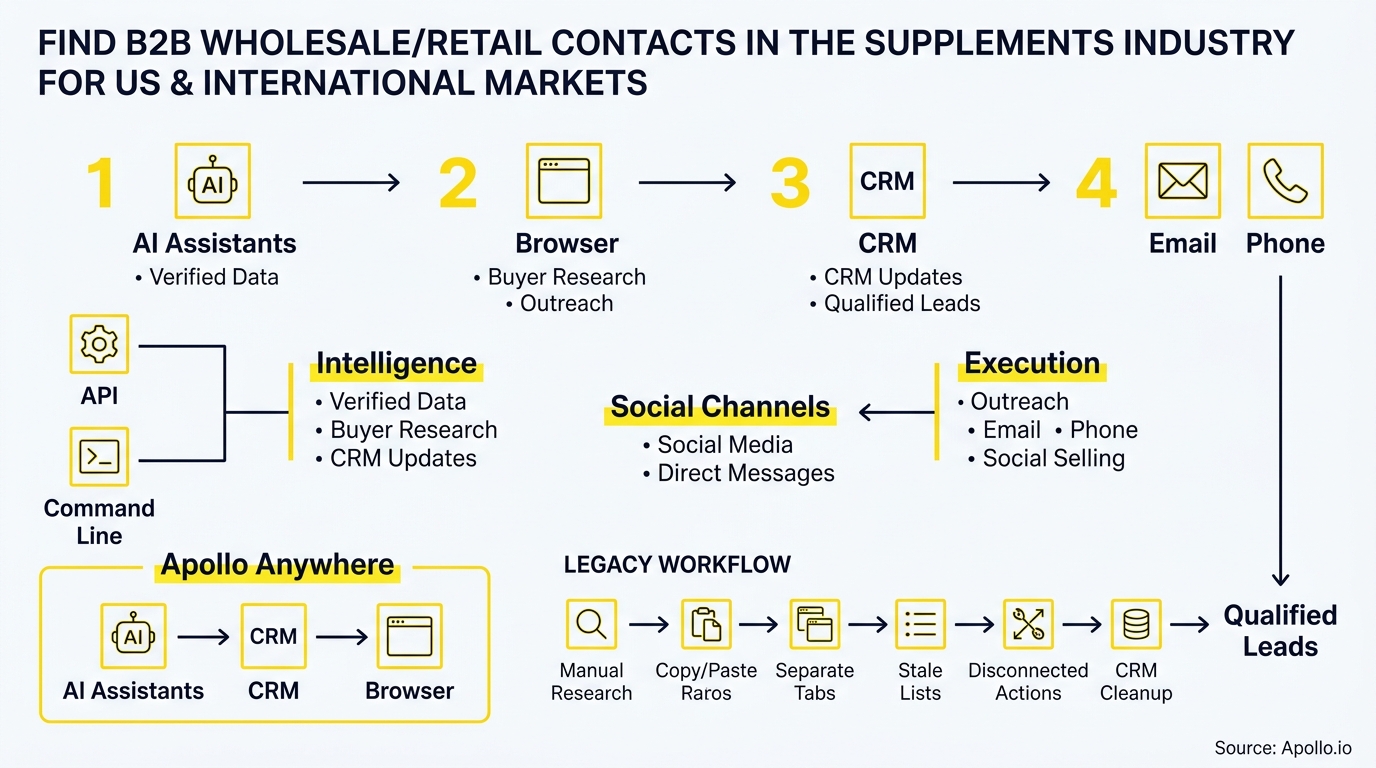
Apollo brings B2B data, sales engagement, and AI-powered exec ution together in one workspace, so supplement brands don't have to stitch together separate vendors for research, outreach, and analysis. Instead of exporting a static list from one tool and manually loading it into a separate outreach platform, sales teams can research retail and wholesale buyers, build segmented lists with 65+ firmographic and contact filters, and launch multi-channel sequences without leaving the platform.
Struggling to keep your supplement contact list accurate across U.S. and international markets? Apollo's enrichment tools help RevOps teams keep buyer records current instead of relying on quarterly manual re-uploads.
Whether you're an SDR booking meetings with independent health store owners, an AE building a pipeline of regional wholesale distributors, or a founder expanding into new international markets, a unified data-and-engagement platform removes the friction of switching between disconnected tools. Apollo serves B2B GTM teams, GTM Engineers, and AI Builders building headless GTM workflows with the Apollo API, CLI, and MCP, alongside Sales Professionals, SDRs/BDRs, AEs, RevOps, Marketing, and Revenue Leaders who need reliable contact data paired with execution tools.
Ready to build your supplement industry contact list and launch outreach in one place? Request a Demo and see how Apollo helps supplement brands find, qualify, and engage wholesale and retail buyers across U.S. and international markets.
Prove ROI Fast, Scale Outreach With Apollo
Struggling to justify tool spend before results show up? Apollo's automation lets reps send more personalized outreach without adding headcount, so pipeline impact shows up in weeks, not quarters. Built-In saw higher win rates and ACV within one quarter.
Start Free with Apollo →Don't miss these
Sales
Inbound vs Outbound Marketing: Which Strategy Wins?
Sales
What Is a Sales Funnel? The Non-Linear Revenue Framework for 2026
Sales
What Is a Go-to-Market Strategy? The 2026 GTM Playbook
See Apollo in action
We'd love to show how Apollo can help you sell better.
By submitting this form, you will receive information, tips, and promotions from Apollo. To learn more, see our Privacy Statement.
4.7/5 based on 9,690 reviews
