
How to Find and Reach Trade Show Exhibitors and Attendees
Roughly 40% of trade show leads are already in motion before the doors open, according to a B2B marketing discussion on Reddit noting that most attendees plan their schedules weeks in advance. If you're still waiting to scan badges on the show floor, you're prospecting after the window has already closed. This guide shows you how to find and reach exhibitors and attendees the right way: using public data, permission-based signals, and outbound prospecting best practices, not purchased attendee lists that put your domain reputation at risk.

Skip The Research, Apollo Finds Contacts Fast
Spending hours manually researching leads and verifying contact info before every trade show. Apollo surfaces verified business contacts instantly with 98% email accuracy. Build your prospect list in minutes, not days.
Start Free with Apollo →Key Takeaways
- Exhibitor directories are public and safe to mine; attendee lists sold by third-party "registration" vendors are frequently scams or violate the event's terms of service.
- Use Apollo MCP when you need to pull a target company's likely buying committee (titles, seniority, department) directly inside ChatGPT, Claude, or Perplexity without opening a separate prospecting tool.
- Score exhibitors and inferred attendees by ICP fit and event intent before you reach out, since 73% of B2B buyers avoid vendors who send irrelevant outreach.
- Pre-show outreach beats onsite hustle: start booking meetings 30 days out instead of waiting for the show floor.
- Use Apollo MCP or the Apollo Chrome extension to enrich exhibitor lists with verified emails and phone numbers in minutes, then load them straight into a sequence.
What Is the Difference Between Exhibitor Data and Attendee Data?
Exhibitor data is public information that any show publishes to promote its floor plan; attendee data is typically protected and owned by the event organizer. Exhibitor directories, booth numbers, and company descriptions live on the show's public website specifically so buyers can plan their visit.
Attendee lists, by contrast, are collected during registration and are rarely shared outside the organizer's own marketing or matchmaking platform.
This distinction matters because it determines what you can ethically and legally use. Treat exhibitor directories as a green light for research.
Treat attendee rosters as something you can only access through approved channels, like the event's official app, sponsorship package, or opt-in matchmaking tool.
What Is a Source-Permission-Confidence Matrix?
A source-permission-confidence matrix ranks each data source by how much legal certainty and data quality it offers. Use it to decide where to spend research time first.
| Source | Permission Level | Confidence | Best Use |
|---|---|---|---|
| Exhibitor directory (event website) | Public | High | Build target account list |
| Event app / official matchmaking tool | Opt-in by attendee | High | Book meetings pre-show |
| Sponsor/organizer data package | Contractual | Medium-High | Add scanned leads post-show |
| Social platform search (job title + company) | Public profile | Medium | Infer likely attendees |
| Purchased "attendee list" from third-party broker | Unverified/risky | Low | Avoid |
How Do You Find Exhibitors for an Upcoming Trade Show?
You find exhibitors by pulling the show's public exhibitor directory, then enriching each company with firmographic and contact data. Most trade show websites publish a searchable exhibitor list months before the event, often filterable by category, booth number, or product type.
Once you have the raw list of company names, the real work starts: turning a spreadsheet of logos into a scored account list. This is where sales prospecting tools save hours of manual lookup. Search Apollo's database with 65+ filters to match exhibitor companies against your ideal customer profile by industry, headcount, and technology stack, then instantly surface the right stakeholders at each one. Struggling to find qualified leads fast? Search Apollo's 240M+ contacts with 65+ filters to build your exhibitor target list in an afternoon instead of a week.
How Do You Find Attendees Without Buying a List?
You find likely attendees by inferring them from public signals instead of purchasing a roster. Search social platforms for job titles at companies in the show's target industry who mention the event, its hashtag, or the host city in their recent activity.
Company career pages, press releases about the show, and speaker or panel rosters (which are almost always public) are strong signals too. If the event offers an opt-in matchmaking app, prioritize signing up early since event engagement data shows the majority of meeting requests get sent before the show floor even opens.
Never buy a list marketed as "verified attendee emails" from a third party unaffiliated with the organizer. These lists are commonly scraped, outdated, or outright fabricated, and using them risks your sender reputation and violates most events' terms of service.
How Do You Score Exhibitors and Attendees for ICP Fit?
You score them by weighting four factors: company fit, role relevance, event intent, and buying-group coverage. This turns a flat list into a prioritized outreach queue.
| Factor | What to Check | Weight |
|---|---|---|
| ICP Fit | Industry, headcount, tech stack match your ideal customer | High |
| Role Relevance | Title matches your buyer persona (technical, financial, procurement) | High |
| Event Intent | Sponsoring, speaking, or exhibiting signals active budget | Medium |
| Buying-Group Coverage | You've identified 2+ stakeholders at the account | Medium |
For Account Executives managing a full pipeline, this scoring step prevents wasted meeting slots on low-fit companies. RevOps leaders find that a shared scoring model also keeps SDRs and AEs aligned on which accounts deserve a pre-show call versus a booth drop-in.

Who Are the Right Stakeholders to Contact at Each Company?
The right stakeholders are the people who influence or approve the purchase, typically spanning technical, financial, operational, procurement, and executive roles. Mapping this buying group before the show means you're not stuck talking to a single junior contact who can't move a deal forward.
- Technical: Evaluates product fit (engineers, IT managers)
- Financial: Controls budget (finance directors, controllers)
- Operational: Owns day-to-day use (ops managers, team leads)
- Procurement: Manages vendor contracts and terms
- Executive: Final sign-off (VP, C-suite)
SDRs booking meetings should aim for at least two contacts per target account. This mirrors buyer lead best practices: single-threaded deals stall more often than multi-threaded ones.
Turn Marketing Leads Into Real Pipeline
Filling the top of funnel with leads that never become opportunities. Apollo's intent signals and scoring flag prospects who are actually ready to buy, so reps chase deals instead of dead ends. Built-In saw a 10% lift in win rate using Apollo's and guidance.
Start Free with Apollo →How Can SDRs Book Meetings Before the Show Starts?
SDRs book pre-show meetings by running a 30-day outbound cadence across email and phone that references the event by name. Waiting until the show floor is too late, since calendars fill up in the two weeks before an event.
| Timeline | Action |
|---|---|
| Day 30-21 | Pull exhibitor list, enrich contacts, score accounts |
| Day 20-14 | Launch email + call sequence referencing the event |
| Day 13-7 | Follow up with booth number or session invite |
| Day 6-1 | Confirm meeting times and locations |
| Post-show | Log notes, enrich new contacts, route to CRM |
A sample message: "Saw [Company] is exhibiting at [Show] next month at booth #[X]. We work with [industry] teams on [pain point] — worth grabbing 15 minutes onsite or beforehand?" Since Porch Group Media reports 77% of B2B buyers prefer being contacted via email over any other channel, lead with email and use calls as a follow-up touch. See more timing guidance in best time to email and call prospects.
Spending hours on manual sequence building? Automate your pre-show outreach with Apollo's multi-channel sequences so calls, emails, and follow-ups run on autopilot while you focus on booked meetings.
How Do You Run This Research Inside ChatGPT or Claude?
You run this entire workflow inside your existing AI tool by connecting Apollo MCP, which brings Apollo's data and actions directly into ChatGPT, Claude, Perplexity, and Codex. Setup is no-code: connect Apollo through the AI tool's connectors menu via OAuth, on any Apollo plan including free.
Once connected, you can ask your AI tool to find companies exhibiting at a named show, pull the likely buying committee by title, enrich contacts with verified emails and phone numbers, and add qualified prospects straight into a sequence, all from one conversation. Your best prospecting session shouldn't require opening a new tab for every step of exhibitor research.
How Do You Avoid Trade Show List Scams?
You avoid scams by verifying the seller is the event's official organizer, never a third party claiming to have "leaked" or "exclusive" attendee data. Common red flags include unsolicited emails offering an attendee list for a show you haven't registered for, prices that seem too low for the claimed data volume, and vendors who won't disclose how they collected the contacts.
- Confirm the list source is the event organizer or an official sponsor package
- Check if the "attendee list" is really just the exhibitor directory in disguise
- Verify emails before sending, since purchased lists degrade quickly
- Watch for pressure tactics ("only available until the show starts")
Legitimate exhibitor and attendee outreach is a growing market. Kande Photo Booths notes the B2B exhibition industry has surpassed pre-pandemic levels in value, with revenue and attendance projected to climb through 2026, meaning more shows and more exhibitor directories to work from every quarter.
How Do You Measure ROI From Trade Show Outreach?
You measure ROI by tracking researched accounts through booked meetings, opportunities, and closed revenue, not just leads collected. SaleHive reports that 72% of marketers say prospects close faster after attending an event, so tie your show activity to sales cycle length, not just pipeline volume.
| Metric | What It Tells You |
|---|---|
| Accounts researched pre-show | Coverage of the target list |
| Meetings booked pre-show | Outreach effectiveness |
| Onsite meetings held | Show-day execution |
| Opportunities created within 30 days | Pipeline conversion |
| Closed revenue within 90 days | True ROI |
Revenue leaders need this full-funnel view to justify the next show's budget. Track every trade show deal from first touch to close in Apollo's deal management instead of piecing it together across spreadsheets and separate event apps.

Turn Your Next Trade Show Into Booked Pipeline
Finding and reaching exhibitors and attendees isn't about buying a bigger list, it's about researching public exhibitor data early, inferring attendees through legitimate signals, and scoring every account before you send a single message. Teams that start this work 30 days out consistently book more meetings than those waiting for the show floor.
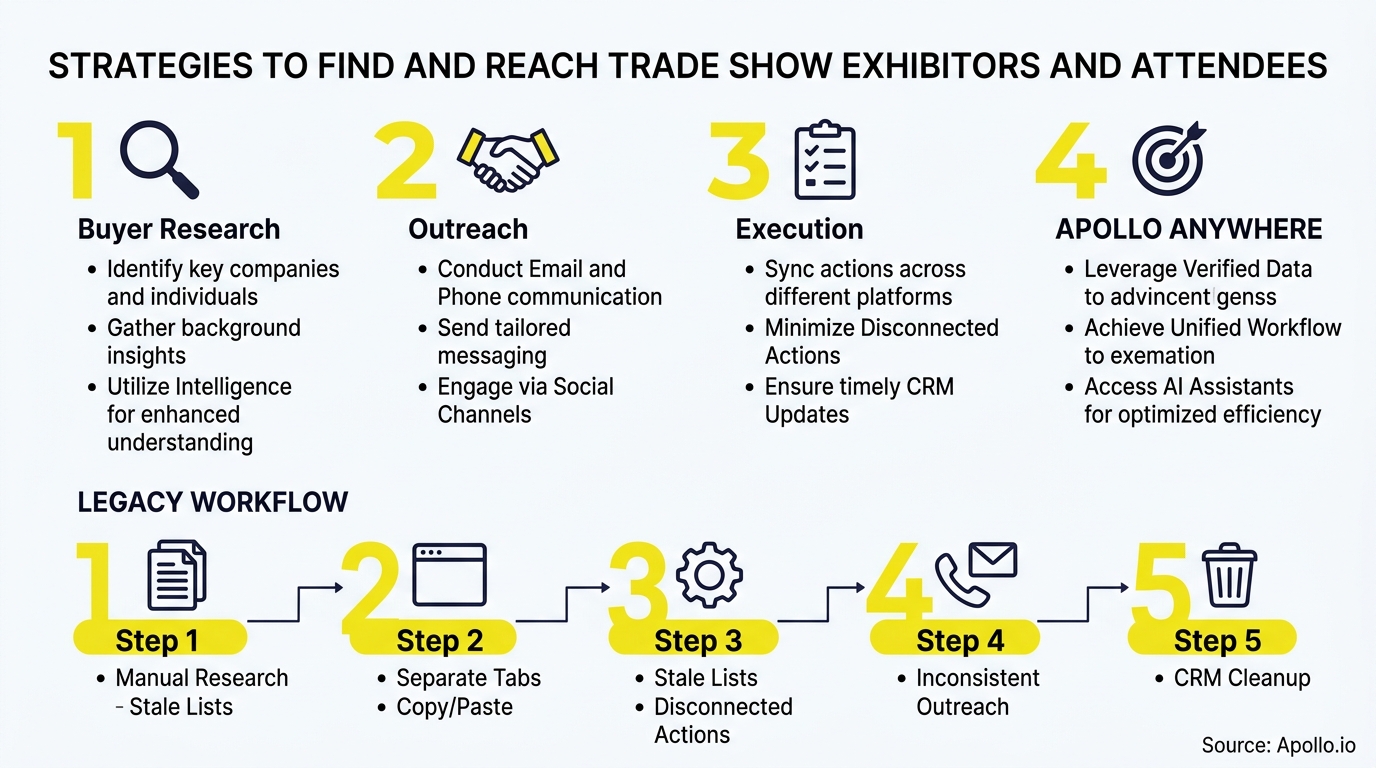
Collin Stewart of Predictable Revenue put it simply: "We reduced the complexity of three tools into one." That's the same consolidation opportunity here: instead of juggling an exhibitor directory, a separate enrichment tool, and a third platform for sequences, Apollo brings data, engagement, and pipeline tracking into one workspace built for GTM teams.
Ready to build your next trade show target list without the manual grind? Request a Demo and see how Apollo helps you find, score, and reach the right exhibitors and attendees before your competitors even open the exhibitor list.
Prove ROI Fast, Scale Outreach With Apollo
Struggling to show leadership real pipeline impact before budget season hits? Apollo's automation lets reps send more personalized outreach without adding headcount, so results show up in weeks, not quarters. Built-In saw a 10% lift in win rate using Apollo's signals and guidance.
Start Free with Apollo →Don't miss these
Sales
Inbound vs Outbound Marketing: Which Strategy Wins?
Sales
What Is a Sales Funnel? The Non-Linear Revenue Framework for 2026
Sales
What Is a Go-to-Market Strategy? The 2026 GTM Playbook
See Apollo in action
We'd love to show how Apollo can help you sell better.
By submitting this form, you will receive information, tips, and promotions from Apollo. To learn more, see our Privacy Statement.
4.7/5 based on 9,690 reviews
