
How to Enrich, Clean, and Deduplicate 1,500 Consultant Records
A 1,500-record consultant database sounds small until you try to clean it. Between shared office phones, personal vs. firm emails, rebranded websites, and consultants who change firms every 18-24 months, a "quick CSV cleanup" turns into a multi-week identity resolution project.
This guide shows the exact workflow: scope, turnaround, sample output fields, acceptance criteria, and what happens to records that can't be resolved automatically.

Skip The Research, Apollo Verifies Instantly
Burning hours a week manually verifying emails and phone numbers before you can even start selling? Apollo delivers 240M+ contacts at 98% email accuracy, so your list is clean before outreach begins. Stop researching, start closing.
Start Free with Apollo →Key Takeaways
- Cleaning 1,500 consultant records requires multi-key identity resolution (name + domain + phone + address), not just email matching.
- Consultant data decays faster than most B2B categories because people change firms, titles, and offices frequently.
- A defensible deliverable includes verification dates, confidence scores, and a documented review queue for unresolved records.
- Continuous refresh cycles (30/90/180-day) outperform one-time cleanups for keeping consultant data AI-ready.
- RevOps and Sales teams can consolidate enrichment, verification, and outreach into one workspace instead of stitching together multiple point tools.
What Does It Mean To Enrich, Clean, and Deduplicate 1,500 Consultant Records?
Enriching, cleaning, and deduplicating 1,500 consultant records means running each row through identity verification, standardizing contact fields, and merging duplicate entries into one accurate profile per person. For consultants specifically, this is harder than typical B2B contacts because a single person may appear under a personal email, a firm email, a former employer's domain, and a shared office phone number, all in the same spreadsheet.
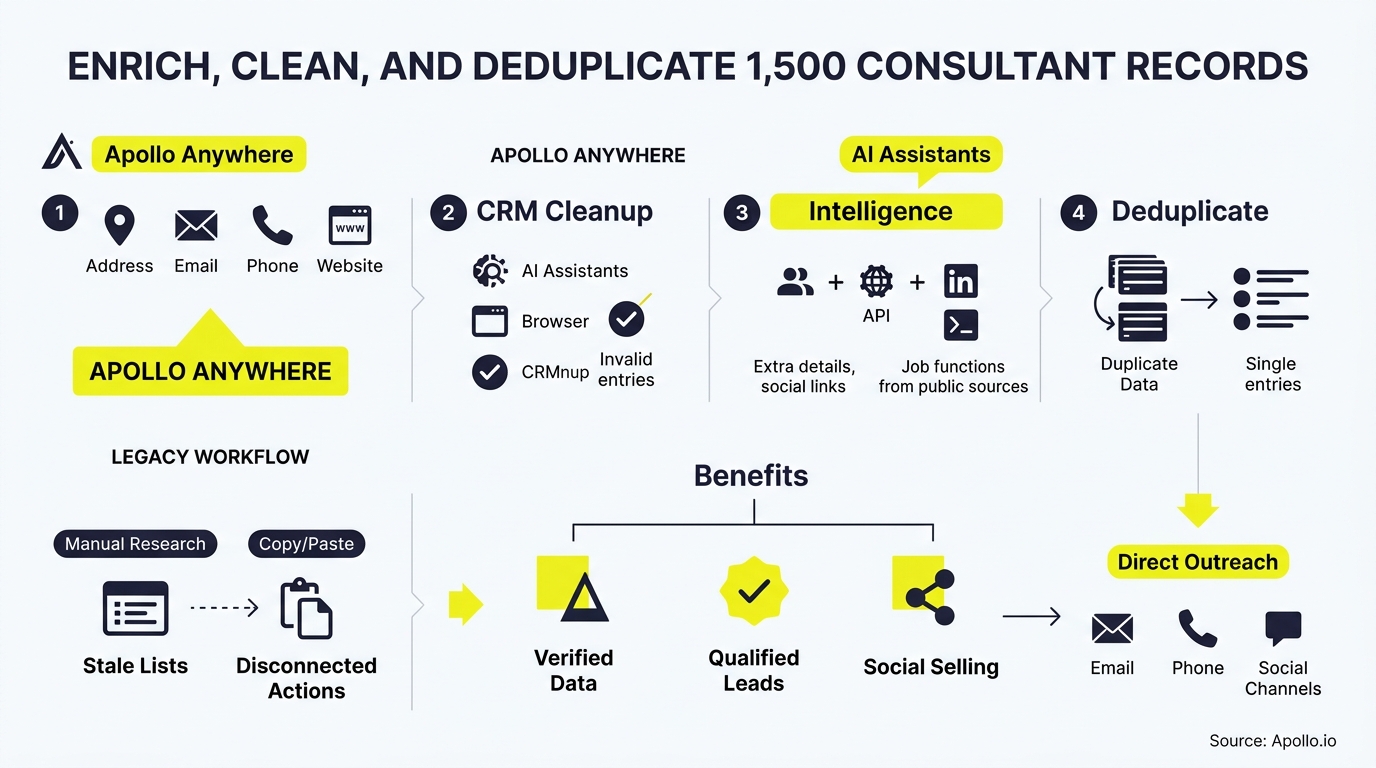
The job has four distinct stages: audit (find what's broken), match (identify duplicates across multiple identity keys), verify (confirm addresses, emails, phones, and websites are current), and enrich (fill gaps with firmographic and role data). Skipping the audit stage is the most common reason cleanup projects fail acceptance review.
Why Is Consultant Contact Data Harder To Maintain Than Other B2B Records?
Consultant contact data decays faster than most B2B categories because job titles and firm affiliations change more frequently in professional services than in other industries. According to Landbase, job titles experience 25%-35% decay specifically because consultants frequently change levels or firms. Separately, Cleanlist.ai reports that consulting firms and agencies see a 20%-25% annual decay rate tied to partner moves and firm restructurings.
This matters for planning: if you clean 1,500 records today, expect 300-375 of them (roughly 20-25%) to need re-verification within a year based on that decay pattern. Addresses compound the problem. As a workload-planning proxy, U.S. Census migration data showing 11.8% of the population moved during 2024 would put roughly 177 of 1,500 address records into an annual re-verification cohort if applied evenly. Consultants who work across client sites move even more often than that baseline suggests.
What Is the Step-By-Step Workflow For Cleaning 1,500 Records?
The workflow for cleaning 1,500 consultant records follows five stages: ingest and audit, multi-key matching, verification, enrichment, and human review of ambiguous cases.

- Ingest and audit: Load all 1,500 records and flag missing fields, malformed emails, invalid area codes, and blank address lines. Expect 15-25% of rows to have at least one structural issue on first pass.
- Multi-key matching: Compare records using normalized name, company domain, phone, and address, not email alone. Two records with different emails but the same normalized phone and firm domain are likely the same consultant.
- Verification: Confirm each email deliverable, each phone active, and each website resolving to a live, firm-matched domain (not a parked or expired page).
- Enrichment: Fill missing firm, title, specialty, and geography fields using verified sources.
- Human review queue: Route ambiguous merges (same name, different firm; same phone, different person) to manual review rather than auto-merging.
What Should the Final Deliverable Include?
The final deliverable should include a clean master file plus an audit trail showing exactly what changed and why. At minimum, expect these output fields:
| Field | Purpose |
|---|---|
| record_status | Merged, corrected, rejected, unresolved, or pending review |
| confidence_score | Match/verification confidence per record |
| last_verified | Date each field was last confirmed accurate |
| verification_source | Where the correction or confirmation came from |
| next_review_date | Scheduled re-verification (30/90/180-day tiers by priority) |
A realistic split for a 1,500-record batch: roughly 60-70% merge or auto-correct cleanly, 10-15% get enriched with new fields, and 10-20% land in a review queue for manual confirmation. The remainder, often 3-5%, stay flagged as unresolved because no source can confirm current contact details.
Unresolved records should never be silently dropped or silently merged; they need a documented status so sales teams know not to rely on them.
Turn Weak Leads Into Real Opportunities
Watching good leads stall before they ever become opportunities? Apollo's intent signals surface prospects who are actually ready to buy, so reps chase deals instead of dead ends. Built-In saw a 10% lift in win rate using Apollo's signals and guidance.
Start Free with Apollo →How Do RevOps Teams and SDRs Use Clean Consultant Data?
RevOps teams use clean consultant data to build a single source of truth that prevents duplicate outreach and inaccurate territory assignment. When a consultant record is duplicated across three CRM entries, two SDRs might unknowingly call the same person in one week, damaging the relationship before an AE ever gets involved.
For SDRs and BDRs booking meetings, accurate phone and email data directly affects connect rates and time spent on research. Sales reps report spending significant time each year dealing with inaccurate data, including researching prospects who have left their roles or dialing wrong numbers, according to Salesmotion. Account Executives rely on the same clean records for pre-meeting intelligence, since outdated firm or title information can lead to a mispositioned pitch in the first five minutes of a call.
Struggling to find qualified leads because your consultant list is stale? Search Apollo's 240M+ contacts with 65+ filters to rebuild your list with verified, current records instead of guessing.
How Often Should You Refresh Consultant Records After the Initial Cleanup?
Consultant records should be refreshed on a tiered schedule: 30 days for high-priority active pipeline contacts, 90 days for mid-priority accounts, and 180 days for low-touch or dormant records. A one-time cleanup is not a permanent fix given how quickly consultant firm affiliations and titles change.
Research from Validity found that 37% of CRM users reported losing revenue directly due to poor data quality, a strong argument for building recurring verification into the process rather than treating cleanup as a one-time project. Trigger-based refreshes (a bounced email, a changed job title signal, a returned mail piece) should also prompt an out-of-cycle re-verification regardless of the scheduled tier.
Tired of manually re-checking contact data every quarter? Start free with Apollo's data enrichment tools to automate ongoing verification instead of running the same manual audit every 90 days.
What Should You Ask a Data Enrichment Vendor Before Handing Over Consultant Records?
Before handing over consultant records, ask any enrichment vendor how they source, store, and dispose of contact data, and whether your records could be pooled into a shared dataset. This matters more after 2026's high-profile cases: HubSpot walked back a proposed enrichment-data plan following customer objections over default enrollment and data ownership, and a separate 16-terabyte lead-generation dataset exposure in late 2025 put names, emails, and phone numbers from multiple vendors at risk.
Specific questions to ask:
- Is our data pooled into any shared or resold dataset, and is participation opt-in or opt-out?
- What is the retention period, and how are deletion requests processed downstream?
- What verification sources back each corrected field?
A vendor that can't answer these clearly is a security and compliance risk, not just a data quality one.
How Can Apollo Help You Manage Consultant Data at Scale?
Apollo helps by combining enrichment, verification, and outreach in one workspace instead of requiring separate tools for each function. Rather than running a one-time 1,500-record cleanup through a standalone vendor and then exporting into a different sales engagement platform, teams can use Apollo's Data Health Center to enrich and clean CRM records directly, then move straight into outreach without a second data hop.
Collin Stewart of Predictable Revenue put it simply: "We reduced the complexity of three tools into one." That kind of consolidation matters for RevOps leaders managing integration overhead and for Sales leaders who need one accurate view of pipeline instead of three conflicting spreadsheets. Apollo's contact enrichment tools also connect to a sales engagement platform, so once your 1,500 consultant records are clean, you can sequence outreach in the same system.

Conclusion: Turn a One-Time Cleanup Into a Repeatable System
A 1,500-record consultant cleanup only pays off if it's built to last. Treat the first pass as a baseline, not a finish line: document what merged, what got corrected, what's still unresolved, and when each record needs a re-check.
Teams that build recurring verification into their process, rather than repeating a manual cleanup every time data goes stale, spend less time firefighting and more time selling.
Ready to stop rebuilding the same spreadsheet every quarter? Start a Trial with Apollo and consolidate enrichment, verification, and outreach into one workspace.
Scale Outreach Without Adding Headcount
Justifying tool spend when pipeline results take too long to show up? Apollo automates prospecting so reps send more outreach without more hires. GTM Ops drove 4x more meetings with the same team size.
Start Free with Apollo →Don't miss these
Sales
Inbound vs Outbound Marketing: Which Strategy Wins?
Sales
What Is a Sales Funnel? The Non-Linear Revenue Framework for 2026
Sales
What Is a Go-to-Market Strategy? The 2026 GTM Playbook
See Apollo in action
We'd love to show how Apollo can help you sell better.
By submitting this form, you will receive information, tips, and promotions from Apollo. To learn more, see our Privacy Statement.
4.7/5 based on 9,690 reviews
