
Top 6 Derrick App Alternatives for RevOps Teams in 2026
Derrick App is a B2B data enrichment platform that helps sales and growth teams find and verify contact information directly in Google Sheets, AI assistants, or via API. It enriches LinkedIn profiles and companies with 100+ data points, including verified emails, direct phone numbers, and tech stacks, using a credit-based pricing model where unused credits roll over. For teams that live in spreadsheets or need lightweight enrichment inside AI assistants, it can be a useful starting point.
But as sales organizations scale, many teams find that a standalone enrichment tool covers only one piece of the go-to-market workflow. Once a contact is enriched, someone still has to sequence outreach, dial, track engagement, sync data back to the CRM, and report on results.
That gap is why RevOps leaders, sales managers, and founders start evaluating Derrick App alternatives, especially platforms that combine data enrichment with prospecting, engagement, and analytics in one place.
This guide compares six alternatives, starting with Apollo, an AI GTM system built to unify data, intelligence, and execution, followed by five other data enrichment and sales intelligence platforms. We'll break down features, pricing, and who each tool tends to fit best so you can make an informed decision.

Skip The Research - Apollo Verifies Contacts
Burning hours a day chasing emails that bounce and numbers that go nowhere. Apollo hands your reps verified contact data instantly, so selling time stops going to data entry. 98% email accuracy means less digging, more dialing.
Start Free with Apollo →Key Takeaways
- Sales Intelligence Capabilities: Apollo combines a large contact and company database with built-in outbound, inbound, and dialer tools, while most alternatives on this list focus primarily on enrichment or intent data.
- AI Features: Apollo's AI Research Agent, AI Sequence Builder, and AI Dialer scripts operate across the full sales workflow, whereas tools like Clay and FullEnrich apply AI mainly to research and enrichment tasks.
- Customer Base: Apollo serves organizations from startups to Fortune 500 teams, while Cognism and Clearbit tend to skew toward mid-market and larger revenue teams with dedicated budgets.
- Platform Scope: Apollo spans prospecting, engagement, dialing, and enrichment; Clay focuses on GTM workflow automation; FullEnrich and Cognism concentrate on contact data and verification.
- Pricing Model: Apollo uses transparent per-seat pricing with annual credit allocations, while several alternatives rely on credit-based or custom annual contract pricing that requires more evaluation.
Apollo

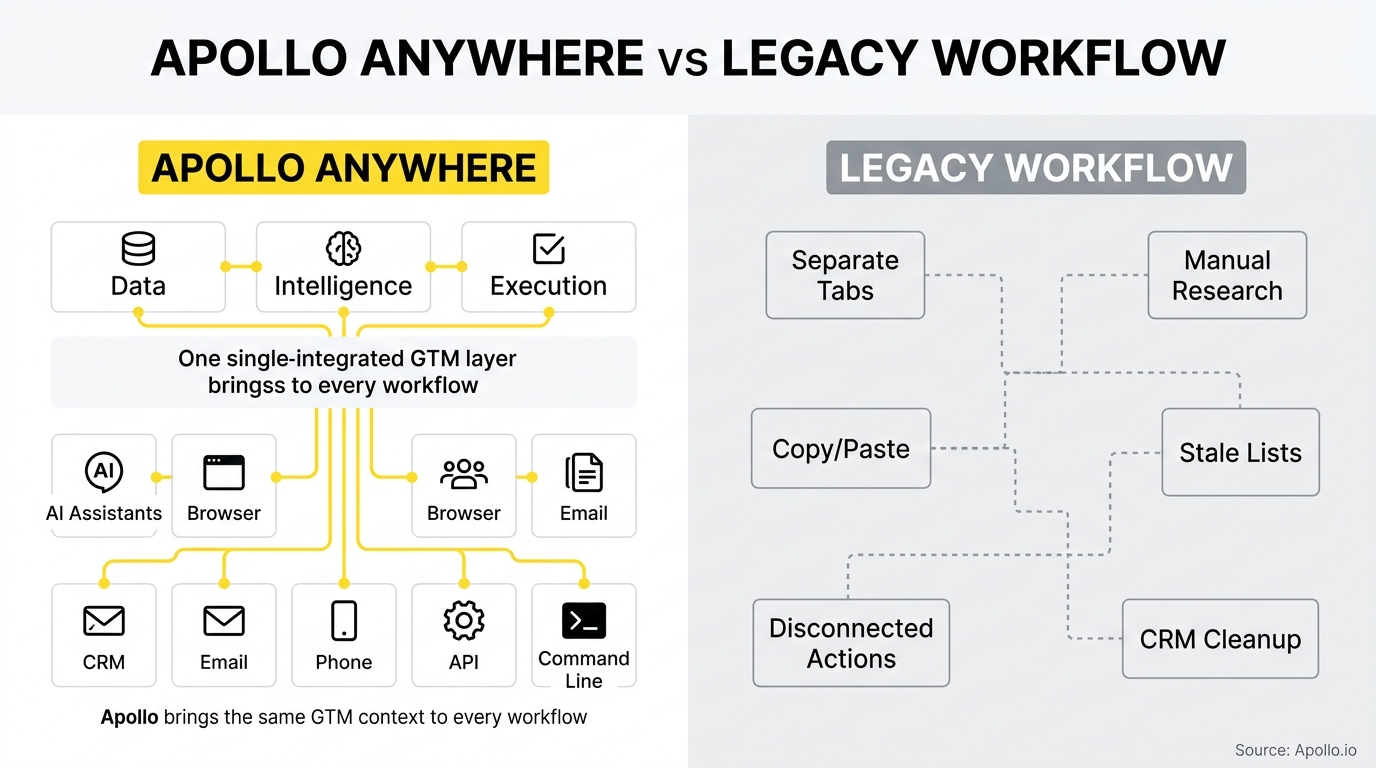
Apollo is an AI GTM system that unifies data, intelligence, and execution. It's built open by design, meeting sellers inside the tools they already use, from AI assistants like ChatGPT, Codex, Claude, and Perplexity via Apollo MCP, Apollo's Model Context Protocol, to the Chrome extension and Salesforce, rather than asking sellers to switch contexts to get value. For technical and advanced users, Apollo CLI provides terminal-native access for headless GTM workflows.
Apollo's database includes 240M+ people and 30M+ companies, with contacts continuously validated and refreshed by Apollo's Living Data Network rather than treated as a static list. On the outbound side, Apollo helps teams define an ICP, let an AI Assistant find and rank accounts, verify emails and phones, and run multi-channel sequences across email, calls, and social, supported by a Power Dialer and Parallel Dialer for efficient calling. On the inbound side, Apollo captures website visitor activity, enriches and shortens forms, and routes leads automatically with AI-assisted nurture sequences. Apollo's data enrichment suite offers waterfall enrichment across multiple vendors, bi-directional CRM sync, CSV enrichment with 65+ data attributes, and API access for bulk enrichment jobs.
Pricing is available on the Apollo pricing page. The Free plan includes 900 credits/year (75/month), 2 sequences, and basic filters. Basic is $49/user/month with 30,000 credits/year, unlimited sequences, and CRM integrations. Professional is $79/user/month and adds a US dialer, 5 mailboxes, and AI research. Organization is $119/user/month (minimum 3 users) with international dialer access, 15 mailboxes, and SSO. All tiers reflect annual billing savings of 20%.
Apollo integrates with Salesforce, HubSpot, Zoho CRM, Pipedrive, Outreach, SalesLoft, Orum, Nooks, Marketo, and more than 50 tools through its integrations marketplace. Customers describe the impact of consolidating their stack:
"We reduced the complexity of three tools into one.", Collin Stewart, CEO at Predictable RevenueOthers point to measurable data quality gains:
"Apollo enriches everything we have: contacts, leads, accounts...And we don't really have to touch it, it just works.", Mark Turner, VP of Revenue Operations at Built In
According to Ramp's vendor data, Apollo is the fastest-growing vendor in the Sales Data Providers category as of August 2026, with adoption up 5 percentage points year-over-year and a 22% competitor switch rate, more than double some other providers in the category, signaling that teams are actively moving to Apollo from other vendors.
Beyond individual vendor performance, Ramp's Sales Data Providers category data shows Apollo tied for the highest share of first-time category adopters as of August 2026, indicating that a large share of teams evaluating sales data tools for the first time are choosing Apollo over incumbents.
Apollo serves B2B GTM teams, GTM Engineers, and AI Builders building headless GTM workflows with the Apollo API, CLI, and MCP, alongside Sales Professionals, SDRs/BDRs, AEs, RevOps, Marketing, and Revenue Leaders. Apollo holds a 4.7/5 G2 rating and is recognized as a G2 Leader across multiple categories, plus the 2026 MarTech Breakthrough Award for "Best AI-Powered Sales Solution".
Clay

Clay is a go-to-market engineering platform that helps revenue teams automate outbound workflows. It provides data enrichment from 150+ providers, an AI research agent called Claygent, signal tracking, and workflow automation for building custom prospecting systems.
Clay's pricing starts with a Free plan (500 actions/month, 100 data credits/month). The Launch tier starts at $185/month ($167/month billed annually) with 2,500 data credits and 15,000 actions/month. Growth starts at $495/month ($446/month annually) with 6,000 data credits and 40,000 actions/month. Enterprise requires custom pricing with an annual commitment and includes 100,000+ data credits and 200,000+ actions/month. Data credit top-ups carry a 30% premium.
- Pros: Combines enrichment from 150+ providers with flexible workflow automation; strong fit for teams building custom GTM logic.
- Pros: Claygent AI agent can handle open-ended research tasks beyond static enrichment fields.
- Cons: Pricing structure with separate action and credit tiers can be complex to forecast at scale.
- Cons: Requires technical setup and workflow-building expertise to get full value.
Apollo vs Clay, here's everything you need to know.
See Deal Stages Clearly, Forecast With Confidence
Forecasting off gut feel because deal stages live in five different spreadsheets. Apollo gives you one real-time view from first touch to closed-won, so leads actually convert into pipeline you can count on. 46% more meetings with AI Research Agent.
Schedule a Demo →Clearbit

Clearbit was acquired by HubSpot in 2023. It converts unstructured information from public and proprietary sources into standardized data sets using LLMs, offering enrichment, lead scoring, and buyer intent signals. Pricing for Clearbit's data enrichment features is now part of HubSpot's platform; no standalone Clearbit pricing page is available.
- Pros: Granular industry categorization using NAICS, GICS, and SIC codes for precise segmentation.
- Pros: Dynamic form shortening reduces friction by auto-enriching fields from an email address alone.
- Cons: Now tied to HubSpot's ecosystem, which may not suit teams on other CRMs.
- Cons: Standalone pricing and account management are no longer available outside HubSpot.
Related reading:Apollo vs Clearbit
FullEnrich

FullEnrich is a lead enrichment platform that finds verified professional emails and mobile phone numbers by aggregating data from 25+ vendors through waterfall enrichment. It includes triple email verification and carrier-based mobile phone verification.
FullEnrich's pricing starts with a free trial offering 50 credits with no credit card required. The Pro plan starts at $55/month for 1,000 credits ($0.055/credit), with a slider up to 100,000+ credits and higher; a 15,000-credit example prices out at $720/month. Credits roll over for 3 months on monthly billing and 12 months on annual billing. Enterprise pricing requires contacting sales.
- Pros: Waterfall enrichment across 25+ providers with triple email verification for accuracy.
- Pros: Transparent, granular credit costs per action (email, phone, reverse lookup).
- Cons: Mobile phone lookups cost 10 credits each, which can consume budget quickly at volume.
- Cons: Focused primarily on enrichment, with outreach and sequencing handled through integrations rather than built in.
Related:Apollo vs FullEnrich

Cognism

Cognism is a B2B sales intelligence and data platform offering phone-verified contact data, company data, and intent signals, with a focus on European market coverage and compliance-first data practices.
Cognism's pricing is based on custom annual contracts, with the Standard tier (5 seats included) and Pro tier (5 seats included) both requiring a quote from sales, plus a CRM Enrichment add-on and Data-as-a-Service pricing that depends on data volume and delivery method. Cognism uses a credit model where one credit is consumed per contact record revealed, and credits are only reused if that contact changes jobs.
- Pros: Cognism reports phone-verified mobile numbers designed to deliver higher connect rates than unverified data.
- Pros: Intent data through Bombora Company Surge helps identify companies actively researching relevant topics.
- Cons: Custom annual contract pricing requires a larger upfront commitment than monthly options, with exact costs varying by tier and negotiated terms.
- Cons: Data-as-a-Service and CRM enrichment are priced as add-ons rather than included in base tiers.
Related reading:Apollo vs Cognism
Comparison Table
| Platform | Starting Price | Pricing Model | Core Focus | AI Features |
|---|---|---|---|---|
| Apollo | $49/user/month (Basic) | Per-seat + annual credits | Prospecting, engagement, dialer, enrichment | AI Research Agent, AI Sequence Builder, AI Dialer scripts |
| Clay | $185/month (Launch) | Hybrid (base + action/credit tiers) | GTM workflow automation | Claygent AI research agent |
| Clearbit | Part of HubSpot pricing | N/A (HubSpot bundle) | Data enrichment, lead scoring | LLM-based data standardization |
| FullEnrich | $55/month (1,000 credits) | Credit-based | Email & phone enrichment | Waterfall verification logic |
| Cognism | Custom annual pricing (Standard) | Annual contract + credits | Phone-verified data, intent signals | AI-powered company research |
| Derrick App | €9/month (Mini) | Credit-based, rollover | Enrichment in Sheets/AI assistants | AI enrichment (Claude, OpenAI) |
How to Choose the Right Alternative
Start by mapping your workflow gaps. If your team needs enrichment plus outbound sequencing, dialing, and CRM sync in one place, a platform spanning the full funnel will reduce handoffs.
If you only need raw contact enrichment layered on top of an existing engagement stack, a focused enrichment tool may suffice, though you'll still need to manage integrations across multiple vendors.
Consider data freshness. Static databases go stale as people change jobs; platforms built on continuously validated data, like Apollo's Living Data Network, reduce the manual cleanup RevOps teams often absorb. Also weigh pricing predictability: per-seat models with published tiers (like Apollo's pricing page) are easier to budget than credit-based or custom annual contracts that scale unpredictably with usage.
Finally, factor in where your team already works. Tools that integrate into existing engagement workflows, CRMs, and AI assistants reduce context-switching and improve adoption across SDRs, AEs, and RevOps alike.
Frequently Asked Questions
What makes Apollo the best Derrick App alternative?
As detailed in the Apollo section above, Apollo serves B2B GTM teams, GTM Engineers, and AI Builders building headless GTM workflows with the Apollo API, CLI, and MCP, alongside Sales Professionals, SDRs/BDRs, AEs, RevOps, Marketing, and Revenue Leaders. It combines the enrichment capabilities teams look for in Derrick App with built-in outbound, inbound, and dialer tools.
Is there a free alternative to Derrick App?
Yes. Apollo, Clay, and FullEnrich all offer free tiers with usage limits, as covered in their respective sections above.
Each free plan is a good way to test enrichment quality and workflow fit before committing to a paid tier.
How does pricing compare across these alternatives?
Pricing models vary significantly, from Apollo's published per-seat tiers starting at $49/user/month to Clay's hybrid action-and-credit system and Cognism's custom annual contract pricing. Review each vendor's official pricing page, linked in the sections above, to compare against your expected usage volume.
Which alternative is best for teams that need phone-verified data?
Cognism specializes in phone-verified mobile data, as noted in its section above. Apollo also supports phone verification within its broader data enrichment and dialer workflows, which can reduce the need for a separate point solution.

Conclusion
Each alternative on this list serves a different piece of the GTM puzzle, from Clay's workflow automation to FullEnrich's waterfall email and phone verification to Cognism's compliance-focused contact data. But for teams that want enrichment, outbound execution, inbound routing, and dialing without stitching together multiple vendors, Apollo stands out as the most complete option, backed by a large validated database, AI-powered workflows, and transparent pricing detailed in the Apollo section above.
If you're evaluating Derrick App alternatives, start with the platform built to grow alongside your GTM motion. Start Free with Apollo and see how data, intelligence, and execution work together in one system.
Justify Your Stack Spend With Apollo
Struggling to prove ROI before the budget review? Apollo replaces scattered tools with one platform your team actually uses, so time saved and pipeline impact show up in the numbers. Leadium tripled annual revenue after consolidating with Apollo.
Schedule a Demo →Don't miss these
Sales
Inbound vs Outbound Marketing: Which Strategy Wins?
Sales
What Is a Sales Funnel? The Non-Linear Revenue Framework for 2026
Sales
What Is a Go-to-Market Strategy? The 2026 GTM Playbook
See Apollo in action
We'd love to show how Apollo can help you sell better.
By submitting this form, you will receive information, tips, and promotions from Apollo. To learn more, see our Privacy Statement.
4.7/5 based on 9,690 reviews
