A "data purchase company" can mean two things: a business that buys data, or a business that sells it. This guide is for buyers.
If you need business contact, firmographic, technographic, or intent data, the question is how to buy usable records, not database size.
Purchased data only pays off when it survives your own tests. That means contact data enrichment is part of the buying decision, not an afterthought. Below is a framework you can run with any supplier: match data types to use cases, compare supplier models, test a sample, and check contract terms.

Skip Manual Research. Apollo Finds Contacts.
Tired of burning hours researching leads and double-checking emails and phone numbers? Apollo puts 240M+ business contacts and 98% email accuracy in one workspace, so reps spend selling time, not data-entry time. Start finding your best-fit buyers today.
Start Free with Apollo →Key Takeaways
- Define your use case first, then choose between contact, firmographic, technographic, and intent data.
- Compare suppliers on cost per accepted record, not total records.
- Run the same sample test on every vendor, using your own target accounts.
- Verify permitted uses, deletion handling, and export rights before signing.
- Treat any unknown or undisclosed vendor detail as a question for the vendor, not an assumption.
What Does Data Purchase Company Mean for B2B Buyers?
For buyers, a data purchase company is any supplier you license business data from: a list broker, an enrichment provider, a data marketplace, or a platform with a built-in database. Many registered data brokers sell consumer data, so registry counts say little about B2B options.
Narrow the field by the type of data you need and the use you intend.
Market growth shows why the choice matters. Lotame reports the global data marketplace platform market is projected to expand from $1.49 billion in 2024 to $5.73 billion by 2030, a 25.2% CAGR. More suppliers means more claims to verify.
Which Type of Data Should You Buy?
Buy the data type that matches the decision you need to make. Most failed purchases start with buying the wrong category.
| Data Type | Best Use Case | What to Test in a Sample |
|---|---|---|
| Contact data | Outbound prospecting by SDRs and BDRs | Valid emails, direct dials, title accuracy |
| Firmographic data | Territory planning and segmentation for RevOps | Industry, size, and location match to your ICP |
| Technographic data | Competitive displacement and integration plays | Stack detection against accounts you already know |
| Intent data | Account prioritization and timing | Signal-to-meeting conversion on a pilot list |
On intent, Demand Gen Report found that target accounts matched with third-party buyer intent signals generated 93% higher multi-touch engagement and 21% more leads per account than standard outbound activation. Read what intent data is and how it powers B2B sales before paying a premium for it.

How Do Data Supplier Models Compare?
Supplier models differ in delivery, licensing, and pricing transparency. The table below is a dated framework as of November 2026.
Fill every blank cell with a written vendor answer before you compare prices.
| Criteria | List Broker | Enrichment API Provider | Platform With Built-In Database |
|---|---|---|---|
| Delivery | One-time file | API or CRM sync | In-app search, export, and sync |
| Licensing | Often limited reuse | Per-call or contract terms | Subscription terms |
| Refresh | Ask vendor (unknown until stated) | Ask vendor (unknown until stated) | Ask vendor (unknown until stated) |
| Pricing | Quote-based | Per record or tiered | Published tiers or quote-based |
| Execution | None | None | May include engagement tools |
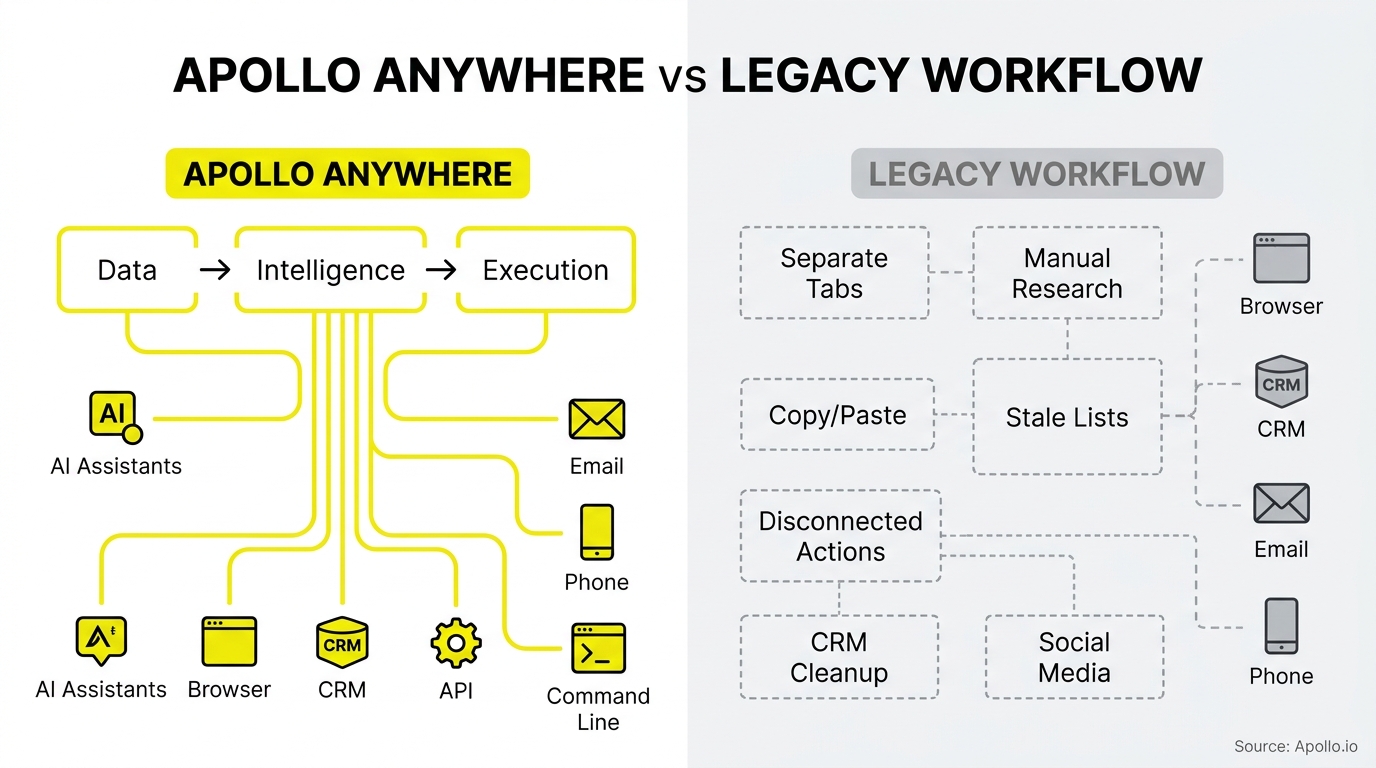
Suppliers are also moving beyond selling records into workflow automation. That is useful, but evaluate the data and the automation separately, and ask about approvals, auditability, and portability.
Apollo Turns Pipeline Guesswork Into Forecasts
Tired of forecasts that feel like guesses because deal data is out of date? Apollo puts prospecting, outreach, and deal activity in one connected workspace, so your funnel fills with quality leads and your numbers hold up. Start free today.
Start Free with Apollo →How Should RevOps Leaders Run a Sample Test?
Request
a sample drawn from your own ideal customer profile (ICP), not the vendor's showcase set. Run the same file through every finalist so the results are comparable.
Score each file before any contract discussion starts.
- Coverage: What share of your target accounts and titles appear in the file?
- Email validity: Send the addresses through your own verification tool and record the bounce rate.
- Phone usefulness: Have a few reps dial a small batch and log connects.
- Title and company match: Compare records against your CRM and a manual spot check.
- Duplicate rate: Check overlap with contacts you already own.
- Licensing: Confirm in writing how many users can access the data, how long you can reuse it, and how opt-outs are handled. Have legal review the terms.
RevOps leaders should own the scorecard, while SDR managers should own the dial and reply tests. Cost belongs in the scorecard too, because the cheapest file is not always the cheapest outcome. Collin Stewart of Predictable Revenue put the full-cost view this way:
"Apollo could be a third of the cost if you look at the full price of what we were spending on ZoomInfo, Outreach, Salesforce, and admins to make it all work."
Where Does Apollo Fit in a Data Purchase?
Apollo is an alternative to buying standalone files: it brings B2B data, sales engagement, and AI-powered execution together in one connected go-to-market system. Teams don't have to stitch together separate vendors for research, outreach, and analysis.
Search business contact information with Apollo's prospecting tools. Keep your CRM records current with data enrichment. Then act on those records with sales engagement. Users control who they contact and how they use the product.
Apollo works where your team already works, including the Chrome extension, Salesforce, and Apollo MCP inside AI assistants like ChatGPT, Claude, and Perplexity. GTM Engineers and AI Builders can also pull Apollo data into their own agents and apps through the API, CLI, and MCP. According to Ramp's Sales Data Providers category data, Apollo.io is the fastest-growing vendor in the category as of November 2026, averaging +0.4 percentage points of adoption growth per month.
"The thing that made me most excited as somebody who's been in sales development a long time was Apollo's integration between sales data and sales engagement and the magic that you can make happen when those two are together on the same platform."
Enterprise teams can review Apollo's Organization tier for governance, security, and admin controls. Check Apollo's pricing page for current plan details.
Frequently Asked Questions About Buying Business Data
Is a Data Purchase Company the Same as a Data Broker?
Not always. "Data broker" historically described list sellers who deliver one-time files. Today the term also covers enrichment APIs and platforms with built-in databases.
A data purchase company is any supplier you buy business contact or company data from, so the delivery model and licensing terms matter more than the label.
How Should an SDR Manager Evaluate Purchased Data?
Test it in the field. Give a few SDRs a sample of records, track bounce rate, connect rate, and reply rate, and compare the results across vendors.
Rep feedback on title accuracy and phone usefulness often exposes problems a spreadsheet review misses.
What Should a RevOps Leader Ask Before Signing?
Ask about licensing scope, reuse rights, refresh cadence, CRM sync behavior, and what happens to your data if you cancel. Get every answer in writing and have legal review the contract.
Does Buying a List Replace a Sales Engagement Platform?
No. A list contains records but does not run outreach. You still need sequencing, calling, and reporting, either in a separate tool or in a platform that includes them.

Ready to Choose a Data Supplier?
Define the data type you need, compare delivery and licensing models, and test every finalist on the same ICP sample before you pay. Judge suppliers on measured results and total cost, not on claims in a sales deck.
If you want business data and execution in one workspace, see how Apollo works for your team. Request a Demo.
Apollo Puts Pipeline Proof In Your Budget Case
Budget approval stuck because nobody can quantify the pipeline impact? Apollo connects prospecting, outreach, and deal activity in one workspace, so you can show leadership what's working. Leadium tripled annual revenue, and GTM Ops booked 4x more meetings.
Start Free with Apollo →Don't miss these
Sales
Inbound vs Outbound Marketing: Which Strategy Wins?
Sales
What Is a Sales Funnel? The Non-Linear Revenue Framework for 2026
Sales
What Is a Go-to-Market Strategy? The 2026 GTM Playbook
See Apollo in action
We'd love to show how Apollo can help you sell better.
By submitting this form, you will receive information, tips, and promotions from Apollo. To learn more, see our Privacy Statement.
4.7/5 based on 9,690 reviews
