
The top Data Axle competitors fall into three groups: enterprise intelligence platforms (ZoomInfo), firmographic and risk data providers (Dun & Bradstreet), and contact-data or workflow tools (Cognism, Lusha, Clay, and Apollo). The right pick depends on the accounts you sell to, the CRM you run, and how much of the workflow you want in one place, not on database size alone.
The category is growing. According to Fortune Business Insights, the global sales intelligence software market was valued at $4.0 billion to $4.85 billion in 2025 and is projected to reach $8.7 billion to $12.45 billion by 2033 to 2034. More vendors means more choices, so a structured shortlist and pilot matter. If you also need to tidy the records you already own, start with this guide to data enrichment tools.

Skip Manual Research. Apollo Finds Contacts.
Tired of burning hours researching leads and verifying emails by hand? Apollo puts 98% email accuracy and 240M+ contacts in one place, so your reps spend the day selling. Start finding verified in minutes.
Start Free with Apollo →Key Takeaways
- Group Data Axle alternatives by use case: enterprise intelligence, firmographic data, contact data, or workflow orchestration.
- Test small-business coverage in your own segments with a stratified sample. Vendor record totals are not comparable.
- Model cost per usable account, not price per seat, because credits and platform fees are now common.
- Check whether a provider's data is reachable inside your CRM and your AI assistants, not just in its own interface.
- Run the pilot worksheet below before you sign anything.
Which Data Axle Competitors Should You Shortlist?
Shortlist one provider from each category that matches your motion, then pilot them side by side. Comparison guides such as third-party roundups list dozens of vendors, but few test your specific segments.
Use the table below to map each category to your motion.
| Category | Best For | What to Test in a Pilot |
|---|---|---|
| Enterprise sales intelligence | Account-based teams selling to larger companies | Org chart depth, buying-group coverage, intent signals |
| Firmographic and marketing data | Marketing teams building lists and segments | Coverage of small and local businesses, record freshness |
| Contact data tools | Reps who need emails and phone numbers fast | Bounce rate, direct-dial reach, business contact information fit |
| Workflow and enrichment orchestration | GTM Engineers building custom pipelines | Setup time, credit consumption, error handling |
| Unified GTM platform (Apollo) | Teams that want data, engagement, and AI in one workspace | Match rate against your CRM, sequence results, reporting |
How Should You Pilot Data Axle Competitors?
Run the same 500 to 1,000 account sample through every provider, then compare usable results rather than raw match counts. A pilot built on your own segments exposes gaps that vendor demos hide.

- Build a stratified sample. Split accounts by size, industry, and region so small-business and mid-market coverage are measured separately.
- Define "usable." A usable account has a verified business email, a correct title, and a reachable business phone for the right role.
- Send a small live campaign. Track bounces, replies, and connects from each source with the same messaging.
- Calculate cost per usable account. Divide total spend, including credits and platform fees, by usable accounts delivered.
- Check CRM and AI reachability. Confirm records sync cleanly and can be pulled into the assistants your team already uses.
Why Do Revenue Teams Choose Apollo as a Data Axle Alternative?
Apollo brings B2B data, sales engagement, and AI-powered execution together in one connected go-to-market system, so teams don't have to stitch together separate vendors for research, outreach, and analysis. Its database spans 240M+ people and 30M+ companies, searchable by title, industry, headcount, and technology.
Enrichment runs against the records you already own. Apollo's data enrichment fills gaps in your CRM, and Mark Turner of Built-In described the experience this way:
"Apollo enriches everything we have: contacts, leads, accounts... And we don't really have to touch it, it just works."
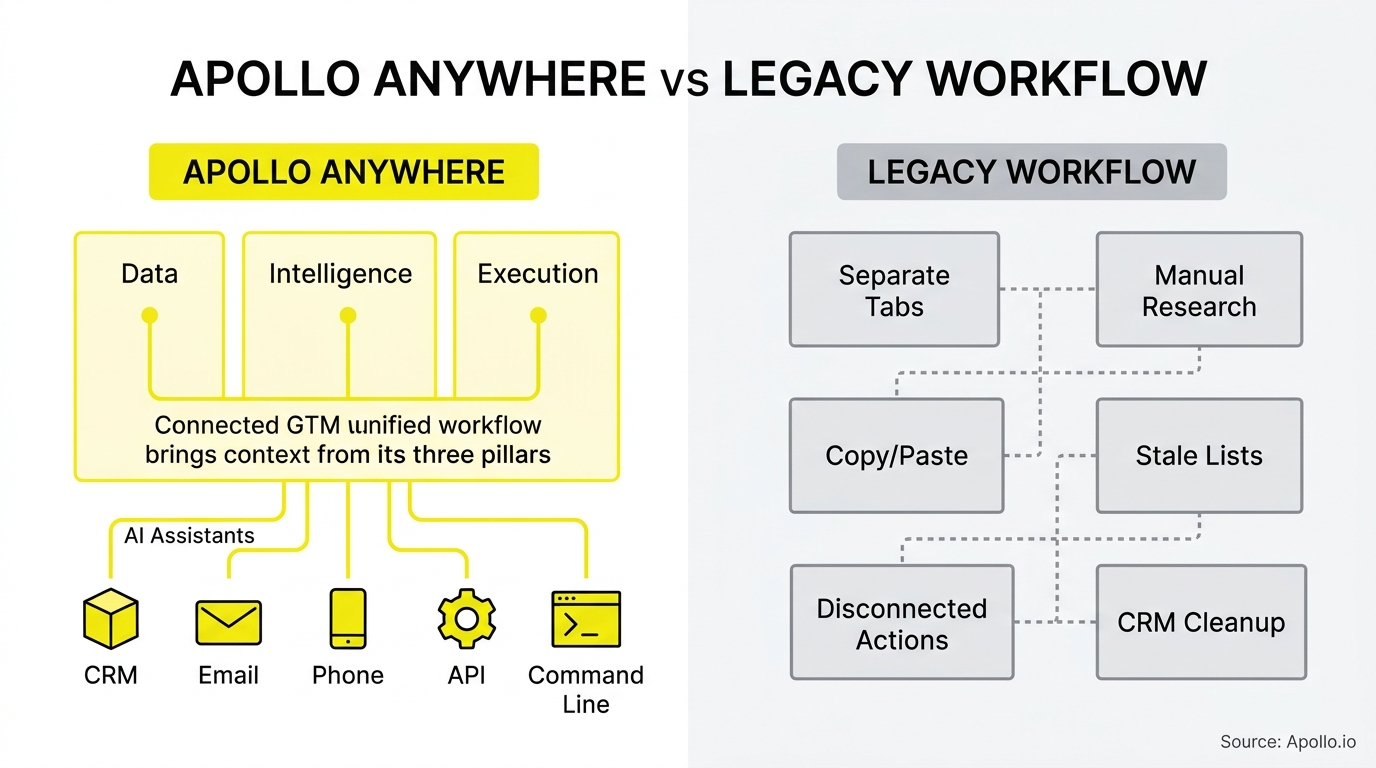
Apollo also works where your team already operates. Apollo MCP exposes Apollo data inside AI assistants like Claude, ChatGPT, and Perplexity, and the Chrome extension and Salesforce integration keep records in the flow of work. For technical users, the Apollo API and CLI support headless workflows.
Market adoption supports the shortlist. According to Ramp's vendor data, 39% of businesses buying in the sales data provider category used Apollo as of November 2026, up 6 percentage points year over year, ranking it #2 in the category. Users control who they contact and how they use the product.
Apollo Turns Forecast Guesswork Into Clarity
Forecasts feel like a coin flip because the deal data is stale? Apollo brings prospecting, engagement, and pipeline into one connected workspace, so your team sees where every opportunity stands. Approach the quarter with confidence, not hope.
Start Free with Apollo →How Do Different Roles Evaluate Data Axle Competitors?
Each role should score providers against its own daily workflow. A shared scorecard keeps the decision from defaulting to whoever has the biggest database.
- SDRs and BDRs: Test verified emails, business phone numbers, and how fast a prospect becomes a sequence step. Apollo's sales engagement tools keep that step in the same workspace.
- RevOps: Measure CRM match rate, duplicate handling, and field mapping. Ask how enrichment credits are consumed on records you already own.
- Sales and Revenue Leaders: Compare total cost per usable account and the number of tools each option replaces.
- GTM Engineers and AI Builders: Check API, CLI, and MCP access, rate limits, and whether data can feed your own agents.
Collin Stewart of Predictable Revenue highlighted why unified data and engagement mattered to him:
"The thing that made me most excited as somebody who's been in sales development a long time was Apollo's integration between sales data and sales engagement and the magic that you can make happen when those two are together on the same platform."

What Are the Most Common Questions About Data Axle Competitors?
What Is the Best Alternative to Data Axle for Small-Business Coverage?
No single provider wins every segment, so test small-business coverage with a stratified sample from your own territory. Compare verified contact rates by company size rather than total record counts.
How Should a RevOps Manager Compare Pricing Across Providers?
Model cost per usable account, including seats, credits, and platform fees. Apollo's pricing is listed on its pricing page: Free is $0, and Basic is $49/user/month on annual billing. Organization is $119/user/month billed annually (minimum 3 users).
Can Data Axle Competitors Connect to My CRM?
Most do, but sync depth varies. Review each provider's integrations for field-level mapping, duplicate handling, and write-back rules for Salesforce and HubSpot. Ask each vendor to demonstrate a live sync with your own field schema before you sign.
How Often Should You Re-Test Data Quality After You Choose a Provider?
Re-test at least quarterly. Pull a fresh sample of records, check email deliverability and phone connect rates, and compare the results with your original pilot baseline.
Contact data decays as people change roles, so a provider that tested well six months ago still needs ongoing checks.
Should You Use More Than One Data Provider?
Some teams do, usually to fill coverage gaps in specific segments or regions. The tradeoff is added cost and the risk of conflicting records.
If you run multiple sources, set clear rules for which one overwrites the others in your CRM and track performance by source.
Conclusion: Choose the Provider That Performs on Your Data
The best Data Axle alternative is the one that performs well against your own ideal customer profile, not the one with the largest database on paper. Build a shortlist, run a controlled pilot, and compare verified contact rates, CRM sync quality, and cost per usable account.
Involve sales, marketing, and RevOps early so the decision reflects how each team will use the data day to day.
Apollo combines a B2B contact and company database with search, enrichment, and outreach workflows in a single platform, so your team can test data quality and act on it without stitching tools together. You can start on the Free plan to run your own pilot before committing to a paid tier.
Start free with Apollo and compare its data against your current provider on your own target accounts.
Prove Pipeline ROI Fast With Apollo
Budget review coming and no clear numbers to defend your tool spend? Apollo brings prospecting, engagement, and pipeline tracking into one workspace, so wins show up fast. Built-In saw a 10% lift in win rate and 10% higher ACV.
Start Free with Apollo →Don't miss these
Sales
Inbound vs Outbound Marketing: Which Strategy Wins?
Sales
What Is a Sales Funnel? The Non-Linear Revenue Framework for 2026
Sales
What Is a Go-to-Market Strategy? The 2026 GTM Playbook
See Apollo in action
We'd love to show how Apollo can help you sell better.
By submitting this form, you will receive information, tips, and promotions from Apollo. To learn more, see our Privacy Statement.
4.7/5 based on 9,690 reviews
