
Contact Information Enrichment: A Complete Guide to Emails, Phones, and Job Titles
Nearly a quarter of your CRM's contact records will be wrong within a year, and you won't know which quarter until an email bounces or a call reaches someone who left the company. Contact information enrichment, adding accurate emails, phone numbers, job titles, and employer data to existing records, is how B2B GTM teams fight that decay.
But most teams treat it as a one-time list cleanup instead of an ongoing operating discipline.
This guide gives you a field-level scorecard, a repeatable enrichment workflow, and a way to calculate what a "usable" contact actually costs you. If you want to see how this works inside a single platform instead of stitched-together tools, Apollo's contact data enrichment guide breaks down the ROI mechanics in more depth.
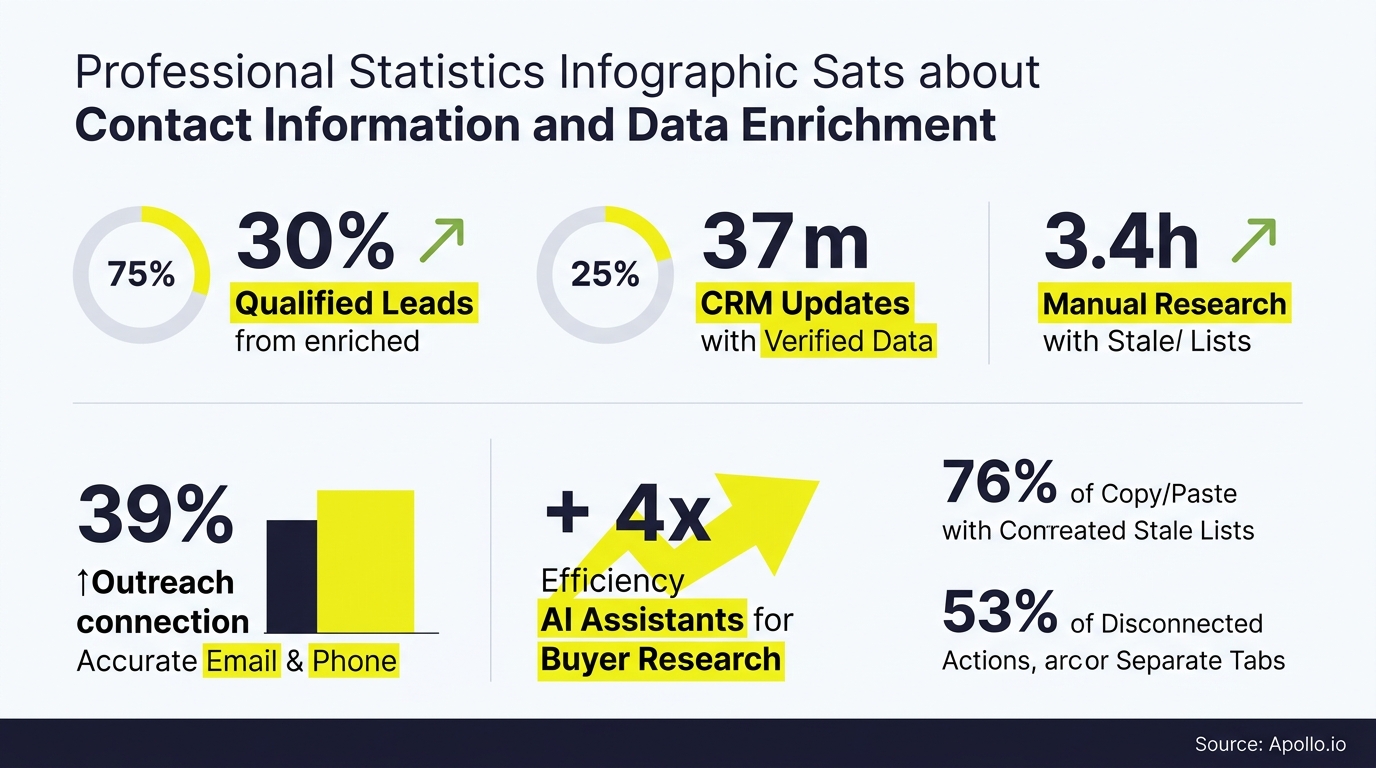

Verified Contacts Replace Manual Research
Spending hours chasing emails and phone numbers that bounce anyway? Apollo hands your team verified business contacts with 98% email accuracy, so reps prospect instead of playing detective. Skip the guesswork and start connecting with real buyers today.
Start Free with Apollo →Key Takeaways
- Contact data decays continuously, not annually. Job titles, emails, and phone numbers need reverification on a rolling schedule, not a once-a-year list scrub.
- Field-level accuracy matters more than database size. A 240M-record database with 60% title accuracy is worse than a smaller one with verified freshness.
- Waterfall enrichment (querying multiple sources in sequence) improves match rates but only pays off if you track cost per usable contact, not just cost per record.
- Enriched data directly affects AI agent performance. If your data is wrong, automated outreach and AI SDR tools will act on wrong information faster and at greater scale.
- Privacy and provenance are now vendor-selection criteria, not just legal checkboxes. Ask where the data came from and how deletions propagate.
What Is Contact Data Enrichment?
Contact data enrichment is the process of appending, verifying, and updating fields like email addresses, phone numbers, job titles, employer, and seniority on existing contact or lead records. It's often confused with data cleansing, but the two are not the same: cleansing removes duplicates and standardizes formatting, while enrichment adds new, verified information to fill gaps.
Enrichment typically pulls from multiple sources, business directories, public professional data, verified email checks, and phone validation, then reconciles conflicts into a single trusted record. For a full breakdown of how enrichment differs from cleansing, see Apollo's guide to data enrichment vs. data cleansing.
Why Does Contact Data Decay So Quickly?
Contact data decays quickly because people change jobs, employers restructure, and email domains get retired faster than most refresh cycles account for. According to Cleanlist.ai, "silent decay" renders nearly a quarter of any database useless within 12 months.
This isn't a data vendor problem, it's a structural one. The U.S.
Bureau of Labor Statistics reported median employee tenure fell to 3.9 years in January 2024, the lowest since 2002, and just 2.7 years for workers ages 25-34. That means roughly a quarter of any workforce changes jobs, titles, or employers every year, and your CRM has to keep pace.
The financial exposure is real. Landbase reports that organizations lose an average of $12.9 million to $15 million annually due to inaccurate contact and company data.
What Does a 30/60/90-Day Freshness Scorecard Look Like?
A freshness scorecard tracks match rate and decay separately for each contact field on a rolling schedule, not a single "accuracy score." Use this structure to audit your own database:
| Field | 30-Day Target | 60-Day Target | 90-Day Target | Why It Decays |
|---|---|---|---|---|
| Email (verified deliverable) | 95%+ | 90%+ | 85%+ | Domain changes, bounces, spam-trap conversions |
| Direct dial / mobile | 90%+ | 85%+ | 80%+ | Carrier changes, employer transitions |
| Job title | 92%+ | 85%+ | 78%+ | Promotions, reorgs, role changes |
| Current employer | 95%+ | 90%+ | 85%+ | Job changes, M&A activity |
| Record completeness | 90%+ | 85%+ | 80%+ | New fields added, partial enrichment |
Run this audit monthly. If any field drops more than 5-8 points between checkpoints, that segment needs a targeted re-enrichment pass, not a full database refresh.
How Do You Build a Contact Enrichment Workflow?
A contact enrichment workflow follows six steps: audit your CRM, waterfall enrich against multiple sources, resolve field-level conflicts, verify deliverability, route to the right owner, and monitor outcomes against pipeline. Skipping verification or monitoring is where most enrichment programs quietly fail.
- Audit your CRM. Segment records by last-touched date and identify which fields (email, phone, title) are stale versus current.
- Waterfall enrich. Query multiple data sources in sequence so if one provider can't fill a field, the next one tries, improving match rate without over-relying on a single source.
- Resolve conflicts. When two sources disagree on a title or employer, use recency and source confidence to pick the winner.
- Verify. Run email verification before sending, and validate phone numbers before dialing.
- Route. Send enriched records to the right rep or sequence based on updated title, seniority, or territory.
- Monitor. Track reply rate, bounce rate, and connect rate by enrichment source to see which providers actually convert.
Struggling to find qualified leads buried in a stale CRM? Search Apollo's 240M+ contact database with 65+ filters to rebuild your pipeline on verified data instead of guesswork.
Find Sales-Ready Leads Before They Stall
Watching marketing leads die before they ever become real opportunities? Apollo surfaces buying intent so reps know exactly who's ready to talk now. Stop guessing which leads deserve a call and start closing the ones that matter.
Start Free with Apollo →What Is Waterfall Enrichment and When Should You Use It?
Waterfall enrichment queries multiple data providers in sequence for a single contact field until a verified match is found, instead of relying on one static database. It's the standard response to the fact that no single provider has complete, current coverage for every field on every contact.
Use waterfall enrichment when you're filling high-value fields like direct-dial phone numbers or verified emails, where a single source typically has gaps. It matters less for lower-stakes fields like company name, where most providers already agree.
Apollo's waterfall enrichment applies this multi-source approach automatically inside one workspace, so reps don't have to manually cross-check three separate tools before a call.
How Does Bad Contact Data Hurt AI-Driven Sales Outreach?
Bad contact data hurts AI-driven outreach because automated systems act on wrong information at greater speed and scale than a human would. If a title, employer, or email is outdated, an AI SDR agent will personalize a message to a role the person no longer holds, or send it to an inbox that no longer exists.
This is a growing operational risk as more RevOps leaders and Sales Professionals hand routine outreach to AI assistants. Enrichment isn't just a data-hygiene task anymore, it's a prerequisite for AI accuracy.
Teams actively using Apollo's AI Assistant are up 2,156% since December 2025, which means enrichment quality increasingly determines whether that automation helps or actively damages sender reputation.
Deliverability adds another layer of risk. Since February 2024, Gmail has required bulk senders to authenticate with SPF, DKIM, and DMARC and keep spam complaints below 0.3% (Google recommends under 0.1%).
Sending to stale or unverified emails pushes complaint rates up and can get your domain flagged before a human ever sees the problem.

How Can SDRs and RevOps Teams Calculate Cost Per Usable Contact?
Cost per usable contact is calculated by dividing your total enrichment spend by the number of records that pass verification and convert to a connected call, reply, or meeting, not just the number of records you purchased. This reframes vendor evaluation around outcomes instead of database size.
Use this simple template:
- Total enrichment cost ÷ Verified, deliverable records = Cost per usable contact
- Cost per usable contact ÷ Reply or connect rate = Cost per engaged contact
- Cost per engaged contact ÷ Meeting conversion rate = Cost per meeting
For SDRs, this matters more than any headline accuracy claim. A Predictable Revenue team found that consolidating tools mattered as much as data quality: "We reduced the complexity of three tools into one," said Collin Stewart of Predictable Revenue. Fewer tools means fewer places for enrichment data to fall out of sync.
For Account Executives prepping for calls, verified job titles and current employer data directly shorten research time before meetings. RevOps leaders should track this metric quarterly by source to justify or cut vendor spend with data instead of anecdotes.
What Should You Check for Privacy and Data Provenance?
Data provenance review means confirming where a vendor's contact data originated, whether deletions actually propagate, and how opt-outs are handled across resellers. This has become a harder requirement in 2026 as state-level enforcement increases.
California's registry now includes roughly 530 registered data brokers, and the state's Delete Act created centralized deletion obligations. If a vendor can't explain how a deletion request flows through their pipeline, or through any subcontractors, that's a red flag worth escalating before signing a contract.
Checklist for vendor evaluation:
- Can they name their primary data sources (not just "proprietary aggregation")?
- Do deleted contacts stay deleted on the next enrichment run, or reappear?
- What's the refresh cadence for phone, email, and title fields specifically?
- Is business contact information (not personal data) the stated scope of what they collect?
Tired of manually verifying every enrichment vendor's sourcing claims? Start free with Apollo's verified business contact database and skip the reseller guesswork.
How Do You Choose the Right Data Enrichment Tool?
Choosing a data enrichment tool means comparing field-level match rates, refresh frequency, and workflow integration, not total contact count. A tool that plugs enrichment directly into your outreach and CRM saves reps from re-keying data across three or four disconnected systems.
For RevOps leaders managing tool sprawl, this is where consolidation pays off. Sales teams often run outreach, enrichment, and CRM syncing as three separate subscriptions, each with its own login, its own sync errors, and its own bill. Cyera summarized the impact of combining these into one system: "Having everything in one system was a game changer," a sentiment echoed across teams evaluating Apollo's enrichment tool alongside outreach and pipeline management in a single workspace.
Compare tools on these criteria: verified email accuracy, job-title refresh cadence, native CRM writeback, and whether enrichment happens automatically or requires manual exports. For a deeper comparison of platforms by category, see Apollo's data enrichment tools breakdown.

What's Next for Contact Data Enrichment?
Contact data will keep decaying faster than manual processes can fix it, which is why enrichment is shifting from a periodic project to an always-on layer inside your CRM and outreach tools. The teams that treat freshness as a monitored metric, not a one-time cleanup, will spend less on wasted sends and more time in front of real, reachable buyers.
Apollo brings verified contact search, waterfall enrichment, and sales engagement together in one connected workspace, so your team isn't stitching together separate tools for research, verification, and outreach. With 98% email accuracy and a database of 240M+ people across 30M+ companies, Apollo gives SDRs, AEs, and RevOps teams one place to find, verify, and act on contact data before it goes stale.
Start Prospecting with Apollo today and stop chasing stale contact data across a dozen tools.
Apollo Turns Pipeline Spend Into Hard Numbers
Struggling to prove ROI before the budget review? Apollo ties every dollar to pipeline and revenue impact, so you're not guessing at renewal time. Leadium tripled annual revenue after automating outreach with Apollo.
Start Free with Apollo →Don't miss these
Sales
Inbound vs Outbound Marketing: Which Strategy Wins?
Sales
What Is a Sales Funnel? The Non-Linear Revenue Framework for 2026
Sales
What Is a Go-to-Market Strategy? The 2026 GTM Playbook
See Apollo in action
We'd love to show how Apollo can help you sell better.
By submitting this form, you will receive information, tips, and promotions from Apollo. To learn more, see our Privacy Statement.
4.7/5 based on 9,690 reviews
