
How to Automate a Recurring ICP-to-Sequence Workflow
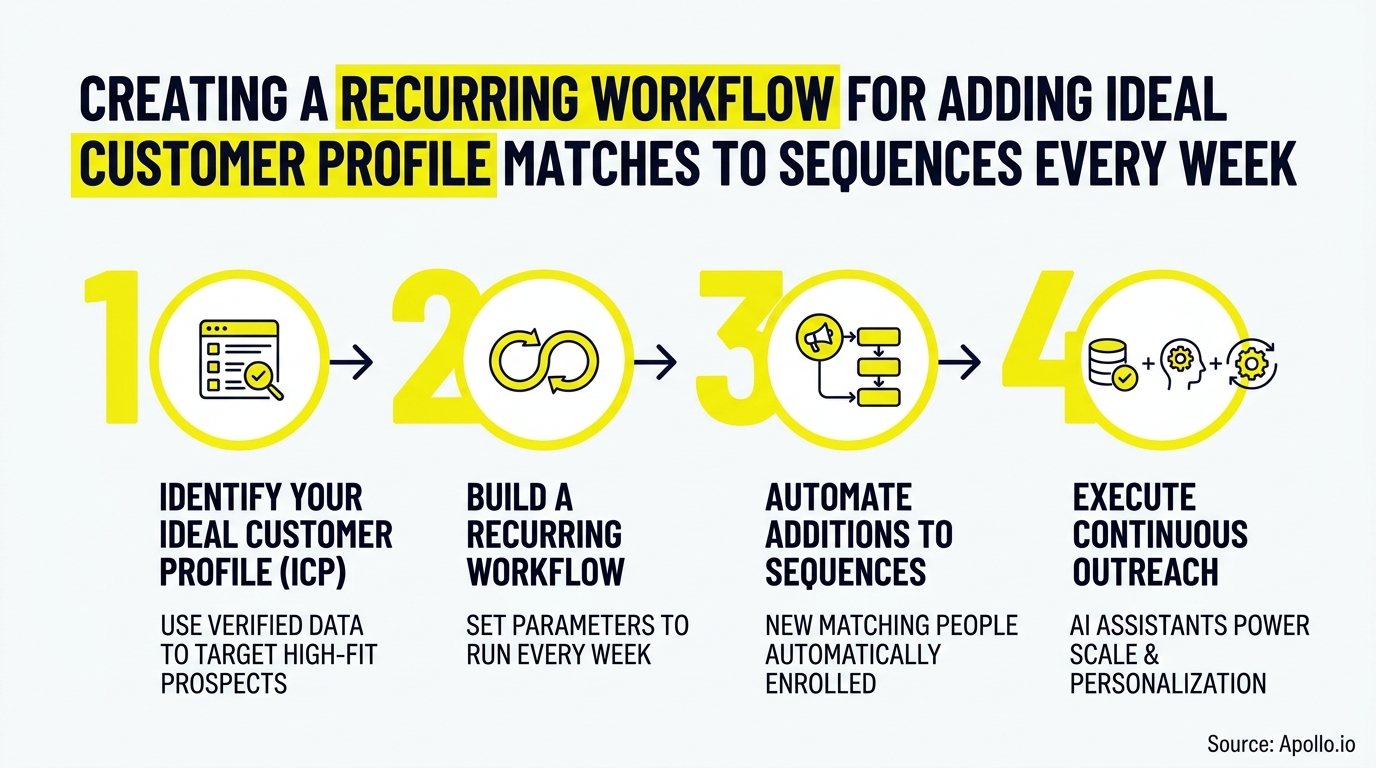
Yes. You can build a recurring workflow that scans for new people matching your ICP and automatically enrolls them into a sequence every week.
Most sales engagement platforms, including Apollo, support this natively with scheduled triggers, filter logic, and enrollment caps. The harder question isn't "can I," it's "should I enroll everyone the filter finds" and the answer is no.
A recurring ICP-to-sequence workflow only works long-term if it includes qualification gates, suppression rules, and volume caps. Without them, you risk burning your sender reputation and re-contacting people who already replied "not interested." Below is a seven-gate framework for building this safely, plus how to implement it in Apollo Workflows.

Skip Manual Research, Get Verified Contacts
Burning hours manually digging up emails and phone numbers that bounce anyway. Apollo hands you verified contact data instantly at 98% accuracy, so reps spend time selling, not searching. Join 600K+ companies prospecting smarter.
Start Free with Apollo →Key Takeaways
- Yes, recurring ICP-to-sequence workflows are technically supported by most GTM platforms, but they need seven safeguards to avoid spam complaints and duplicate outreach.
- Use Apollo MCP when you need to build or check this workflow without leaving Apollo MCP-connected tools like ChatGPT, Claude, or Perplexity.
- Dynamic signals (job changes, funding, hiring, intent) outperform static title-and-industry filters for weekly re-enrollment.
- Use Apollo MCP when you need a quick answer like "how many new ICP-matched contacts were added to my sequence this week" without opening a dashboard.
- Volume caps and reply-based exit rules protect deliverability and prevent the same net-new contact from getting flagged twice.
Is It Possible To Automate Weekly ICP Enrollment Into A Sequence?
Yes, this is a standard capability in modern sales engagement and workflow tools, not a custom build. Apollo Workflows, for example, can run on a weekly schedule, filter contacts against ICP criteria, and automatically enroll qualifying people into a sales sequence. Salesforce's Hunter agent and HubSpot's Prospecting Agent now offer comparable signal-triggered automation, so this pattern has moved from niche to mainstream across the category.
The mechanics are simple: a scheduled trigger runs your search, a filter checks it against exclusion lists, and an action step enrolls the surviving records. The complexity lives in what happens between "search" and "enroll," which is where most teams get this wrong.
What Are The Seven Gates A Recurring ICP Workflow Needs?
A recurring ICP workflow needs seven checkpoints between finding a contact and enrolling them in outreach. Skipping any one of these gates is how teams end up re-pitching existing customers or triggering spam complaints.
| Gate | Purpose | Example Rule |
|---|---|---|
| 1. ICP match | Confirms firmographic fit | Title = VP/Director, employees 50-500, target industry |
| 2. Net-new check | Prevents re-enrolling known contacts | Exclude anyone in CRM > 90 days |
| 3. Account suppression | Blocks existing customers/open deals | Exclude accounts with active opportunity |
| 4. Signal qualification | Prioritizes timing, not just fit | Job change, funding event, hiring surge, intent spike |
| 5. Data verification | Confirms deliverable contact info | Verified email/phone only, no catch-all guesses |
| 6. Volume cap | Protects sender reputation | Max 50-100 new enrollments per week |
| 7. Reply/approval gate | Stops outreach on signal or requires sign-off | Auto-pause on reply; optional manager approval step |
Build your ICP definition before configuring gate one. A vague ICP produces a noisy weekly list no amount of downstream filtering can fix.
Why Do Dynamic Signals Matter More Than Static ICP Filters?
Dynamic signals matter because timing converts better than firmographic fit alone. A person who matches your ICP today likely matched it last month too, so a purely static filter just re-surfaces stale names. professional networks's 2024 analysis found that people who started a new job within the previous 90 days were 62% more likely to accept outreach, and director-level buyers were more likely to change roles in January than other months.
Layer these signals on top of your static ICP filters instead of replacing them:
- Recent job change or promotion
- New funding round or headcount growth
- Hiring for roles tied to your product category
- Website or content engagement (intent data)
- Technology or vendor changes
Buyers still control most of the early research phase. Gartner's research on B2B buying found that 73% of buyers avoid suppliers who send irrelevant messages, so signal-based prioritization isn't optional polish, it's what keeps your weekly batch from reading as generic.

How Do SDRs Avoid Automating Irrelevant Outreach?
SDRs avoid irrelevant outreach by pairing automated enrollment with a personalization gate, not by removing automation entirely. Research from professional networks and Ipsos found that 78% of B2B buyers strongly agreed outreach should be personalized to their business, which means auto-enrolled contacts still need message variables pulled from real account data, not just \{\{first_name\}\}.
For SDRs managing multiple sequences, the practical fix is a two-tier system: a smaller, high-signal segment gets manually reviewed messaging, while a broader ICP-matched segment gets templated but personalized-at-scale copy using enriched fields like recent funding, tech stack, or headcount.
This keeps volume up without making every message feel automated.
How Do RevOps Leaders Set Caps And Approval Rules?
RevOps leaders set caps and approval rules by defining a weekly enrollment ceiling and deciding which segments need human sign-off before sending. A common structure looks like this:
| Segment | Weekly Cap | Approval Needed? |
|---|---|---|
| High-intent signal match | 25 contacts | No, auto-enroll |
| Standard ICP match | 50-75 contacts | Spot-check sample only |
| Enterprise/named accounts | 10 contacts | Yes, AE sign-off required |
RevOps should also monitor deliverability weekly. Google requires senders delivering more than 5,000 messages per day to Gmail addresses to keep spam complaint rates under 0.10% and never reach 0.30%, per Google's sender guidelines. A recurring workflow without a cap can silently push you past that threshold within a few weeks.
Tired of dirty data breaking your enrichment step? Start free with Apollo's 240M+ verified business contacts.
Turn Lead Chaos Into Real Pipeline
Marketing hands off leads that go nowhere and forecasts feel like guesswork. Apollo scores and prioritizes prospects by buying intent, so reps chase deals ready to close, not dead ends. Built-In saw a 10% lift in win rate using Apollo's signals.
Start Free with Apollo →How Do You Build This In Apollo Or From An AI Tool Like ChatGPT?
You build this in Apollo by creating a scheduled Workflow with a weekly trigger, ICP filter criteria, exclusion rules, and a sequence enrollment action. Apollo Workflows lets you set the run frequency, cap contacts per run, and require approval before enrollment, which covers gates one through seven above in a single build.
If you'd rather manage this from inside an AI tool you already use, Apollo MCP connects Apollo to ChatGPT, Claude, Perplexity, and Codex. From one of those chats, you can ask Apollo to search for people matching your ICP, enrich them with verified emails and phone numbers, and add qualifying contacts to a sequence, all without opening a separate dashboard.
Setup is no-code: connect via OAuth inside the AI tool's connectors settings, and your data and action limits mirror whatever Apollo plan you're on, including free. Developers can use the Apollo CLI for the same actions from a terminal.
Your best prospecting session shouldn't require opening a new tab. For teams building sequences manually, review proven sequence structures before automating enrollment, since a recurring workflow only amplifies whatever cadence you plug it into.
What Should A Weekly QA And Compliance Checklist Include?
A weekly QA checklist should confirm your workflow is enrolling the right people at a safe volume without duplicating past outreach. Run through this before each weekly batch goes live:
- Confirm net-new filter is excluding anyone contacted in the last 90 days
- Spot-check 5-10 enrolled contacts against your ICP definition
- Verify email/phone data on the batch, not just at initial enrichment
- Check spam complaint rate is under Google's 0.10% guideline
- Confirm reply-triggered auto-pause is functioning
- Review account suppression list for new customers or active deals
- Audit total weekly volume against your cap
For RevOps leaders managing this at scale, consistent QA is what separates a workflow that compounds pipeline from one that quietly damages deliverability. Teams using AI-driven automation for prospecting research save measurable time versus manual list-building, according to Overton Collective, but that time savings only pays off if the QA layer is running in parallel.
How Does This Fit Into A Broader Sales Tech Stack?
This fits best when your data, sequencing, and enrollment logic live in one connected system instead of stitched-together tools. Running ICP search, enrichment, suppression checks, and sequence enrollment across separate platforms multiplies the places something can break, from stale exports to mismatched suppression lists.
Collin Stewart of Predictable Revenue said, "We reduced the complexity of three tools into one." Consolidating search, enrichment, and sequencing into a single workspace is what makes a recurring workflow maintainable by one RevOps admin instead of a rotating cast of point solutions.
Struggling to keep sequences full without manual list pulls every week? Automate ICP-matched enrollment with Apollo's sales engagement platform.
Frequently Asked Questions
Can I set up a recurring workflow that adds new people matching my ICP to a sequence every week?
Yes. Apollo Workflows and comparable platforms support scheduled, filter-based enrollment on a weekly cadence, provided you add net-new checks, suppression rules, and volume caps.
How do I stop the workflow from re-enrolling the same contacts?
Add a net-new filter that excludes anyone already in your CRM or previously enrolled in the sequence within a defined window, typically 90 days.
What's a safe weekly enrollment limit?
Most teams start with 50-100 new contacts per week per sequence, adjusting based on reply rates and deliverability metrics like spam complaint percentage.
Should the workflow require manual approval?
For named or enterprise accounts, yes. For high-intent signal matches at lower volume, auto-enrollment with spot-check QA is typically sufficient.
Does this replace manual list building entirely?
No. It replaces the repetitive weekly search-and-export task, but ICP definition, messaging strategy, and QA still require human oversight.

Ready To Automate Your Weekly ICP Enrollment?
A recurring ICP-to-sequence workflow saves real time, but only when it's built with the guardrails above: net-new checks, suppression, signal prioritization, verified data, volume caps, and reply-based exits. Skip any gate and you risk burning deliverability or re-pitching existing customers instead of building pipeline.
Apollo brings ICP search, verified contact data, and sequence automation into one workspace, so RevOps doesn't have to stitch together separate tools for research, enrichment, and outreach. Start free with Apollo, then explore sequence-building best practices to make sure your automated enrollment feeds a cadence that actually converts.
Request a Demo to see how Apollo Workflows can automate your weekly ICP enrollment safely.
Justify Spend With Apollo's Real Pipeline Math
Struggling to justify tool spend when leadership wants hard numbers, not promises? Apollo replaces scattered point tools with one platform, so reps spend less time switching apps and more time closing. Leadium 3x'd annual revenue after consolidating with Apollo.
Start Free with Apollo →Don't miss these
Sales
Inbound vs Outbound Marketing: Which Strategy Wins?
Sales
What Is a Sales Funnel? The Non-Linear Revenue Framework for 2026
Sales
What Is a Go-to-Market Strategy? The 2026 GTM Playbook
See Apollo in action
We'd love to show how Apollo can help you sell better.
By submitting this form, you will receive information, tips, and promotions from Apollo. To learn more, see our Privacy Statement.
4.7/5 based on 9,690 reviews
