
How to Build a Multi-Step Email, Call, and LinkedIn Outreach Sequence
A multichannel sequence beats a single-channel blast because buyers now research and respond across many touchpoints before they ever book a call. McKinsey's 2024 B2B Pulse research found buyers use an average of 10 interaction channels during a purchase, up from five in 2016.
If your sequence still means "email, email, email, give up," you're leaving meetings on the table.
This piece gives you a 14-day email, call, and professional networks sequence template, a branching map for how to react to buyer behavior, a stakeholder matrix for multi-threading, and the metrics that actually predict pipeline.
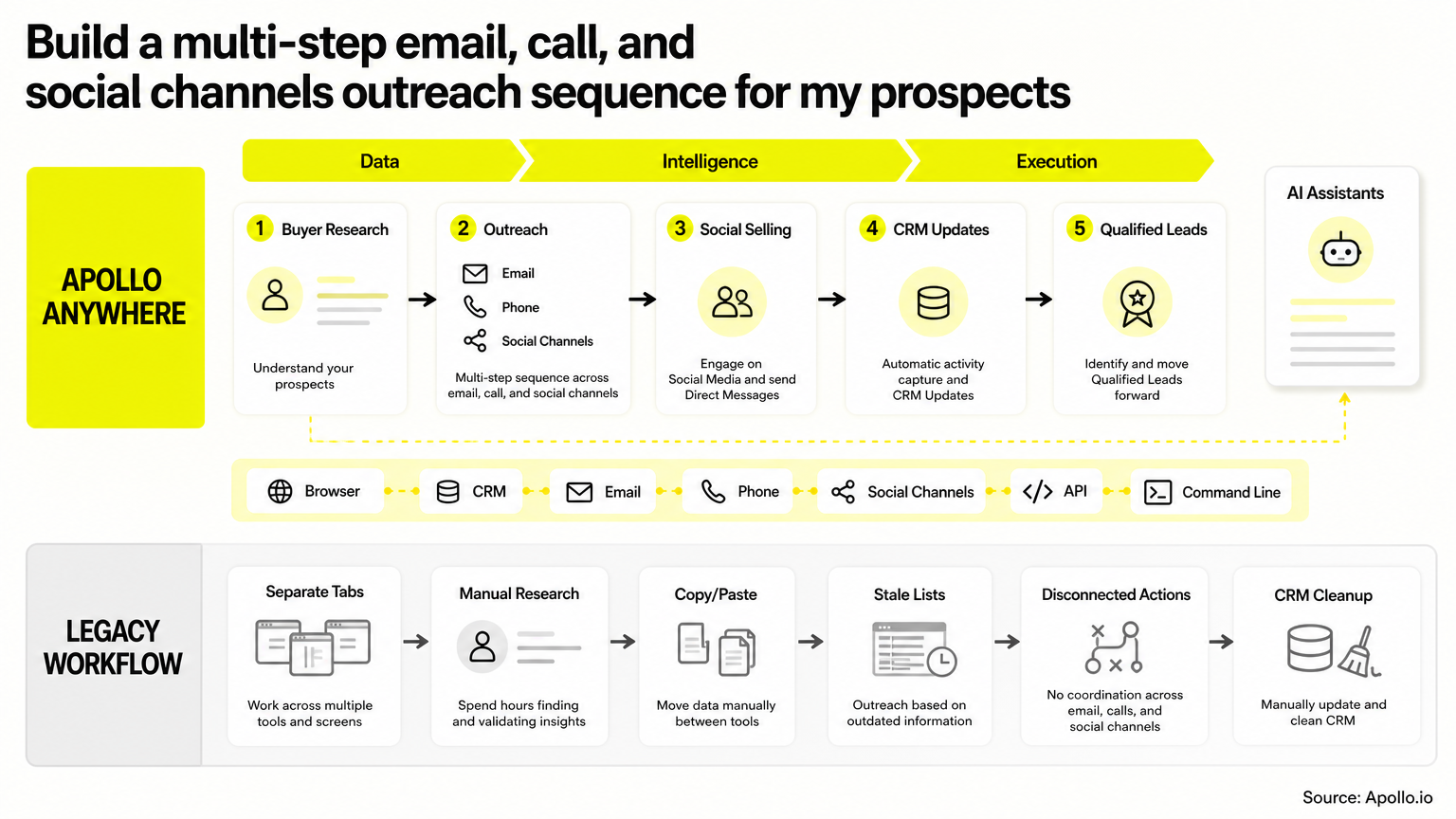
You'll also see how to build and run this inside Apollo Outreach or directly inside the AI tool you already have open.

Skip The Research, Apollo Finds Contacts Fast
Still spending hours hunting down emails and phone numbers that turn out wrong. Apollo puts 240M+ verified contacts at your fingertips with 98% email accuracy, so reps sell instead of searching. Get back to pipeline-building today.
Start Free with Apollo →Key Takeaways
- A 14-day sequence that mixes email, calls, and professional networks outperforms single-channel outreach because it matches how buyers actually research and respond.
- Use Apollo MCP when you need to research a prospect, draft a personalized opener, and add them to a sequence without leaving ChatGPT, Claude, or Perplexity.
- Branch your sequence based on buyer behavior (reply acceptance, content click, call connect) instead of running every prospect through the same fixed calendar.
- Multi-threading into finance, IT, legal, and procurement early prevents deals from stalling with a single champion who can't get budget approved alone.
- Track positive reply rate and meetings booked, not just opens, since deliverability rules from Gmail and Outlook make open rates less reliable in 2026.
What Is A Multichannel Outreach Sequence?
A multichannel outreach sequence is a planned series of email, phone, and social touches, ordered over time, that adapts based on how a prospect responds. It is not simply the same message sent through three channels.
It is a coordinated cadence where each touch has a distinct job: warm up, add proof, create urgency, or offer an exit.
According to Skipcall, sequences using three or more channels (email, phone) achieve a 287% higher response rate than single-channel sequences. That gap exists because buyers self-select the channel where they're most comfortable engaging, and a single-channel sequence only reaches the fraction who prefer that one path.
This is different from generic "drip" automation, which fires on a fixed schedule regardless of buyer behavior. A true multichannel sequence branches: a reply pauses automation, a professional networks acceptance triggers a different next step, and silence after five or six touches ends the sequence entirely.
What Does A 14-Day Core Outreach Sequence Look Like?
A 14-day core sequence opens with email, layers in a call and a professional networks touch by day 3-4, and closes with a breakup message by day 14.
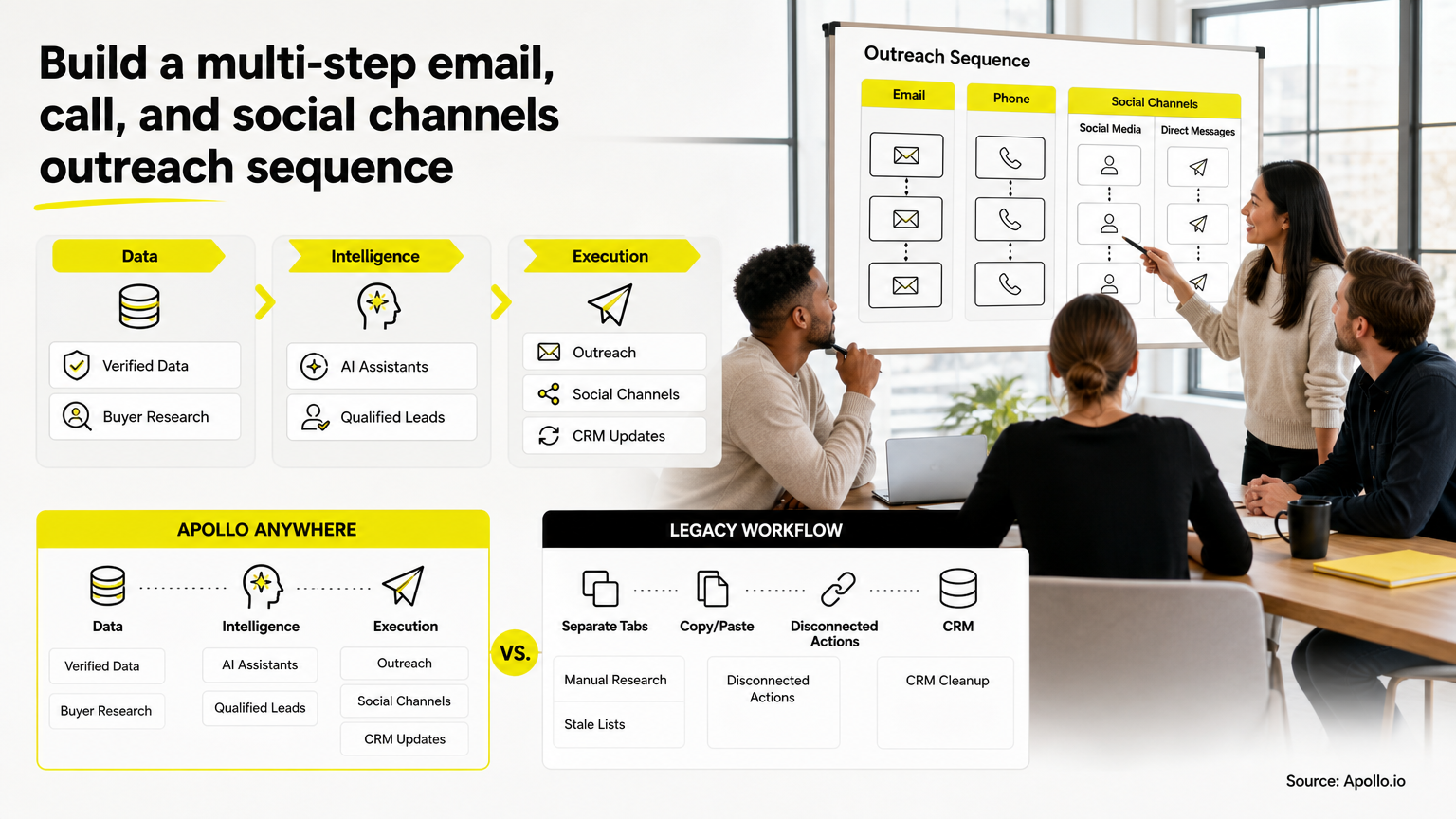
Below is a template you can adapt in Apollo's sequence builder.
| Day | Channel | Objective | Personalization Cue | CTA | Exit Rule |
|---|---|---|---|---|---|
| 1 | Open with relevance | Recent trigger event (funding, hire, product launch) | Low-friction question | Reply pauses sequence | |
| 2 | professional networks | Connection request | Reference shared connection or content | None (just connect) | Skip if already connected |
| 4 | Call | First live attempt | Reference email sent | Ask for 15 minutes | Log voicemail, continue |
| 6 | Add proof | Relevant case study or customer quote | Offer to share more detail | Content click triggers call | |
| 8 | professional networks | Value-add comment/DM | Engage with their recent post | Soft check-in | Reply pauses sequence |
| 10 | Call | Second live attempt | Reference professional networks engagement | Propose specific time | Connect triggers meeting flow |
| 12 | Create urgency | Tie to buyer's fiscal calendar or initiative | Direct meeting ask | No reply continues | |
| 14 | Breakup | Permission-based close | "Should I close your file?" | Sequence ends either way |
Spending hours building this manually for every list? Automate multi-channel sequences with Apollo so reps spend time on conversations, not on manually toggling between inboxes, dialers, and professional networks tabs.
How Should You Branch A Sequence Based On Buyer Behavior?
You should branch a sequence by routing prospects down different paths the moment they show a signal, instead of forcing everyone through the same fixed steps. Five behaviors should trigger a branch:
- Positive reply: Pause all automation immediately and route to a live conversation.
- No engagement after 3 touches: Switch the angle (new pain point, new proof) rather than repeating the same message.
- professional networks connection accepted: Shift to professional networks as the primary channel for the next touch instead of defaulting back to email.
- Content or case study clicked: Trigger an immediate call attempt while interest is warm.
- Call connects but no decision: Move to a shorter, more targeted 3-touch nurture instead of restarting the full 14-day cadence.
This matters more in 2026 because professional networks has been actively reducing distribution of repetitive, automated-looking activity since its June 2026 announcement on keeping conversations authentic. Treat social touches as human-reviewed relationship steps, not a fully automated leg of your cadence.
Know Which Leads Are Sales-Ready With Apollo
Marketing hands off leads that never turn into real opportunities, and forecasts feel like guesswork because deal stages aren't tracked in real time. Apollo scores and prioritizes prospects so reps chase the right deals, not dead ends. See your pipeline clearly and forecast with confidence.
Start Free with Apollo →How Do SDRs Multi-Thread Into A Buying Committee?
SDRs multi-thread by mapping each stakeholder role to a specific type of proof, then running parallel (not identical) sequences into each contact. A single champion rarely has authority to sign alone, and deals stall when only one person is engaged.
| Role | Primary Concern | Best Asset |
|---|---|---|
| Champion | Does this solve my team's problem? | Peer case study, product demo |
| Executive Sponsor | Strategic fit, ROI | Executive summary, analyst data |
| Finance | Cost, budget impact | ROI calculator, pricing comparison |
| IT/Security | Integration, data handling | Security overview, integration docs |
| Legal/Procurement | Contract terms, risk | MSA template, compliance summary |
This is where professional networks social selling earns its place in the cadence. Sharing relevant content builds trust with roles who never take a cold call. Edelman and professional networks's 2025 B2B Thought Leadership research found that hidden decision-makers who rarely interact with sales reps become measurably more receptive to outreach when a vendor consistently publishes credible thought leadership.
How Can AEs Personalize Outreach Without Spending Hours On Research?
AEs personalize efficiently by pulling firmographic and trigger-event data into their opener before writing a single word, rather than researching each account from scratch. Generic openers are the single biggest reason sequences underperform: Gartner's 2025 survey found 73% of B2B buyers actively avoid suppliers who send irrelevant outreach.
For Account Executives managing a full pipeline, the fastest path is pulling enriched account and contact data directly into the sequence tool. Struggling to find the right trigger events and job changes at scale? Search Apollo's 240M+ contacts with 65+ filters to build a targeted list before your first touch goes out.
You can also skip the tab-switching entirely. With Apollo MCP connected inside ChatGPT, Claude, or Perplexity, an AE can ask their AI tool to pull a prospect's role, company news, and verified contact details, draft a personalized email, and add them straight to a sequence, all in one conversation. Developers and RevOps teams building custom workflows can do the same from the terminal using Apollo's CLI.
Why Does Sequence Timing And Follow-Up Cadence Matter?
Timing matters because most reps quit too early while most buyers need repeated exposure before they respond. Research from GrowLeads found that 44% of sales reps give up after one follow-up, even though 80% of sales require five or more touches to close.
That persistence gap compounds over the full buying cycle. A study by Cirrus Insight found average B2B buying cycles now run roughly 10 months, with buyers interacting with their eventual vendor an average of 16 times before purchasing. Your 14-day sequence is the opening act, not the whole show; plan a longer-term nurture track for prospects who go quiet but haven't said no. See more on the best times to call and email prospects to tighten your send windows further.
How Do You Measure If A Multichannel Sequence Is Working?
You measure a sequence by tracking positive replies and meetings booked, not opens and clicks, since deliverability rules now suppress and mask that data. Gmail and Outlook have both tightened bulk-sender requirements since 2025, which means open-rate tracking pixels are increasingly unreliable signals.
- Positive reply rate: Replies expressing interest, not just any response.
- Meetings booked per 100 prospects: Your true conversion benchmark.
- Stakeholder coverage: Percentage of target accounts with 2+ engaged contacts.
- professional networks acceptance rate: A healthy range for a well-defined ICP sits between 30-40%, according to LinkedCamp.
- Spam complaints and opt-outs: Keep these low to protect domain reputation for every future sequence.
Can't tell which deals are actually moving? Get pipeline visibility with Apollo's deal management so reps and managers see sequence performance next to actual revenue outcomes, not just activity counts.
How Do You Build This Sequence Without Managing Five Different Tools?
You build it in one workspace that handles data, sequencing, calling, and reporting together, instead of stitching together a data provider, a dialer, a professional networks tool, and a separate reporting layer. That stitching is exactly the toggle tax that slows teams down: exporting lists, cleaning duplicates, re-importing into a dialer, then building the sequence by hand.
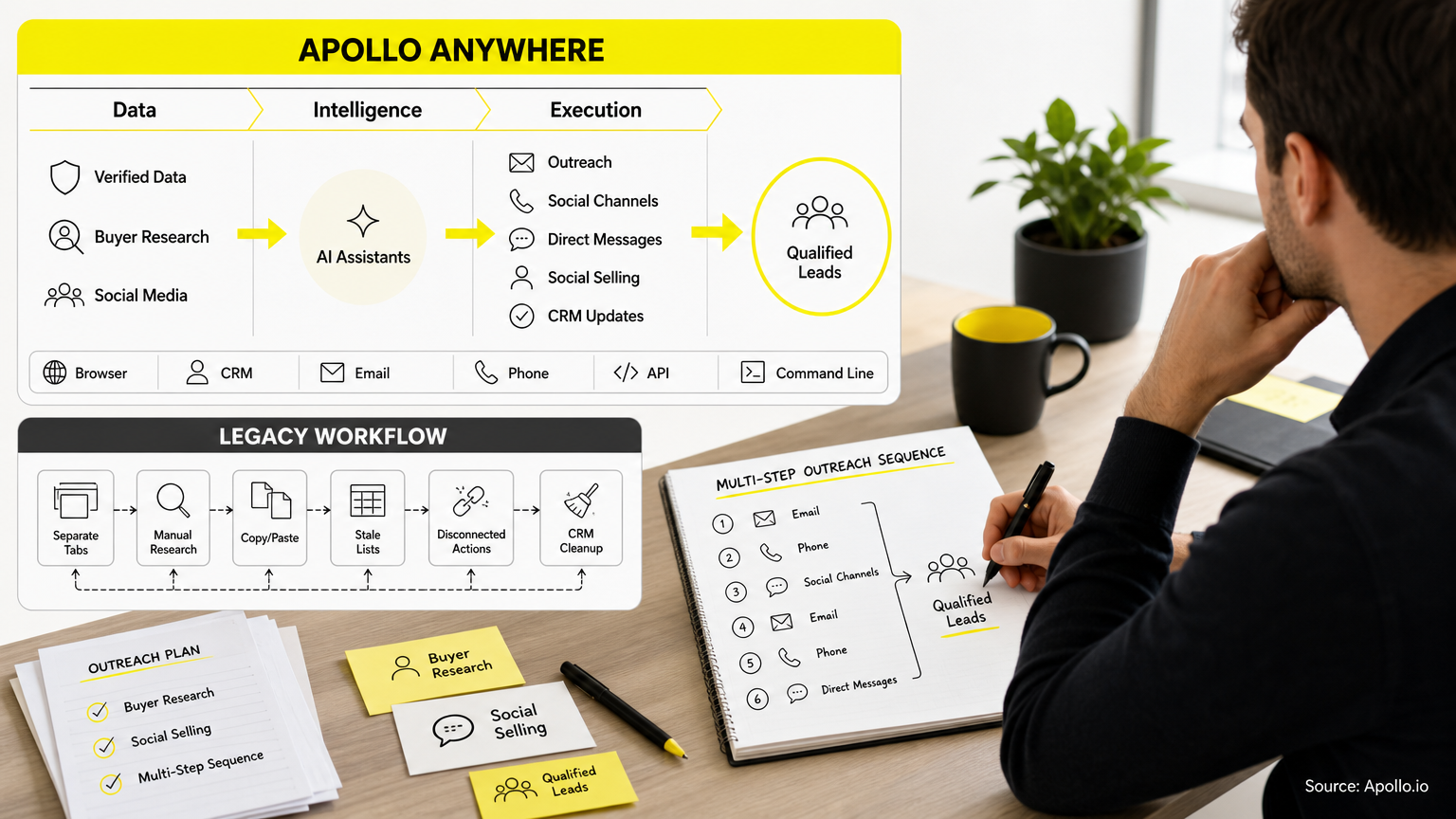
Collin Stewart of Predictable Revenue put it simply: "We reduced the complexity of three tools into one." That's the model to aim for: one place to find contacts, verify emails and phone numbers, launch the sequence above, and see what's working, rather than reconciling data across separate platforms every week.
If you compare sequencing platforms directly, see how the major options stack up in Apollo vs Outreach vs Salesloft before you commit to a stack.
Ready To Launch Your Multichannel Sequence?
Building a sequence that blends email, calls, and professional networks isn't about adding more touches. It's about matching the right channel to the right signal at the right moment, then giving reps the data and tools to execute without friction.
The template, branching logic, and stakeholder matrix above give you the framework; the next step is running it without cobbling together separate tools for data, sequencing, and calling.
Apollo brings B2B data, sales engagement, and AI-powered execution together in one connected go-to-market system, so SDRs, AEs, and RevOps teams don't have to stitch together separate vendors for research, outreach, and analysis. Start free with Apollo today.
What Are Common Questions About Multi-Step Outreach Sequences?
How Many Touchpoints Should A Multi-Step Sequence Include?
Most effective sequences include 8-12 touchpoints spread across 15-20 business days, mixing email, phone, and social channels. Fewer touches risk under-engaging a prospect who needs more context; more than 12-15 touches in a single sequence tends to produce diminishing returns and higher opt-out rates.
The exact number should flex based on deal size: enterprise accounts often warrant longer sequences with more research-driven personalization, while transactional deals can convert with shorter, faster-moving cadences.
Should Email, Calls, Or professional networks Come First In A Sequence?
There's no universal rule, but the channel order should match how your buyer persona prefers to engage. A common pattern is to open with a personalized email (low friction, easy to ignore or reply to on the prospect's schedule), follow with a call once the email has had a day or two to land, then layer in social touches to stay visible between calls and emails.
For inbound or high-intent leads, calling first often makes sense since speed matters more than sequencing finesse.
How Do RevOps Teams Keep Sequence Data Clean Across Channels?
RevOps teams keep sequence data clean by routing every touchpoint, email opens, call outcomes, and social engagement, into a single system of record instead of reconciling exports from separate tools. This eliminates the manual work of matching activity logs across platforms and gives revenue leaders one accurate view of what's working. Consolidating data enrichment, sequencing, and calling into one go-to-market platform is the most direct way to solve this, since every action logs against the same contact record automatically.
Can I Build And Launch A Sequence Directly From My AI Assistant?
Yes. With Apollo MCP, you can ask Claude, ChatGPT, Perplexity, or Codex to pull a list of prospects matching your ICP, enrich their contact details, and queue them into a multi-step sequence, all without leaving that conversation.
This is especially useful for reps who want to move from research to outreach in one workflow instead of switching between a data tool, a sequencer, and a spreadsheet.
Prove ROI Fast With Apollo's One Platform
Struggling to justify tool spend when value takes months to show up? Apollo replaces scattered point solutions with one platform reps adopt in days, not quarters. Leadium 3x'd annual revenue after consolidating their stack with Apollo.
Start Free with Apollo →Don't miss these
Sales
Inbound vs Outbound Marketing: Which Strategy Wins?
Sales
What Is a Sales Funnel? The Non-Linear Revenue Framework for 2026
Sales
What Is a Go-to-Market Strategy? The 2026 GTM Playbook
See Apollo in action
We'd love to show how Apollo can help you sell better.
By submitting this form, you will receive information, tips, and promotions from Apollo. To learn more, see our Privacy Statement.
4.7/5 based on 9,690 reviews
