
Apollo vs Zoho (2026): Features, Pricing & Which Platform Wins for B2B Sales
If you're evaluating tools for your B2B sales team, Apollo and Zoho represent two fundamentally different approaches. Zoho is a broad business operating system spanning HR, finance, and sales.
Apollo is purpose-built for B2B pipeline generation. Choosing between them comes down to whether you need a general-purpose business suite or a dedicated sales intelligence and engagement platform.

Research Less, Close More With Apollo
Tired of burning hours verifying contacts that go nowhere? Apollo delivers 240M+ business contacts with 98% email accuracy so your reps spend time selling, not searching. Start building real pipeline today.
Start Free with Apollo →Key Takeaways
- Platform scope: Zoho One bundles 50+ business apps across sales, HR, finance, and operations. Apollo focuses specifically on B2B GTM execution, combining prospecting data, sequencing, and a dialer in one connected system.
- Sales intelligence capabilities: Apollo includes a built-in B2B database with 240M+ people and 30M+ companies, buyer intent signals, and 98% email accuracy. Zoho does not include a native B2B prospecting database.
- AI features: Apollo offers AI-powered sequence building, lead scoring, call summaries, research agents, and an AI dialer. Zoho's AI capabilities are built around general business operations rather than outbound sales execution.
- Who Apollo serves: Apollo serves B2B GTM teams, GTM Engineers, and AI Builders building headless GTM workflows with the Apollo API, CLI, and MCP, alongside Sales Professionals, SDRs/BDRs, AEs, RevOps, Marketing, and Revenue Leaders.
- Pricing model: Apollo offers transparent per-seat pricing starting at $49/user/month (annual billing) with a free tier. Zoho One starts at $9/user/month (annual billing) for its Essentials plan, scaling to $37/employee/month for the Standard All Employee plan.
What is Apollo?

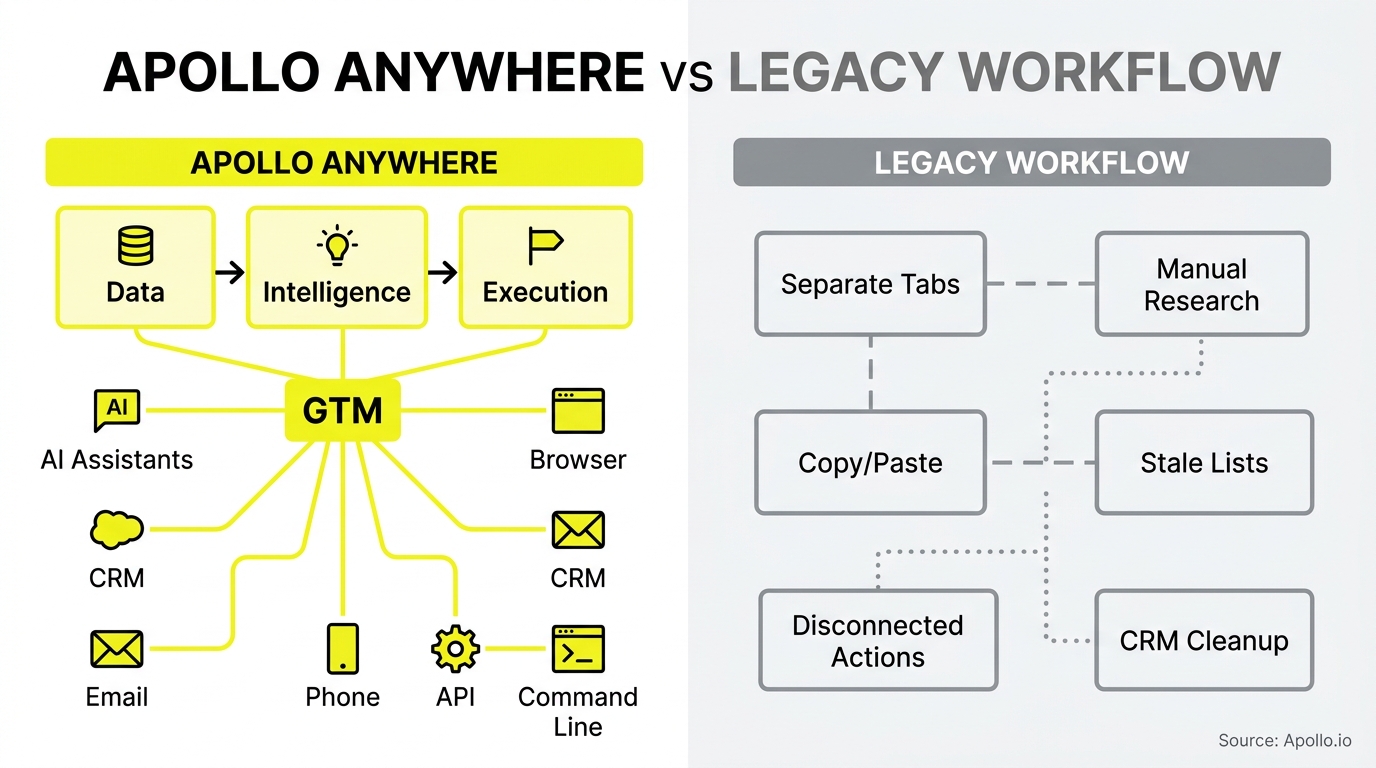
Apollo is an AI GTM system that unifies data, intelligence, and execution into one connected GTM system. Rather than requiring teams to stitch together a prospecting tool, a sequencer, a dialer, and a CRM enrichment layer, Apollo brings each of these into a single workspace. Sales teams can identify and research prospects, launch multi-channel sequences, make calls, and enrich their CRM records without switching contexts. Apollo's B2B database spans 240M+ people and 30M+ companies, with 98% email accuracy powered by its Living Data Network.
Apollo meets sellers inside the tools they already use. Through Apollo MCP, Apollo's Model Context Protocol, teams can surface Apollo data and intelligence directly inside AI assistants including ChatGPT, Codex, Claude, and Perplexity. The Apollo Chrome extension enables prospecting from anywhere across the web. For technical and advanced users, Apollo CLI provides terminal-native access for headless GTM workflows and API-driven automation.
According to Ramp's vendor data, as of July 2026, 38% of organizations using a Sales Data Providers tool use Apollo, with adoption up 5 percentage points year-over-year. Apollo holds a 22% competitor switch rate, meaning a substantial share of its customers actively chose Apollo after using another platform in the same category. Apollo offers transparent pricing starting at $49/user/month (annual billing), with a free tier available.

What is Zoho?

Zoho is a business software company that offers Zoho One, a suite of 50+ unified applications covering sales, marketing, customer service, finance, HR, and operations. The platform is designed to give businesses a single vendor for their entire operational stack, with centralized user administration, a unified interface, and a single billing invoice across all apps.
Zoho One's CRM application, Zoho CRM, is the sales-facing component of the suite. It provides contact and deal management, pipeline tracking, workflow automation, and reporting.
The platform includes Zia, Zoho's built-in AI assistant, which supports sales forecasting, activity suggestions, and anomaly detection within the CRM context. Zoho also offers email marketing, web analytics, help desk, and project management tools within the same subscription.
Zoho One is structured around licensing flexibility. The Standard All Employee plan requires a license for every person on your payroll at $37/employee/month (annual billing), which suits companies wanting a true company-wide deployment.
The Flexible User plan at $67/user/month (annual billing) lets teams license only the users who need access. An Essentials plan at $9/user/month (annual billing) covers 15+ apps for teams with lighter requirements.
It is important to note what Zoho One does not include for B2B sales teams: the platform does not provide a native B2B contact prospecting database, outbound sequence automation comparable to a dedicated sales engagement tool, or a built-in power or parallel dialer. Teams using Zoho CRM for outbound prospecting would typically connect it to third-party data and engagement tools to cover those workflows. Apollo, by contrast, integrates directly with Zoho CRM as a data and engagement layer, per the Apollo Integrations page.
Feature Comparison
| Feature | Apollo | Zoho One |
|---|---|---|
| Starting Price | $49/user/month (annual billing); free tier available | $9/user/month billed annually (Essentials); $37/employee/month or $67/user/month (Standard, annual) |
| B2B Database | 240M+ people, 30M+ companies, built in | No native B2B prospecting database |
| Email Accuracy | 98% | Not applicable, no native contact database |
| Sequences | Multi-channel sequences (email, calls, social, tasks); AI Sequence Builder included | Email campaigns available via Zoho Campaigns; not a dedicated sales sequencing tool |
| Dialer | Power Dialer and Parallel Dialer with AI call summaries, voicemail drop, real-time coaching | Zoho CRM integrates with Zoho PhoneBridge for calling; no built-in parallel dialer |
| AI Capabilities | AI Research Agent, AI Sequence Builder, AI lead scoring, AI dialer, call summaries, AI-personalized messaging | Zia AI for sales forecasting, activity suggestions, and anomaly detection within CRM |
| Data Enrichment | Waterfall enrichment, CRM enrichment (Salesforce, HubSpot, Zoho CRM), CSV and API enrichment | CRM data entry and basic enrichment; relies on third-party integrations for B2B contact data |
| Free Trial | Free tier with 900 credits/year | 15-day free trial available |
The core distinction is platform purpose. Zoho One is designed to replace a wide range of business software with a single subscription.
Apollo is built specifically around the B2B sales motion, providing data, engagement, and intelligence in one system. Teams that need CRM, HR, finance, and customer support under one vendor may find Zoho's breadth valuable.
Teams whose primary goal is outbound pipeline generation will find Apollo's native prospecting and engagement layer more aligned with their workflow.

Pricing Comparison
Apollo's full pricing breakdown, available at apollo.io/pricing, is structured around four tiers (annual billing):
- Free: $0, 900 credits/year, 2 sequences, basic filters
- Basic: $49/user/month, 30,000 credits/year, unlimited sequences, CRM integrations, intent topics
- Professional: $79/user/month, 48,000 credits/year, US dialer, automated workflows, AI research
- Organization: $119/user/month (min. 3 users), 72,000 credits/year, international dialer, SSO, advanced security
Zoho One's pricingoffers three structures:
- Essentials: $9/user/month billed annually, 15+ apps, centralized user control
- Standard, All Employee Pricing: $37/employee/month billed annually, requires a license for every employee on payroll; includes 50+ apps and mobile device management
- Standard, Flexible User Pricing: $67/user/month billed annually ($90/user/month on monthly billing), license only the users who need access
On a per-seat basis, Zoho One's Essentials plan is significantly lower cost than Apollo's paid tiers. However, the comparison is not apples-to-apples in terms of functionality.
Zoho's sales-specific plan does not include a B2B prospecting database, a power dialer, or dedicated sales sequencing. Teams that add third-party data and engagement tools to complement Zoho CRM will see their total cost increase.
Apollo's credit-based model covers both data access and enrichment within a single subscription, consolidating what might otherwise require separate tools.
"We paid less for one tool than for two tools together...we cut our costs in half.", Sylvain Giuliani, Head of Growth & Operations at Census
Turn Funnel Guesswork Into Pipeline Wins
Pipeline forecasting a guessing game while quality leads stall before they ever reach your AEs? Apollo surfaces in-market buyers and signals exactly when to strike. Nearly 5M users stopped guessing and started closing.
Start Free with Apollo →How Apollo Differs from Zoho
The most significant difference is that Apollo is built ground-up for B2B revenue generation, while Zoho One is a horizontal business suite. This distinction shapes every feature decision.
Apollo's database, sequencing engine, dialer, and AI tools are all designed to accelerate the same workflow: find the right people, reach them at the right time, and convert conversations into pipeline. Zoho CRM is one module within a much broader platform, optimized for record management and business operations rather than outbound prospecting.
For teams building GTM workflows programmatically, Apollo provides an open architecture. Apollo MCP enables AI assistants to query Apollo data natively.
The Apollo API supports bulk enrichment and integration with data warehouses. These capabilities make Apollo a fit not just for individual sellers but for GTM Engineers and AI Builders constructing automated pipeline systems.
Apollo's sales engagement layer includes a Power Dialer and Parallel Dialer with AI-generated call scripts, automatic voicemail drop, real-time manager coaching, and call summaries pushed to CRM. This is native to the platform at the Professional tier, not an add-on. Zoho CRM connects to telephony via Zoho PhoneBridge, which supports integrations with third-party calling tools rather than a built-in parallel dialing system.
According to Ramp's Sales Data Providers category data, as of July 2026, Apollo is the fastest-growing vendor in the Sales Data Providers category, averaging +0.7 percentage points of adoption per month. Apollo also ranked second for new adopter share at 34%, meaning that among teams purchasing a sales data platform for the first time, Apollo captured a third of all new customers.

"Having Apollo and having everything be in one system was a game changer, for BDRs specifically.", Andrew Froning, BDR Leader at Cyera
Frequently Asked Questions
Can Apollo replace Zoho CRM?
Apollo is not a full CRM replacement. It functions as a sales intelligence and engagement layer that syncs bidirectionally with CRMs including Zoho CRM, Salesforce, and HubSpot.
Teams using Zoho CRM can connect Apollo to enrich records, run sequences, and book meetings, while keeping their CRM as the system of record.
Is Apollo only for outbound sales teams?
No. Apollo serves B2B GTM teams, GTM Engineers, and AI Builders building headless GTM workflows with the Apollo API, CLI, and MCP, alongside Sales Professionals, SDRs/BDRs, AEs, RevOps, Marketing, and Revenue Leaders.
The platform includes inbound capabilities such as website visitor identification, form enrichment, and lead routing alongside its outbound sequencing and dialer tools.
Does Zoho One include a B2B contact database?
No. Zoho One does not include a native B2B prospecting database.
Zoho CRM manages the contacts your team already has. To source net-new prospect data, teams would connect Zoho CRM to an external data provider.
Apollo includes its own built-in database, as detailed in the feature comparison above.
How does Apollo's pricing compare to Zoho at scale?
Zoho One's Standard All Employee plan requires purchasing a license for every employee on payroll, which can increase costs for companies where only a portion of staff uses the sales tools. Apollo's per-seat model lets sales teams pay only for the seats they use.
For a detailed breakdown, see the Pricing Comparison section above.
Is Apollo recognized as a leading platform in its category?
Apollo holds a 4.7/5 G2 rating and received the 2026 MarTech Breakthrough Award for "Best AI-Powered Sales Solution". It is also recognized on G2's Top 100 Best Software Products and Top 50 Sales Products lists.

Conclusion
Apollo and Zoho serve different core needs. Zoho One is a broad business operating system suited for companies that want to consolidate general business functions, including sales, HR, and finance, under a single vendor.
Apollo is a purpose-built AI GTM system designed for B2B revenue teams that need prospecting data, multi-channel engagement, and AI-driven execution in one connected system.
For B2B sales teams focused on generating pipeline, Apollo provides capabilities that Zoho One does not include natively: a verified contact database, sales sequencing, a parallel dialer, intent signals, and AI-powered research and personalization tools. These are the building blocks of an outbound motion, and with Apollo they come pre-integrated rather than assembled from separate subscriptions.
If your team's priority is accelerating B2B pipeline generation, try Apollo free today and see how data, intelligence, and execution work together in one platform.
Prove Pipeline ROI From Day One
Budget approval stuck waiting for proof that your sales tools actually work? Apollo delivers measurable pipeline impact fast — Leadium 3x'd annual revenue, Built-In gained +10% win rate. Start free today.
Start Free with Apollo →Don't miss these
Sales
Inbound vs Outbound Marketing: Which Strategy Wins?
Sales
What Is a Sales Funnel? The Non-Linear Revenue Framework for 2026
Sales
What Is a Go-to-Market Strategy? The 2026 GTM Playbook
See Apollo in action
We'd love to show how Apollo can help you sell better.
By submitting this form, you will receive information, tips, and promotions from Apollo. To learn more, see our Privacy Statement.
4.7/5 based on 9,690 reviews
