
Apollo vs Unify (2026): AI GTM System Comparison & Pricing
Choosing between Apollo and Unify comes down to a core question: do you want a connected system that spans data, engagement, and execution, or a prospecting-focused tool built around AI-generated outbound campaigns? Both platforms serve B2B sales teams looking to move faster with better data, but they take different approaches to how that data turns into pipeline.
This comparison breaks down features, pricing, and where each platform fits so you can make an informed decision for 2026.

Apollo Ends Hours Of Manual Contact Research
Still researching contacts one by one before you can even start a sequence? Apollo surfaces verified buyers instantly and keeps outreach consistent as your team scales. Get 98% email accuracy from day one.
Start Free with Apollo →Key Takeaways
- Platform scope: Apollo combines sales intelligence data with built-in execution tools including sequences, a native dialer, and workflow automation, while Unify centers on AI-native prospecting, enrichment, and signal-based outbound campaigns.
- Pricing structure: Apollo's paid plans start at $49/user/month on annual billing with a free tier included; Unify's paid plans start at $20/seat/month on monthly billing, with its top Business tier requiring a quote.
- Calling capabilities: Apollo includes Power Dialer and Parallel Dialer functionality natively in its platform; Unify's product centers on multi-channel sequencing without a named standalone dialer product.
- Credit-based models: Both platforms use credits for enrichment and outreach actions, but allocate and price those credits differently by plan and seat count.
- Who each platform serves: Apollo serves B2B GTM teams, GTM Engineers, and AI Builders building headless GTM workflows with the Apollo API, CLI, and MCP, alongside Sales Professionals, SDRs/BDRs, AEs, RevOps, Marketing, and Revenue Leaders.
What is Apollo?
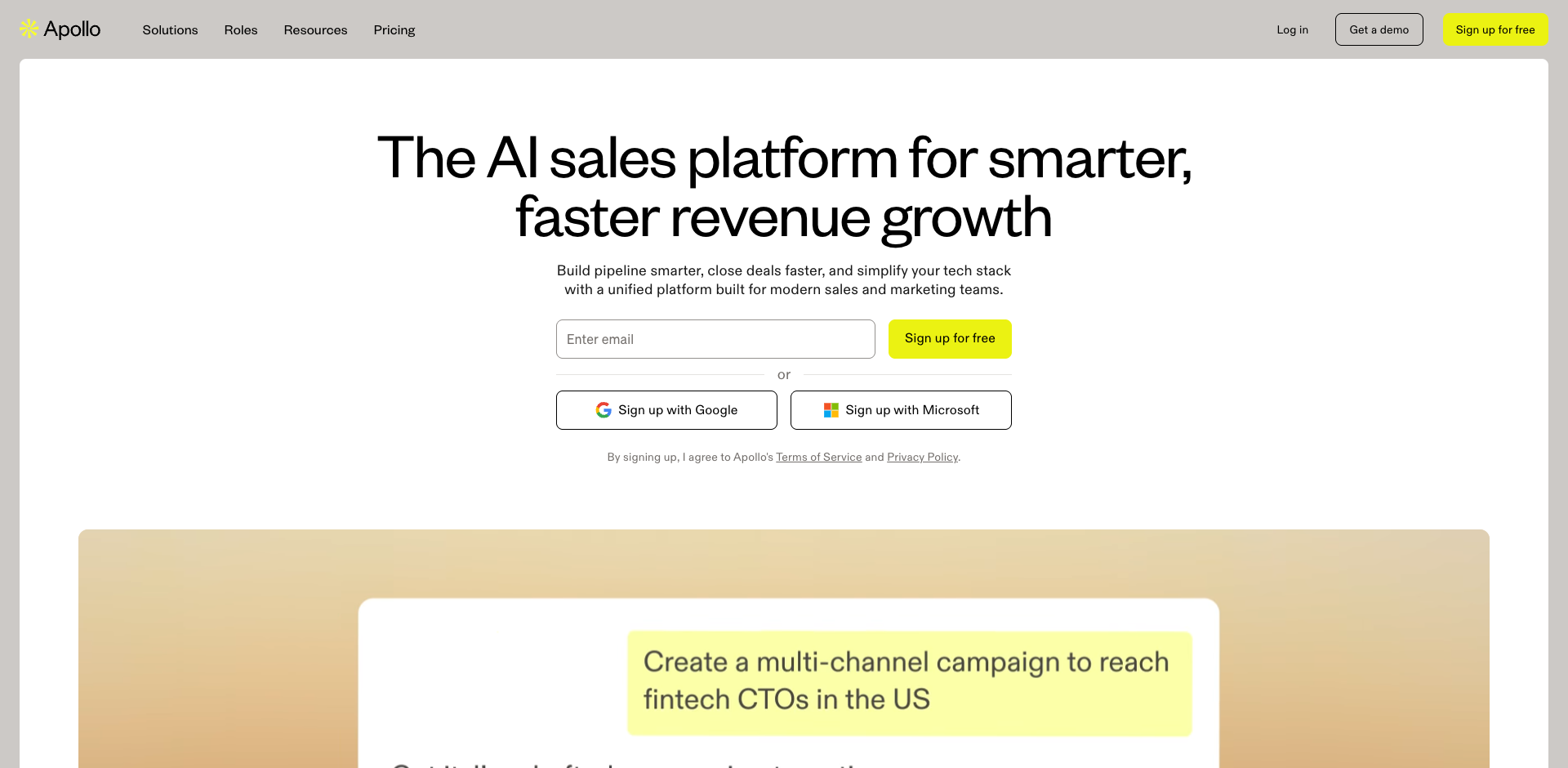
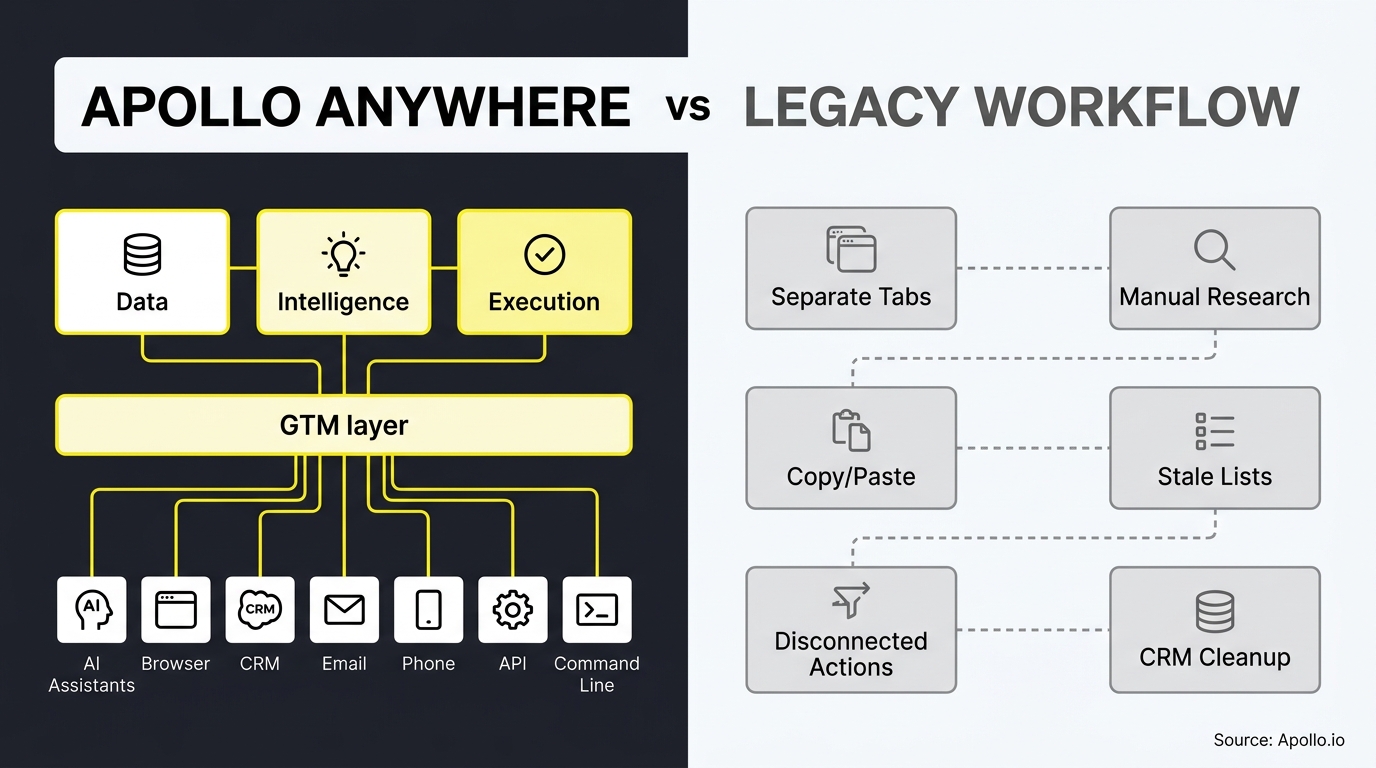
Apollo is an AI GTM system that unifies data, intelligence, and execution, giving sales teams one connected system to find prospects, engage them across channels, and analyze what's working. Apollo's database includes 240M+ people and 30M+ companies, with 98% email accuracy, continuously validated through Apollo's Living Data Network rather than treated as a static export.
Apollo is built to meet sellers where they already work. Through Apollo MCP, Apollo's Model Context Protocol, teams can access Apollo's data and workflows directly inside AI assistants like ChatGPT, Codex, Claude, and Perplexity. A Chrome extension brings enrichment and prospecting tools across the web, and for technical teams building headless GTM workflows, Apollo CLI offers terminal-native access.
According to Ramp's vendor data, drawn from real spend activity across thousands of businesses, Apollo holds a 39% adoption rate among companies buying Sales Data Providers software as of September 2026, ranking #2 in the category and up 5 percentage points year-over-year (Ramp's vendor data). Mid-market companies represent Apollo's largest customer group by company size, and enterprise adoption has climbed from 26% to 31% over the past year, reflecting growing adoption across companies of every size.

Core capabilities span prospecting and outbound execution, inbound routing and enrichment, and analytics dashboards for tracking performance. Apollo offers transparent pricing starting at $49/user/month (annual billing), with a free tier also available.
What is Unify?
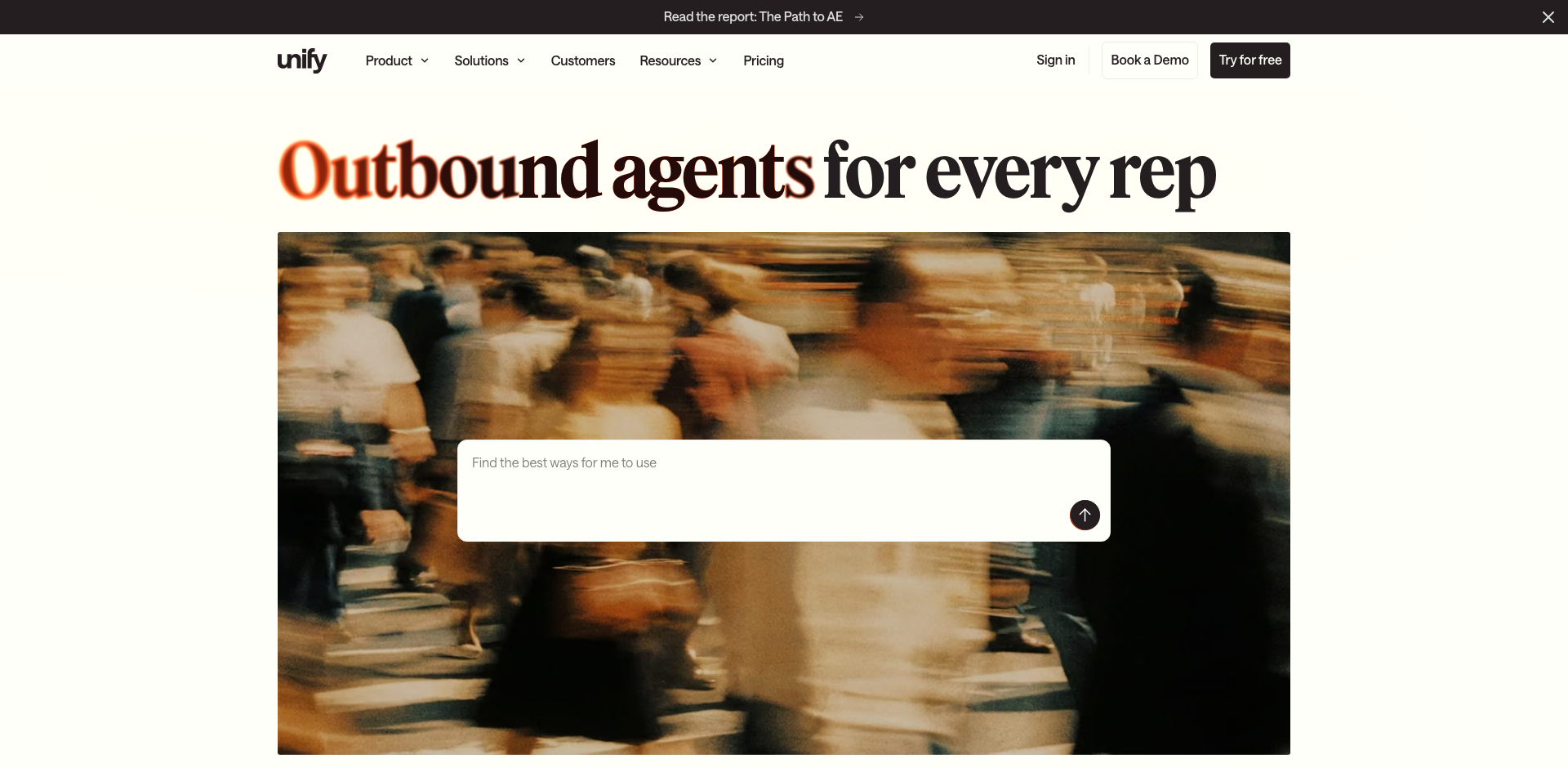
Unify is an AI-native platform for prospecting, research, enrichment, and sequencing, designed to help sellers move from a prompt to targeted outbound campaigns. The platform combines data from 40+ sources, AI-generated messaging, intent and other signals, multi-channel engagement, and deliverability management in a single workflow.
Unify claims access to 1.1B+ people and 65M+ companies across its data sources, according to the company. Key features include AI agents for prompt-driven prospecting, contact and company enrichment, AI-generated email and social copywriting, signal-driven outbound triggered by intent and hiring data, and managed email deliverability with mailbox creation and warming.
Unify integrates with HubSpot and Salesforce, and its Business tier adds advanced models and signal-triggered automations.
Unify's pricing starts with a free tier for up to 3 seats, and paid Base and Pro plans beginning at $20/seat/month billed monthly. Unify is built for BDRs, account executives, and sales leaders running AI-assisted outbound campaigns.
Feature Comparison
| Feature | Apollo | Unify |
|---|---|---|
| Starting Price | $49/user/month (annual billing) | $20/seat/month (billed monthly) |
| B2B Database | 240M+ people, 30M+ companies | Unify claims 1.1B+ people, 65M+ companies |
| Email Accuracy | 98% | Not publicly displayed |
| Sequences | Unlimited multi-channel sequences (email, calls, social, tasks) from Basic tier up | Multi-channel sequencing across email, calls, and social outreach |
| Dialer | Power Dialer and Parallel Dialer built into the platform | Not listed as a standalone dialer product |
| AI Capabilities | AI Assistant, AI Research Agent, AI Sequence Builder, sentiment analysis | AI agents for prospecting, AI-generated email/social copywriting, signal-triggered automations |
| Data Enrichment | Waterfall enrichment, CRM enrichment, CSV enrichment, API enrichment | Contact and company enrichment from 40+ sources, phone and email enrichment (Base tier) |
| Free Trial | Free plan available; 900 credits/year | Free tier (up to 3 seats); 14-day free trial on Pro |
The comparison highlights a key structural difference: Apollo bundles calling, sequencing, and enrichment into one system with plans built around seat-based access to the full toolset, while Unify's plans scale primarily around credit volume and AI feature access, with calling handled as part of its broader multi-channel sequencing rather than a dedicated dialer product.
Apollo Ranks Your Hottest Leads Automatically
Reps guessing which leads to chase while conversions slip? Apollo scores and routes leads by fit and intent the moment marketing hands them off, so follow-up never stalls. Built-In saw higher win rates using Apollo's scoring and signals.
Start Free with Apollo →
Pricing Comparison
Apollo's plans, billed annually, are structured as follows:Free at $0 with 900 credits/year, 2 sequences, and basic filters; Basic at $49/user/month with 30,000 credits/year, unlimited sequences, and CRM integrations; Professional at $79/user/month with 48,000 credits/year, a US dialer, 5 mailboxes, and AI research; and Organization at $119/user/month (minimum 3 users) with 72,000 credits/year, an international dialer, 15 mailboxes, and SSO. Full details are available on Apollo's pricing page.
Unify's pricing, per its official pricing page, includes a free tier ($0, up to 3 seats, limited credits), a Base tier at $20/seat/month billed monthly with 800 credits/seat/month, a Pro tier at $60/seat/month billed monthly with 2,400 credits/seat/month and a 14-day free trial, and a Business tier with requested pricing billed annually and a custom credit pool per workspace, available by contacting Unify's sales team.
Both platforms use credit-based systems to meter enrichment and outreach actions, but allocate credits differently: Apollo scales credits by plan tier per user per year, while Unify scales credits per seat per month with the option to add more. Teams evaluating total cost should weigh credit volume needs against how each platform's features map to their workflow, since Apollo's Professional and Organization tiers include dialer access and AI research as part of the seat price, while Unify's advanced models and signal-triggered automations are reserved for its custom-quoted Business tier.
How Apollo Differs from Unify
Per Ramp's vendor directory, Apollo.io is the fastest-growing vendor in the Sales Data Providers category as of September 2026, posting the largest month-over-month adoption gains among all vendors tracked, according to Ramp's Sales Data Providers category data. That growth, paired with Apollo's rising enterprise adoption noted earlier, points to teams increasingly consolidating research, outreach, and calling into one system rather than stitching together separate tools.

Apollo's architecture brings B2B data, sales engagement, and AI-powered execution together in one connected go-to-market system. That includes a native Power Dialer and Parallel Dialer, waterfall data enrichment across multiple vendors, and an AI Assistant that recently saw a sharp jump in usage: in 11 weeks, over 11,000 teams began using Apollo directly inside AI tools like Claude, ChatGPT, and Perplexity with more than 6 million requests, and teams actively using Apollo's AI Assistant are up 2,156% since December 2025.
Customers have pointed to this consolidation directly. As Collin Stewart, CEO of Predictable Revenue, put it: "We reduced the complexity of three tools into one." Apollo has also earned recognition including the 2025 MarTech Breakthrough Award for "Best AI-Powered Sales Solution" and 624 badges in G2's Winter 2026 Report.
For teams building custom workflows, Apollo's API and 50+ tool integrations, detailed on the Apollo Integrations page, connect directly with dialers like Orum and Nooks, CRMs like Salesforce and HubSpot, and engagement tools teams already run.
Frequently Asked Questions
Which platform has more sales intelligence data?
Apollo's database is detailed above, including its database size and email accuracy figures. Unify reports a larger self-stated database size across 40+ sources, though that figure comes from Unify directly and is not independently verified.
Teams should evaluate data quality within their own workflows rather than by database size alone.
Does Apollo include a dialer, and does Unify?
Yes, Apollo includes Power Dialer and Parallel Dialer functionality as part of its Professional and Organization plans, as covered in the feature comparison above. Unify's product centers on multi-channel sequencing including calls, but does not list a standalone dialer product on its pricing page.
Is Unify cheaper than Apollo?
Unify's entry-level paid plan is priced lower on a monthly basis, but the two platforms bill differently (Unify monthly vs. Apollo annual) and include different features at each tier, as detailed in the pricing section above.
Teams should compare the specific features included at each price point, not just the headline number.
Which platform is better for small teams just getting started?
Both platforms offer a free tier: Apollo's Free plan is $0/month, separate from its Basic plan at $49/user/month (annual billing). Unify's Free tier is also $0/month for up to 3 seats.
Smaller teams should compare included credits and features at each free tier against their expected usage.
Who is Apollo built for?
Apollo serves B2B GTM teams, GTM Engineers, and AI Builders building headless GTM workflows with the Apollo API, CLI, and MCP, alongside Sales Professionals, SDRs/BDRs, AEs, RevOps, Marketing, and Revenue Leaders.

Apollo Turns New Reps Into Quota-Ready Fast
Ramping new reps takes too long and the pipeline window closes before they're productive? Apollo gets teams sending, calling, and booking meetings from one workspace on day one. Leadium 3x'd revenue by automating outbound at scale.
Start Free with Apollo →Conclusion
Apollo and Unify both help sales teams identify prospects and run AI-assisted outbound, but they differ in scope. Apollo pairs sales intelligence data with built-in execution tools, including sequencing, a native dialer, and enrichment, in one connected system with transparent, published pricing at every tier.
Unify focuses on AI-native prospecting and signal-based outbound with credit-based plans, reserving its most advanced capabilities for a custom-quoted Business tier.
For teams that want prospecting, engagement, calling, and analytics working together without piecing together multiple vendors, try Apollo free today.
Don't miss these
Sales
Inbound vs Outbound Marketing: Which Strategy Wins?
Sales
What Is a Sales Funnel? The Non-Linear Revenue Framework for 2026
Sales
What Is a Go-to-Market Strategy? The 2026 GTM Playbook
See Apollo in action
We'd love to show how Apollo can help you sell better.
By submitting this form, you will receive information, tips, and promotions from Apollo. To learn more, see our Privacy Statement.
4.7/5 based on 9,690 reviews
