
Apollo vs Skrapp (2026): Features, Pricing & Which Platform Fits Your Team
Choosing between Apollo and Skrapp comes down to one central question: do you need a dedicated email finder, or a platform that takes you from contact discovery all the way through booked meetings? Both tools serve B2B sales teams looking to fill their pipelines, but they operate at very different scopes.
This comparison covers features, pricing, and key differentiators so you can make an informed decision in 2026.

Verified Contacts. Zero Wasted Hours.
Tired of burning hours tracking down emails that bounce and numbers that go nowhere? Apollo surfaces verified business contacts instantly, so your team sells instead of searches. Nearly 5M users trust Apollo to keep their pipeline moving.
Start Free with Apollo →Key Takeaways
- Platform Scope: Apollo is an AI GTM system combining data, sequencing, dialing, and analytics in one connected GTM system. Skrapp focuses on email finding and contact enrichment.
- Sales Intelligence Capabilities: Apollo provides 240M+ people and 30M+ companies in its database alongside buyer intent signals, AI research, and multi-channel engagement. Skrapp claims a database of 200M+ B2B contacts oriented around email discovery.
- AI Features: Apollo includes an AI Sequence Builder, AI Research Agent, AI-powered call scripts, and AI sentiment analysis. Skrapp offers AI-powered lead search within its platform.
- Audience: Apollo serves B2B GTM teams, GTM Engineers, and AI Builders building headless GTM workflows with the Apollo API, CLI, and MCP, alongside Sales Professionals, SDRs/BDRs, AEs, RevOps, Marketing, and Revenue Leaders. Skrapp targets sales teams, recruiters, and marketers focused on email prospecting.
- Execution Layer: Apollo includes built-in sequencing, a power and parallel dialer, and inbound routing. Skrapp does not include native outreach execution or calling capabilities.
What is Apollo?

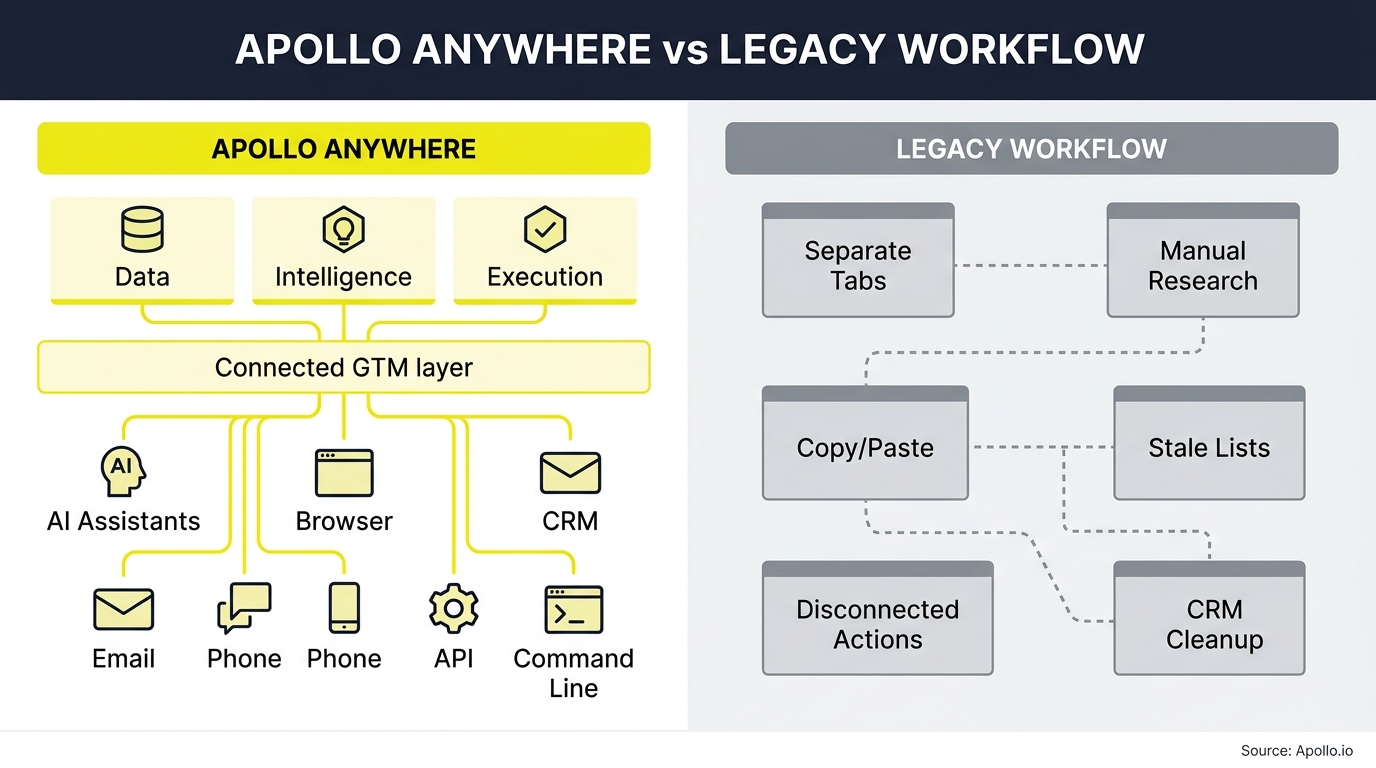
Apollo is an AI GTM system that unifies data, intelligence, and execution into one connected GTM system, built open by design so teams can prospect, engage, and convert from a single workspace without stitching together separate tools. Apollo's database covers 240M+ people and 30M+ companies, with 98% email accuracy verified through its Living Data Network.
The platform spans the full GTM motion: contact and account search with 65+ filters, multi-channel sequences, a power and parallel dialer, inbound routing, data enrichment, and AI-driven research and personalization.
Apollo meets sellers where they already work. Apollo MCP, Apollo's Model Context Protocol, connects Apollo's data and actions directly inside AI assistants including ChatGPT, Codex, Claude, and Perplexity, so teams can trigger prospecting workflows without leaving their existing environment. The Chrome extension enables prospecting across the web. For technical and advanced users, Apollo CLI provides terminal-native access for headless GTM workflows and API-driven automation.
According to Ramp's vendor data, Apollo holds a 38% adoption rate among businesses using Sales Data Providers tools as of July 2026, up 5 percentage points year-over-year, with 33% of first-time category buyers choosing Apollo and a 22% competitor switch rate. Customers including Anthropic, Redis, and Smartling trust the platform, and Apollo has earned a 4.7/5 rating on G2 along with the 2026 MarTech Breakthrough Award for "Best AI-Powered Sales Solution".

Apollo offers transparent pricing starting at $49/user/month (annual billing), with a free tier available.
What is Skrapp?

Skrapp is a B2B email finder and contact enrichment platform designed for sales teams, recruiters, and marketers who need to locate and verify professional email addresses at scale. The platform combines pattern recognition and real-time email verification to surface business emails from company websites and its contact database. According to Skrapp, its database includes 200M+ B2B contacts and 40M+ company profiles.
Skrapp's core capabilities center on email discovery. Its Chrome extension integrates with LinkedIn Basic, Sales Navigator, and LinkedIn Recruiter to extract contact information directly from profiles.
The platform also offers multi-page enrichment for LinkedIn, auto-connect functionality with LinkedIn profiles, and list saving for Sales Navigator searches. Bulk CSV exports and a REST API allow teams to move enriched data into downstream tools.
On the data side, Skrapp provides firmographic enrichment alongside individual profile data, and its AI-powered lead search enables users to query the database with natural language. CRM integrations include Salesforce and HubSpot for syncing enriched contact lists.
Skrapp states it operates on a fair credit policy where credits roll over between months and users only pay for deliverable emails.
Skrapp is best understood as a specialized email-finding tool. It does not include native outreach sequences, calling capabilities, inbound routing, or a built-in engagement layer.
Teams using Skrapp for prospecting would rely on separate platforms to execute their outreach campaigns and track engagement outcomes.

Feature Comparison
| Feature | Apollo | Skrapp |
|---|---|---|
| Starting Price | $49/user/month (annual billing); free tier available | $29/month (annual billing); free tier available, see Skrapp Pricing |
| B2B Database | 240M+ people, 30M+ companies | Skrapp claims 200M+ B2B contacts, 40M+ company profiles |
| Email Accuracy | 98% | Skrapp claims 97% verification accuracy |
| Sequences | Multi-channel sequences (email, calls, social, tasks); AI Sequence Builder | Not included |
| Dialer | Power Dialer and Parallel Dialer with AI call scripts and CRM logging | Not included |
| AI Capabilities | AI Research Agent, AI Sequence Builder, AI scoring, AI call summaries, AI sentiment analysis | AI-powered lead search |
| Data Enrichment | Waterfall enrichment, CRM enrichment, CSV enrichment, API enrichment with 65+ attributes | Firmographic and individual profile enrichment; bulk CSV export; REST API |
| Free Tier | Yes, 900 credits/year, 2 sequences, basic filters | Yes, 50 credits, 1 user, limited lead search |
The table above highlights the core distinction between the two platforms. Skrapp delivers email discovery and contact enrichment.
Apollo covers that same ground and extends further into execution: sequencing, dialing, inbound routing, and AI-driven personalization. Teams evaluating both tools should assess whether they need prospecting data alone or a connected workflow from data to conversation.
Turn Funnel Guesswork Into Pipeline Clarity
Pipeline forecasting a guessing game because marketing leads never convert? Apollo surfaces quality prospects already showing buying intent, so your funnel fills with opportunities — not dead weight. 600K+ companies trust Apollo to drive predictable revenue.
Start Free with Apollo →Pricing Comparison
Apollo's full tier breakdown, per Apollo's official pricing page (annual billing):
- Free: $0, 900 credits/year, 2 sequences, basic filters
- Basic: $49/user/month, 30,000 credits/year, unlimited sequences, CRM integrations, 6 intent topics
- Professional: $79/user/month, 48,000 credits/year, US dialer, 5 mailboxes, automated workflows, AI research
- Organization: $119/user/month (min. 3 users), 72,000 credits/year, international dialer, 15 mailboxes, SSO, advanced security
Skrapp's pricing (from Skrapp's official pricing page, both monthly and annual billing available with 25% savings on annual):
- Free: $0, 50 credits, 1 user, limited lead search (10 people searches/day)
- Professional: $29/month (annual billing) or $39/month (monthly billing), 2,000 credits/month, 2 users, credits roll over, AI enrichment; credit options scale to 25K/month
- Enterprise: $262/month (annual billing) or $349/month (monthly billing), 50,000 credits/month, 15 users, API integration, SSO, dedicated account manager; credit options scale to 500K/month
Both platforms use credit-based models for data lookups, and both offer free tiers. Apollo's free tier includes 900 credits per year alongside sequencing capabilities, while Skrapp's free tier offers 50 credits with limited daily search volume.
At the paid tier level, Skrapp's Professional plan starts lower on a per-month basis. However, Apollo's paid plans include the full engagement layer, sequences, dialing, analytics, and AI features, that Skrapp does not offer, meaning teams using Skrapp for outreach would need additional tools to execute campaigns.
How Apollo Differs from Skrapp
The primary difference is platform depth. Skrapp is built around one workflow: find an email, verify it, export it.
Apollo is built around the full sales motion. When a rep identifies a contact in Apollo, they can immediately enroll that contact in a multi-channel sequence, call them using the parallel dialer with an AI-researched script, log the outcome automatically to their CRM, and review engagement analytics in the same system.
That end-to-end connection removes handoffs between tools and keeps data consistent across the workflow.
Apollo's AI layer goes beyond search. The AI Research Agent surfaces account insights and personalizes outreach based on prospect context.
The AI Sequence Builder generates full sequences from natural language prompts. AI sentiment analysis tracks reply quality across campaigns.
These capabilities are built into the platform rather than added as separate modules.
For teams running inbound and outbound in parallel, Apollo's inbound routing layer handles website visitor identification, form enrichment, and criteria-based meeting booking alongside outbound sequencing. Skrapp does not include inbound capabilities.
Market adoption data reinforces this trajectory. According to Ramp's Sales Data Providers category data as of July 2026, Apollo is the fastest-growing vendor in the category, averaging +0.7 percentage points of adoption per month, outpacing every other provider tracked. That growth reflects teams actively consolidating their sales tech around platforms that deliver more than a single data function.

"We reduced the complexity of three tools into one.", Collin Stewart, CEO at Predictable Revenue
Apollo also provides broader CRM and workflow integrations through its integrations marketplace, connecting with Salesforce, HubSpot, Outreach, Salesloft, Marketo, and 50+ additional tools. Skrapp integrates with Salesforce and HubSpot for list syncing.
Frequently Asked Questions
Is Apollo a direct replacement for Skrapp?
Apollo covers Skrapp's core use case, finding and verifying B2B email addresses, and extends further into sequencing, calling, inbound routing, and AI-driven personalization. Teams currently using Skrapp solely as an email finder can replicate that function within Apollo and add execution capabilities on top of it within the same platform.
Does Skrapp include outreach or sequencing features?
No. Skrapp focuses on email discovery and contact enrichment.
It does not include native email sequencing, multi-channel campaign execution, or calling capabilities. Teams that use Skrapp for prospecting would connect it to a separate outreach platform to run campaigns.
How do the free tiers compare?
As covered in the pricing section above, Apollo's free tier includes sequences and broader prospecting filters alongside its annual credit allocation. Skrapp's free tier is more limited in daily search volume and credits.
Both are useful for evaluating the platforms before committing to a paid plan.
Who is Apollo built for?
Apollo serves B2B GTM teams, GTM Engineers, and AI Builders building headless GTM workflows with the Apollo API, CLI, and MCP, alongside Sales Professionals, SDRs/BDRs, AEs, RevOps, Marketing, and Revenue Leaders. Apollo is used by 100+ teams at Fortune 500 companies and 100K+ paying customers across companies of all sizes.
Can Apollo integrate with the tools my team already uses?
Yes. As noted in the feature comparison, Apollo connects with Salesforce, HubSpot, Zoho CRM, Pipedrive, and 50+ other tools through its integrations marketplace.
Apollo MCP also enables direct integration with AI assistants, and the Chrome extension works across the web for prospecting outside the platform.

Conclusion
Apollo and Skrapp both address B2B contact data, but they serve different scopes. Skrapp is a focused email-finding tool suited for teams whose primary need is sourcing verified email addresses and enriching contact records.
Apollo is an AI GTM system that handles that same data need while adding the sequences, dialing, inbound routing, and AI capabilities teams need to turn contacts into conversations.
For teams looking to run their full outbound and inbound motion from a single platform, Apollo delivers the data and the execution layer together. Try Apollo free today and see how it compares to your current stack.
Scale Your Team. Prove ROI. Fast.
Quota pressure mounting while new reps take months to ramp? Apollo gets teams up and running fast with scalable workflows built for every rep. 600K+ companies use Apollo to drive measurable pipeline from day one.
Start Free with Apollo →Don't miss these
Sales
Inbound vs Outbound Marketing: Which Strategy Wins?
Sales
What Is a Sales Funnel? The Non-Linear Revenue Framework for 2026
Sales
What Is a Go-to-Market Strategy? The 2026 GTM Playbook
See Apollo in action
We'd love to show how Apollo can help you sell better.
By submitting this form, you will receive information, tips, and promotions from Apollo. To learn more, see our Privacy Statement.
4.7/5 based on 9,690 reviews
