
Apollo vs Melissa Data (2026): Features, Pricing & Best Use Cases
When evaluating sales technology tools, Apollo and Melissa Data often surface in the same conversation, but they serve meaningfully different purposes. Melissa Data is a data quality and identity verification platform built around address validation, compliance, and record hygiene.
Apollo is a GTM platform built for B2B sales teams who need to find prospects, enrich records, and run outreach all in one place. Understanding where each fits helps teams avoid buying tools that don't match their actual workflow.

Research Less, Close More With Apollo
Tired of burning hours verifying contact info instead of selling? Apollo delivers 240M+ contacts with 98% email accuracy so your team hits the ground running. Start building pipeline today, not next quarter.
Start Free with Apollo →Key Takeaways
- Platform scope: Apollo combines sales intelligence, prospecting, engagement sequences, and a built-in dialer into one connected system. Melissa Data focuses on data quality services, address verification, email validation, phone validation, and identity proofing.
- Audience: Apollo serves B2B GTM teams, GTM Engineers, and AI Builders building headless GTM workflows with the Apollo API, CLI, and MCP, alongside Sales Professionals, SDRs/BDRs, AEs, RevOps, Marketing, and Revenue Leaders. Melissa Data targets enterprises and developers needing compliant data quality APIs.
- AI features: Apollo includes AI sequence builders, AI research agents, call summaries, lead scoring, and buyer intent signals. Melissa Data provides data cleansing automation and identity proofing workflows.
- Pricing model: Apollo offers transparent, self-serve pricing starting at $49/user/month (annual billing) with a free tier. Melissa Data publishes usage-based pricing for its verification APIs on its website.
What is Apollo?

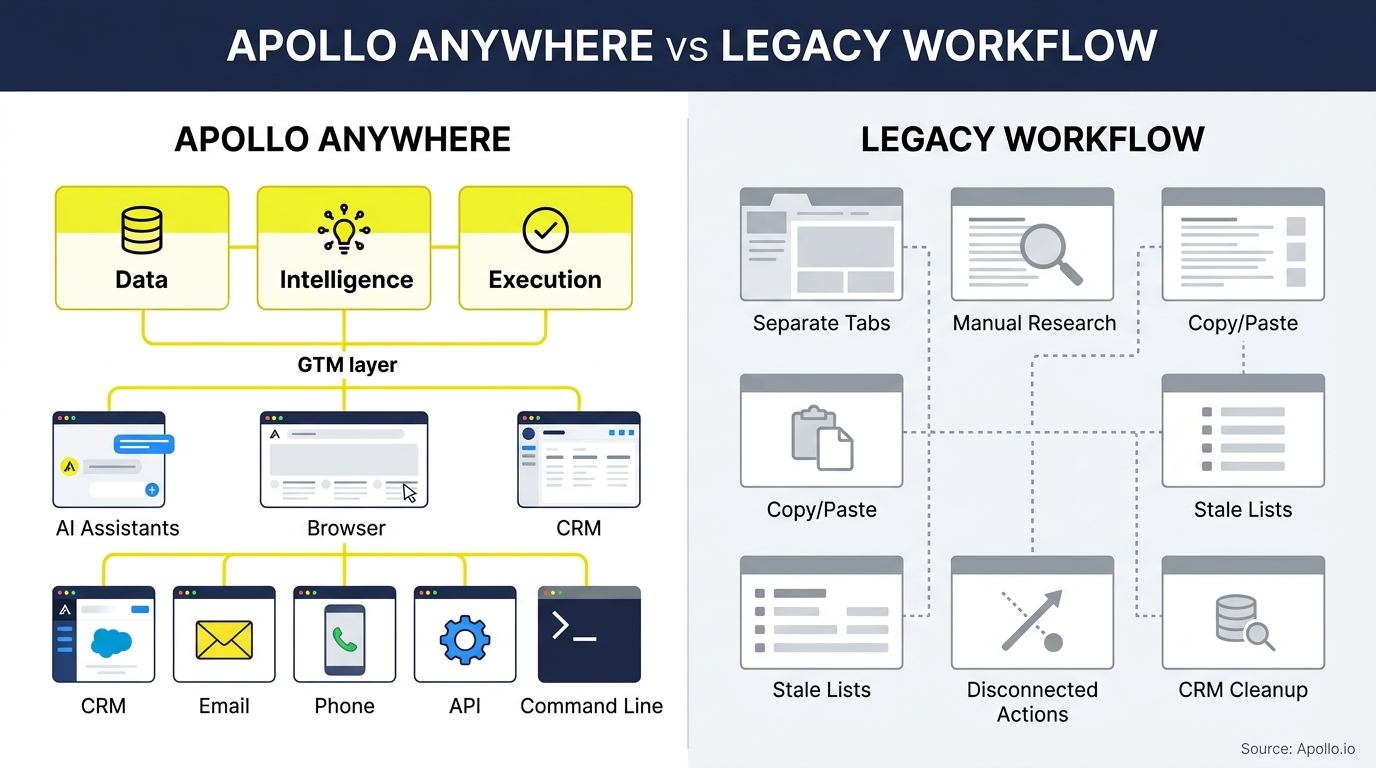
Apollo is an AI sales platform that unifies data, intelligence, and execution into one connected GTM system, covering everything from prospecting and enrichment to multi-channel engagement and analytics. The platform includes a 240M+ person database with 98% email accuracy, multi-step sequences, a built-in power and parallel dialer, AI research agents, buyer intent signals, and CRM enrichment, all within a single workspace.
Apollo meets sellers inside the tools they already use. Apollo MCP, Apollo's Model Context Protocol, connects Apollo's data and workflows to AI assistants including ChatGPT, Codex, Claude, and Perplexity, letting teams prospect and enrich records without leaving their AI environment. The Chrome extension enables prospecting from anywhere across the web. For technical teams and GTM Engineers building headless workflows, Apollo CLI provides terminal-native access to Apollo's full data and execution layer.
According to Ramp's vendor data, 38% of businesses purchasing software in the Sales Data Providers category use Apollo as of July 2026, up 5 percentage points year-over-year, with a 22% competitor switch rate, meaning a significant share of Apollo's customer base actively moved from another vendor. Apollo is trusted by 100K+ paying customers and used by 100+ teams at Fortune 500 companies, alongside Anthropic, Redis, Smartling, and Cyera.

Apollo offers transparent pricing starting at $49/user/month (annual billing), with a free tier available. Full pricing details are in the Pricing Comparison section below.
What is Melissa Data?

Melissa Data is a global provider of data quality and identity verification solutions. Its core services include U.S. And international address verification (CASS and DPV certified), email validation, phone number validation, name parsing, and National Change of Address (NCOA) processing. The platform also offers identity proofing services including KYC, KYB, PEP screening, watchlist checks, and sanctions screening.
On the enrichment side, Melissa Data provides geocoding, property data covering 400+ fields according to the company, and demographic and firmographic append services. Batch data cleansing is available through its Melissa Alert Service for ongoing record maintenance.
The platform integrates directly with Salesforce, Microsoft Dynamics, Excel, Google Sheets, Snowflake, and Shopify, and exposes developer APIs and SDKs for custom integration work.
Melissa Data's target audience includes enterprises requiring SOC 2, HIPAA, and GDPR-aligned data handling, developers building data quality into their applications, and operations teams managing CRM hygiene at scale. It is not a prospecting or sales engagement tool, there are no sequences, no dialer, no contact search interface for SDRs, and no buyer intent signals.
Teams using Melissa Data for data quality would need separate tools for outbound execution.
Pricing is published on Melissa Data's website and is usage-based, ranging from a free tier for Global Address Verification (250 records/month) up to subscription and unlimited tiers for high-volume use. See the Pricing Comparison section for a full breakdown.

Feature Comparison
| Feature | Apollo | Melissa Data |
|---|---|---|
| Starting Price | $49/user/month (annual billing); free tier available | $0 for 250 records/month (Global Address Verification); paid tiers from $40/month |
| B2B Database | 240M+ people, 30M+ companies | No prospecting database; focuses on validating and enriching existing records |
| Email Accuracy | 98% | Email validation services offered; no published accuracy benchmark |
| Sequences | Multi-channel sequences (email, phone, social, tasks); AI Sequence Builder | Not available |
| Dialer | Power Dialer and Parallel Dialer with AI call summaries and voicemail drop | Not available |
| AI Capabilities | AI Research Agent, AI lead scoring, AI call summaries, AI sequence builder, buyer intent signals | Automated batch cleansing via Melissa Alert Service; identity proofing workflows |
| Data Enrichment | Waterfall enrichment, CRM enrichment (Salesforce, HubSpot), CSV and API enrichment with 65+ attributes | Address, geocoding, property, demographic, and firmographic append via API; NCOA processing |
| Free Trial | Free tier with 900 credits/year | Free tier: 250 records/month for Global Address Verification |
The comparison above illustrates a fundamental difference in platform intent. Apollo is built for outbound and inbound GTM execution, finding the right contacts, enriching their records, and converting them through sequences and calls.
Melissa Data is built for data quality infrastructure, ensuring that records already in your system are accurate, deliverable, and compliant. These tools are not direct competitors in most buying scenarios.
Turn Funnel Guesswork Into Pipeline Wins
Tired of watching quality leads stall before they ever reach your pipeline? Apollo surfaces in-market buyers with precision targeting so every rep works the right prospects at right moment. Nearly 5M users stopped guessing and started closing.
Start Free with Apollo →Pricing Comparison
Apollo's full pricing breakdown (annual billing, per user per month) is available at apollo.io/pricing:
- Free: $0, 900 credits/year, 2 sequences, basic filters
- Basic: $49/user/month, 30,000 credits/year, unlimited sequences, CRM integrations, 6 intent topics
- Professional: $79/user/month, 48,000 credits/year, US dialer, 5 mailboxes, automated workflows, AI research
- Organization: $119/user/month (min. 3 users), 72,000 credits/year, international dialer, 15 mailboxes, SSO, advanced security
Melissa Data's pricing, published at melissa.com/pricing, follows a usage-based and subscription model structured around record volume rather than per-user seats:
- Global Address Verification (Free): $0, 250 records/month
- Global Address Verification (Sub 1K): $40/month, 1,000 records/month
- Global Address Verification (Sub 2.5K): $95/month, 2,500 records/month
- Global Address Verification (5K): $190/month, 5,000 records/month
- Global Address Verification (10K): $350/month, 10,000 records/month
- US Address Verification SUB: $5,145/year, 1,000,000 records/year
- US Address Verification Unlimited: $16,000/year, unlimited records
- BusinessCoder Cloud API: $8,000/year, 100,000 records/year
- Personator Enrich Cloud API: $14,300/year, 1,000,000 records/year
Pay-as-you-go credits are also available: $40 for 10,000 credits, $350 for 100,000 credits (12.5% off), and $3,200 for 1,000,000 credits (20% off). Melissa Data also notes that additional tiers are available by calling 1-800-MELISSA.
These pricing models address different needs. Apollo's per-seat model covers a full GTM workflow, data access, sequences, dialer, AI, and analytics, for a sales rep.
Melissa Data's record-volume model is suited to operations teams running batch validation jobs or developers calling verification APIs. Teams evaluating both should assess whether their primary need is outbound pipeline generation or data quality infrastructure.
How Apollo Differs from Melissa Data
The clearest differentiator is platform scope. Apollo is built to generate pipeline, from identifying the right contacts in a 240M+ person database, to enriching and verifying their information, to executing personalized outreach across email, phone, and social, to tracking results and iterating. That full workflow lives in one system, which is why customers like Collin Stewart at Predictable Revenue noted: "We reduced the complexity of three tools into one."
Melissa Data does not offer a contact search interface, sequences, a dialer, or buyer intent signals. Its strength is in validating and cleansing records that already exist, particularly for compliance-sensitive use cases like KYC, NCOA processing, and address standardization.
A team using Melissa Data for address verification would still need a separate prospecting and engagement platform to run outbound sales.
Apollo's AI layer also sets it apart for sales teams. The AI Research Agent surfaces account-level insights before a call, the AI Sequence Builder creates personalized sequences from natural language prompts, and AI call summaries are automatically logged to the CRM.
These features are designed around sales rep productivity, not data infrastructure management.
On market momentum, Ramp's Sales Data Providers category data as of July 2026 shows Apollo is the fastest-growing vendor in the category, averaging +0.7 percentage points of adoption per month, ahead of every other named vendor in the space. That growth reflects teams consolidating onto a platform that covers more of the GTM workflow rather than stitching together point solutions.

For teams that genuinely need high-volume address verification, postal compliance, or KYC/KYB workflows, Melissa Data serves a specific and legitimate purpose. But for B2B sales teams focused on building pipeline, Apollo's combination of verified contact data, AI-powered outreach, and built-in execution tools addresses a fundamentally broader set of needs.
Frequently Asked Questions
Are Apollo and Melissa Data direct competitors?
No. As detailed above, these platforms serve different functions.
Apollo is a sales intelligence and engagement platform built for pipeline generation. Melissa Data is a data quality and identity verification service built for record hygiene and compliance.
Teams may use both for different purposes, Melissa Data to cleanse CRM records and Apollo to prospect, enrich, and engage new contacts.
Who is Apollo built for?
Apollo serves B2B GTM teams, GTM Engineers, and AI Builders building headless GTM workflows with the Apollo API, CLI, and MCP, alongside Sales Professionals, SDRs/BDRs, AEs, RevOps, Marketing, and Revenue Leaders. It is used by startups through Fortune 500 teams, with 100K+ paying customers across a wide range of company sizes and industries.
Can Apollo replace Melissa Data for data quality?
Apollo includes data enrichment with waterfall enrichment, CRM enrichment, and email verification as part of its platform. For standard B2B contact enrichment and validation, Apollo covers most sales team needs. However, teams with specific requirements, such as postal CASS/DPV certification, NCOA processing, property data append, or KYC/AML compliance screening, may still find Melissa Data's specialized services useful alongside Apollo.
Does Apollo offer a free tier?
Yes. Apollo's free tier includes access to the contact database, basic filters, and 900 credits per year, enough for teams to explore the platform before committing to a paid plan.
As covered in the pricing section above, paid plans start at $49/user/month on annual billing.
How does Apollo handle CRM data quality?
Apollo's CRM integrations support scheduled, real-time, and one-off enrichment jobs with bi-directional sync for Salesforce and HubSpot. Data writing rules (Autofill and Overwrite) give RevOps teams control over how and when records are updated, keeping CRM data current without manual effort. As Mark Turner, VP of Revenue Operations at Built In, described: "Apollo enriches everything we have: contacts, leads, accounts...And we don't really have to touch it, it just works."
Conclusion
Apollo and Melissa Data are built for different buyers with different problems. Melissa Data addresses data quality infrastructure, address validation, identity proofing, and record hygiene, primarily for operations and compliance teams.
Apollo addresses pipeline generation, finding, enriching, and engaging the right contacts, for B2B GTM teams across every stage of the sales process.
For sales teams evaluating tools to build pipeline, run outreach, and close more deals, Apollo's combination of verified B2B data, AI-powered engagement, and built-in execution sets it apart. The 4.7/5 G2 rating and the 2026 MarTech Breakthrough Award for "Best AI-Powered Sales Solution"reflect what users consistently report: more pipeline, less tool complexity.
Ready to see what Apollo can do for your team? Try Apollo free today.
Prove Pipeline Value With Apollo
ROI pressure killing your tool budget? Apollo delivers measurable pipeline impact from day one — so you can walk into any budget review with real numbers. Leadium 3x'd annual revenue. You're next.
Start Free with Apollo →Don't miss these
Sales
Inbound vs Outbound Marketing: Which Strategy Wins?
Sales
What Is a Sales Funnel? The Non-Linear Revenue Framework for 2026
Sales
What Is a Go-to-Market Strategy? The 2026 GTM Playbook
See Apollo in action
We'd love to show how Apollo can help you sell better.
By submitting this form, you will receive information, tips, and promotions from Apollo. To learn more, see our Privacy Statement.
4.7/5 based on 9,690 reviews
