
Apollo vs Lobstr (2026): Social Selling Automation, Data, and Which Platform Fits Your GTM Stack
Choosing between Apollo and Lobstr comes down to a fundamental question: do you need a web scraping tool to collect data from public sources, or a GTM platform that combines verified B2B contact data with built-in outreach and engagement? Both platforms use credit-based models and serve sales and marketing teams, but they are built for different workflows and different depths of go-to-market execution.
This comparison walks through features, pricing, and use cases so B2B revenue teams can make an informed decision heading into 2026.

Research Less. Pipeline More With Apollo.
Tired of burning hours verifying contacts before a single email goes out? Apollo surfaces accurate, ready-to-work leads so your reps spend time selling — not searching. Nearly 5M users have already made the switch.
Start Free with Apollo →Key Takeaways
- Platform scope: Apollo is an AI sales platform combining verified B2B data, multi-channel engagement, and AI-driven workflows in one connected GTM system. Lobstr is a no-code web scraping platform that collects data from public sources like Google Maps and social networks.
- Sales intelligence: Apollo's database includes 240M+ people and 30M+ companies with 98% email accuracy, purpose-built for B2B prospecting. Lobstr provides raw data extraction that teams then process and enrich separately.
- Execution layer: Apollo includes sequences, a power and parallel dialer, AI research, and inbound routing. Lobstr focuses on data collection and export, without a native sales engagement layer.
- Audience: Apollo serves B2B GTM teams, GTM Engineers, and AI Builders building headless GTM workflows with the Apollo API, CLI, and MCP, alongside Sales Professionals, SDRs/BDRs, AEs, RevOps, Marketing, and Revenue Leaders. Lobstr targets data analysts, developers, and teams that need structured data at scale from web sources.
- Pricing: Both platforms offer free tiers and credit-based plans. Apollo's paid plans start at $49/user/month (annual billing). Lobstr's paid plans start at $16/month (annual billing).
What is Apollo?

Apollo is an AI sales platform that unifies data, intelligence, and execution into one connected GTM system, built for every stage of the revenue cycle from prospecting to closed-won. Apollo's database spans 240M+ people and 30M+ companies, with contacts continuously validated through Apollo's Living Data Network to maintain 98% email accuracy.
Teams use Apollo to find the right contacts, build and run multi-channel sequences, dial prospects, enrich CRM records, and analyze results without switching between tools.
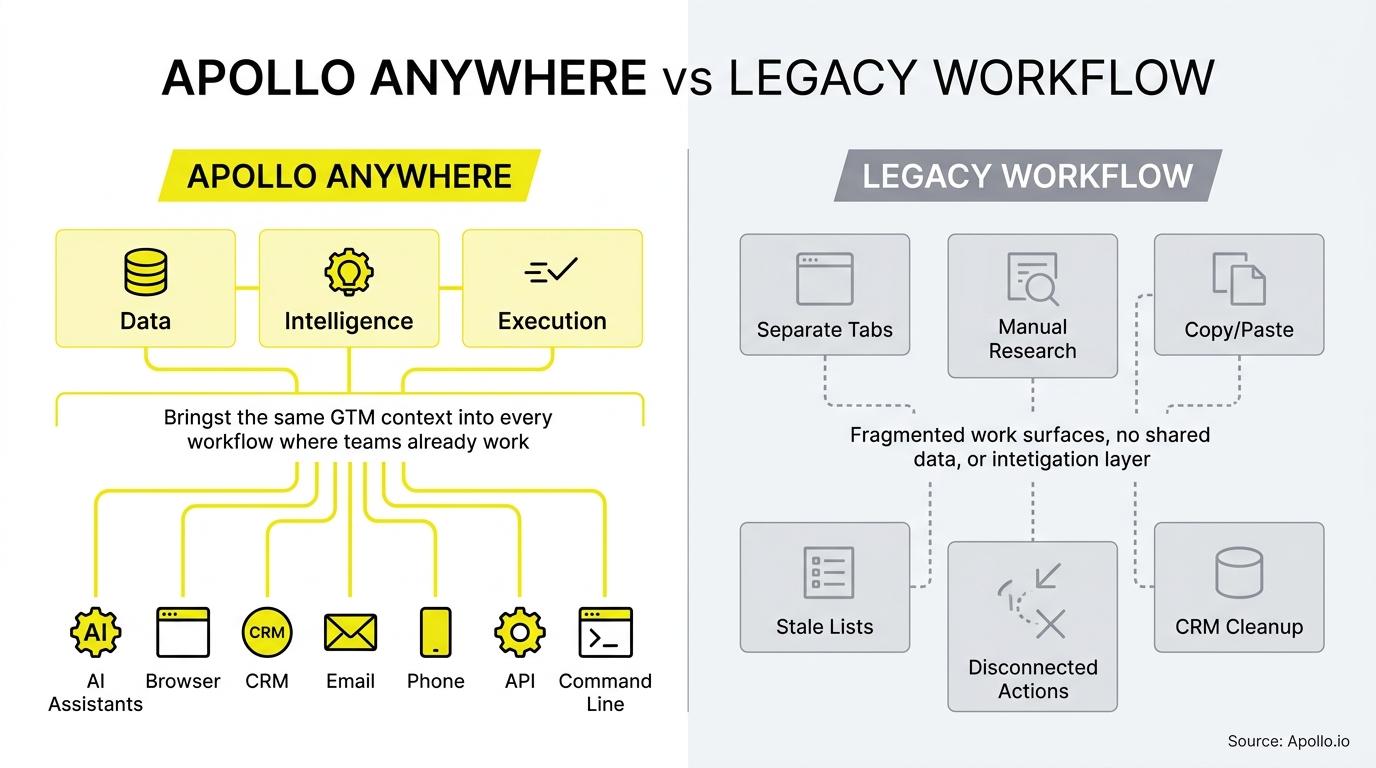
Apollo meets sellers where they already work. Apollo MCP, Apollo's Model Context Protocol, connects Apollo's data and workflows directly into AI assistants including ChatGPT, Codex, Claude, and Perplexity, so GTM Engineers and AI Builders can trigger prospecting actions from within the tools they already use. The Chrome extension enables prospecting across the web, and for terminal-native workflows, Apollo CLI gives technical users headless access to Apollo's full data and engagement layer.
According to Ramp's vendor data, as of July 2026, Apollo holds a 38% adoption rate among businesses using Sales Data Providers software, up 5 percentage points year-over-year, with 22% of current Apollo customers having switched from a competing vendor in the same category. Apollo is trusted by 100K+ paying customers and used by 100+ teams at Fortune 500 companies, and it earned the 2026 MarTech Breakthrough Award for "Best AI-Powered Sales Solution".

Apollo offers transparent pricing starting at $49/user/month (annual billing), with a free tier available.
What is Lobstr?

Lobstr is a no-code web scraping and automation platform that provides ready-made scrapers and APIs for extracting structured data from public web sources. The platform targets data analysts, developers, and teams that need to collect data at scale from sites such as Google Maps, social networks, YouTube, and e-commerce platforms.
Lobstr's core value proposition is data collection flexibility. Users can launch scrapers against a variety of public sources without writing code, schedule recurring scraping jobs, and export results to Google Sheets, S3, or SFTP.
The platform supports multi-threading, meaning multiple scrapers can run simultaneously, with plan tier determining the number of concurrent slots available.
Key capabilities include 1-click account synchronization via a Chrome extension (no credential sharing required), automated export, scheduling at daily or weekly intervals, and an API with a Python SDK. According to Lobstr, 1 credit equals 1 unique result, and duplicates are not charged.
The platform also offers email and phone enrichment capabilities, and an MCP server for use with AI agents.
Lobstr is positioned as a general-purpose data extraction tool. It does not include a native sales engagement layer such as email sequencing, a dialer, or CRM-native routing.
Teams using Lobstr for B2B prospecting typically export raw data and then process, verify, and activate it through separate tools. Lobstr notes custom plans are available for companies with complex requirements.
Lobstr's pricing is transparent and credit-based, with plans ranging from a free tier through a Team plan at $500/month (monthly billing) or $400/month (annual billing). Full pricing details are in the Pricing Comparison section below.
Feature Comparison
| Feature | Apollo | Lobstr |
|---|---|---|
| Starting Price | $49/user/month (annual billing); free tier available | $16/month (annual billing); free tier available |
| B2B Database | 240M+ people, 30M+ companies, purpose-built for B2B prospecting with 65+ filters | No proprietary B2B database; extracts publicly available data from web sources |
| Email Accuracy | 98% email accuracy | Not reported; accuracy depends on source data quality |
| Sequences | Multi-channel sequences (email, phone, social, tasks) with AI Sequence Builder | No native sequencing; data export only |
| Dialer | Power Dialer and Parallel Dialer with AI call scripts, auto-logging, and voicemail drop | No dialer included |
| AI Capabilities | AI Research Agent, AI Sequence Builder, AI lead scoring, AI call summaries, 500% YoY AI platform growth | MCP server for AI agent integration; no native AI-driven sales features |
| Data Enrichment | Waterfall enrichment, CRM enrichment (Salesforce, HubSpot), CSV enrichment, API enrichment | Email and phone enrichment available; export to Google Sheets, S3, SFTP |
| Free Trial | Free tier with 900 credits/year | Free tier with 100 credits/month |
The table above illustrates a clear distinction: Apollo is a full GTM execution platform with verified B2B data, built-in engagement, and AI-driven sales workflows, while Lobstr is a data extraction utility designed for collecting raw data from public web sources. Teams evaluating both platforms should consider whether their primary need is data collection from public sources or an end-to-end B2B prospecting and engagement workflow.

Pricing Comparison
Both platforms use credit-based pricing, though what a "credit" represents differs meaningfully between them.
Apollo Pricing (annual billing, per Apollo's pricing page):
- Free: $0, 900 credits/year, 2 sequences, basic filters
- Basic: $49/user/month, 30,000 credits/year, unlimited sequences, CRM integrations, 6 intent topics
- Professional: $79/user/month, 48,000 credits/year, US dialer, 5 mailboxes, automated workflows, AI research
- Organization: $119/user/month (min 3 users), 72,000 credits/year, international dialer, 15 mailboxes, SSO, advanced security
Lobstr Pricing (per Lobstr's pricing page):
- Free: $0, 100 credits/month, 1 concurrent scraper slot, limited export (30 rows per request), 7 days data retention
- Starter: $20/month (monthly) or $16/month (annual), 10,000 credits/month, 2 slots, unlimited export, 28 days retention
- Pro: $100/month (monthly) or $80/month (annual), 100,000 credits/month, 10 slots, unlimited export (most popular)
- Team: $500/month (monthly) or $400/month (annual), 1,000,000 credits/month, 50 slots, unlimited export
- Enterprise: Contact Lobstr sales for requested pricing
Note that Lobstr credits represent unique scraped results (1 credit = 1 unique result, no duplicates charged), while Apollo credits cover contact data exports, enrichment, and related actions. Apollo's credits are applied across the full platform including prospecting, enrichment, and dialer use, whereas Lobstr credits are used solely for data extraction volume.
VAT may apply to Lobstr plans for European customers.
For teams whose primary need is raw data volume at low cost, Lobstr's pricing is accessible. For teams that need verified B2B contact data alongside sequencing, dialing, and CRM sync in one workflow, Apollo's pricing reflects the consolidation of multiple tools into one platform. As Collin Stewart, CEO at Predictable Revenue, noted: "We reduced the complexity of three tools into one."
Turn Weak Leads Into Real Pipeline
Tired of watching marketing leads stall before they ever reach your pipeline? Apollo surfaces in-market buyers with 98% email accuracy so your team stops guessing and starts closing. 600K+ companies already made the switch.
Start Free with Apollo →How Apollo Differs from Lobstr
The most important distinction is that Apollo is an end-to-end sales execution platform, and Lobstr is a data collection utility. Where Lobstr extracts raw data from public sources and exports it, Apollo verifies business contact information, routes it through AI-driven research, and activates it across email, phone, and social channels without requiring additional tools.
For sales engagement, Apollo includes multi-channel sequences with an AI Sequence Builder, a Power Dialer and Parallel Dialer, inbound routing, and automated follow-up triggered by form submissions or buyer intent signals. None of these capabilities exist natively in Lobstr. Teams using Lobstr for prospecting export raw data and then activate it through separate engagement tools, adding workflow complexity and cost.
Apollo's AI layer is also purpose-built for sales workflows. The AI Research Agent surfaces account-level insights before outreach, AI lead scoring prioritizes the most relevant contacts, and AI-generated call summaries push directly to CRM after every call.
Lobstr offers an MCP server for AI agent integration, which enables technical users to incorporate scraped data into AI workflows, but there are no pre-built sales AI features included.
On the data enrichment side, Apollo supports waterfall enrichment, scheduled CRM enrichment with bi-directional Salesforce and HubSpot sync, and CSV enrichment across 65+ attributes. Lobstr offers email and phone enrichment as part of its scraping capability, but without native CRM sync or structured enrichment pipelines.
According to Ramp's Sales Data Providers category data, as of July 2026, Apollo is the fastest-growing vendor in the category, averaging +0.7 percentage points of adoption per month, ahead of all other vendors tracked. This growth reflects demand for platforms that combine data and execution rather than point solutions that require additional tooling to activate.

For teams building headless GTM workflows, Apollo's API, Apollo CLI, and Apollo MCP provide programmatic access to verified B2B data and engagement triggers that Lobstr's scraping approach cannot replicate at the same fidelity for sales-specific use cases.
Frequently Asked Questions
Is Apollo or Lobstr better for B2B prospecting?
For B2B prospecting specifically, Apollo provides a purpose-built experience: verified contact data, intent signals, AI research, and outreach sequences in one platform. Lobstr extracts publicly available data from web sources, which requires additional steps to verify, enrich, and activate for outreach.
Teams focused on building and working prospect lists will generally find Apollo's workflow more direct.
Can Lobstr replace a sales intelligence platform?
Lobstr is designed for data collection and extraction, not sales intelligence. It does not include a proprietary B2B contact database, email accuracy guarantees, sales sequencing, or a dialer.
Teams that need those capabilities alongside their data would use Lobstr as a data source feeding into other tools, rather than as a standalone sales platform.
Who is Apollo for?
Apollo serves B2B GTM teams, GTM Engineers, and AI Builders building headless GTM workflows with the Apollo API, CLI, and MCP, alongside Sales Professionals, SDRs/BDRs, AEs, RevOps, Marketing, and Revenue Leaders. Apollo is used by 100K+ paying customers across companies of all sizes, including 100+ teams at Fortune 500 companies.
Do both platforms offer free tiers?
Yes. As detailed in the pricing section above, Apollo's free tier includes 900 credits/year with access to sequences and core prospecting filters.
Lobstr's free tier includes 100 credits/month with limited export and 7 days of data retention. Both are useful for evaluating the platform before committing to a paid plan.
Does Apollo integrate with the tools my team already uses?
Apollo integrates with Salesforce, HubSpot, Zoho CRM, Pipedrive, Outreach, SalesLoft, Marketo, and 50+ additional tools through its integrations marketplace. The Chrome extension supports prospecting across the web, and Apollo MCP connects Apollo's data layer to AI assistants including ChatGPT, Codex, Claude, and Perplexity.

Conclusion
Apollo and Lobstr serve different core needs. Lobstr is a no-code web scraping platform suited for teams that need to extract structured data from public sources at scale, while Apollo is an AI sales platform that combines verified B2B data, multi-channel engagement, and AI-powered execution in one connected GTM system.
For B2B revenue teams that need to prospect, engage, and analyze pipeline without stitching together multiple tools, Apollo delivers a more complete workflow from the first contact search through closed-won. Rated 4.7/5 on G2 and recognized as a Top 50 Sales Product, Apollo is built to scale with your team's GTM motion.
Ready to see what a unified prospecting and engagement platform looks like? Try Apollo free today.
Apollo Pays Off Before Q1 Ends
ROI pressure killing your next tool approval? Apollo ramps new reps faster with scalable, repeatable playbooks built in. Teams like Leadium 3x'd annual revenue — start seeing returns before next board review.
Schedule a Demo →Don't miss these
Sales
Inbound vs Outbound Marketing: Which Strategy Wins?
Sales
What Is a Sales Funnel? The Non-Linear Revenue Framework for 2026
Sales
What Is a Go-to-Market Strategy? The 2026 GTM Playbook
See Apollo in action
We'd love to show how Apollo can help you sell better.
By submitting this form, you will receive information, tips, and promotions from Apollo. To learn more, see our Privacy Statement.
4.7/5 based on 9,690 reviews
