
AI for surfacing high-intent accounts daily works by pulling fresh buying signals, matching them to your target accounts, ranking those accounts by fit and timing, and delivering a short list to the owning rep each morning. The goal is a shortlist your team trusts, not a longer dashboard to check.
This guide walks through a vendor-neutral daily workflow, how to define high intent, and how to test whether AI beats the way you prioritize today. Teams that also need clean contact data can start with Apollo Buying Intent Data as one input.
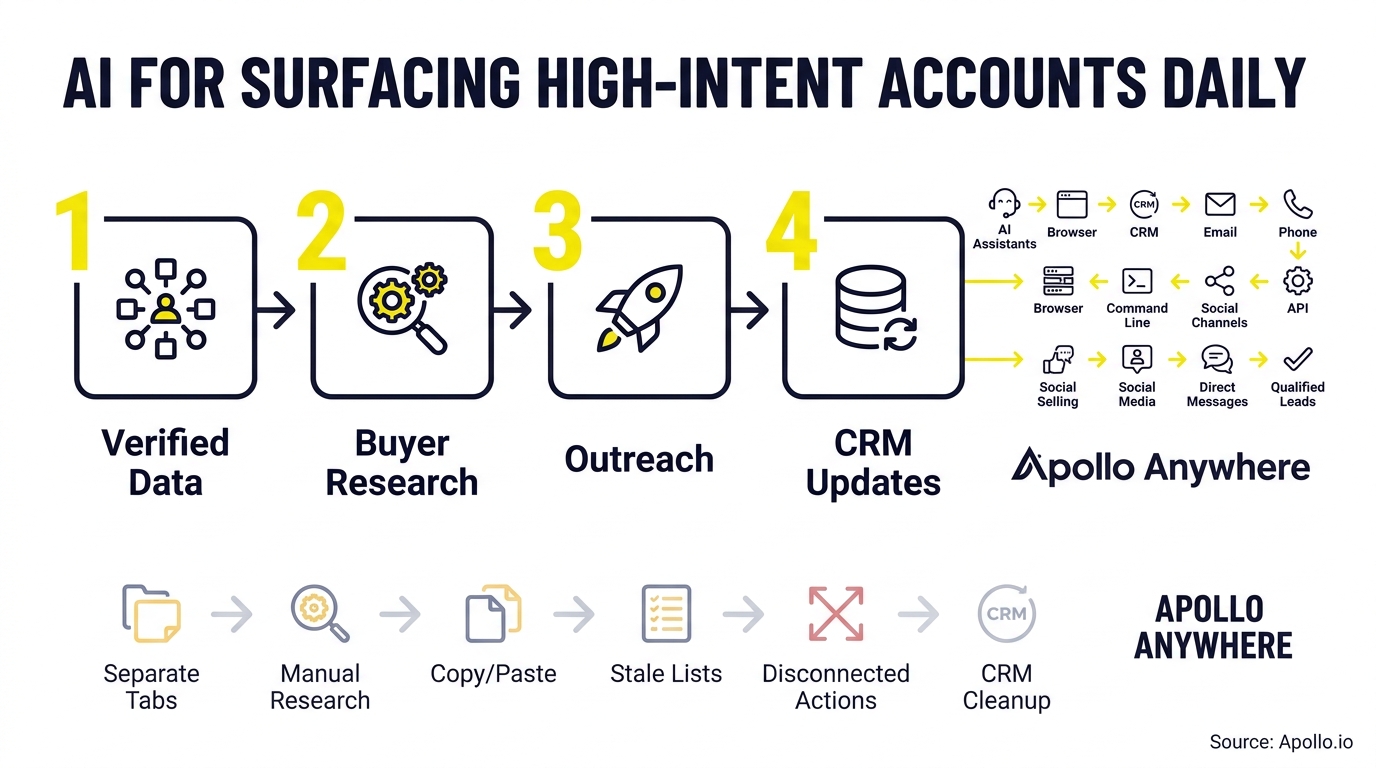

Skip Manual Research, Reach Buyers Faster
Tired of burning hours researching leads and verifying contact info instead of selling? Apollo puts verified business info at your fingertips with 98% email accuracy. Start free and get your selling time back today.
Start Free with Apollo →Key Takeaways
- A good daily shortlist separates observed facts, inferred readiness, and confidence.
- Intent should guide relevant outreach, not increase message volume.
- Test AI ranking against a simple baseline before you trust it.
- Account signals need buying-group research before anyone sends a message.
- Fewer, explainable accounts beat long ranked lists nobody reads.
What Does a Daily High-Intent Account Shortlist Look Like?
A daily shortlist is 5 to 15 accounts per rep, each with a reason it surfaced, the evidence behind it, a confidence level, and a suggested next action. Here is a sample format.
| Field | Example |
|---|---|
| Account | Northwind Logistics |
| Observed fact | Three visitors read pricing and integration pages yesterday |
| Inferred readiness | Likely evaluating options this quarter |
| Confidence | Medium (fit is strong, signal is one source) |
| Next action | Research the buying group, send a relevant resource |
Keeping facts apart from inferences lets reps judge a recommendation in seconds instead of taking a score on faith.
How Do You Define High Intent for Your Team?
High intent means an account shows recent, repeated, relevant buying behavior and also matches your ideal customer profile. A single page view is activity.
A pattern of research on your category plus strong fit is intent.
- Fit: Industry, size, region, and tech stack match your ICP.
- Timing: Signals appeared in the last few days, not months ago.
- Strength: Multiple signals across more than one source.
- Exclusions: Existing customers, competitors, and active opportunities are removed.
Write this definition down and share it across SDRs, AEs, and marketing. Without it, every team debates what counts as "hot."
How Does the Daily Workflow Run From Signal to CRM?
The workflow has five steps: ingest signals, match them to accounts, rank, apply exclusions, and route to the CRM owner. Each step should be visible so reps can see why an account appears.
- Ingest: Pull website activity, research topics, and engagement events overnight.
- Match: Resolve signals to the correct account record to avoid duplicates.
- Rank: Combine fit, signal strength, and recency into one priority order.
- Exclude: Remove customers, open deals, and do-not-contact accounts.
- Route: Send the shortlist to the owning rep through the CRM or a morning alert.
Match quality decides everything downstream. According to Demandbase, data quality is a recurring drag on go-to-market teams, so clean account records are worth fixing first. For connecting your tools, see CRM integration with HubSpot and Salesforce.
Why Does Daily Surfacing Matter Before Sales Engages?
Daily surfacing matters because buyers do most of their research before talking to a seller. 6sense's 2024 Buyer Experience Report, surveying 2,509 recent B2B buyers, found that 69% of the purchase process occurred before seller engagement and 81% selected a preferred vendor before speaking with sales. This is vendor-sponsored research, so treat it as directional rather than proof of AI accuracy.
The implication is simple. Early signals help you show up while buyers are still forming a shortlist. 6sense's 2026 findings add a caution: the eventual winner appeared on the Day 1 shortlist 92% of the time, so daily surfacing complements earlier brand building rather than replacing it.

How Should Teams Use Intent Without Spamming Buyers?
Teams should use intent to choose relevant content and channels, not to send more messages. Gartner's June 2025 release, covering 632 buyers surveyed in August and September 2024, reported that 73% of B2B buyers actively avoid suppliers sending irrelevant outreach.
Practical rules for AEs and SDRs:
- Lead with a resource tied to the research topic, not a generic pitch.
- Cap outreach per account per week.
- Prefer the channel the account already engages with.
Struggling to turn signals into relevant outreach? Build multi-channel sequences with Apollo's sales engagement platform so each touch matches the signal.
Apollo Turns Forecast Guesswork Into Clarity
Struggling to trust a forecast built on stale deal data? Apollo gives your team prospects worth pursuing and a clean view of every opportunity's stage. Teams actively using Apollo's AI Assistant are up 2,156% since December 2025.
Start Free with Apollo →How Do You Test AI Ranking Against a Baseline?
Test AI ranking by comparing it to a simple baseline, such as ICP fit alone, over the same period and the same reps. Measure results with a few clear metrics instead of relying on vendor claims.
| Metric | What It Tells You |
|---|---|
| Precision@K | Of the top K accounts surfaced, how many showed real buying activity |
| Sales acceptance rate | Share of accounts reps agree are worth pursuing |
| Rejection rate | Share dismissed as irrelevant |
| Opportunities created | Pipeline from surfaced accounts versus baseline |
| Seller time | Minutes spent researching before outreach |
Run a second, separate test for cadence: compare daily review against weekly review on freshness, processing delay, and seller review time. Daily only wins if the underlying data actually refreshes that often.
Demandbase's June 2025 release notes document 24-hour intent updates, a concrete benchmark for what "daily" can mean.
How Do SDRs and RevOps Teams Keep the Shortlist Trustworthy?
SDRs and RevOps teams keep a shortlist trustworthy by requiring evidence for every recommendation and reviewing false positives weekly. 6sense announced explainable predictions in November 2026, showing the signals, evidence, and confidence behind scores. That shifts the question from "Who should I contact?" to "Why this account, now?"
Use this review checklist:
- Does each account list its source signals and timestamps?
- Can a rep verify the rationale in under a minute?
- Are rejected accounts tagged with a reason, so scoring improves?
- Are exclusions for customers and open deals working?
RevOps leaders should also treat AI explanations with care. NIST's July 2024 Generative AI Profile identifies 12 risk categories, including fabricated outputs, so require supporting evidence rather than trusting a fluent summary. For related guidance, see sales performance management strategy and ROI.
How Do Account Signals Connect to the Buying Group?
An account signal tells you who is interested at the company level, not who will sign. Forrester's 2024 research found an average of 13 internal participants per buying decision, with 89% of purchases involving at least two departments.
So after an account surfaces, map the buying group: the likely champion, the economic buyer, and missing personas. Demandbase's July 2026 release notes describe this direction, pairing prioritization with engaged contacts and single-threaded account warnings. Need verified contacts for those roles? Search Apollo's 240M+ contacts with 65+ filters to find the right people at a surfaced account. This is where tool consolidation helps: Collin Stewart of Predictable Revenue said, "We reduced the complexity of three tools into one."
What Should You Do This Week to Launch?
Launch with a small pilot: one segment, a handful of reps, and templates for the shortlist, alert, and review checklist.
Run a baseline comparison for several weeks before expanding.
- Write your high-intent definition and exclusion rules.
- Choose one segment and one daily delivery channel, such as CRM tasks or a morning email.
- Capture acceptance, rejection reasons, and opportunities from day one.
- Review results weekly and adjust scoring.
Record cohort definitions and observation windows so results stay credible and comparable. To keep qualified accounts moving once they enter the CRM, see Apollo's AI sales automation platform.

Conclusion: Turn Daily Signals Into Trusted Action
The best use of AI for surfacing high-intent accounts daily is a short, explainable shortlist that reps trust and can act on in minutes. Define intent clearly, keep facts separate from inference, test against a baseline, and let buying-group research guide who you contact.
For teams that want to consolidate prospecting, intent, and outreach in one place, Start a Trial with Apollo.
Prove Pipeline ROI Before Renewal With Apollo
Budget approval stuck on unclear pipeline impact? Apollo gives your team one workspace for data, outreach, and AI execution, so wins are easy to show. Built-In saw +10% win rate and +10% ACV. Start free and show results fast.
Start Free with Apollo →Don't miss these
Sales
Inbound vs Outbound Marketing: Which Strategy Wins?
Sales
What Is a Sales Funnel? The Non-Linear Revenue Framework for 2026
Sales
What Is a Go-to-Market Strategy? The 2026 GTM Playbook
See Apollo in action
We'd love to show how Apollo can help you sell better.
By submitting this form, you will receive information, tips, and promotions from Apollo. To learn more, see our Privacy Statement.
4.7/5 based on 9,690 reviews
