6sense intent data is account-level research activity (website visits, keyword research, and partner-network behavior) that 6sense resolves to companies and turns into buying-stage and prioritization signals. It tells you which accounts appear to be researching, not which person decided to buy. This guide covers what the signals show, what they cannot prove, how to run a trial scorecard, and how to measure return honestly.
Before you buy any provider, it helps to understand the basics. Apollo's guide to what intent data is and how it powers B2B sales explains first-party versus third-party signals in plain language.

Skip Manual Research - Apollo Finds Contacts
Tired of burning selling hours researching leads and double-checking contact info? Apollo puts verified business contacts at your fingertips with 98% email accuracy. Start building pipeline faster today.
Start Free with Apollo →Key Takeaways
- 6sense intent data is account-level. It identifies companies showing research behavior, not named individuals deciding to purchase.
- Intent is strongest as a timing and prioritization input, paired with fit data and first-party engagement, never as standalone permission to contact.
- Run any trial against a scorecard: ICP coverage, relevance, source overlap, freshness, and total activation cost.
- Measure incremental qualified opportunities, not just influenced pipeline.
- Pair intent with contact data and execution so signals turn into conversations without stitching together separate vendors.
What Does 6sense Intent Data Actually Show?
6sense intent data shows that an account has researched topics, visited your site, or engaged with partner content. It does not show who inside the account is the decision-maker, why they researched, or whether a purchase is planned. 6sense's own research leadership cautions that individual signals do not reliably establish purchase intent, which is why its releases now expose the drivers behind scores.
The signal families commonly discussed on 6sense's public intent page are:
- Website visits: accounts identified visiting your owned properties.
- Keyword intent: research activity across the B2B web tied to terms you track.
- Partner intent: activity from publisher and review-site partners.
What Can't 6sense Intent Data Establish?
Intent data cannot confirm budget, authority, or timeline. It also cannot reveal private conversations, including AI-assistant research. 6sense's 2026 buyer study reports that 81% of buyers use LLMs but only 17% to 21% call them influential during decision-making, so private AI research is a real blind spot to plan around, not ignore.
How Do Keyword Intent, Partner Intent, and Website Visits Compare?
Each source answers a different question, so they complement rather than replace each other. Use the table to decide what to test first.
| Signal Source | What It Answers | Main Limitation | Best Use |
|---|---|---|---|
| Website visits (first-party) | Which accounts are already engaging with us? | Only captures people who already found you | Sales alerts, retargeting known interest |
| Keyword intent | Which accounts research topics we care about? | Keyword spikes alone can mislead | Early-stage audience building |
| Partner intent | Which accounts engage on review and publisher networks? | May require separate access terms; confirm in writing | Evaluation-stage prioritization |
| Fit and firmographic data | Does this account match our ICP? | Says nothing about timing | Filtering intent to relevant accounts |
Is 6sense Intent Data Worth Investing In?
It can be, if your team has the fit data and activation workflow to use it. Adoption is established: Gartner's March 2024 research reports that 93% of technology marketers at companies with at least $100 million in revenue used third-party intent data for at least one use case.
That figure covers large technology companies, not all B2B, so it signals maturity, not universal fit.
Timing also supports early-stage investment. According to Airfleet, between 61% and 69% of the B2B purchase evaluation is completed before a buyer reaches out to vendor sales teams. And Demand Gen Report notes 81% to 82% of buying groups rank a preferred vendor before speaking to sales. These are vendor-produced buyer-behavior findings, so treat them as directional rather than proof that purchasing 6sense improves outcomes.
Does Intent Replace Brand Building?
No. Forrester reported in August 2026 that 68% of buyers begin a purchase with a preferred vendor, which wins 55% of the time. Use intent to inform timing, and pair it with sustained category education so you are already the preferred option when the account surfaces.
How Do You Run a 6sense Intent Data Trial Scorecard?
Score any provider trial on five dimensions using your own accounts, not vendor demos. Define pass/fail thresholds before the trial starts so results can't be rationalized afterward.
| Dimension | Test | How to Score |
|---|---|---|
| ICP coverage | What share of your named target accounts return any signal? | Pass threshold set before trial |
| Relevance | Do surfaced topics map to problems you solve? | Rep review of 50 sampled accounts |
| Source overlap | How much duplicates signals you already pay for? | Overlap % against current providers |
| Freshness | How fast do new signals appear, and is old activity backfilled? | Timestamp audit, backfill vs. live check |
| Total cost | Platform, partner access, integrations, and admin time | All-in cost per actionable account |
What Should You Ask About Partner Subscriptions?
Ask in writing whether partner intent requires separate subscriptions, which partners are included, and how that is documented. Link your answer to dated official documentation, since packaging changes. Also ask how signals are tied to accounts, and confirm that website visitor identification resolves to the account, not a named individual.

How Does an Account Move from Signal to Action?
Work through one account end to end so every handoff has an owner. Here is a worked example for an account that surfaces with rising keyword research and a pricing-page visit.
- Integration QA: Confirm the signal reached your CRM, with the correct account match, a timestamp, and no duplicate record.
- Fit check: Verify the account matches your ICP before anyone acts.
- Channel actions: Add the account to relevant display and content audiences, and alert the owning rep.
- Suppression rules: Exclude open opportunities, active customers, recently contacted accounts, and competitors.
- Contact selection: Identify the buying group, since the signal named a company, not a person.
- Handoff ownership: Marketing owns audience and content; the rep owns outreach within a set response window.
Step five is where most workflows stall. Account intent and person-level evidence are separate questions, and Informa TechTarget's joint materials with 6sense distinguish the two. Contact data closes that gap. Struggling to find the right people at an in-market account? Search Apollo's database of 240M+ people and 30M+ companies with detailed filters to build the buying group.
Why Do Suppression Rules Matter?
Gartner reported in June 2025 that 73% of B2B buyers actively avoided suppliers sending irrelevant outreach, and 61% preferred a rep-free experience. An intent signal is not permission to contact everyone.
Suppression rules and selective engagement protect both response rates and brand.
What Do the Latest 6sense Releases Change for Buyers?
Recent releases push intent toward explainability and automation. The fall 2026 release adds Explainable Scores and Model Center in open beta, showing why accounts receive particular fit and buying-stage assessments.
A BDR Agent and signal-triggered workflows are in closed beta, and a Signals API is included. The summer release introduced an MCP server and a Keyword Intent Data API in beta.
For buyers, the evaluation question shifts from "how many signals?" to three practical checks:
- Can reps see why an account is flagged, and when should they override it?
- How long does a signal take to reach the tool where action happens?
- What permissions and human review does automated outreach require?
Beta features should temper procurement expectations. Ask what is generally available today, and what is roadmap.
Turn Forecast Guesswork Into Pipeline Clarity
Forecasts feel unreliable because your deal data is stale? Apollo gives your team one connected view of pipeline, plus buying signals that show which accounts are ready to talk. Nearly 5M users already work from one system. Start free today.
Start Free with Apollo →How Do You Calculate ROI on 6sense Intent Data?
Measure incremental qualified opportunities, not just influenced pipeline. Influenced pipeline credits intent for deals that may have happened anyway.
ANA's October 2025 study found only 39% of B2B marketing leaders were very or extremely confident measuring marketing's financial impact, so a disciplined design matters.
| ROI Worksheet Line | What to Record |
|---|---|
| Total annual cost | Platform, partner access, integration, admin time |
| Test group | Accounts worked using intent signals |
| Control group | Matched accounts worked without intent signals |
| Time-to-action | Signal timestamp to first meaningful touch |
| Qualified meetings | Test vs. control, same window |
| Opportunities created | Test vs. control, same window |
| Incremental opportunities | Test minus control, adjusted for group size |
| Cost per incremental opportunity | Total cost divided by incremental opportunities |
Forrester Consulting has modeled financial impact for 6sense in a commissioned Total Economic Impact study built on a composite enterprise organization. Because it is commissioned and composite-based, use it as a modeling reference, then validate with your own control group.
Where Does Apollo Fit Alongside 6sense Intent Data?
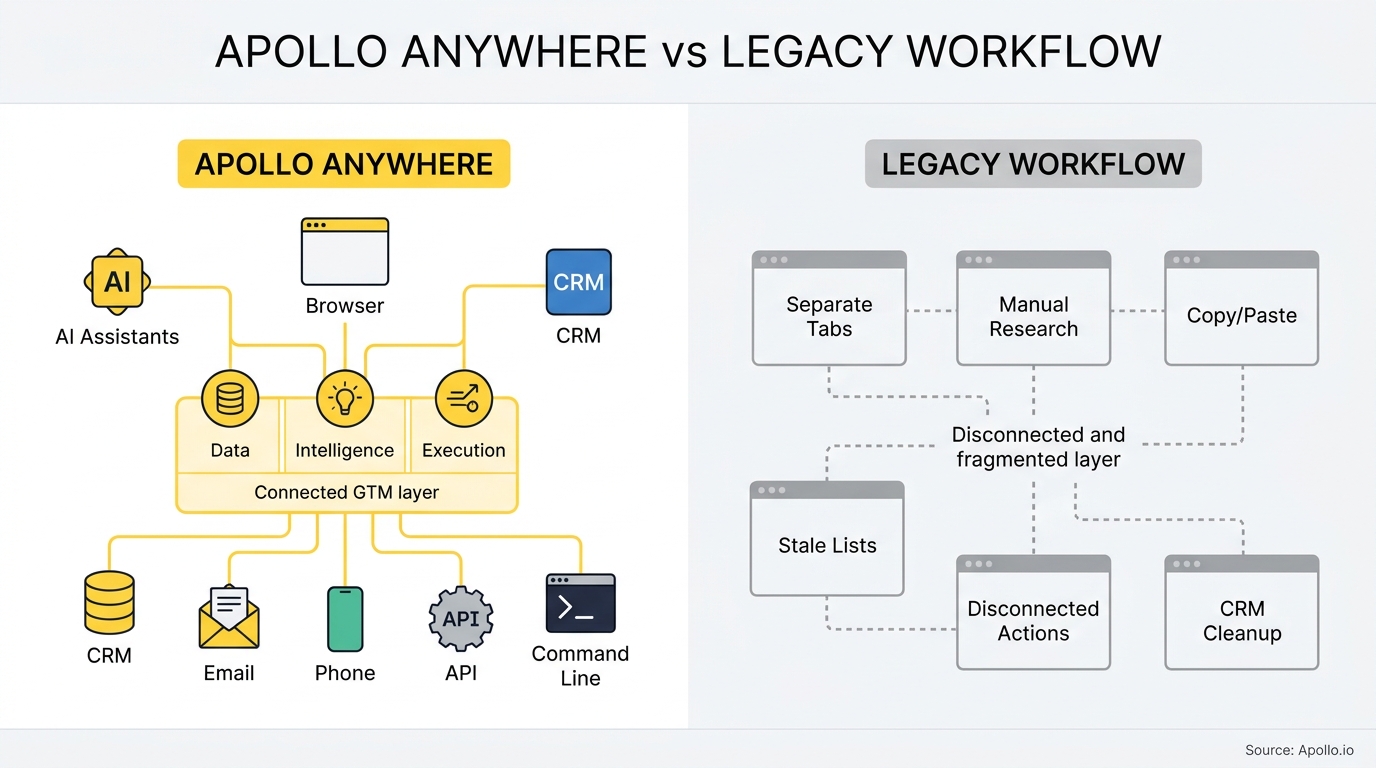
Apollo brings B2B data, sales engagement, and AI-powered execution together in one connected go-to-market system, so teams don't have to stitch together separate vendors for research, outreach, and analysis. Whether you use Apollo's own buying intent data or layer other signals on top, the goal is the same: turn a signal into a conversation quickly.
"The thing that made me most excited as somebody who's been in sales development a long time was Apollo's integration between sales data and sales engagement and the magic that you can make happen when those two are together on the same platform."
Spending hours turning flagged accounts into outreach? Automate multi-channel sequences with Apollo so the moment an account surfaces, the right contacts are already in motion.
Why Does Contact Quality Matter for Intent Programs?
A signal is only as useful as your ability to reach the right person. Clean CRM records make routing, suppression, and handoffs work. Apollo's guide to contact data enrichment and ROI covers how verified titles and company data reduce the cost of bad data, and Apollo's enrichment product keeps records fresh so intent-driven routing doesn't break on stale fields.
"Having Apollo and having everything be in one system was a game changer, for BDRs specifically."

What Should You Do Next?
Define your scorecard thresholds first, then run a time-boxed trial against your own named accounts with a control group. Document partner-access terms and integration behavior in writing, and decide suppression rules and handoff owners before the first signal fires.
- Week 1: Set ICP list, thresholds, and control group.
- Weeks 2 to 6: Run the trial and log signals, timestamps, and actions.
- Week 7: Score the five dimensions and compute cost per incremental opportunity.
Intent tells you when to engage, but you still need the right contacts and a fast way to reach them. To see why Apollo stands alone as the only fully agentic GTM platform, combining sales intelligence, outbound execution, and enrichment in one workspace, Start Prospecting free with Apollo today.
Prove Pipeline ROI Without The Guesswork
Budget review coming and you can't show what your tools actually return? Apollo brings data, engagement, and AI into one system, so pipeline impact is easier to see. Leadium tripled annual revenue and Built-In gained 10% win rate. Start free.
Start Free with Apollo →Don't miss these
Sales
Inbound vs Outbound Marketing: Which Strategy Wins?
Sales
What Is a Sales Funnel? The Non-Linear Revenue Framework for 2026
Sales
What Is a Go-to-Market Strategy? The 2026 GTM Playbook
See Apollo in action
We'd love to show how Apollo can help you sell better.
By submitting this form, you will receive information, tips, and promotions from Apollo. To learn more, see our Privacy Statement.
4.7/5 based on 9,690 reviews
