Searches for "6 sense data" usually mean one thing: buyers want to know what 6sense's account intelligence actually contains and whether it is worth buying. 6sense data is account-level intent and predictive intelligence that helps B2B teams decide which companies to prioritize. This guide labels each claim by evidence type and gives you tools to test it. For background on the category, start with Apollo's intent data primer.

Apollo Hands Reps Their Selling Hours Back
Tired of burning hours researching leads and double-checking contact info? Apollo puts business contact info and 98% email accuracy in one workspace, so reps spend the day talking to buyers. Start free today.
Start Free with Apollo →Key Takeaways
- 6sense data is best understood as account-level signals plus predictive scoring. Confirm in writing what is person-level and what is not.
- Intent data helps with timing, but many buyers form preferences before they ever talk to sales.
- Evaluate data provenance, integration, privacy, and licensing before you sign.
- Run a controlled pilot with comparable account groups, a baseline, and a fixed test window.
- Intent signals only create pipeline when contact data and outreach execution sit behind them.
What Is 6sense Data and What Signals Does It Include?
6sense data is a set of account-level signals and predictive scores used to estimate which companies may be in a buying cycle. The table below shows common signal categories in intent platforms.
The details of any specific vendor's package are labeled "confirm with vendor" because they vary by contract.
| Signal Type | Typical Source | Scope | Key Limitation |
|---|---|---|---|
| First-party engagement | Your website, ads, CRM, marketing automation | Account, sometimes contact | Limited to accounts that already know you |
| Third-party research activity | Content consumption across external sites | Usually account | Provenance and recency vary; confirm with vendor |
| Predictive fit scoring | Modeled from firmographics and past wins | Account | A score is a probability, not a confirmed need |
| Firmographic and technographic | Company databases and tech detection | Account | Can lag real-world changes |
Does 6sense Identify Individuals?
6sense's positioning centers on account-level intelligence. Whether named contacts are included depends on package, region, and licensing, so get it in writing before you assume person-level reach.
Where Does 6sense Intent Data Come From?
Intent platforms generally blend first-party activity with third-party research signals. Ask any vendor, 6sense included, for a source list, refresh cadence, and the rules governing each source.
Why Does Intent Timing Matter in 2026?
Intent data matters because buyers decide earlier than sales teams expect. 6sense's 2025 Buyer Experience Report found that the point at which buyers first engage sellers shifted from about 70% into the journey to 59%-60%. That is a vendor-reported survey result. It describes buyer behavior and does not prove any tool lifts revenue.
Geisheker reports that 95% of winning vendors were already on the buyer's Day One shortlist. Separately, Milan Novotny's attribution roundup puts the average B2B purchase cycle at 10.1 months in 2025, down from 11.3 months in 2024. Together, these findings suggest intent signals work best alongside early education content, not as a late-stage trigger for more outreach.
How Should You Evaluate 6sense Data Before You Buy?
Evaluate 6sense data by testing coverage, signal sources, and activation paths against your own target accounts. A vendor demo shows the product at its best, so run your own list through it.
- Coverage: Upload 100 to 200 of your target accounts and check how many return usable signals.
- Contact reach: Confirm in writing whether named contacts are included in your package and region.
- Source transparency: Request the source list, refresh cadence, and usage rules for each signal type.
- Activation: Map where signals go next, such as your CRM, ad platforms, or sales engagement tool.
- Pricing: 6sense's pricing is not publicly displayed, so teams contact its sales team for pricing details.
Signals only produce pipeline when someone acts on them quickly. Check how many steps sit between a signal firing and a rep sending a message.

How Does Apollo Compare With 6sense for Account Intelligence and Outreach?
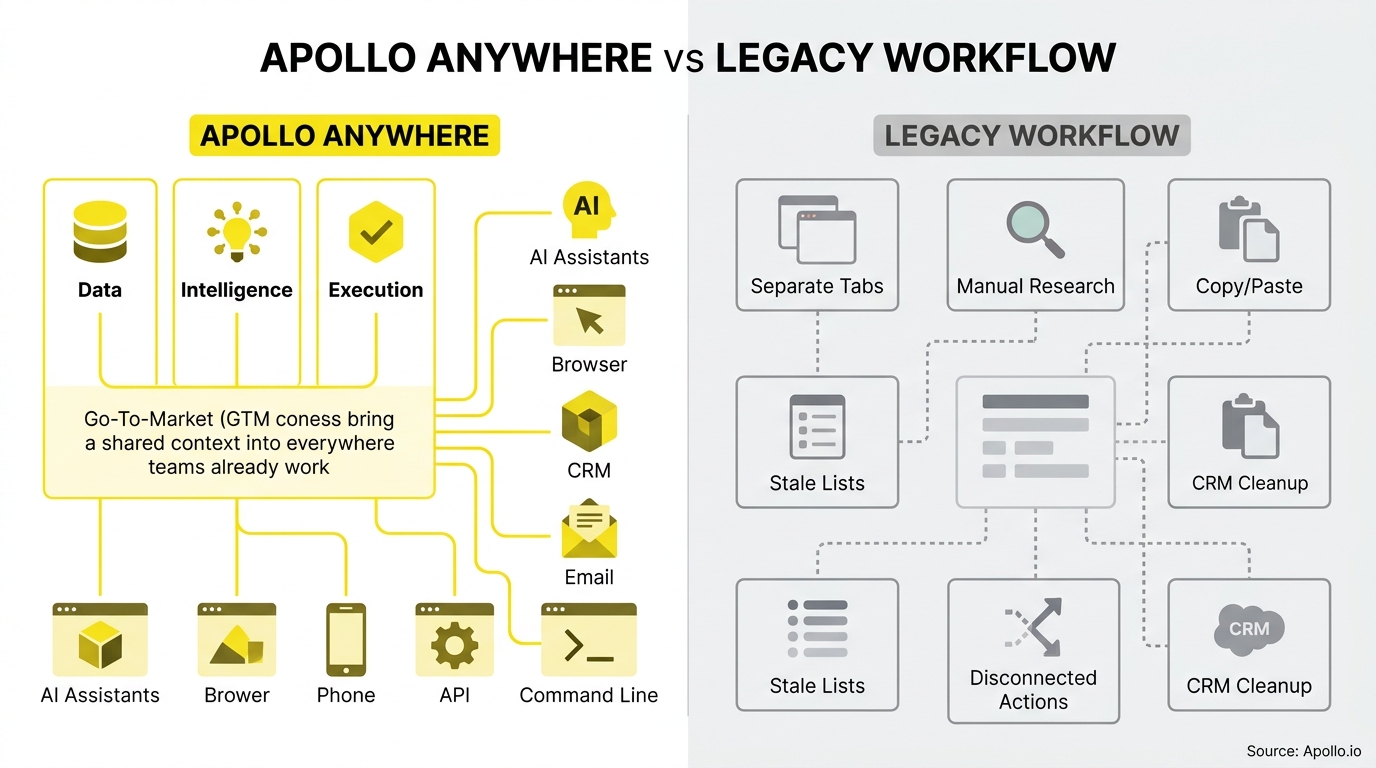
6sense centers on account-level intelligence, while Apollo brings B2B data, sales engagement, and AI-powered execution together in one connected go-to-market system. Teams don't have to stitch together separate vendors for research, outreach, and analysis.
| Capability | 6sense | Apollo |
|---|---|---|
| Primary focus | Account identification, intent signals, and predictive scoring | Sales intelligence, outbound execution, and enrichment in one workspace |
| Contact search | Depends on package, region, and licensing | Search across 240M+ people and 30M+ companies, with business contact information |
| Outreach | Integrates with engagement tools | Built-in sequences across email, phone, and social |
| Enrichment | Account and contact data within the platform | Data enrichment for CRM records |
| AI access | In-platform features | Apollo MCP inside Claude, ChatGPT, and Perplexity |
| Pricing | Not publicly displayed | Free at $0; Basic at $49/user/month on annual billing; Organization at $119/user/month billed annually (min 3 users). See Apollo pricing |
Predictable Revenue CEO Collin Stewart described the value of having data and engagement together:
"The thing that made me most excited as somebody who's been in sales development a long time was Apollo's integration between sales data and sales engagement and the magic that you can make happen when those two are together on the same platform."
Market data points the same direction. According to Ramp's Sales Data Providers category data, Apollo was the fastest-growing vendor in the category as of November 2026.
Apollo Turns Forecast Guesswork Into Pipeline
Forecasts feel like guesswork because the funnel starts with weak leads? Apollo puts 98% email accuracy and sales intelligence in one workspace, so your team fills the top of funnel with buyers worth chasing. Start free today.
Start Free with Apollo →How Do SDRs and RevOps Leaders Put Intent Data to Work?
Intent data pays off when it feeds a repeatable workflow with clear owners. Each role uses it differently.
- SDRs and BDRs: Prioritize accounts showing activity, find the right business contacts, and start a sequence the same day.
- RevOps leaders: Set routing rules, keep CRM records enriched, and measure which signals correlate with meetings booked.
- Sales and revenue leaders: Review signal-to-meeting conversion by segment, then adjust territory and coverage.
- GTM Engineers: Pull account and contact data into agents and workflows through the Apollo API, CLI, and MCP.
Speed from signal to first touch is the deciding factor. Andrew Froning of Cyera described how a unified system supports that:
"The moment we select someone in our database, they're instantly added to a sequence and we can take action right away. We're effective and efficient with our outreach."
Users control who they contact and how they use the product, so each team can shape this workflow around its own ICP.

What Is the Bottom Line on 6sense Data?
6sense data is account-level intent and predictive intelligence. Whether it includes named contacts depends on your package, region, and licensing, so verify sources, refresh cadence, and contact reach before signing.
Buyers engage sellers earlier than they used to, which makes the gap between signal and outreach the metric to watch.
If you want data, engagement, and AI-powered execution in one workspace, Apollo's AI platform connects the research step to the first message. To see how Apollo fits your workflow, start with a free Apollo account and test it against the accounts already on your target list.
Frequently Asked Questions About 6sense Data
Is 6sense data first-party or third-party?
It is a mix. 6sense combines signals from your own properties, such as website visits and CRM activity, with third-party signals like keyword research and content consumption across publisher networks. Ask the vendor how each source is weighted so you know what is driving an account's score.
How accurate is 6sense intent data?
Accuracy varies by region, industry, and account size. Run a pilot against closed-won and closed-lost accounts from the last few quarters, then check whether high-intent accounts converted at a meaningfully higher rate than the rest.
Can I get contact-level data from 6sense?
Contact availability depends on your package and licensing. Confirm in writing which contact fields are included, how often they are refreshed, and what coverage looks like for your ICP before you commit.
What should I do with an account showing high intent?
Route it to the right owner quickly, confirm the buying committee, and start outreach tied to the topic the account has been researching. Speed matters because intent signals fade as buyers move through their evaluation.
Do I need a separate tool to act on intent signals?
Often, yes. Intent data tells you where to focus, but you still need verified contacts, sequencing, and CRM sync to turn that signal into meetings.
Some teams pair an intent platform with an engagement tool, and others consolidate into a single workspace like Apollo.
Conclusion
6sense data can help you see which accounts are researching your category, but its value depends on what you can verify before buying and how fast your team acts on it. Test source transparency, refresh cadence, and contact coverage against your own ICP, then measure the time from signal to first touch.
Apollo helps close that gap by combining B2B data, engagement, and AI-powered workflows in one place, so your team can go from finding accounts to booking meetings without switching tools.
Try Apollo free and see how quickly your team can turn account signals into pipeline.
Prove Pipeline ROI Faster With Apollo
Struggling to show leadership what your sales stack actually delivers? Apollo puts 98% email accuracy and sales intelligence in one workspace, so wins show up fast enough to defend the budget. Built-In saw +10% win rate and +10% ACV. Start free today.
Start Free with Apollo →Don't miss these
Sales
Inbound vs Outbound Marketing: Which Strategy Wins?
Sales
What Is a Sales Funnel? The Non-Linear Revenue Framework for 2026
Sales
What Is a Go-to-Market Strategy? The 2026 GTM Playbook
See Apollo in action
We'd love to show how Apollo can help you sell better.
By submitting this form, you will receive information, tips, and promotions from Apollo. To learn more, see our Privacy Statement.
4.7/5 based on 9,690 reviews
