
Which Companies Visited Your Website, and Who to Contact
Knowing which companies visited your website is only half the answer. The harder question is who to contact there, and whether that visit even means what you think it means.
A single anonymous pageview is not proof that a specific buyer wants to talk to sales; it's a signal that needs validation before it becomes outreach.

Skip The Research Grind With Apollo
Burning hours a day chasing bad emails and dead numbers instead of selling. Apollo hands your team verified contact data instantly, so reps spend time closing, not digging. 98% email accuracy means fewer bounces and more real conversations.
Start Free with Apollo →Key Takeaways
- Website visitor identification reveals company-level interest, not individual intent. Treat it as one signal among several, not proof someone wants a sales call.
- Use Apollo MCP when you need to check an identified account's fit, pull the right contacts, and launch a sequence without leaving ChatGPT, Claude, or Perplexity.
- Map page visits to likely buying-group roles (pricing, security, integrations) instead of guessing at a single decision-maker.
- Score every identified visit before outreach: confirm ICP fit, check page intent, and set a confidence threshold before anyone gets a message.
- Use Apollo MCP when you need to automate the research-to-outreach handoff the moment a target account shows up in your analytics.
What Does It Mean When a Company Visits Your Website?
It means a business tied to a specific domain loaded pages on your site, based on IP-to-company matching or similar identification methods, not that one named employee raised their hand. Visitor identification tools resolve anonymous traffic to a company record using firmographic and network data.
That company-level match is useful, but it is fundamentally different from knowing which person clicked what.
This distinction matters because most of the buying journey happens before anyone talks to sales. According to Forrester, success in B2B now depends on navigating a "loose network" of stakeholders rather than a single decision-maker; a single visitor ID rarely represents that whole network. Treat the account match as a starting point for research, not a green light for a personalized cold call.
Why Shouldn't You Contact the First Name You Find?
You shouldn't contact the first name you find because major B2B purchases involve a group, not an individual, and messaging the wrong person burns the signal. Identifying the company is only the first step, according to Influ2, which frames buying committees as multi-person structures that require broader mapping before outreach.
Two failure modes are common:
- Guessing a title: Emailing "whoever is Head of Sales" based on a hunch wastes the visit and can damage trust.
- Ignoring hidden buyers: Finance, Legal, Compliance, and Procurement stakeholders hold veto power but rarely browse your site. Edelman found that over 40% of B2B deals stall due to internal misalignment caused by these hidden buyers.
The fix is building a role-based buying group from page behavior, not a single guessed contact.

How Do You Map Website Pages to Buying-Group Roles?
You map pages to roles by grouping your site into clusters (pricing, security, integrations, case studies) and assigning each cluster a likely stakeholder type, confidence threshold, and response action. This turns raw pageviews into a structured signal instead of a guess.
| Page Cluster | Likely Role | Confidence Threshold | Recommended Action | Do-Not-Contact Trigger |
|---|---|---|---|---|
| Pricing / plans | Economic buyer, RevOps | High (repeat visits + ICP fit) | Route to AE for tailored outreach | Single visit, non-ICP company size |
| Security / compliance | Legal, IT, Procurement | Medium | Send security one-pager, no hard pitch | Visitor from unrelated industry |
| Integrations / API docs | Technical evaluator, RevOps | Medium | Offer technical demo or docs link | Bot traffic or dev-tool referral |
| Case studies / customer stories | Champion, end user | Low-Medium | Add to nurture sequence | Bounce rate under 10 seconds |
| Careers / about | Not a buyer signal | N/A | No sales action | Always exclude from outreach |
This structure lets SDRs and AEs prioritize the accounts and roles most worth a personalized message, instead of blasting one contact per visit.
Find Ready Buyers Before They Go Cold
Marketing leads stalling before they become real opportunities. Apollo surfaces buying intent and prioritizes accounts actively in-market, so your team engages at the right moment. Built-In saw a 10% lift in win rate using Apollo's scoring.
Start Free with Apollo →How Should You Score an Identified Visit Before Reaching Out?
You should score a visit by combining account fit, page intent, and visit frequency into a simple threshold before any outreach goes out. A decision tree works well:
- Identify: Resolve the anonymous session to a company using your visitor ID tool.
- Validate: Confirm the company matches your ICP (size, industry, existing CRM status).
- Score: Weight the page cluster visited, visit frequency, and referral source (an AI-assistant referral, for example, often signals more research depth than a generic search click).
- Select response level: High-confidence accounts get a rep-led sequence; low-confidence accounts get nurture content only.
- Map roles: Assign likely stakeholders using the table above.
- Measure outcomes: Track reply rate and meeting rate by confidence tier to refine thresholds over time.
This matters more now because referral source itself is a growing signal. Demandbase reported that monthly ChatGPT referrals across its measured B2B websites rose sharply between June 2025 and June 2026, meaning a visitor arriving from an AI-generated comparison may already be deep in evaluation.
Skipping the scoring step and messaging every identified account equally ignores that nuance entirely.
Struggling to turn identified accounts into a real pipeline? Apollo's pipeline tools help you qualify and route identified accounts before outreach.
How Can SDRs and AEs Turn a Website Visit Into a Qualified Contact?
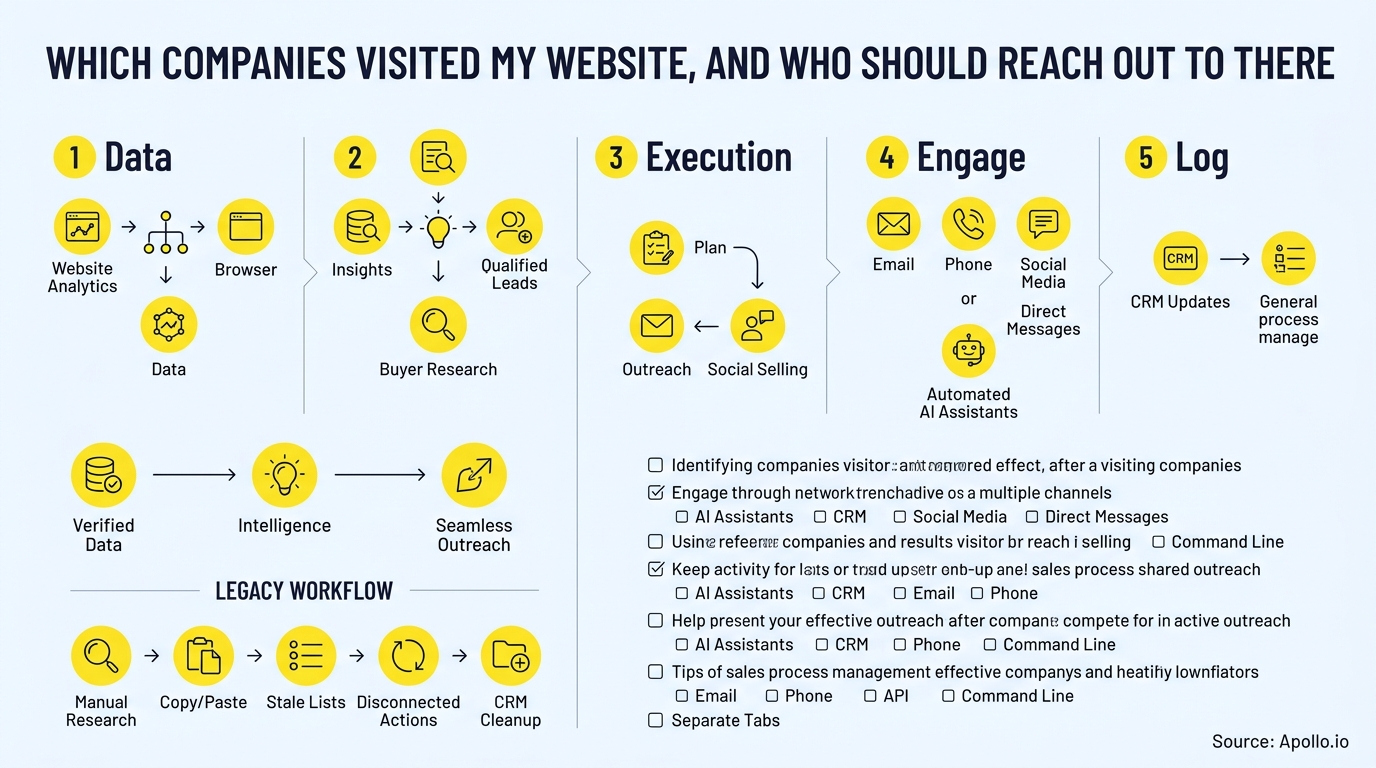
SDRs and AEs turn a website visit into a qualified contact by enriching the identified company with verified contacts, checking CRM ownership, and building a small buying-group list instead of one name. For SDRs working target accounts, that means pulling two to three contacts across the roles mapped in the table above, not just a single "best guess" title.
For Account Executives managing existing pipeline, a website visit from a known account can be a strong signal to move a deal forward, especially if the visit hits pricing or security pages late in a cycle. RevOps leaders benefit from standardizing this workflow across the team so reps aren't manually cross-referencing spreadsheets for every alert.
This is also where consolidating tools matters. Collin Stewart at Predictable Revenue said his team "reduced the complexity of three tools into one" by moving research, enrichment, and outreach into a single workspace. Apollo serves B2B GTM teams, GTM Engineers, and AI Builders working across sales, RevOps, and marketing, and brings data, intelligence, and execution together so reps aren't stitching together separate vendors for research and outreach. Learn more in Apollo's outbound prospecting guide.
Can You Run This Whole Workflow From ChatGPT or Claude?
Yes, you can identify, enrich, and act on a target account visit directly inside the AI tool you're already using, without switching tabs. Apollo MCP connects Apollo's data and execution layer to ChatGPT, Claude, Perplexity, and Codex, so you can ask a question like "pull the RevOps and Security contacts at [Company]" and get verified emails and phone numbers back in the same conversation.
From there, you can add those contacts to a sequence, update CRM records, or check campaign performance, all without leaving the AI tool. Setup is no-code: connect Apollo through the AI tool's connectors via OAuth, on any Apollo plan including free.
Your best prospecting session shouldn't require opening a new tab.
Spending hours on manual outreach after every visitor alert? Automate your sequences with Apollo's multi-channel engagement platform once you've confirmed the right contacts.
Is It Legal or Appropriate to Tell a Prospect They Visited Your Site?
It's generally not advisable to reference a specific visit in outreach, because doing so can feel invasive and signals covert tracking rather than genuine interest in the account. Company-level identification typically relies on IP-to-firmographic matching, which is a lower-risk data category than person-level tracking, but transparency and restraint still matter.
Cisco's global privacy research, cited broadly across the industry, found that a majority of buyers will not purchase from organizations they don't trust with their data, and Gartner's buyer research shows most B2B buyers actively avoid vendors who send irrelevant or overly specific outreach. Practical guardrails:
- Reference the account's general interest area ("saw your team exploring integrations") rather than exact pages or timestamps.
- Never reveal person-level browsing detail unless the visitor explicitly opted in through a form or chat.
- Maintain suppression lists and honor deletion requests, especially as more U.S. states enforce comprehensive privacy laws.
- Lead with value (a relevant case study or answer to a likely question) instead of proof you were watching.
What's the Best Way to Get Started With Website Visitor Identification?
The best way to start is by picking a narrow account list, mapping your key pages to buying-group roles, and testing a scored outreach workflow before automating anything company-wide. Begin with your target account list, not your entire site traffic, so you can validate accuracy before scaling.
Once the scoring model works on a small list, layer in enrichment and sequencing. Tired of dirty data slowing that process down? Apollo's data enrichment tools verify contact details so the buying-group list you build from page visits is accurate from the start. Review Apollo's guide to lead lists that convert for building that first target list.
Frequently Asked Questions
How accurate is website visitor identification?
Accuracy varies significantly by vendor and identification type. Company-level matching (resolving a visit to a business) is generally more reliable than person-level matching (resolving a visit to a named individual), so always ask a vendor to report these two metrics separately during evaluation.
Is website visitor identification legal?
Company-level identification based on IP and firmographic data is a widely used practice, but privacy obligations are increasing. More U.S. states have enacted comprehensive privacy laws in recent years, so confirm your vendor's data sourcing and deletion processes before layering on person-level enrichment.
Should I tell a prospect I saw them visit my website?
No. Referencing specific page-level or timestamped browsing behavior in outreach can feel invasive. Use the visit as an internal prioritization signal, and lead your message with relevant value instead of proof of tracking.
Who should I actually contact when a target account visits?
Map the pages they viewed to likely roles (economic buyer, technical evaluator, procurement) and build a small buying-group list of two to three contacts rather than reaching out to a single guessed name.

Turn Identified Visits Into a Real Pipeline
Website visitor identification tells you a company is interested. It doesn't tell you who to email, what to say, or whether the moment is right.
The teams that win treat every identified visit as a signal to validate, score, and route to the right buying-group roles, not as an invitation to fire off a single cold email.
Apollo brings that validation, enrichment, and outreach into one workspace instead of a stack of disconnected tools. Whether you're working from Apollo directly or from Apollo MCP inside ChatGPT or Claude, you can confirm fit, pull verified contacts, and launch a sequence in the same motion you use to research the account.
Justify Spend With Apollo-Driven Pipeline
Can't prove ROI fast enough to keep leadership happy? Apollo turns rep activity into measurable pipeline from day one, so budget approval stops being a fight. Leadium 3x'd annual revenue after automating outbound with Apollo.
Start Free with Apollo →Don't miss these
Sales
Inbound vs Outbound Marketing: Which Strategy Wins?
Sales
What Is a Sales Funnel? The Non-Linear Revenue Framework for 2026
Sales
What Is a Go-to-Market Strategy? The 2026 GTM Playbook
See Apollo in action
We'd love to show how Apollo can help you sell better.
By submitting this form, you will receive information, tips, and promotions from Apollo. To learn more, see our Privacy Statement.
4.7/5 based on 9,690 reviews
