
GTM Engineer vs. Traditional Sales Operations: What's the Difference in 2026?
Sales Ops and GTM Engineering are often used interchangeably. They shouldn't be. One governs process. The other ships revenue systems. Understanding the difference helps revenue leaders hire correctly, structure teams efficiently, and stop asking process managers to do an engineer's job. For a deeper foundation on the role itself, see Apollo's GTM Engineer explainer.

Apollo Turns Hours of Research Into Minutes
Tired of burning your best selling hours on manual lead research and dead-end contact data? Apollo surfaces verified contacts instantly so your team spends time closing, not digging. Nearly 100K paying customers scaled pipeline without scaling headcount.
Start Free with Apollo →Key Takeaways
- Traditional Sales Ops focuses on process governance, reporting, and CRM hygiene. GTM Engineering focuses on building automated revenue systems that run at scale.
- The roles are complementary: RevOps governs, GTM Engineering builds. Both functions are needed in mature GTM organizations.
- Buyer behavior is pushing the shift. B2B buyers now expect personalized, timely, relevant outreach — requirements that manual Sales Ops processes cannot consistently deliver.
- The best GTM Engineers are revenue strategists, not tool administrators. Stack consolidation beats integration overhead every time.
- For SDRs and RevOps leaders, the practical impact is clear: a GTM Engineer changes what lands in the queue and how fast it gets there.
What Does Traditional Sales Operations Actually Do?
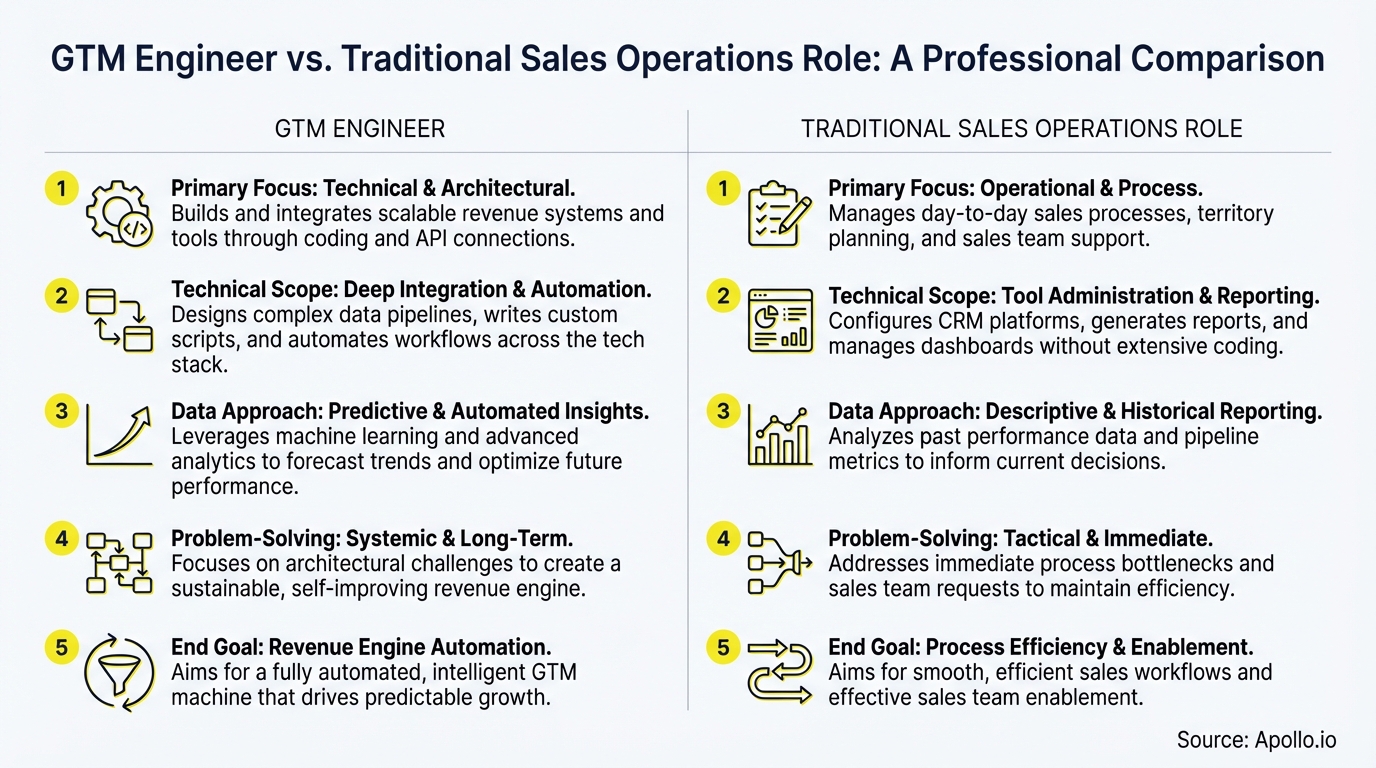
Traditional Sales Ops optimizes process adherence across the sales organization. The charter centers on CRM hygiene, forecasting accuracy, territory design, compensation operations, and reporting.
Sales Ops is the function that makes sure the current system runs correctly.
Core Sales Ops responsibilities include:
- CRM data governance and pipeline reporting
- Territory and quota management
- Forecasting models and revenue dashboards
- Sales process documentation and enablement coordination
- Tool administration (configuring existing platforms)
The limitation: Sales Ops excels at managing existing workflows but rarely builds new ones. When the GTM motion needs to change — new ICP, new channel, new signal layer — Sales Ops can document the new process but typically cannot automate it into execution. That gap is where GTM Engineering begins. To understand the broader operational context, see What Is Revenue Operations and How Does It Drive Growth?
What Does a GTM Engineer Actually Build?
A GTM Engineer builds, automates, and optimizes scalable revenue systems across sales, marketing, and customer success. According to Landbase, a GTM Engineer is primarily a technical strategist — not a process manager. The output is running systems, not slide decks or SOP documents.
GTM Engineering outputs include:
- TAM lists qualified by AI prompts, not manual filters
- Scoring models that rank every account on weighted signals
- Enrichment and routing workflows triggered by real-time data
- Messaging intelligence tied to account-specific research
- Agentic sequences that execute without manual handoffs
The role is closer to a product engineering operating model than classic Sales Ops. GTM Engineers write automation logic, design data architectures, and ship systems that compound over time. Spending hours on manual outreach instead of building systems that do it automatically? Automate your GTM workflows with Apollo's AI sales automation.
Turn Funnel Gaps Into Quota Wins
Pipeline forecasting a guessing game because quality leads never materialize into real opportunities? Apollo surfaces in-market buyers with verified contact data so your pipeline reflects reality, not hope. 600K+ companies forecast with confidence.
Start Free with Apollo →How Do GTM Engineering and Sales Ops Compare Side by Side?
| Dimension | Traditional Sales Ops | GTM Engineer |
|---|---|---|
| Primary output | Reports, process docs, dashboards | Running automated systems |
| Core skill | Process design, CRM config, Excel/BI | APIs, SQL, workflow automation, AI prompting |
| Change response | Updates the SOP, retrains reps | Adjusts scoring weights, system re-prioritizes overnight |
| Data role | Governs data quality and definitions | Builds data pipelines and enrichment automations |
| Relationship to tools | Administers existing tools | Designs the architecture; consolidates the stack |
| Cadence | Quarterly planning cycles | Continuous, evergreen execution |
The distinction formalizing in 2026: Sales Ops and RevOps own governance, reporting, and accountability. GTM Engineering owns the build function — shipping automations faster and keeping the system compounding. As Tabula notes, a GTM Engineer is primarily a technical strategist who builds, automates, and optimizes scalable revenue systems — a definition that does not overlap with traditional Ops.
Why Is This Distinction Mattering More in 2026?
Buyer behavior is forcing the shift. A Gartner survey of 632 B2B buyers (Aug–Sep 2024) found that 61% preferred a rep-free buying experience and 73% actively avoided suppliers sending irrelevant outreach.
That raises the bar for data quality, routing logic, personalization, and automation — the exact systems GTM Engineers build, not the process documents Sales Ops writes.
McKinsey's 2024 B2B Pulse found buyers now use an average of 10 interaction modes across the purchase journey, split roughly equally across in-person, remote, and digital self-serve channels. Orchestrating that requires engineering-style integration work, not quarterly process reviews. Understanding what a Revenue Operations Framework looks like helps clarify where each role fits in the broader structure.

How Do RevOps Leaders and SDRs Experience This Difference?
For RevOps leaders, the GTM Engineer solves the governance-to-execution gap. RevOps defines what a qualified lead means.
The GTM Engineer encodes that definition into automated scoring so it never gets interpreted differently by 12 different reps. A Gartner survey of 243 CSOs (Nov–Dec 2024) found that 49% said Sales' definition of a qualified lead differs greatly from Marketing's — a coordination failure that GTM Engineering fixes by encoding shared definitions into the system itself.
For SDRs, the day looks different when a GTM Engineer has built the system. Instead of spending the morning pulling lists and researching accounts manually, the system surfaces 50 prioritized accounts with AI-researched context before 9am. SDRs review the top accounts, approve or refine messages, and focus on conversations — not data entry. That shift reclaims selling capacity at the rep level. Apollo's GTM Engineering (GTME) Program is specifically designed to build this system in 12 weeks alongside a team's existing operations.
Struggling to keep your pipeline populated with the right accounts? Build a signal-scored pipeline with Apollo.
Is GTM Engineer Just Rebranded RevOps?
No. The roles are complementary, not synonymous.
RevOps remains the umbrella function: it owns governance, data definitions, forecasting, territory design, and accountability. GTM Engineering is the specialized build function inside or alongside RevOps — analogous to how analytics engineering specialized within data teams.
The honest critique worth naming: many GTM Engineers in 2026 wear a badge of honor around how many disparate tools they've strung together and call it a "seamless workflow." Seamless and a 14-tool Frankenstack are an oxymoron. The best GTM Engineers are revenue strategists, not tool sommeliers. They collapse the stack into one end-to-end workflow with minimal integration overhead — because great strategy demands execution velocity, not API babysitting. See how to build a sales tech stack that actually scales for a practical framework on consolidation.
The trajectory points toward Agentic GTM: systems that research, score, message, and sequence autonomously, with humans reviewing only the highest-priority accounts. The GTM Engineer who wins long-term deploys the most elegant strategy at the highest velocity — not the most elaborate workflow. For more on the sales analytics layer that supports this, see How Does Sales Analytics Drive Revenue Growth?
Which Role Does Your Team Need Right Now?
Most teams need both. If your CRM data is unreliable, your forecasting is inconsistent, and your process is poorly documented — start with Sales Ops. If your process is solid but execution is manual, slow, and inconsistent across reps — that's a GTM Engineering problem. According to RevPartners, the GTM Engineer role is among the most underrated in B2B precisely because it sits at the intersection of strategy and systems execution.
A practical signal: if your team is rebuilding targeting lists every quarter, re-explaining ICP criteria to every new rep, and manually researching accounts before every outreach campaign — you need a GTM Engineer. If your pipeline reporting is opaque and your forecast is unreliable — you need stronger Sales Ops first.

Build the System, Not the Workaround
The GTM Engineer and Sales Ops roles serve different functions. Sales Ops governs the system.
GTM Engineering builds it. Both matter.
But the demand for GTM Engineers is growing because modern pipeline generation is a systems problem — and process governance alone does not solve it.
Apollo is built for teams that want to consolidate the stack and execute with one unified workflow. As Cyera put it: "Having everything in one system was a game changer." If your team is ready to stop rebuilding and start compounding, start a free trial of Apollo today.
Prove Pipeline ROI Before Next QBR
ROI pressure killing your budget approval? Apollo delivers measurable pipeline impact from day one — no guesswork, no waiting. Leadium 3x'd annual revenue. See your ROI fast.
Start Free with Apollo →Don't miss these
Revenue Operations
Top Market Intelligence Tools for B2B Teams in 2026
Revenue Operations
Sales Operations Analyst Salary: 2026 Compensation Guide and Benchmarks
Revenue Operations
Sales Compensation Software: How to Automate Commission Management
See Apollo in action
We'd love to show how Apollo can help you sell better.
By submitting this form, you will receive information, tips, and promotions from Apollo. To learn more, see our Privacy Statement.
4.7/5 based on 9,690 reviews
