
What's a Sales Intelligence Platform and What Problems Does It Solve?
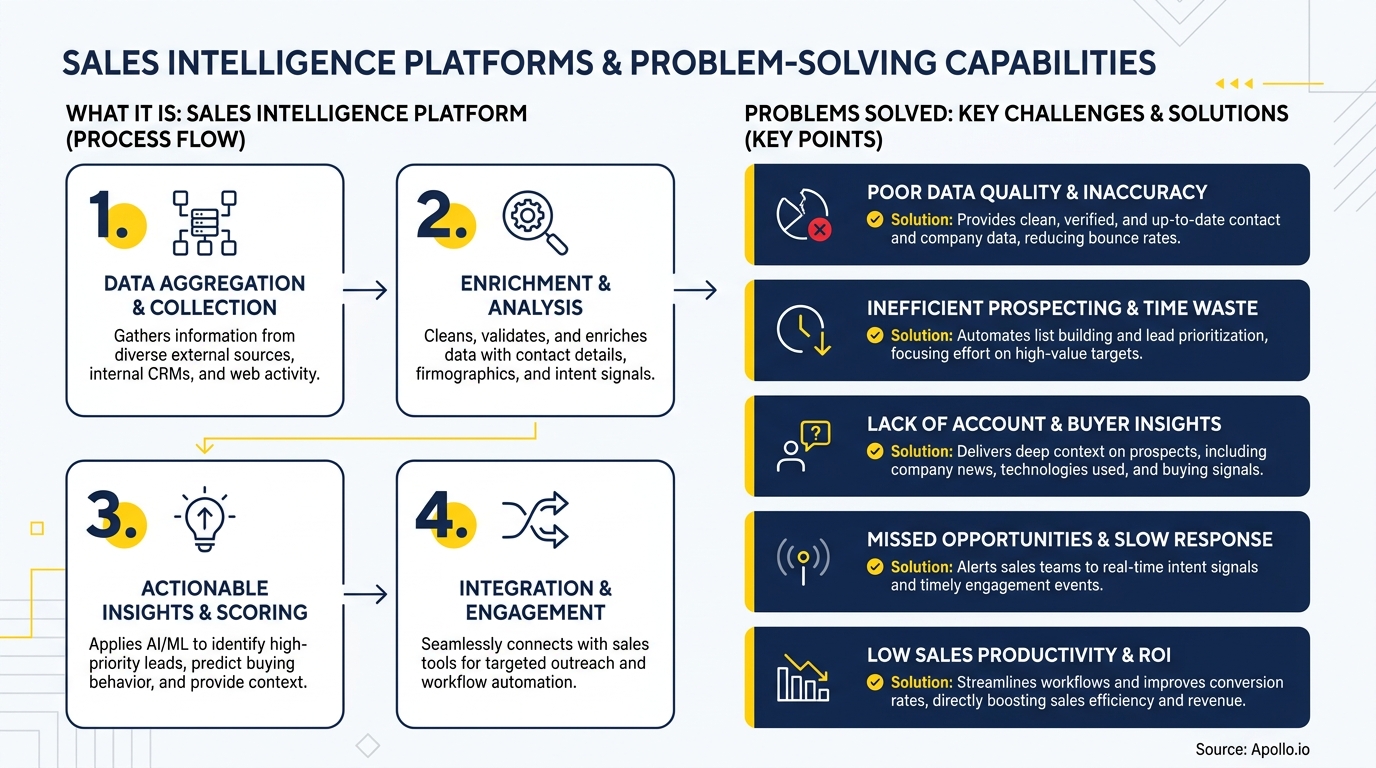
A sales intelligence platform is software that aggregates, analyzes, and activates business contact and account data so sales teams can find the right buyers, reach them with relevant messaging, and close deals faster. If your reps are spending more time researching than selling, this is the category that fixes it. See how it works with an Apollo on-demand demo.

Research Less, Pipeline More With Apollo
Tired of burning hours verifying contacts that go nowhere? Apollo delivers 230M+ accurate business contacts so your reps sell instead of search. Join 600K+ companies building pipeline faster.
Start Free with Apollo →Key Takeaways
- Sales intelligence platforms turn raw contact and account data into seller-ready insights, reducing time spent on manual research.
- Poor data quality is endemic: only about 8% of marketing teams report their data is more than 91% accurate, which directly kills pipeline.
- AI is rapidly becoming the primary interface for prospect research, with Gartner predicting 95% of seller research workflows will start with AI by 2027.
- SDRs, AEs, and RevOps leaders all gain distinct workflow advantages from a unified sales intelligence platform vs. disconnected point tools.
- The best platforms consolidate prospecting, enrichment, engagement, and analytics in one workspace, cutting tool sprawl and cost.
What Is a Sales Intelligence Platform?
A sales intelligence platform is a unified system that combines firmographic, technographic, predictive, and intent data from sources like CRM systems, company websites, news feeds, and job postings to create comprehensive account profiles. According to Crunchbase, these platforms pull from internal and external signals to identify relevant opportunities and surface them to sellers at the right moment.
Sales intelligence is not the same as a CRM. A CRM stores what already happened.
A sales intelligence platform tells you what to do next, and with whom. It is also distinct from revenue intelligence, which focuses on analyzing recorded deals rather than sourcing new ones.
What Problems Does a Sales Intelligence Platform Solve?
Sales intelligence platforms solve six core problems that drain B2B revenue teams of time, pipeline, and credibility.
| Problem | Root Cause | How Sales Intelligence Fixes It |
|---|---|---|
| Reps spend too little time selling | Manual research and admin dominate the workday | AI synthesizes account context automatically |
| Dirty, decaying contact data | B2B data degrades rapidly without active enrichment | Continuous enrichment keeps records accurate |
| Irrelevant outreach | No signal-based targeting or ICP filtering | Intent and firmographic filters surface in-market buyers |
| Long sales cycles | Wrong personas, slow follow-up, poor qualification | Buying group data and prioritized account lists |
| Inconsistent messaging | Reps improvise without a shared data foundation | Centralized intelligence standardizes rep execution |
| Inaccurate forecasting | Gut-feel pipeline reviews with bad underlying data | Predictive analytics improve pipeline visibility |
Data quality is the foundation of all other problems. Research from Fortune Business Insights found that only about 8% of marketing representatives report their sales and marketing data is 91% to 100% accurate. That gap between perceived and actual data quality is where pipeline silently leaks.
Struggling to find qualified leads inside your ICP? Search Apollo's 230M+ verified contacts with 65+ filters to find buyers who match your exact criteria.
How Does a Sales Intelligence Platform Work?
Sales intelligence platforms operate across three layers: data ingestion, AI synthesis, and workflow activation.
- Data ingestion: The platform pulls firmographic data (company size, industry, revenue), technographic data (tech stack), intent signals (content consumption, buying activity), and contact details from verified sources.
- AI synthesis: AI agents aggregate multi-source signals into account summaries, talking points, and prioritized prospect lists. Modern sales intelligence tools now surface these insights directly in seller workflows rather than requiring manual lookups.
- Workflow activation: Enriched records flow into sequences, CRM records, and outreach cadences automatically, so reps act on insights without switching tools.
Gartner predicts that by 2027, 95% of seller research workflows will begin with AI, up from less than 20% in 2024. Platforms built around AI-first synthesis, rather than simple database access, are where the market is heading.

How Do SDRs and AEs Use Sales Intelligence Day to Day?
SDRs and AEs use sales intelligence platforms differently but depend on the same underlying data layer.
For SDRs: The platform replaces hours of manual research per account. Instead of stitching together information from multiple tabs, SDRs get pre-built account profiles, verified contact details, and intent signals that tell them which companies are actively researching solutions like theirs. This directly addresses the finding from the Salesforce State of Sales report that reps spend 70% of their time on non-selling tasks.
For AEs: Sales intelligence supports deal progression. Account history, stakeholder maps, and technographic context help AEs tailor proposals and anticipate objections. Connecting this to sales analytics and revenue operations workflows gives the full picture of deal health.
For RevOps: A unified intelligence platform means one source of truth for pipeline data, cleaner CRM records, and more reliable forecasting inputs. SNS Insider notes that these platforms enrich existing records with fresh, accurate data and ensure data hygiene, which is exactly what RevOps leaders need to trust their reporting.
Turn Weak Leads Into Pipeline With Apollo
Tired of watching marketing leads die before they reach sales? Apollo surfaces in-market buyers the moment they're ready, so your reps chase opportunities — not dead ends. 600K+ companies trust Apollo to fill their funnel with quality.
Start Free with Apollo →What Capabilities Should a Sales Intelligence Platform Include?
The strongest platforms map capabilities directly to sales workflow stages rather than offering isolated feature sets.
| Workflow Stage | Required Capability | What to Look For |
|---|---|---|
| Research and ICP targeting | Advanced search and filtering | 65+ firmographic, technographic, and intent filters |
| Data enrichment | Automated record enrichment | 97%+ email accuracy, continuous refresh |
| Outreach and engagement | Multi-channel sequence automation | Email, phone, and social touchpoints in one workflow |
| Call preparation | AI account summaries and talking points | Pre-meeting briefs generated from live account signals |
| Pipeline management | Deal tracking and forecasting | Integrated deal management with signal-based scoring |
| Analytics | Performance reporting | Team-level and rep-level activity and outcome data |
Platforms that require separate tools for each stage create data silos and inflate tool costs. As Cyera put it: "Having everything in one system was a game changer." Predictable Revenue echoed this: "We reduced the complexity of three tools into one."
Spending too much time stitching together outreach across disconnected tools? Run multi-channel sequences directly inside Apollo without switching platforms.
How Is Sales Intelligence Different from CRM and Revenue Intelligence?
Sales intelligence, CRM, and revenue intelligence solve different parts of the sales workflow and are often confused because modern platforms blend all three.
- CRM: Records customer interactions and manages existing relationships. It is a system of record, not a system of insight.
- Sales intelligence: Sources and surfaces new opportunities. It tells reps who to contact, when, and with what message, before a relationship exists.
- Revenue intelligence: Analyzes recorded conversations and deal activity to improve forecast accuracy and coaching. It looks backward to improve future outcomes.
The trend in 2026 is toward platforms that unify all three layers. Signal-to-workflow convergence means the best sales intelligence tools now activate intent data directly into sequenced outreach and feed clean data back into CRM automatically. Explore how this connects to sales performance management for a full-stack view.

Why Apollo Is Built for the AI-First Sales Intelligence Era
Apollo is an all-in-one GTM platform trusted by nearly 100K paying customers and 2M+ users across 600K+ companies. It consolidates prospecting, data enrichment, multi-channel engagement, AI automation, deal management, and analytics in one workspace.
That means SDRs, AEs, RevOps, and revenue leaders all work from the same data layer with no manual syncing between tools.
Apollo's database covers 230M+ people and 30M+ companies with 97% email accuracy. The AI Research Agent has helped users book 46% more meetings, and AI-powered messaging has driven a 35% increase in bookings. Census summarized the consolidation value directly: "We cut our costs in half." Explore Apollo's sales intelligence and lead database or visit the Apollo Wall of Love to see what customers say.
Sales intelligence is no longer a nice-to-have. With B2B buyers increasingly self-educating and 73% actively avoiding suppliers that send irrelevant outreach (Gartner, 2025), teams that rely on guesswork and stale data will keep losing to teams running on verified signals and AI-synthesized context.
The platform you choose should turn raw data into seller-ready actions across the full GTM motion.
Ready to see what a unified sales intelligence platform looks like in practice? Start Prospecting with Apollo for free and give your team the data, AI, and engagement tools they need in one place.
Prove Pipeline ROI With Apollo
ROI pressure killing your next budget approval? Apollo delivers measurable pipeline impact from day one — so you can walk into any review with hard numbers. Join 600K+ companies turning GTM spend into results.
Start Free with Apollo →Don't miss these
Sales
Inbound vs Outbound Marketing: Which Strategy Wins?
Sales
What Is a Sales Funnel? The Non-Linear Revenue Framework for 2026
Sales
What Is a Go-to-Market Strategy? The 2026 GTM Playbook
See Apollo in action
We'd love to show how Apollo can help you sell better.
By submitting this form, you will receive information, tips, and promotions from Apollo. To learn more, see our Privacy Statement.
4.7/5 based on 9,690 reviews
