
How AI Personalizes Email Content at Scale
Most B2B email personalization still means inserting a first name and calling it done. AI changes that equation entirely.
It analyzes buyer signals, account context, buying stage, and engagement history to generate email content that feels individually relevant at scale. For SDRs, AEs, and marketing teams under quota pressure, that shift from static tokens to dynamic relevance is the difference between ignored outreach and booked meetings.
If you want to understand how to use content in prospecting emails to actually move buyers, AI personalization is the mechanism that makes it scale.

Research Less, Pipeline More With Apollo
Tired of burning hours verifying contact info that goes nowhere? Apollo delivers 230M+ business contacts with 97% email accuracy so your reps spend time selling, not searching. Start building pipeline today.
Start Free with Apollo →Key Takeaways
- AI personalizes email content across four layers: signal collection, content decisions, dynamic copy modules, and send-time optimization.
- Most B2B teams use AI for email, but fewer than 1 in 5 have it integrated into daily workflows, creating a significant competitive gap for early movers.
- Deliverability is now a personalization problem: personalized emails that never reach the inbox produce zero results.
- SDRs and AEs who combine verified contact data with AI-assisted messaging book significantly more meetings than those relying on manual research alone.
- Effective AI email personalization requires a data foundation first, guardrails second, and measurement built in from the start.
What Role Does AI Play in Personalizing Email Content?
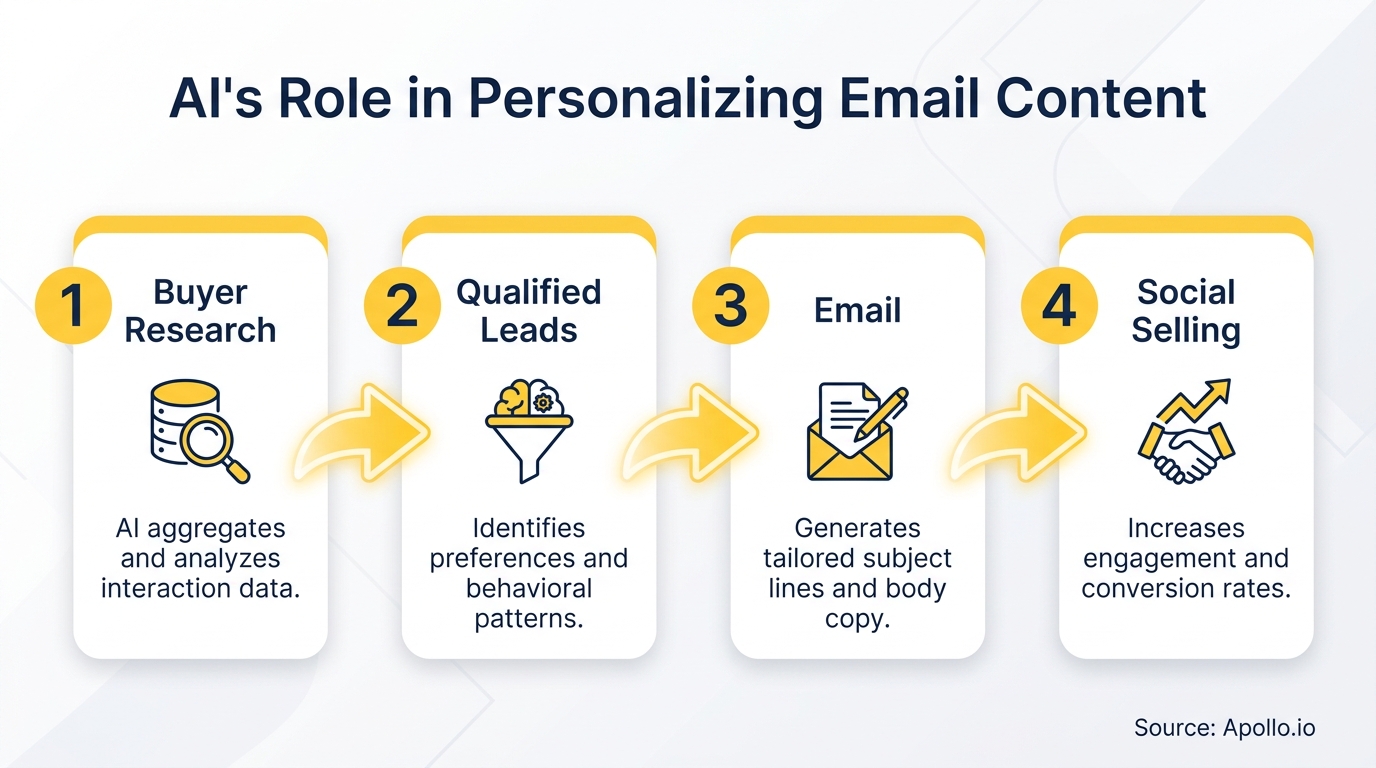
AI personalizes email content by converting structured and unstructured buyer data into segment-specific copy, subject lines, dynamic content modules, and next-best-action recommendations. It moves personalization from a manual, one-at-a-time task to an automated, data-driven process that operates at the scale of your entire contact database.
According to Humanic.ai, 57% of B2B marketers already report using AI or advanced automation in their email programs. The shift is real, but most implementations are still shallow. AI's actual role spans four distinct layers of every email:
| Email Layer | AI's Role | Example Use Case |
|---|---|---|
| Signal collection | Aggregates CRM, intent, engagement, and account data | Identifies which accounts are in an active buying cycle |
| Content decisions | Selects messaging angle, persona fit, and buying stage | Chooses a pain-point message for a CFO vs. a technical message for a VP Engineering |
| Dynamic copy | Generates subject lines, body text, and CTAs per segment | Produces 12 persona-specific email variations from one brief |
| Delivery optimization | Determines send time, frequency, and channel sequencing | Sends to each contact at their statistically optimal open window |
How Does AI-Driven Personalization Improve Email Performance?
AI-driven personalization improves email performance by matching message content to buyer context, which directly raises open rates, reply rates, and downstream conversion.
Research published on ResearchGate found that AI-driven campaigns achieved significantly higher average open rates of 35%, compared to 20% for non-AI campaigns. The performance gap reflects what buyers now expect: a 2026 B2B email marketing analysis confirms that generic broadcast emails consistently underperform segment-specific, contextually relevant outreach.
The highest-impact AI applications in email are not just copywriting. They include:
- Subject line optimization: Testing and selecting lines by predicted open probability per segment
- Dynamic written content: Swapping body paragraphs based on industry, role, or buying stage
- Next-best-action recommendations: Triggering follow-up sequences based on engagement signals
- Send-time prediction: Scheduling delivery at each contact's highest-engagement window
Spending hours crafting individual emails for every prospect? Apollo's AI sales automation generates personalized, contextually relevant outreach at scale, so your team focuses on conversations, not copywriting.
How Do SDRs and AEs Use AI Email Personalization to Book More Meetings?
SDRs and AEs use AI email personalization by feeding verified account and contact data into AI-assisted workflows that generate role-specific, stage-appropriate messages at the moment a buyer shows intent.
For SDRs running high-volume outbound, AI eliminates the research bottleneck. Instead of manually reading professional profiles and company news to craft an opening line, AI surfaces relevant signals (recent funding, new hire patterns, technology stack changes) and incorporates them into a personalized first line automatically.
This frees SDRs to focus on sequencing strategy and follow-up, not data assembly.
For AEs managing mid-cycle and expansion conversations, AI personalization looks different. It pulls CRM history, deal stage, and previous interaction data to suggest the most relevant case study, objection response, or next-step message for each account. Apollo's AI-powered messaging has been shown to produce a 35% increase in bookings when teams apply it to outreach sequences.
The practical workflow for SDRs and AEs:

- Identify target accounts using intent signals and firmographic filters
- Enrich contact records with verified business data
- Generate AI-assisted email variations by persona and buying stage
- Launch multi-step sequences with automated follow-ups triggered by engagement
- Review AI-generated copy before sending (human QA is non-negotiable)
What Is the Difference Between Static and Dynamic Email Personalization?
Static personalization uses fixed data fields (first name, company name) inserted at send time, while dynamic email personalization swaps entire content modules in real time based on the recipient's profile, behavior, or account context.
Static personalization is table stakes. Dynamic personalization is where AI adds genuine value.
A dynamic email can show a different value proposition to a CFO than to a VP of Sales, even when both addresses are in the same send list, without requiring two separate campaigns.
| Personalization Type | How It Works | Limitation |
|---|---|---|
| Static (merge tags) | Inserts fixed field values at send time | No contextual adaptation; same message structure for all |
| Segment-based | Different email versions per audience segment | Manual effort to create and maintain variations |
| AI-dynamic | Content modules selected or generated per recipient in real time | Requires unified data foundation; QA discipline essential |
For teams building B2B drip email sequences, moving from static to AI-dynamic content is the highest-leverage upgrade available in 2026.
Turn Funnel Gaps Into Qualified Pipeline
Leads stalling before they ever reach your AEs. Apollo surfaces high-intent prospects and arms your team with the signals to act fast. 600K+ companies stopped guessing and started closing.
Start Free with Apollo →Why Does AI Email Personalization Fail Without a Data Foundation?
AI email personalization fails when the underlying contact and account data is incomplete, stale, or siloed across disconnected tools. AI can only personalize based on the signals it can access; bad data produces bad personalization.
Adobe's research found that only 41% of B2B organizations have a unified customer data foundation capable of supporting AI at scale. That means the majority of teams running AI personalization are doing so on fragmented data, which produces generic or, worse, inaccurate messaging that damages sender reputation.
A practical AI personalization readiness checklist:
- Data foundation: CRM records are complete, enriched, and deduplicated
- Signal integration: Intent, engagement, and firmographic data flow into one system
- Workflow automation: AI triggers are embedded in sequences, not applied manually
- QA guardrails: Human review step before AI-generated copy reaches the inbox
- Measurement plan: Open rate, reply rate, and meeting-booked metrics tracked by variant
Struggling with fragmented contact data across multiple tools? Apollo's data enrichment keeps your contact records verified and complete, so AI personalization has accurate signals to work with across 230M+ verified business contacts.
How Does AI Govern Email Personalization Without Damaging Deliverability?
AI governs email personalization responsibly through relevance scoring, frequency capping, and deliverability monitoring, ensuring personalized content actually reaches inboxes rather than spam folders.
Sinch Mailgun's 2026 Email Impact Report, which analyzed 400 billion emails sent in 2025, found that nearly 18% of emails fail to reach the inbox. A personalized email that lands in spam delivers zero value. This makes email deliverability a personalization problem, not just a technical one.
AI governance for email personalization should include:
- Relevance scoring: Flag AI-generated content that doesn't match the recipient's known interests or stage
- Frequency caps: Prevent over-contacting accounts that show low engagement signals
- Consent verification: Confirm opt-in status and preference data before triggering AI sequences
- A/B testing discipline: Run controlled experiments on AI-generated variants; only 30% of B2B teams currently prioritize this despite its direct impact on performance
- Human review: Require a final approval step on AI copy before bulk send
For practical steps to improve email deliverability alongside AI personalization, sequence diagnostics can identify the specific points where engagement drops and inbox placement suffers.
How Do You Measure the ROI of AI Email Personalization?
You measure the ROI of AI email personalization by comparing engagement and pipeline metrics between AI-personalized and non-personalized cohorts, using controlled A/B tests with clearly defined success metrics per email layer.
According to Lead-Spot.net, 75% of B2B marketing leaders plan to initiate or expand their use of generative AI, but measurement frameworks often lag behind adoption. Without a measurement plan, teams cannot distinguish AI's contribution from other variables like list quality or send frequency.
Key metrics to track by personalization layer:
- Subject line: Open rate by variant, by segment
- Body copy: Reply rate, click-through rate by persona and buying stage
- Send-time optimization: Open rate change pre/post AI scheduling
- Full sequence: Meeting booked rate, pipeline generated per cohort
RevOps leaders should build dashboards that attribute pipeline to specific email personalization variables, not just campaign-level results. That granularity is what justifies continued AI investment and enables iterative improvement.

Start Personalizing at Scale with Apollo
AI email personalization works when it operates on accurate data, follows governance guardrails, and feeds into a unified outreach workflow. Without those foundations, even the most sophisticated AI generates irrelevant messages that hurt your sender reputation and waste your team's time.
Apollo brings contact intelligence, AI-powered messaging, and multi-channel sales engagement into one platform. SDRs, AEs, and revenue leaders use it to move from generic outreach to contextually relevant conversations, without stitching together five separate tools.
As Cyera's team put it: "Having everything in one system was a game changer."
Ready to put AI personalization into practice across your entire GTM motion? Schedule a Demo and see how Apollo's AI-powered platform helps your team book more meetings with less manual effort.
Prove Pipeline ROI Before Next Quarter
Budget approval stuck on unclear metrics? Apollo surfaces measurable pipeline impact from day one — so you walk into every budget review with hard numbers, not gut feel. Leadium 3x'd annual revenue. You're next.
Start Free with Apollo →Don't miss these
Sales
Inbound vs Outbound Marketing: Which Strategy Wins?
Sales
What Is a Sales Funnel? The Non-Linear Revenue Framework for 2026
Sales
What Is a Go-to-Market Strategy? The 2026 GTM Playbook
See Apollo in action
We'd love to show how Apollo can help you sell better.
By submitting this form, you will receive information, tips, and promotions from Apollo. To learn more, see our Privacy Statement.
4.7/5 based on 9,690 reviews
