
What Risks Should You Consider When Moving to an Agentic Sales Model?
Agentic sales models promise autonomous prospecting, personalized outreach at scale, and faster pipeline generation. But moving from AI-assisted selling to fully autonomous agents introduces risks that can compound faster than your team can contain them. Before your SDRs hand off sequences to agents or your RevOps team wires agents into your CRM, you need a clear-eyed risk register. This guide covers the critical risks, mapped to practical controls, so your sales development strategy stays ahead of the downside.

Let Apollo Do The Research For You
Tired of your reps burning hours on manual lead research instead of selling? Apollo surfaces verified contacts instantly, so your team spends time closing — not digging. Join 600K+ companies building pipeline faster.
Start Free with Apollo →Key Takeaways
- Data security is the top agentic AI concern: cybersecurity professionals increasingly view autonomous agents as a primary attack vector.
- Brand accuracy failures scale fast when agents act without human review checkpoints built into the workflow.
- Governance readiness, not AI capability, is the gating factor for safe agentic adoption.
- Only 4% of teams allow AI agents to act without any human approval, meaning human-in-the-loop defaults remain the industry norm.
- Phased adoption (assisted, semi-agentic, fully agentic) dramatically reduces implementation risk and makes ROI measurable.
What Is an Agentic Sales Model and What Makes It Different?
An agentic sales model uses AI agents that can plan, decide, and take actions autonomously across sales tools, including prospecting, sequencing, CRM updates, and meeting scheduling, without step-by-step human instruction. This differs from AI-assisted selling, where a rep uses AI recommendations but retains control over every action. The key distinction matters for risk: agents act across systems, so errors propagate automatically at scale rather than being caught by human review. Understanding what factors affect sales performance helps set the baseline before introducing autonomous agents into your motion.
What Are the Core Risks of Agentic Sales in 2026?
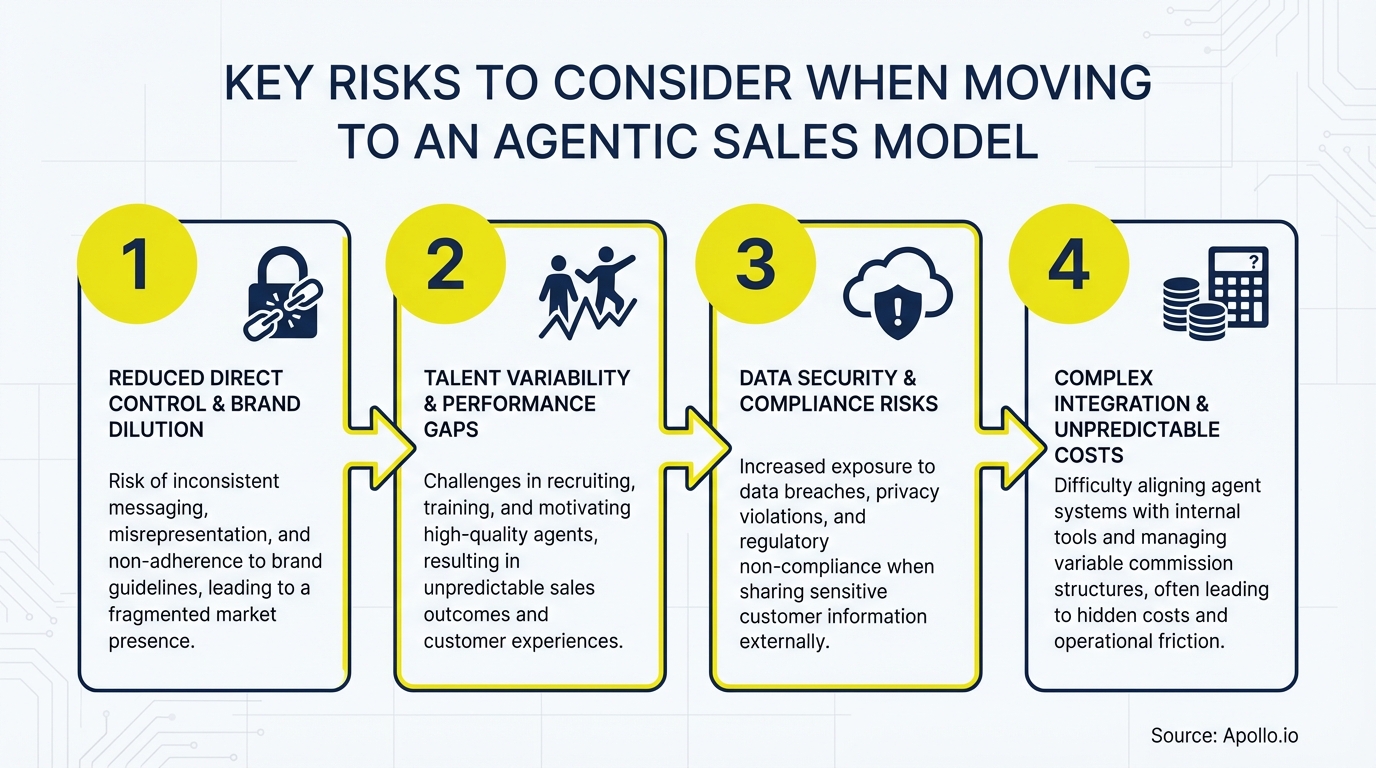
The risks of moving to an agentic sales model fall into five categories: data security, brand and accuracy, governance gaps, trust erosion, and cost unpredictability.
| Risk Category | Key Threat | Primary Control | Owner |
|---|---|---|---|
| Data Security | Data leakage via agent tool access | Least-privilege permissions, scoped API access | RevOps / Security |
| Brand & Accuracy | Factual errors in agent-generated outreach | Human review gates on high-stakes sends | Sales Leadership |
| Governance Gaps | Agents deployed before policies exist | Phased rollout with stage-specific SLAs | RevOps / Legal |
| Trust Erosion | Prospects detect generic AI outreach | Human-in-the-loop for enterprise accounts | AEs / SDR Managers |
| Cost Sprawl | Agent-seat pricing models inflate spend | Agent inventory audits, usage caps | Finance / RevOps |
According to Termly, 84% of business leaders identify cybersecurity risks as their primary concern regarding AI adoption. That concern is well-founded: a Dark Reading poll cited by Bessemer Venture Partners found that 48% of cybersecurity professionals view agentic AI and autonomous systems as the most dangerous attack vector.
How Does Data Security Risk Escalate With Agentic Agents?
Data security risk escalates with agentic systems because agents read and write across multiple tools simultaneously, creating far more exposure surface than any single human rep. When an agent can access your CRM, enrichment APIs, email system, and document stores in one workflow, a misconfigured permission or injected instruction in an email or CRM note can trigger unintended data exports or record changes.
Research from Secureframe shows that data leaks linked to generative AI are the top security concern for 34% of organizations in 2026, a sharp increase from 22% in 2025. Greenberg Glusker specifically warns that outbound AI requests can lead to "input peril" for privacy and intellectual property, as sensitive information is often sent to unknown destinations via AI tools.
Controls to implement immediately:
- Apply least-privilege access: agents should only read/write the specific objects they need for each task.
- Maintain an agent inventory with documented tool permissions and a named owner for each agent.
- Enable audit logs for every agent action across CRM, email, and enrichment systems.
- Review enrichment data pipelines before connecting agents. Worried about data quality undermining your agents? Verify your contact data with Apollo's 230M+ verified business contacts before automating outreach.
Fill Your Funnel With Buyers Who Convert
Running out of qualified leads before the quarter ends? Apollo surfaces in-market prospects aligned to your ICP, so your pipeline stays full — not just busy. Nearly 100K paying customers use Apollo to turn outreach into opportunities.
Start Free with Apollo →How Do Brand Accuracy and Trust Risks Compound at Scale?
Brand accuracy risk compounds at scale because agents generate and send content faster than human review capacity, so a single flawed template or hallucinated claim reaches hundreds of prospects before anyone catches it.
For B2B sales teams selling complex or high-value solutions, one factually wrong email to a senior buyer can permanently damage a relationship.
According to Nylas, only 4% of teams currently allow AI agents to act without any human approval, indicating a widespread need for human oversight in high-stakes decisions. For high-ticket sales and enterprise accounts, this human checkpoint is non-negotiable.
Practical accuracy controls:

- Build a canonical claims library: a single approved source of product facts, pricing ranges, and value statements agents are permitted to use.
- Set human review gates for first-touch outreach to named accounts or deals above a defined contract value.
- Run weekly sample audits of agent-generated content, even when you trust the workflow.
- Flag any outreach referencing competitors, pricing, or legal commitments for mandatory rep approval.
How Should SDR Managers and RevOps Teams Phase Agentic Adoption?
SDR Managers and RevOps teams should phase agentic adoption across three stages: AI-assisted, semi-agentic, and fully agentic, with specific governance requirements at each stage before advancing.
| Stage | What Agents Do | Human Role | Key KPI |
|---|---|---|---|
| AI-Assisted | Draft emails, surface contact data, suggest next steps | Approves every action | Rep time saved per week |
| Semi-Agentic | Enroll contacts in sequences, update CRM fields, schedule follow-ups | Reviews flagged exceptions | Sequence accuracy rate, opt-out rate |
| Fully Agentic | Autonomous prospecting, multi-step outreach, pipeline reporting | Audits outcomes, handles escalations | Pipeline generated per agent, reply quality score |
A lack of technical expertise affects 38% of organizations, according to Sopro, impeding effective implementation, scaling, or maintenance of AI systems. RevOps leaders should audit internal capability gaps before advancing past Stage 1. Tracking the right sales KPIs at each stage is essential to prove ROI before expanding agent autonomy.
Spending hours configuring disconnected tools before you can even launch agents? Apollo's AI sales automation consolidates prospecting, sequencing, and enrichment in one platform, giving your team a single governance layer instead of managing risk across multiple vendors.
What Governance and Ethical Risks Are Specific to AI Sales Agents?
Governance and ethical risks in agentic sales include algorithmic bias in targeting, lack of audit trails for autonomous decisions, and outreach that violates channel policies or regulations. These risks are distinct from general AI risk because agents act on behalf of your company, meaning their outputs carry legal and reputational weight.
As noted by SalesTechStar, AI systems are not inherently neutral and can learn biases from their training data or human designers, potentially leading to unfairness or discrimination in how prospects are scored or targeted. For RevOps teams responsible for pipeline integrity, undetected bias in agent targeting directly distorts your funnel data and forecasting.
Governance checklist before full deployment:
- Define a documented acceptable use policy for each agent, including what it cannot do.
- Require named human owners for every active agent in production.
- Schedule quarterly bias audits on agent targeting criteria and outreach content.
- Establish escalation paths: what triggers a human takeover, and who is notified.
- Maintain immutable audit logs for compliance and incident response.
How Do You Measure ROI Accurately in an Agentic Sales Motion?
Accurate ROI measurement in an agentic sales motion requires separating gains from AI-assisted actions versus fully autonomous agent actions, because conflating the two overstates agentic ROI and understates risk. Use instrumented dashboards that attribute pipeline and revenue to specific agent workflows, not just to "AI" as a category.
Key metrics to instrument from day one:
- Agent-attributed pipeline: deals where an agent initiated or advanced contact without rep intervention.
- Reply quality score: human-rated quality of agent-generated messages sampled weekly.
- Error rate: factual mistakes, wrong recipients, or policy violations per 1,000 agent actions.
- Opt-out and complaint rate: monitored separately for agent-driven vs. rep-driven outreach.
Connecting these metrics to your broader sales analytics framework ensures agentic adoption is treated as a measurable business initiative, not an experiment. Review your sales productivity benchmarks before and after each adoption phase to isolate agent impact.

Is Your Team Ready to Move to an Agentic Sales Model?
Moving to an agentic sales model is the right direction for most B2B GTM teams in 2026, but readiness determines whether the transition creates compounding advantage or compounding risk. Start with a clean data foundation, implement phased governance, and keep humans in the loop for high-stakes decisions until each stage earns its autonomy.
Teams that get this right gain real competitive leverage: faster pipeline generation, consistent outreach quality, and RevOps teams spending time on strategy rather than manual tasks. Teams that skip governance end up managing reputational damage, data incidents, and broken prospect relationships instead.
Apollo gives B2B GTM teams the unified platform to run agentic prospecting and outreach with verified data, built-in sequencing, and CRM integration in one workspace. As Cyera put it, "Having everything in one system was a game changer." Try Apollo free and build your agentic sales motion on a foundation you can trust.
Prove Pipeline ROI Before Next QBR
ROI pressure killing your tool budget before you can scale? Apollo delivers measurable pipeline outcomes your exec team can see. Leadium 3x'd annual revenue — start your free trial today.
Start Free with Apollo →Don't miss these
Sales
Inbound vs Outbound Marketing: Which Strategy Wins?
Sales
What Is a Sales Funnel? The Non-Linear Revenue Framework for 2026
Sales
What Is a Go-to-Market Strategy? The 2026 GTM Playbook
See Apollo in action
We'd love to show how Apollo can help you sell better.
By submitting this form, you will receive information, tips, and promotions from Apollo. To learn more, see our Privacy Statement.
4.7/5 based on 9,690 reviews
