
What Is Sales Revenue? Definition, Types, Calculation (2026)
Sales revenue is the income a company generates from selling products or services before deducting expenses. In 2026, with 80% of B2B sales interactions happening in digital channels, understanding how to measure and optimize sales revenue across multiple touchpoints has become critical for every revenue team. According to Landbase, the global B2B eCommerce market was estimated at $32.11 trillion in 2025 and is projected to reach $36.16 trillion by 2026, growing at a CAGR of 14.5%. This explosive growth means revenue tracking must span in-person, remote, and self-serve channels to capture the complete picture.
For SDRs, AEs, and RevOps leaders, sales revenue is more than a financial metric. It's the foundation for tracking sales KPIs, forecasting pipeline, and proving ROI on every outreach effort. Yet many teams still conflate bookings with recognized revenue or fail to account for expansion, churn, and discount leakage.

Apollo Eliminates 4+ Hours Of Daily Research
Tired of spending 4+ hours daily hunting for contact info? Apollo delivers 224M verified contacts with 96% email accuracy. Join 550K+ companies who stopped wasting time on manual prospecting.
Start Free with Apollo →Key Takeaways
- Sales revenue is total income from product/service sales before expenses, while net revenue accounts for returns, discounts, and allowances
- Modern B2B revenue spans three channels: in-person, remote, and digital self-serve, requiring unified tracking and attribution
- Net Revenue Retention (NRR) has become the critical metric for SaaS and subscription businesses, measuring expansion minus churn
- Price realization and discount discipline directly impact sales revenue, with many teams losing revenue structurally through approval gaps
- CFO-grade revenue reporting demands clear distinctions between bookings, invoiced revenue, and recognized revenue under ASC 606
What Is Sales Revenue?
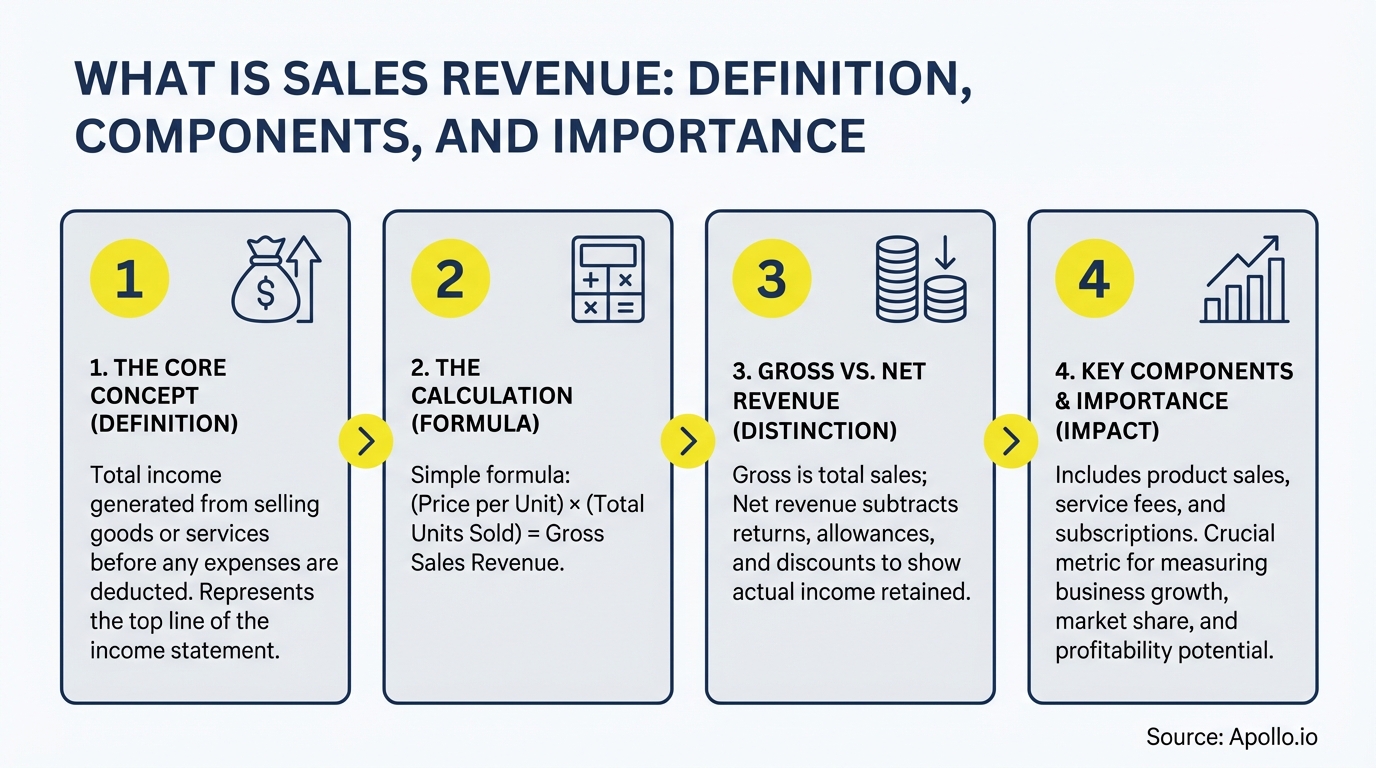
Sales revenue is the total monetary value a company receives from selling goods or services to customers during a specific period. It appears at the top of the income statement and represents the starting point for calculating profitability.
Sales revenue is also called gross revenue, top-line revenue, or simply "the top line" because it sits above all expense deductions.
In B2B contexts, sales revenue includes both new customer acquisitions and expansion from existing accounts. For subscription businesses, sales revenue often gets reported as Annual Recurring Revenue (ARR) or Monthly Recurring Revenue (MRR).
However, ARR and bookings are not the same as recognized revenue under accounting standards like ASC 606, which governs when revenue can be recorded on financial statements.
The distinction matters because sales leaders track bookings (contracts signed), while finance teams track recognized revenue (value delivered and earned). RevOps leaders bridge this gap by aligning revenue operations frameworks that connect pipeline to financial outcomes.
How Is Sales Revenue Calculated?
The basic sales revenue formula is straightforward: Sales Revenue = Number of Units Sold × Price Per Unit. For service businesses, substitute "units" with contracts, subscriptions, or billable hours.
For multi-product companies, sum revenue across all product lines.
In practice, B2B sales revenue calculations must account for:
- Discounts: List price vs. realized price (the actual amount collected after discounts, promotions, and negotiations)
- Returns and Allowances: Revenue adjustments for refunds, credits, or service-level failures
- Multi-Year Contracts: Total contract value (TCV) spread across contract duration for recognized revenue
- Expansion Revenue: Upsells, cross-sells, and usage overages from existing customers
- Channel Attribution: Revenue split across in-person, remote, and digital self-serve motions
For example, if an AE closes a $120,000 annual contract with a 15% discount, the bookings are $102,000. If the contract spans three years, recognized revenue is $34,000 per year (assuming ratable recognition).
If the customer expands by $30,000 in year two, total year-two revenue is $64,000.
What Are the Different Types of Sales Revenue?
Modern B2B revenue teams track multiple revenue types to understand business health:
| Revenue Type | Definition | Why It Matters |
|---|---|---|
| Gross Revenue | Total sales before any deductions | Shows top-line growth and market demand |
| Net Revenue | Gross revenue minus returns, discounts, allowances | True revenue available for operations and profit |
| Recurring Revenue (ARR/MRR) | Predictable subscription income normalized annually or monthly | Forecasting and valuation for SaaS businesses |
| New Revenue | Revenue from net-new customer logos | Measures market penetration and acquisition efficiency |
| Expansion Revenue | Upsells, cross-sells, usage growth from existing customers | Often cheaper to capture than new logos; drives NRR |
| Recognized Revenue | Revenue recorded per GAAP/ASC 606 when earned | Financial reporting, compliance, and investor transparency |
Sales leaders focus on bookings and pipeline, while finance teams track recognized revenue. RevOps teams unify these views to create a single source of truth.
Without alignment, teams celebrate bookings that don't translate to recognized revenue, creating forecast gaps and investor confusion.
Apollo Turns Forecast Guesswork Into Revenue
Pipeline forecasting a guessing game? Apollo's real-time deal intelligence gives you accurate visibility across every stage. Built-In boosted win rates 10% with Apollo's scoring.
Start Free with Apollo →Why Is Net Revenue Retention the Real Revenue Story?
Net Revenue Retention (NRR) measures how much recurring revenue a cohort of customers generates over time, accounting for expansion, contraction, and churn. The formula is: NRR = (Starting MRR + Expansion - Churn - Contraction) / Starting MRR × 100.
For example, if you start January with $100,000 MRR from a customer cohort, add $20,000 in expansion, lose $5,000 to churn, and contract $3,000, your NRR is 112% (($100K + $20K - $5K - $3K) / $100K). An NRR above 100% means your existing customers are growing faster than you're losing revenue, a key indicator of product-market fit and expansion efficiency.
In 2026, GTM teams increasingly treat NRR as the practical definition of revenue health because it bakes in expansion, contraction, and churn. As new-logo acquisition costs rise and buyer scrutiny tightens, revenue durability matters more than topline bookings.
SaaS companies with NRR above 120% are typically valued at premium multiples because they prove compounding growth without constant new-logo dependency.
For Account Executives managing renewal and expansion motions, NRR is the north-star metric. It reflects not just initial sales effectiveness but long-term customer success, product adoption, and pricing strategy.

How Do SDRs and AEs Impact Sales Revenue?
SDRs generate pipeline that feeds sales revenue by qualifying prospects, booking meetings, and creating opportunities. AEs convert that pipeline into closed-won deals, which become bookings and eventually recognized revenue.
Both roles directly influence revenue velocity, win rates, and average deal size.
Key revenue contributions by role:
- SDRs: Pipeline creation, lead qualification, meeting-to-opportunity conversion, target account coverage
- AEs: Deal closure, average contract value (ACV), sales cycle length, discount discipline, expansion identification
- RevOps: Data quality, territory design, quota setting, sales analytics and forecasting accuracy
Struggling to fill your pipeline with qualified leads? Search Apollo's 224M+ contacts with 65+ filters to build targeted prospect lists fast. SDRs using Apollo report significant time savings on research, allowing them to focus on personalized outreach and meeting booking.
For AEs, sales revenue depends on shortening sales cycles, maintaining pricing discipline, and identifying expansion opportunities early. Using B2B sales techniques that focus on value-based selling and multi-threading can materially increase deal size and win rates.
What Is the Difference Between Bookings, Billings, and Revenue?
These three metrics are often confused but represent different stages of the revenue lifecycle:
| Metric | Definition | Timing | Who Tracks It |
|---|---|---|---|
| Bookings | Total contract value (TCV) of closed deals | When contract is signed | Sales teams, CROs |
| Billings | Amount invoiced to customers | When invoice is issued (often upfront or periodic) | Finance, billing operations |
| Recognized Revenue | Revenue earned per ASC 606 (when value is delivered) | Over the contract period as services are delivered | Finance, CFO, auditors |
Example: An AE closes a $120,000 three-year SaaS contract in January. Bookings are $120,000 in Q1.
The company invoices $40,000 annually, so billings are $40,000 in January. Recognized revenue is $10,000 per month ($40,000 / 12 months) as the software is delivered.
Sales celebrates the booking, finance tracks the billing, and the CFO recognizes $120,000 over 36 months.
Misalignment between these metrics creates forecasting errors, cash flow surprises, and board-level confusion. RevOps leaders use revenue operations frameworks to ensure sales, finance, and leadership speak the same language.
How Does Omnichannel Selling Change Revenue Tracking?
In 2026, B2B buyers engage across multiple channels before purchasing. McKinsey's B2B Pulse research shows a "rule of thirds": roughly one-third prefer in-person, one-third remote, and one-third digital self-serve at any buying stage.
Revenue tracking must capture all three to avoid attribution gaps and channel blindspots.
Omnichannel revenue challenges include:
- Attribution: Which channel gets credit when a buyer uses all three before purchasing?
- Conversion Metrics: Different channels have different conversion rates and sales cycles
- Cost to Serve: In-person sales cost more per deal than digital self-serve
- Data Fragmentation: CRM tracks in-person/remote, e-commerce platform tracks self-serve
Best practices for omnichannel revenue reporting:
- Use a unified data model that connects CRM, e-commerce, and marketing automation
- Implement multi-touch attribution (first-touch, last-touch, and weighted models)
- Track assisted vs. unassisted conversion rates by channel
- Monitor cart abandonment and leakage in digital self-serve funnels
- Align channel definitions across sales, marketing, and finance
Can't track your deals across multiple channels? Get complete pipeline visibility with Apollo's deal management and multi-channel tracking. RevOps teams report that having everything in one system eliminates data fragmentation and improves forecast accuracy.
Frequently Asked Questions About Sales Revenue
What Is the Difference Between Sales Revenue and Profit?
Sales revenue is total income before expenses. Profit is what remains after subtracting costs (COGS, operating expenses, taxes).
A company can have high revenue but low or negative profit if expenses exceed income.
How Do Returns and Discounts Affect Sales Revenue?
Returns and discounts reduce gross revenue to net revenue. If you sell $100,000 with $10,000 in returns and $5,000 in discounts, net revenue is $85,000.
Finance teams track net revenue for accurate profitability analysis.
What Is Price Realization and Why Does It Matter?
Price realization is the percentage of list price actually collected after discounts and negotiations. If your list price is $100,000 but you close at $84,000, your realization is 84%.
Poor realization signals weak pricing discipline, aggressive discounting, or structural approval gaps.
How Does ASC 606 Impact Revenue Recognition?
ASC 606 is the accounting standard governing when revenue can be recognized. It requires companies to recognize revenue when performance obligations are satisfied (value delivered), not when contracts are signed or invoiced.
Multi-year contracts must be recognized ratably over the contract period.
What Sales KPIs Predict Revenue Performance?
Leading indicators include pipeline coverage (3-4× quota), win rate, average deal size, sales cycle length, and pipeline velocity. Track these alongside sales KPIs like quota attainment and forecast accuracy to predict revenue outcomes.

Conclusion: Master Sales Revenue to Drive Predictable Growth
Sales revenue is the lifeblood of every business, but in 2026, it's no longer just about topline bookings. Revenue leaders must track gross vs. net revenue, bookings vs. recognized revenue, new vs. expansion revenue, and omnichannel attribution to understand true business health. With U.S. manufacturing and wholesale distribution sales reaching $15.12 trillion in 2025, the B2B revenue landscape is massive and complex.
For SDRs, AEs, and RevOps teams, the path to predictable revenue starts with clean data, unified systems, and clear definitions. Focus on Net Revenue Retention to measure revenue quality, not just quantity.
Implement omnichannel tracking to capture revenue across in-person, remote, and self-serve channels. And align sales, finance, and operations on a single source of truth that connects pipeline to recognized revenue.
Ready to build a revenue engine that scales? Get Leads Now with Apollo's all-in-one platform. Consolidate your tech stack, access 224M+ verified contacts, and automate your outreach to drive predictable sales revenue growth.
Prove Apollo's ROI In Your First 30 Days
Budget approval stuck on unclear metrics? Apollo tracks every touchpoint from first contact to closed deal. Built-In increased win rates 10% and ACV 10% with Apollo's scoring and signals.
Start Free with Apollo →Don't miss these
Sales
Inbound vs Outbound Marketing: Which Strategy Wins?
Sales
What Is a Sales Funnel? The Non-Linear Revenue Framework for 2026
Sales
What Is a Go-to-Market Strategy? The 2026 GTM Playbook
See Apollo in action
We'd love to show how Apollo can help you sell better.
By submitting this form, you will receive information, tips, and promotions from Apollo. To learn more, see our Privacy Statement.
4.7/5 based on 9,690 reviews
