
What Is Sales Operations? Definition, Role, and Impact on Revenue Growth
Sales operations teams are the backbone of revenue growth in 2026. They design the systems, processes, and workflows that enable SDRs, AEs, and RevOps leaders to hit quota consistently. With Grand View Research projecting the Revenue Operations market to reach USD 16.98 billion by 2033, sales ops has evolved from tactical CRM administration to strategic revenue architecture. Companies now recognize that operational excellence directly impacts pipeline velocity, forecast accuracy, and seller productivity.

Apollo Cuts Research Time From Hours To Seconds
Tired of spending 4+ hours daily hunting for contact info? Apollo delivers 224M verified contacts with 96% email accuracy instantly. Join 550K+ companies who stopped wasting time on manual research.
Start Free with Apollo →Key Takeaways
- Sales operations builds the infrastructure that connects data, tools, and processes across your GTM motion
- Organizations using RevOps frameworks exceed revenue goals at measurably higher rates than traditional sales ops models
- Effective sales ops reduces seller tool overwhelm and improves outreach relevance for buyer-centric engagement
- Transitioning from sales ops to RevOps requires governance artifacts like RACI matrices and unified dashboards
What Is Sales Operations?
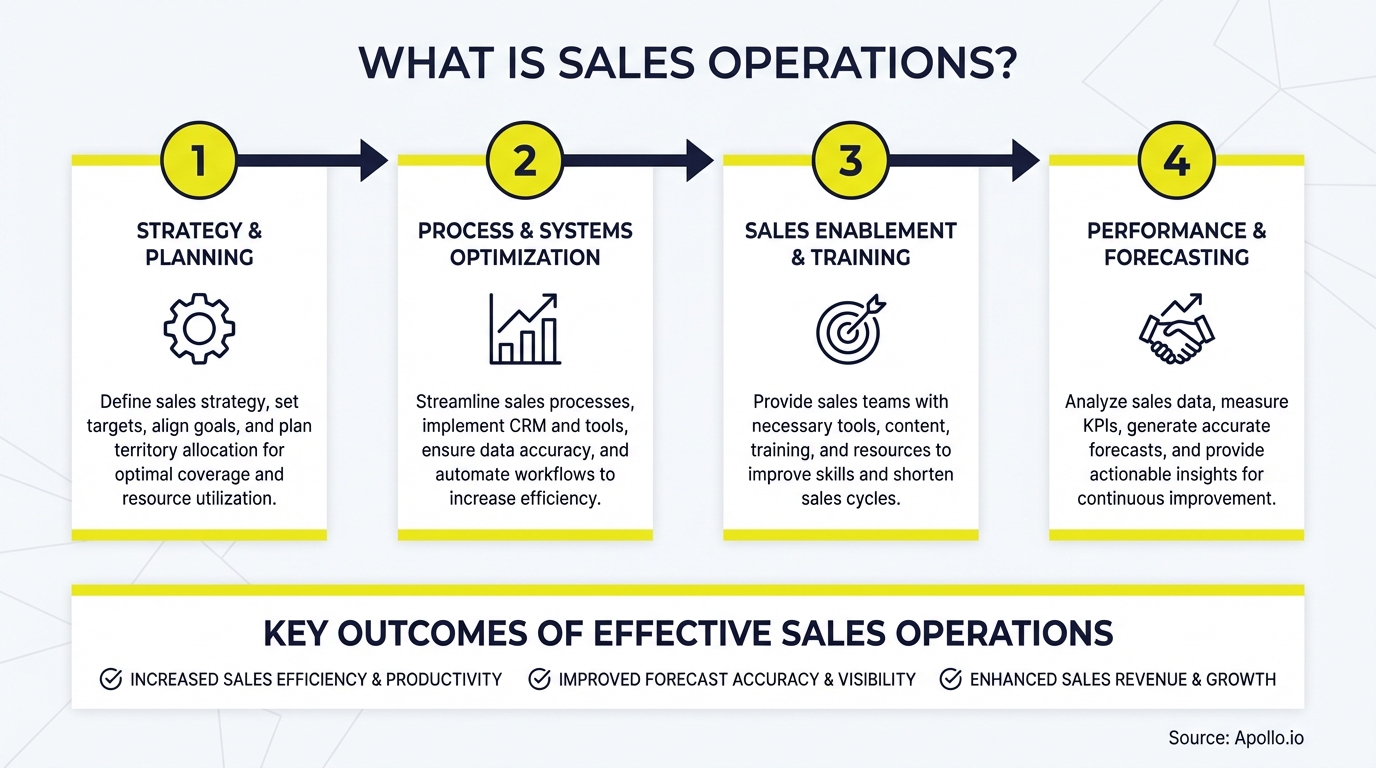
Sales operations is the function responsible for designing, implementing, and optimizing the systems, processes, and data infrastructure that enable sales teams to execute efficiently. Sales ops owns CRM configuration, territory planning, quota allocation, pipeline reporting, tool stack management, and process documentation.
The role sits between sales leadership and frontline sellers, translating strategic goals into executable workflows.
Unlike revenue operations, which unifies sales, marketing, and customer success under one operating model, traditional sales ops focuses specifically on the sales organization. However, according to DealHub, 75% of the highest-growth companies will deploy a RevOps model by the end of 2025, signaling a shift toward cross-functional alignment.
Why Does Sales Operations Matter in 2026?
Sales ops delivers measurable business impact by removing friction from the revenue engine. Research from Deloitte Digital shows that B2B organizations using RevOps were 1.4 times as likely to exceed 2023 revenue goals by 10% or more, compared to those not using RevOps.
The stakes are higher now because sellers face cognitive overload and buyers demand relevance. Sales ops addresses both challenges through process optimization and tooling rationalization.
For RevOps leaders managing cross-functional teams, consolidated operations reduce handoff failures and data inconsistencies that cause deals to stall.
Struggling with scattered tools and messy data? Consolidate your tech stack with Apollo's 224M+ verified contacts and unified GTM platform.
What Are the Core Responsibilities of Sales Operations?
Sales ops teams own the operational infrastructure that determines whether reps hit quota or miss by double digits. Core responsibilities include:
- CRM Administration: Data model design, field governance, automation workflows, user permissions
- Territory and Quota Planning: Account segmentation, capacity modeling, compensation alignment
- Pipeline Management: Stage definitions, exit criteria, conversion tracking, forecast hygiene
- Sales Analytics:KPI dashboards, activity metrics, win/loss analysis, trend reporting
- Tool Stack Optimization: Vendor evaluation, integration management, license optimization, training coordination
- Process Documentation: Playbooks, SLAs, handoff protocols, change management
For SDRs and AEs, this translates to fewer manual tasks, clearer success metrics, and faster access to accurate prospect intelligence. Sales ops ensures reps spend time selling instead of fighting systems.

How Do Sales Operations Teams Support Buyer-Centric Engagement?
Modern sales ops must design workflows that match how buyers actually want to engage. This requires operational capabilities around routing logic, intent signal integration, content governance, and SLA enforcement.
| Capability | Operational Design | Business Impact |
|---|---|---|
| Lead Routing | Account-based assignment rules with intent thresholds | Reduces response time and improves qualification accuracy |
| Intent Signal Integration | Automated alerts for buying committee engagement patterns | Increases outreach relevance and reduces buyer avoidance |
| Content Governance | Version control, approval workflows, usage tracking | Ensures messaging consistency across channels |
| SLA Enforcement | Automated escalation, activity monitoring, compliance reporting | Prevents deal stalls from missed handoffs |
Sales ops teams that implement these capabilities reduce the friction buyers experience when navigating complex purchasing processes. According to Corefactors, companies aligning people, processes, and technology across their sales and marketing teams achieved 36% more revenue growth and up to 28% more profitability.
Turn Forecast Guesswork Into Revenue Certainty
Pipeline forecasting a guessing game? Apollo delivers real-time deal visibility and intent signals so your team knows exactly which opportunities will close. Built-In boosted win rates 10% with Apollo's scoring.
Start Free with Apollo →How Do Sales Operations Teams Transition to RevOps?
The shift from sales ops to revenue operations frameworks requires governance artifacts, unified metrics, and cross-functional process alignment. Sales ops leaders building RevOps capabilities should implement:
- RACI Matrix: Define decision rights across sales, marketing, and customer success for shared workflows (lead handoff, account planning, renewal forecasting)
- Unified Data Model: Establish single source of truth for accounts, contacts, opportunities, and revenue attribution
- Cross-Functional Dashboard: Track end-to-end metrics from lead acquisition through renewal and expansion
- Governance Cadence: Weekly pipeline reviews, monthly forecast calibration, quarterly business reviews with executive alignment
For Founders and CEOs evaluating this transition, the operational investment pays dividends in forecast accuracy and team coordination. RevOps eliminates the departmental silos that cause revenue leakage.
Can't get visibility into your full revenue pipeline? Get complete pipeline tracking with Apollo's unified deal management platform.
What Tools Do Sales Operations Teams Use?
Sales ops teams manage an average tech stack that includes CRM, sales engagement platforms, data enrichment services, conversation intelligence tools, and analytics dashboards. The challenge in 2026 is tool sprawl creates the very complexity sales ops exists to eliminate.
Leading sales ops teams consolidate their tech stack to reduce integration overhead and licensing costs. Apollo provides a unified platform that combines contact data, engagement automation, meeting coordination, and pipeline management in one workspace.
Customer Predictable Revenue reported: "We reduced the complexity of three tools into one." Census added: "We cut our costs in half." Cyera emphasized: "Having everything in one system was a game changer."
The operational benefit extends beyond cost savings. Unified platforms eliminate data sync issues, reduce training burden, and give reps a single interface for prospecting through close.

What Metrics Should Sales Operations Teams Track?
Sales ops teams are accountable for operational health metrics that predict revenue outcomes. Track these KPIs to measure operational effectiveness:
- Pipeline Velocity: Days to progress through each stage, conversion rates by stage, velocity trends by segment
- Data Quality: Contact accuracy rates, duplicate records, missing critical fields, enrichment coverage
- Tool Adoption: Active users by platform, feature utilization rates, workflow completion metrics
- Process Compliance: Activity completion rates, SLA adherence, documentation currency
- Forecast Accuracy: Variance between commit and actual, deal slippage rates, stage-by-stage confidence intervals
For Sales Leaders managing quota-carrying teams, these operational metrics serve as leading indicators for revenue performance. When pipeline velocity slows or data quality degrades, it signals process breakdowns before they impact the forecast.
Conclusion
Sales operations in 2026 is the design system for buyer-centric revenue growth. As organizations transition from function-specific ops to unified RevOps models, the teams that build operational excellence into their GTM motion will capture disproportionate market share.
With verified market data showing measurable advantages for operationally mature companies, investing in sales ops infrastructure delivers compounding returns.
Ready to streamline your sales operations? Request a Demo to see how Apollo consolidates your sales tech stack into one unified platform.
Prove Apollo's ROI In Your First 30 Days
Budget approval stuck on unclear metrics? Apollo tracks every touchpoint from prospect to close, delivering measurable pipeline impact. Built-In increased win rates 10% and ACV 10% with Apollo's scoring.
Start Free with Apollo →Don't miss these
Sales
Inbound vs Outbound Marketing: Which Strategy Wins?
Sales
What Is a Sales Funnel? The Non-Linear Revenue Framework for 2026
Sales
What Is a Go-to-Market Strategy? The 2026 GTM Playbook
See Apollo in action
We'd love to show how Apollo can help you sell better.
By submitting this form, you will receive information, tips, and promotions from Apollo. To learn more, see our Privacy Statement.
4.7/5 based on 9,690 reviews
