
How to Verify Email Addresses Before Launching a Campaign
Before you hit send on any campaign, run this check: verify every email address, confirm your suppression list is current, and make sure SPF, DKIM, and DMARC are passing. Skipping any one of those steps can tank inbox placement even if your list is 100% valid. A July 2026 DMA benchmark found B2B delivered rates climbed to 95.6%, yet global inbox placement held around 87%, according to Validity's 2026 DMA benchmark analysis. That gap is the difference between a list that passes verification and a campaign that actually reaches buyers.
This guide gives you a go/no-go launch checklist, not just a definition of email verification. If you want the mechanics of how verification works first, see how to verify email addresses for B2B sales.
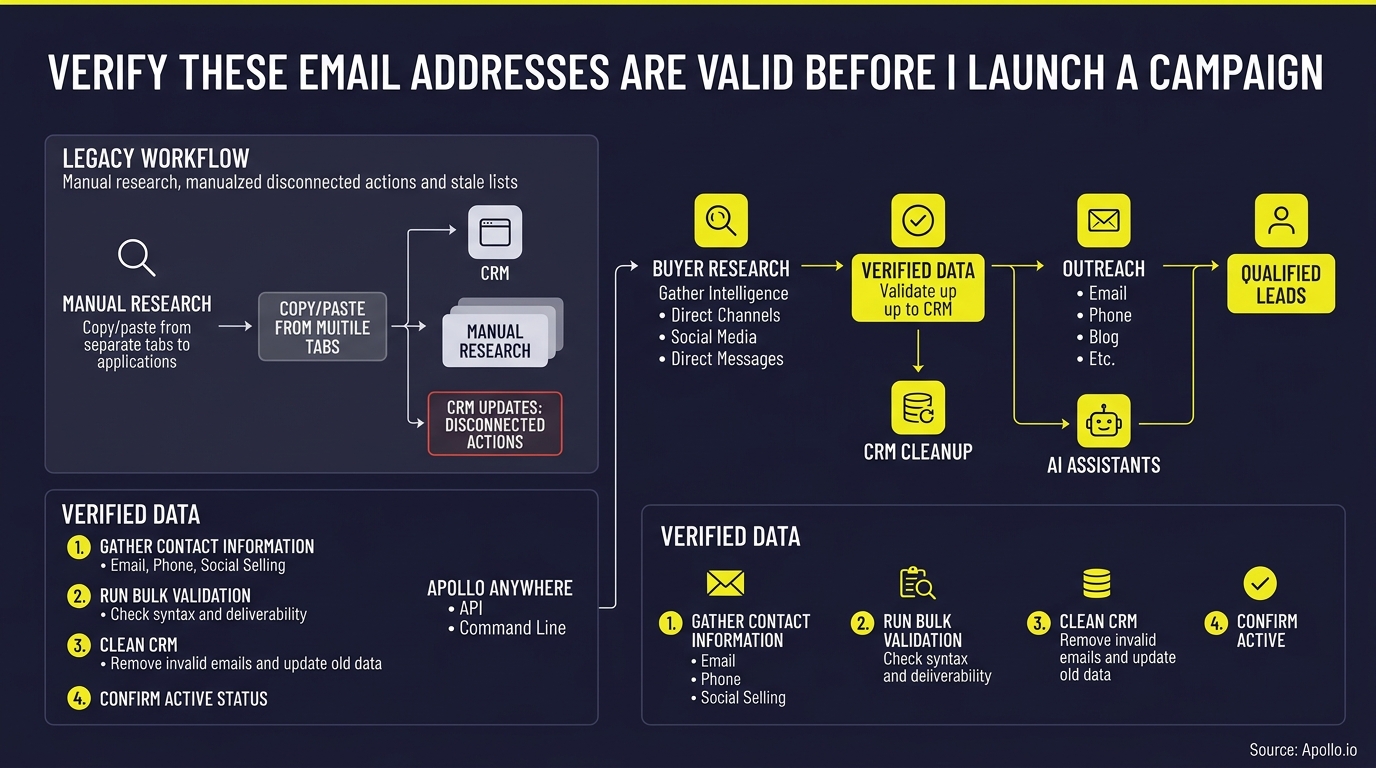

Apollo Ends Manual Lead Research For Good
Spending hours hunting down emails and phone numbers that turn out wrong. Apollo hands your reps verified contact data instantly, so selling time doesn't disappear into spreadsheets. 98% email accuracy means less guessing, more closing.
Start Free with Apollo →Key Takeaways
- Valid syntax and a real mailbox are necessary but not sufficient. Authentication, suppression lists, and spam-complaint thresholds all gate inbox placement separately.
- B2B contact data goes stale fast. Re-verify close to send time, not just when the list was first built.
- Catch-all results mean "unresolved," not "invalid." Segment and test those addresses instead of deleting them.
- Use Apollo MCP when you need to verify and enrich a prospect list without leaving ChatGPT, Claude, or Perplexity before a send.
- Track inbox placement and spam-complaint rate after launch, not just delivery rate. Delivered doesn't mean seen.
What Does It Mean To Verify Email Addresses Before A Campaign?
Verifying email addresses means confirming each address has correct syntax, a real domain, and an active mailbox before you send to it. This process catches typos, dead domains, and closed accounts that generate hard bounces.
It does not check whether the recipient wants your email, whether your domain is authenticated, or whether spam filters trust your sender reputation.
Verification is one layer in a larger deliverability system. A 2025 Validity benchmark report found that roughly 1 in 6 legitimate marketing emails failed to reach the inbox, even though many of those addresses were technically valid. Treat verification as your first filter, not your finish line.
What Should Be On Your Pre-Launch Verification Checklist?
Your pre-launch checklist should cover five layers: address validity, list suppression, sender authentication, complaint-rate limits, and a placement test. Missing any one layer creates a launch risk even if the others pass.
| Layer | What To Check | Action If It Fails |
|---|---|---|
| Address validity | Syntax, domain (MX record), mailbox status | Remove hard invalids; flag catch-all for segmented testing |
| List suppression | Unsubscribes, bounces, opt-outs, do-not-contact | Exclude before send; never re-add without fresh consent |
| Sender authentication | SPF, DKIM, DMARC records live and passing | Fix DNS records; delay send until authentication passes |
| Complaint-rate limits | Spam complaint rate against provider thresholds | Pause and re-segment if trending near limits |
| Placement test | Seed-list test across Gmail, Outlook, Yahoo | Adjust content or warm-up before full send |
Google recommends keeping user-reported spam below 0.1% and never reaching 0.3%, according to Google's bulk sender guidelines. At 0.3%, just 3 complaints per 1,000 inbox-delivered messages can trigger that ceiling, so this isn't a large margin for error.

Why Does Verification Status Determine Your Send Decision?
Verification status determines your send decision because each status carries a different bounce and complaint risk. Not every address falls into a clean valid/invalid binary, so your go/no-go decision needs a status-to-action mapping, not a single pass/fail gate.
| Status | Meaning | Recommended Action |
|---|---|---|
| Valid | Mailbox confirmed active | Send |
| Invalid | Domain or mailbox doesn't exist | Remove immediately |
| Catch-all | Domain accepts all mail; individual mailbox unconfirmed | Segment into a smaller test batch; monitor bounces closely |
| Risky/unknown | Full mailbox, temporary block, or role-based address | Deprioritize or exclude from cold sends |
| Disposable | Temporary email service | Remove immediately |
Catch-all domains are common in enterprise environments running Microsoft 365 or Proofpoint, and secure gateways often return inconclusive results rather than a clean validation. Vendor tooling has improved at resolving more catch-all addresses into confirmed valid or invalid categories, but treat that as a signal to test, not a green light to skip verification entirely.
Turn Cold Leads Into Sales-Ready Deals
Marketing leads stalling before they ever reach a rep. Apollo surfaces buying intent so you engage prospects while they're actually in-market, not weeks too late. Built-In improved win rates using Apollo's scoring.
Start Free with Apollo →Why Does B2B Contact Data Go Stale So Quickly?
B2B contact data goes stale quickly because people change jobs faster than most lists get refreshed. Median U.S. employee tenure fell to 3.9 years as of January 2024, the lowest level since 2002, and workers aged 25-34 had a median tenure of just 2.7 years, according to the U.S. Bureau of Labor Statistics.
Research from Marketrithm indicates that B2B contact data is decaying faster than ever due to high job turnover and corporate restructuring. That means a list validated six months ago may already have meaningfully more dead or reassigned addresses today.
Use freshness tiers to prioritize re-verification:
- 0-30 days old: Low risk. Spot-check before sending.
- 31-90 days old: Moderate risk. Full re-verification recommended, especially for senior titles that change roles more often.
- 90+ days old: High risk. Treat as unverified and re-run the entire list before launch.
RevOps leaders managing shared lists across multiple campaigns should build re-verification into the workflow, not just the initial list-build step.
How Do SDRs And AEs Verify Lists Without Adding Manual Work?
SDRs and AEs verify lists efficiently by enriching and validating contacts inside the same workspace where they build sequences, rather than exporting to a separate tool. Manually checking each address in a spreadsheet doesn't scale once a list passes a few hundred contacts.
Struggling to find qualified leads with accurate emails in the first place? Search Apollo's 240M+ contacts with 65+ filters to build a list that's accurate from the start, cutting the volume of stale addresses you need to clean later.
You can also run this from inside the AI tools you already use. Apollo MCP connects to ChatGPT, Claude, Perplexity, and Codex, so an SDR can ask their AI assistant to pull a segment, check verification status, and enrich missing emails and phone numbers in one conversation, without switching tabs to a separate tool. Setup is no-code: connect Apollo inside your AI tool's connectors via OAuth on any plan, including free.
For AEs prepping a targeted send to decision-makers before a deal cycle, this matters more than volume. A wrong email to a VP contact wastes the one shot you had at that account.
How Does Verification Fit Into A Bigger Deliverability Strategy?
Verification fits into deliverability as the first of five layers: valid addresses, suppression hygiene, authentication, complaint-rate management, and inbox placement testing. Skipping any layer downstream of verification can still tank a campaign that started with a perfectly clean list.
Since May 2025, Microsoft requires SPF, DKIM, and DMARC for domains sending more than 5,000 daily messages to Outlook.com, Hotmail, and Live addresses, per Microsoft's high-volume sender requirements. Messages failing authentication can be rejected outright, regardless of how clean your address list is. Gmail applies a comparable rule at the same 5,000-message threshold.
The FTC also notes that CAN-SPAM applies to B2B email with no exemption, and penalties can reach up to $53,088 per noncompliant message, according to the FTC's CAN-SPAM compliance guide. Pair every verification pass with a current suppression list and working unsubscribe mechanism. See how to improve email deliverability in 5 steps for the full sequence-level breakdown.
What Should You Measure After Launch Instead Of Just Delivery Rate?
After launch, track inbox placement, hard bounce rate, spam complaint rate, and reply rate, not just "delivered" volume. Delivery rate only confirms a receiving server accepted the message.
It says nothing about whether that message landed in the inbox, spam, or a quarantine folder.
A March 2026 Validity benchmark found average inbox placement was 83% at hosting platforms and 79% behind corporate filtering providers, illustrating the gap enterprise senders face even after passing basic delivery. Sinch Mailgun's 2025 survey of 1,100 senders found only 13.3% of teams actually used inbox-placement reports, meaning most senders never see this gap at all.
Sample post-launch scorecard:
| Metric | What It Tells You |
|---|---|
| Delivered rate | Server accepted the message (not the same as seen) |
| Inbox placement | Message reached the primary inbox, not spam/quarantine |
| Hard bounce rate | Signals list quality issues; should trend near zero after verification |
| Spam complaint rate | Must stay under provider thresholds (0.3% ceiling) |
| Positive reply rate | Actual buyer engagement, the outcome that matters |
Sales leaders coaching a team on outbound performance should review this scorecard weekly, not just check open rates, since open-rate tracking has become unreliable due to privacy protections and automated image fetching.

Verify, Authenticate, Then Launch
A clean list is your starting point, not your finish line. Verification catches dead addresses; suppression lists, authentication, and complaint-rate discipline are what actually get your message into the inbox.
Treat every send as a five-layer check: valid addresses, current suppression, passing SPF/DKIM/DMARC, complaint rates under threshold, and a placement test before scale-up.
Tired of dirty data slowing down every campaign launch? Start free with Apollo's 240M+ verified business contacts and cut the back-and-forth between your data tool and your sending tool. As Collin Stewart of Predictable Revenue put it: "We reduced the complexity of three tools into one." That's the kind of tool consolidation RevOps leaders need when they're accountable for both data quality and campaign performance.
Ready to verify, enrich, and launch from one workspace? Start Your Free Trial today.
Ramp Reps Faster With Apollo's One Workflow
Onboarding new reps takes forever when knowledge lives in five different tools. Apollo unifies prospecting, outreach, and data in one workspace so new hires ramp faster and leaders finally see clear ROI. Trusted by 600K+ companies scaling smarter.
Start Free with Apollo →Don't miss these
Sales
Inbound vs Outbound Marketing: Which Strategy Wins?
Sales
What Is a Sales Funnel? The Non-Linear Revenue Framework for 2026
Sales
What Is a Go-to-Market Strategy? The 2026 GTM Playbook
See Apollo in action
We'd love to show how Apollo can help you sell better.
By submitting this form, you will receive information, tips, and promotions from Apollo. To learn more, see our Privacy Statement.
4.7/5 based on 9,690 reviews
