
How to Source Ownership and Decision-Maker Contacts at Acquisition Targets
Most acquisition target lists die in due diligence because nobody verified who actually owns the company or who else in the building has veto power over a sale. A firm can spend weeks building a target list, then discover the "decision-maker" they contacted was a minority partner with no authority to negotiate. Axial describes this as a market coverage gap, where most firms fail to see the majority of relevant acquisition targets in their space.
Sourcing ownership and decision-maker contacts is a verification discipline, not a database lookup. It requires cross-referencing legal ownership, beneficial ownership, and operating control, then mapping every person with influence over a sale decision.
Teams that skip this step waste outreach cycles on the wrong contact and lose proprietary deal flow to competitors who got there first.

Stop Chasing Ghost Contacts On Bad Data
Hours spent verifying emails and phone numbers before you even make a call. Apollo delivers 240M+ contacts at 98% email accuracy, so deal sourcing runs on verified data instead of guesswork. Skip the manual research and get straight to outreach.
Start Free with Apollo →Key Takeaways
- Verifying acquisition-target ownership means checking legal owner, beneficial owner, and operating controller separately, since they're often three different people or entities.
- Modern deal decisions involve buying groups, not single owners. Build a multi-contact map with confidence scores instead of chasing one CEO email.
- Use Apollo MCP when you need to pull verified executive contacts and ownership signals directly inside ChatGPT, Claude, Perplexity, or Codex without switching tabs.
- Track your funnel from verified target to qualified conversation. Industry benchmarks show a wide gap between contacts sourced and deals closed, so measuring conversion at each stage catches broken sourcing early.
- Contact provenance and suppression handling are now compliance requirements, not just data hygiene, following California's 2026 data broker deletion rules.
What Is Ownership Verification In Deal Sourcing?
Ownership verification is the process of confirming who legally owns an acquisition target, who beneficially controls it, and who operationally runs it, before initiating outreach. These three roles frequently belong to different people.
A holding company might be the legal owner, a private equity sponsor might be the beneficial owner, and a hired CEO might be the operating controller with day-to-day authority but no equity stake.
Skipping this distinction leads deal teams to approach the wrong party or misjudge who can actually approve a transaction. A founder-led business might list a spouse or family trust as legal owner while the founder retains all operating decisions.
An accurate target record separates these roles explicitly, with a source and confidence level attached to each one.
How Do You Build A Verified Target-Record Template?
A verified target-record template captures ownership type, source, and confidence score for every acquisition target before outreach begins.
Use a consistent structure so every analyst on the team fills in the same fields the same way.
| Field | Source Hierarchy | Confidence Signal |
|---|---|---|
| Legal Owner | State registry filing, Secretary of State record | High if matched to filing date within 12 months |
| Beneficial Owner | SEC filings, press releases, PE portfolio pages | Medium unless confirmed by two independent sources |
| Operating Controller | Company website, professional network profile, press mentions | High if title matches public bio and recent activity |
| Decision Group | Org chart inference, executive contact database | Medium; requires multi-threaded confirmation |
Because the U.S. has no single federal beneficial-ownership registry available to deal teams, triangulation across state filings, company websites, and commercial datasets is unavoidable. Layer in a waterfall enrichment approach that checks multiple data sources in sequence until a verified match appears.
Why Does A Single Decision-Maker Contact Fail In M&A Deals?
A single decision-maker contact fails because most acquisition decisions involve a buying group, not one person with final authority. According to AI Digital, the single decision-maker is effectively extinct in 2025-2026, with deals now involving complex, often invisible networks of stakeholders.
This mirrors what Gartner has found in B2B purchasing: decision groups can include family members, co-founders, minority investors, outside counsel, and a CFO who controls the numbers. Miss one, and a signed letter of intent can unravel weeks later when a silent partner objects.
For Account Executives running late-stage acquisition conversations, this means multi-threading early. Map every name with financial or veto power, not just the person who answered the first email.
Turn Deal Guesswork Into Clean Pipeline Data
Can't see where deals actually stand, so forecasts are basically educated guesses? Apollo gives you real-time visibility into every stage, so weak leads stop clogging your pipeline before they hit forecast. Built-In improved win rates using Apollo's scoring and signals.
Start Free with Apollo →How Do You Score Contact Confidence In A Decision-Maker Map?
A confidence-score rubric ranks each contact by how verifiable and current their role and reachability are, so deal teams know which contacts to trust for outreach. Score each contact on three factors: source reliability, recency, and cross-verification.
- High confidence: Verified email/phone, confirmed title from two independent sources, activity within the last 90 days.
- Medium confidence: Verified contact info, title confirmed from one source, no recent activity signal.
- Low confidence: Inferred title, unverified contact method, no independent confirmation.
Struggling to find qualified leads at your target companies? Search Apollo's 240M+ contacts with 65+ filters to build a scored decision-maker map before your first outreach touch.

What Funnel Benchmarks Should Deal Teams Track?
Deal teams should track conversion from verified target to first conversation to qualified deal, using published benchmarks as a baseline. A study by CT Acquisitions found that well-run sourcing programs convert 1% to 3% of cold touches into a letter of intent, and 10% to 20% of those LOIs into a closed deal.
| Funnel Stage | Benchmark | What Breaks It |
|---|---|---|
| Cold touch → Response | Varies by list quality | Wrong contact, stale ownership data |
| Cold touch → LOI | 1%–3% | Poor targeting, unverified decision-makers |
| LOI → Closed deal | 10%–20% | Missed stakeholders surfacing late in diligence |
Poor contact data compounds these losses. Landbase reports that organizations lose an average of 15% of revenue due to inaccurate contact data and poor data quality, a cost that hits deal sourcing just as hard as pipeline generation.
How Can RevOps Teams Keep Ownership Data Compliant?
RevOps teams keep ownership data compliant by documenting where each contact came from, how it can be used, and how deletion requests get honored across every connected system. This has become urgent since California's Delete Request and Opt-out Platform (DROP) required registered data brokers to process consumer deletion requests on a rolling 45-day basis starting August 1, 2026, with more than 325,000 requests already filed against over 600 active brokers, according to the California Privacy Protection Agency.
For deal-sourcing and sales teams, this means purchased decision-maker data needs a documented source, a suppression list that syncs across your CRM and outreach tools, and a refresh policy so deleted records don't silently reappear. RevOps leaders find that consolidating enrichment, suppression, and outreach into a single system, instead of stitching together several point tools, is the only realistic way to keep this current.
Tired of dirty, unverifiable data sitting in your pipeline? Start free with Apollo's 240M+ verified business contacts and 30M+ company records, all documented with source and refresh logic built in.
How Do You Run This Workflow Inside ChatGPT Or Claude?
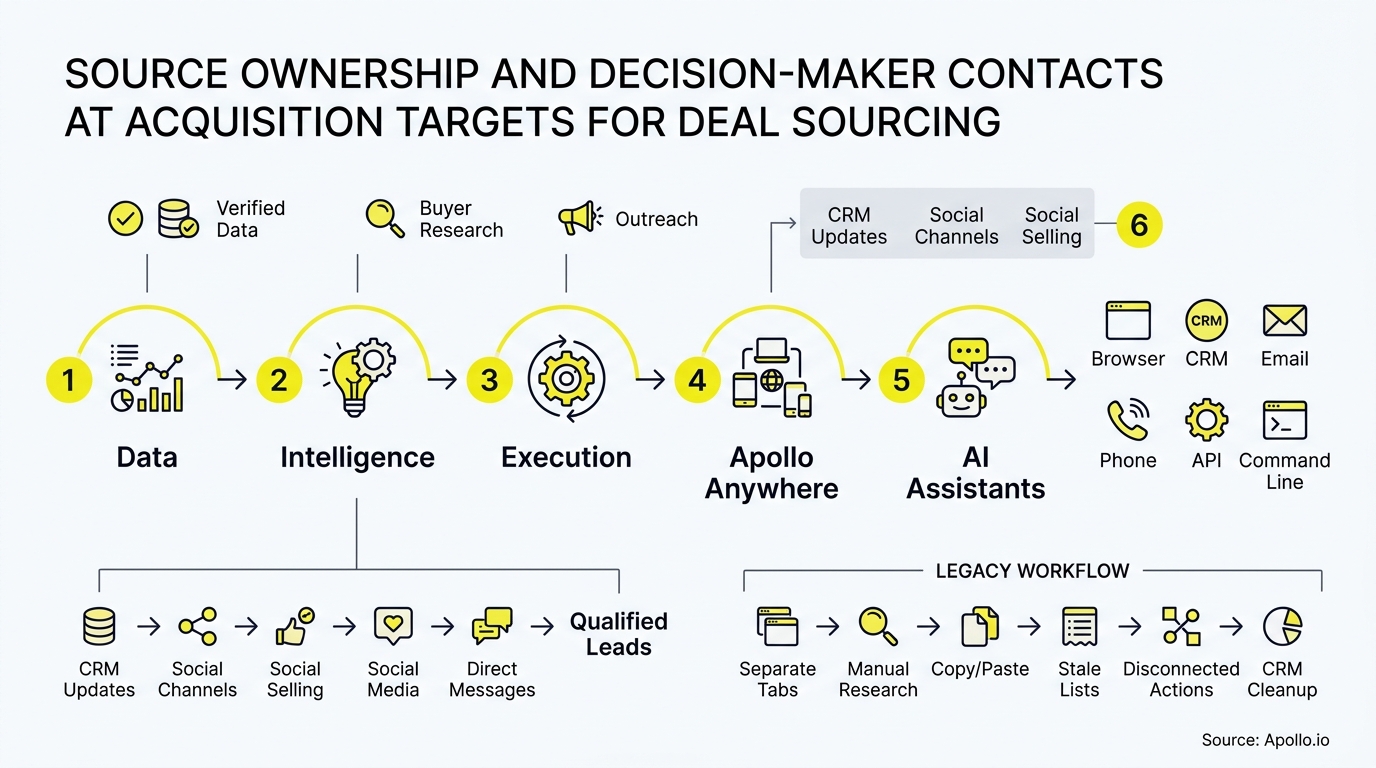
You can run target verification and decision-maker mapping directly inside ChatGPT, Claude, Perplexity, or Codex by connecting Apollo MCP to your AI tool. Once connected via OAuth, no code required, you can ask your AI assistant to search for companies matching an acquisition profile, enrich the ownership and executive contacts on that list, and add qualified prospects straight into a sequence, all from one conversation.
For technical teams building custom deal-sourcing workflows, the Apollo command-line interface gives terminal-native access to the same data and actions. This matters because deal teams increasingly expect AI tools to connect to approved, source-attributed data rather than working from static exports.
Your best target-verification session shouldn't require opening six separate tabs.
What's the Difference Between Legal Owner, Beneficial Owner, and Operating Controller?
The legal owner is the entity listed on official filings, the beneficial owner is the person or fund that actually controls economic benefit and voting rights, and the operating controller is whoever runs day-to-day decisions, regardless of equity stake. These roles are often conflated in casual research but must be verified independently.
A target company might show a holding LLC as the legal owner, a private equity sponsor as the beneficial owner following a prior recapitalization, and a non-equity CEO as the operating controller with full authority over an acquisition conversation. Missing any one of these three roles risks pitching a deal to someone without the standing to say yes.

Conclusion
Verified ownership and multi-threaded decision-maker mapping turn a scattershot target list into a sourcing program that actually closes. The firms winning proprietary deal flow aren't the ones with the biggest lists; they're the ones who know exactly who owns the target and who else has to sign off before outreach ever starts.
Build that verification into your workflow with a system that consolidates data, enrichment, and outreach instead of stitching together separate tools. As one Apollo customer put it, "We reduced the complexity of three tools into one" — Predictable Revenue. Explore Apollo's deal management tools to keep every verified contact, ownership record, and conversation in one workspace.
Prove ROI Fast, Scale Outreach With Apollo
Struggling to justify tool spend when value takes months to show up? Apollo replaces scattered manual research with automated outreach your whole team can scale immediately. Leadium tripled annual revenue after automating outbound with Apollo.
Start Free with Apollo →Don't miss these
Sales
Inbound vs Outbound Marketing: Which Strategy Wins?
Sales
What Is a Sales Funnel? The Non-Linear Revenue Framework for 2026
Sales
What Is a Go-to-Market Strategy? The 2026 GTM Playbook
See Apollo in action
We'd love to show how Apollo can help you sell better.
By submitting this form, you will receive information, tips, and promotions from Apollo. To learn more, see our Privacy Statement.
4.7/5 based on 9,690 reviews
