
How to Score and Prioritize Inbound Leads by ICP Fit
A hot inbound lead sitting in your queue for even an hour can go cold. SERP Sculpt found that contacting a high-fit inbound lead within 5 minutes makes a rep 21x more likely to qualify it compared to waiting 30 minutes. Yet most teams still triage inbound leads in the order they arrive, not the order they matter.
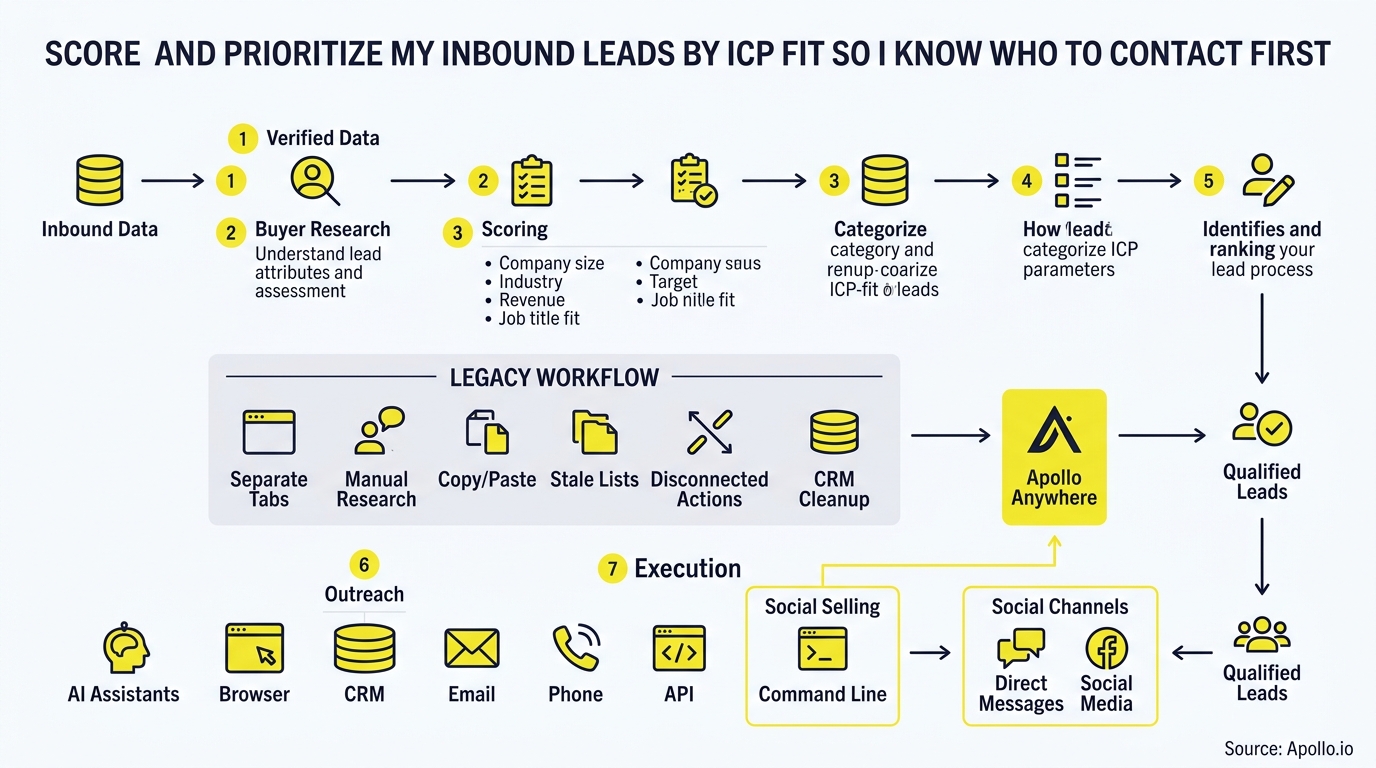
Scoring and prioritizing inbound leads by ICP fit fixes that. Instead of guessing, you build a system that ranks every lead by how well it matches your ideal customer profile, layers in real intent signals, and routes the best-fit accounts to the right rep automatically.

Ditch Research, Apollo Hands You Contacts
Burning hours verifying emails and phone numbers before you even pick up the phone. Apollo hands your team verified contact data instantly, with 98% email accuracy. Get back to selling, not searching.
Start Free with Apollo →Key Takeaways
- ICP fit should score the whole buying group, not just the person who filled out a form. Modern B2B deals involve multiple stakeholders and departments, so account-level scoring beats individual lead scoring.
- Combine fit with intent and data confidence. A high-fit account with zero recent activity is not the same priority as a high-fit account that just visited your pricing page twice.
- Use Apollo MCP when you need to score and prioritize inbound leads inside ChatGPT, Claude, or Perplexity without switching tabs to your CRM.
- Speed matters more than most teams admit. Static point systems miss real-time behavior; dynamic scoring catches it.
- Every priority tier needs an owner, an SLA, and a defined next action, or the score becomes a vanity metric nobody acts on.
What Is ICP Lead Scoring?
ICP lead scoring is the practice of ranking inbound leads based on how closely their firmographic, technographic, and behavioral attributes match your ideal customer profile. It answers one question before a rep ever picks up the phone: is this account worth contacting right now?
Unlike generic lead scoring, which often rewards any engagement (email opens, page views, content downloads), ICP scoring weights fit first. A VP of Sales at a 200-person SaaS company who fits your target segment should outrank a student who downloaded your ebook, even if the student clicked more links.
Research from CXL shows organizations with a formally documented and enforced ICP achieve 68% higher account win rates than those without one. Fit isn't a nice-to-have filter, it's the foundation the entire scoring model sits on. Learn more about building that foundation in our guide on what ICP means in sales.
Why Is Fit Alone Not Enough to Prioritize Leads?
Fit alone is not enough because it tells you who could buy, not who is buying now. A perfect-fit account with no recent activity may be months away from a decision, while a good-fit account showing active buying signals could close this quarter.
Forrester's 2024 research on B2B purchasing found that an average of 13 people participate in a single B2B purchase, and 89% of purchases involve at least two departments, according to Forrester's investor report. Scoring one contact from that buying group tells you almost nothing about whether the account is ready.
McKinsey's 2024 survey of B2B decision-makers found buyers now use an average of 10 interaction channels, up from five in 2016, according to McKinsey. A single form fill captures a fraction of that behavior. Fit narrows the list; intent tells you who to call first.
How Do You Build a Copyable ICP Scoring Model?
You build an ICP scoring model by weighting four categories: firmographic fit, behavioral intent, buying-group coverage, and data confidence, then summing weighted points into a single account-level score. Here's a starting framework you can adapt:
| Category | Signal | Weight | Example Points |
|---|---|---|---|
| Firmographic Fit | Industry match | 15% | 15 pts if exact match |
| Firmographic Fit | Company size / employee count | 15% | 15 pts if in target range |
| Firmographic Fit | Tech stack match | 10% | 10 pts if uses complementary tool |
| Behavioral Intent | Pricing/demo page visits | 15% | 15 pts if visited in last 7 days |
| Behavioral Intent | Form submission type | 10% | 10 pts for demo request vs. 3 pts for ebook |
| Buying-Group Coverage | # of distinct contacts engaged | 15% | 15 pts if 2+ departments active |
| Buying-Group Coverage | Seniority mix | 10% | 10 pts if decision-maker + user both present |
| Data Confidence | Verified email/phone | 10% | 10 pts if enriched and verified |
Weighting formula: Total Score = (Firmographic Fit × 0.40) + (Behavioral Intent × 0.25) + (Buying-Group Coverage × 0.25) + (Data Confidence × 0.10)
Automatic disqualifiers (override any score to zero):
- Free/personal email domain with no verified company match
- Company below minimum employee or revenue threshold
- Geography outside serviceable territory
- Competitor domain or known reseller
Gartner's newer guidance reinforces this shift away from static rules. Gartner's 2025 Sales Survey also found that 49% of CSOs say their sales team's definition of a "qualified lead" differs significantly from marketing's, which is exactly the misalignment a shared, weighted model is designed to remove.
Turn Weak Leads Into Sales-Ready Pipeline
Marketing leads dying before they reach a rep. Apollo scores and prioritizes prospects by real buying intent, so reps chase deals ready to close, not cold names on a list. Built-In boosted win rates using Apollo's scoring.
Start Free with Apollo →What Is the Fit-Intent Matrix and How Do You Use It?
The fit-intent matrix is a four-quadrant framework that plots ICP fit against buying intent to instantly categorize every inbound lead into a priority tier. It turns two scores into one clear action.
| Quadrant | Fit | Intent | Priority | Action |
|---|---|---|---|---|
| Hot Account | High | High | Tier 1 | Contact within 5 minutes, phone + email |
| Nurture Now | High | Low | Tier 2 | Add to sequence, monitor for intent spike |
| Fast Mover | Low | High | Tier 3 | Quick qualify, route to SDR queue |
| Deprioritize | Low | Low | Tier 4 | Auto-nurture or disqualify |
Only Tier 1 and Tier 3 leads should trigger an immediate human touch. Everything else goes into automated nurture until the score changes. This is the fit × intent × value model that's replacing single-dimension MQL scoring, and it's built for a market where Norwest's 2025 B2B benchmark found organizations tightening qualification around simpler, sharper criteria.

How Do You Route Scored Leads to the Right Owner and SLA?
You route scored leads by mapping each priority tier to a specific owner, response-time SLA, and outreach channel inside your CRM or routing tool. A score without a routing rule just sits in a dashboard.
| Tier | Owner | SLA | Channel | Enablement Asset |
|---|---|---|---|---|
| Tier 1 (Hot) | Senior AE / Territory owner | 5 minutes | Phone first, then email | Account snapshot + buying-group map |
| Tier 2 (Nurture) | SDR/BDR | 1 business day | Sequenced email + social | Case study matched to industry |
| Tier 3 (Fast Mover) | SDR/BDR | 15 minutes | Phone or chat | Qualification script |
| Tier 4 (Low Priority) | Marketing automation | N/A | Automated nurture | Educational content series |
For SDRs and BDRs, this routing table means the queue is already sorted, so the first call of the day goes to the account most likely to convert, not whoever filled out a form five minutes ago. For RevOps leaders, this is also the layer where marketing and sales finally agree on what "qualified" means, closing the definitional gap Gartner identified above.
Struggling to find qualified leads buried in a messy inbound queue? Search Apollo's 240M+ contacts with 65+ filters to instantly confirm fit before you route.
How Can You Score Inbound Leads Directly Inside ChatGPT or Claude?
You can score inbound leads directly inside ChatGPT, Claude, or Perplexity by connecting Apollo MCP, which brings Apollo's data and actions into the AI tool you're already using. Setup is no-code: connect Apollo through the tool's integrations menu via OAuth on any Apollo plan, including free.
Once connected, you can ask your AI assistant to pull a list of inbound leads, enrich them with verified emails and phone numbers, check firmographic fit against your ICP, and push the highest scorers straight into a sequence, all in one conversation. For technical teams, the Apollo CLI offers the same access from the terminal.
Your best prospecting session shouldn't require opening a new tab. This matters more as AI-assisted discovery grows: Demandbase reported monthly ChatGPT referrals to B2B websites grew 303% year-over-year as of Demandbase's 2026 analysis, meaning some of your best-fit inbound leads may arrive via AI search rather than a traditional form.
How Do You Validate and Improve Your Scoring Model Over Time?
You validate a scoring model by tracking conversion rates by tier every month and adjusting weights when a tier consistently over- or under-performs its expected close rate. If Tier 2 leads convert as often as Tier 1, your intent weighting is off.
Data quality is the biggest failure point. Nearly 75% of marketers in a 2025 B2B survey believed at least 10% of their lead data was inaccurate or outdated, a gap that quietly breaks even well-designed scoring models.
Run a quarterly audit: check for duplicate accounts, verify a sample of enriched emails and phones, and confirm your firmographic fields (employee count, industry, revenue) are current.
Tired of dirty data undermining your scoring accuracy? Start free with Apollo's data enrichment to keep firmographic and contact fields current without manual cleanup.
For Account Executives, validated scoring means less time double-checking whether a "hot" lead is actually a fit before a discovery call. For Sales and Revenue Leaders, it means forecasting gets more reliable because pipeline stages reflect real fit and intent, not just activity volume.
What Are Common FAQs About ICP Lead Scoring?
What Is the Difference Between Fit and Intent in Lead Scoring?
Fit measures whether an account matches your ideal customer profile (industry, size, tech stack); intent measures whether that account is actively showing buying behavior right now (page visits, demo requests, content engagement). You need both: fit tells you if they can buy, intent tells you if they're ready to.
What Score Threshold Should Trigger Immediate Outreach?
There's no universal number, but most teams set the Tier 1 threshold where an account scores in the top 20-25% on both fit and intent dimensions simultaneously, not just a high combined total. A single very high fit score paired with zero intent should not trigger the same 5-minute SLA as a true fit-and-intent match.
How Often Should You Re-Score Leads?
Re-score in real time when new behavioral data arrives (a pricing page visit, a second form fill, a new contact engaging) rather than on a fixed daily or weekly batch. Static, infrequent scoring is exactly what Gartner has warned will underperform against dynamic, AI-enabled models.
Can Small Sales Teams Use This Framework Without Heavy Engineering?
Yes. Founders and small RevOps teams can start with the four-category weighting table above in a spreadsheet or basic CRM field, then automate routing once volume justifies it.
The framework works whether you're scoring 50 leads a month or 5,000.

Start Prioritizing Inbound Leads by ICP Fit Today
Scoring inbound leads by ICP fit isn't about adding more fields to your CRM. It's about combining firmographic fit, real-time intent, buying-group coverage, and data confidence into one weighted score that tells every rep exactly who to call first and how fast.
The teams winning right now aren't the ones with the most leads. They're the ones who can tell a Tier 1 account from a Tier 4 account in seconds and route accordingly. Collin Stewart of Predictable Revenue put it simply: "We reduced the complexity of three tools into one." That's the consolidation advantage of building fit, intent, and routing into a single workspace instead of stitching together a scoring tool, an enrichment tool, and a sequencing tool separately.
Apollo brings B2B data, sales intelligence, and outreach execution together in one system , so teams don't have to stitch together separate vendors for research, outreach, and analysis. Instead of exporting lists to one tool for enrichment, another for scoring, and a third for outreach, GTM teams can score, route, and engage inbound leads from a single workspace.
Ready to stop guessing which inbound leads deserve a call today? Start Your Free Trial and turn your inbound pipeline into a prioritized, ICP-scored queue your reps can act on the moment a lead comes in.
Prove ROI Fast, Not In A Future Quarter
Struggling to justify tool spend before leadership loses patience? Apollo replaces scattered point solutions with one platform, so wins show up in pipeline faster. Leadium 3x'd annual revenue after consolidating with Apollo.
Start Free with Apollo →Don't miss these
Sales
Inbound vs Outbound Marketing: Which Strategy Wins?
Sales
What Is a Sales Funnel? The Non-Linear Revenue Framework for 2026
Sales
What Is a Go-to-Market Strategy? The 2026 GTM Playbook
See Apollo in action
We'd love to show how Apollo can help you sell better.
By submitting this form, you will receive information, tips, and promotions from Apollo. To learn more, see our Privacy Statement.
4.7/5 based on 9,690 reviews
