
What Are Sales Systems and How Do They Drive Revenue in 2026?
Modern sales systems are no longer just CRMs and email sequences. They are the complete architecture that connects data, content, automation, and process into a single revenue engine. According to dring.ai, buyers now complete 60% to 70% of their decision-making journey digitally before engaging with a sales rep. That means your sales tech stack must do the heavy lifting long before a human conversation starts.
The teams winning in 2026 treat sales systems as decision infrastructure, not just activity trackers. They build for digital-first buyers, pre-shortlist influence, and AI-assisted execution at every stage.

Research Less, Close More With Apollo
Tired of burning hours manually hunting down contact info that's already outdated? Apollo delivers verified emails and business numbers so your team sells instead of searches. Nearly 100K paying customers have made the switch.
Start Free with Apollo →Key Takeaways
- Sales systems now span data, content, engagement, and AI automation — not just CRM.
- Buyers complete most of their journey before talking to a rep, so your system must convert content into pipeline.
- Pre-shortlist presence is critical: 41% of B2B buyers already have a preferred vendor before formal evaluation begins.
- RevOps teams that unify their systems around a single source of truth see faster pipeline velocity and cleaner attribution.
- AI-powered platforms like Apollo consolidate the stack, reducing cost and complexity while improving rep performance.
What Are Sales Systems?
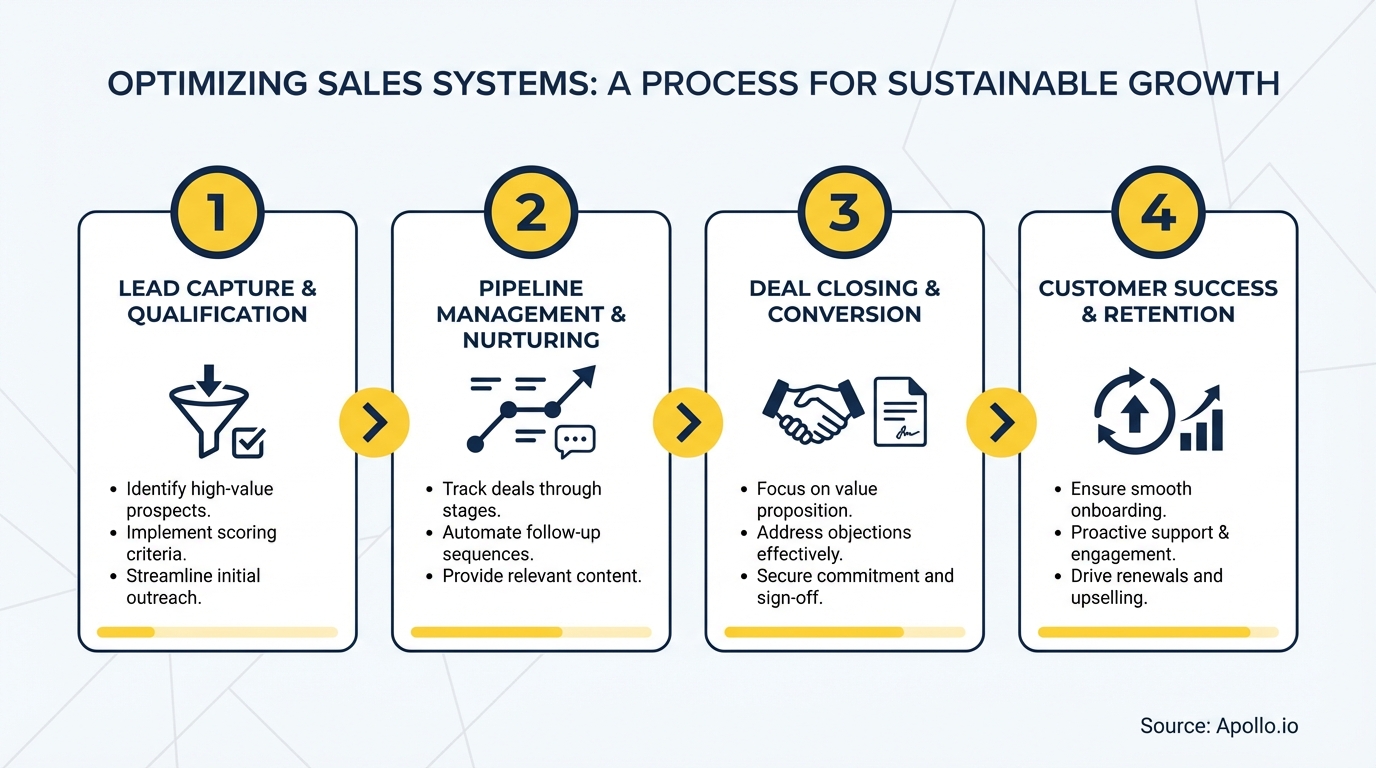
Sales systems are the integrated set of processes, tools, and data flows that move prospects from first awareness to closed deal and beyond. A modern sales system includes four layers: data and intelligence (contact records, firmographics, intent signals), engagement (sequences, calls, multi-channel outreach), pipeline management (deal stages, forecasting, coaching), and automation and AI (workflow triggers, scoring, content delivery).
What separates a system from a collection of tools is integration. Disconnected platforms create blind spots, duplicate work, and break attribution.
A true sales system routes the right signal to the right rep at the right moment — automatically.
| Layer | Function | Example Outputs |
|---|---|---|
| Data & Intelligence | Identify and enrich target accounts | Verified contacts, ICP filters, intent scores |
| Engagement | Reach buyers across channels | Email sequences, calls, social touches |
| Pipeline Management | Track and advance deals | Stage movement, deal health, forecast |
| AI & Automation | Execute and optimize at scale | Auto-routing, AI messaging, call summaries |
Why Do Sales Systems Matter More Than Ever in 2026?
Buyer behavior has fundamentally changed. Research from icumulus.ai shows that 93% of B2B buying processes begin with an online search. And according to Semrush, B2B buyers consume an average of 13 pieces of content before making a purchase decision. Your sales system must serve that content at every touchpoint, or a competitor will.
The Salesforce State of Sales 2026 report highlights that disconnected systems and weak data quality are the top barriers to AI automation delivering measurable results. In other words: your AI agent is only as good as the systems underneath it.
RevOps leaders building unified revenue architectures are pulling ahead of teams still patching together point solutions.
Struggling to build pipeline from your current stack? See how Apollo's AI-powered pipeline builder connects data, outreach, and automation in one place.

How Do RevOps Leaders Build a Modern Sales System?
RevOps leaders treat sales systems as architecture, not tooling. The goal is a single source of truth: canonical lifecycle stages (MQL, SQL, opportunity), clear SLAs between marketing and sales, unified attribution, and instrumented handoffs.
Without this foundation, AI automation amplifies chaos instead of reducing it.
A practical RevOps build follows five steps:
- Define stages and exits: Standardize lifecycle definitions across CRM, marketing automation, and engagement platforms.
- Instrument every handoff: Capture timestamps, owner changes, and signal triggers at each transition.
- Unify contact data: Enrich records continuously so reps always have accurate business contact information.
- Automate routing and follow-up: Use workflow rules to assign leads, trigger sequences, and escalate stalled deals.
- Govern AI outputs: Set quality controls, review cadences, and feedback loops from sales back to content and scoring models.
Learn more about building this foundation in our guide to what revenue operations is and how it drives growth.
Turn Funnel Guesswork Into Pipeline Clarity
Pipeline forecasting a guessing game because quality leads never make it past the top of the funnel? Apollo surfaces in-market buyers and moves them forward — so your forecast reflects reality. Join nearly 100K paying customers who stopped guessing.
Schedule a Demo →How Do SDRs and AEs Use Sales Systems to Hit Quota?
For SDRs, a well-designed sales system eliminates the prospecting research gap. Instead of manually sourcing contacts, SDRs work from enriched, pre-scored lists with verified contact information and intent signals.
They spend time on outreach and conversations, not data hygiene. Teams using structured systems with ICP filters and automated sequences report stronger pipeline conversion compared to those relying on manual prospecting.
For Account Executives managing active deals, the system provides pre-meeting intelligence, stakeholder maps, and conversation summaries. The deal management layer surfaces deal health warnings and next-step recommendations, so AEs focus on advancing deals rather than updating CRM fields. As Cyera noted after consolidating their stack: "Having everything in one system was a game changer."
Spending hours on manual outreach instead of closing? Automate your multi-channel sequences with Apollo and let reps focus on conversations that convert.
What Role Does AI Play in Modern Sales Systems?
AI is shifting from a feature inside tools to the operating layer across the entire system. Agentic AI executes tasks across CRM, engagement, and intelligence platforms: drafting outreach, routing leads, summarizing calls, flagging at-risk deals, and recommending next steps.
This is what vendors mean when they describe AI agents as the new "sales system UI."
Apollo's AI platform has grown 500% year over year, with 50,000 weekly users leveraging AI features. Teams using Apollo's AI Research Agent book 46% more meetings, and AI-powered messaging drives a 35% increase in bookings. Explore how AI sales tools are actually closing more deals in 2026.
Governance matters equally. As AI generates more content and automates more decisions, revenue leaders need audit trails, quality controls, and outcome-based measurement.
The teams winning with AI are not just deploying more agents — they are building the governance layer that keeps agents accurate and accountable.
How Should You Measure Sales System Performance?
Effective measurement connects activity metrics to revenue outcomes. Tracking vanity metrics like emails sent or calls logged tells you nothing about system health. The KPIs that matter are:
- Pipeline coverage ratio: Qualified pipeline vs. quota target by rep and team.
- Stage conversion rates: Where deals stall or drop out of the funnel.
- Time-to-first-response: Speed of follow-up on inbound and triggered signals.
- Content-to-pipeline attribution: Which assets influence shortlist formation and deal progression.
- AI output quality scores: Accuracy and reply rates on AI-generated messages vs. manual.
Pair these with the sales KPIs your team should track in 2026 and a feedback loop back to content and scoring. Use sales analytics to surface patterns, not just reports.

How Do You Build a Sales System That Scales?
The most scalable sales systems share one trait: they are built on a consolidated platform, not a fragmented stack. Every additional tool adds integration risk, data latency, and administrative overhead.
Predictable Revenue consolidated their stack and reported: "We reduced the complexity of three tools into one." Census cut their costs in half after switching to a unified platform.
Apollo gives B2B GTM teams a single workspace for prospecting, engagement, data enrichment, deal management, and AI automation. With 230M+ people and 30M+ companies in the database, 97% email accuracy, and native workflows connecting every stage, teams replace multiple point solutions with one system. Read the full playbook on how sales automation software drives revenue and start building a system that compounds over time.
Ready to replace your fragmented stack with a unified sales system? Request a Demo and see how Apollo's all-in-one GTM platform helps SDRs, AEs, and RevOps teams build pipeline faster with less complexity.
Prove Pipeline ROI With Apollo
ROI pressure killing your next budget approval? Apollo delivers measurable pipeline impact from day one — so you walk into every review with hard numbers. Leadium 3x'd their annual revenue after making the switch.
Start Free with Apollo →Don't miss these
Sales
Inbound vs Outbound Marketing: Which Strategy Wins?
Sales
What Is a Sales Funnel? The Non-Linear Revenue Framework for 2026
Sales
What Is a Go-to-Market Strategy? The 2026 GTM Playbook
See Apollo in action
We'd love to show how Apollo can help you sell better.
By submitting this form, you will receive information, tips, and promotions from Apollo. To learn more, see our Privacy Statement.
4.7/5 based on 9,690 reviews
