
Sales Enablement Framework: Definition, Benefits, and Best Practices
Sales teams waste countless hours searching for outdated content while reps struggle to access the right materials at the right moment. A sales enablement framework solves this by creating a structured system that equips revenue teams with tools, training, and content to engage buyers effectively.
In 2026, the most impactful frameworks integrate AI-driven content delivery, governance protocols, and cross-functional alignment to accelerate deal velocity and reduce tech stack complexity.
According to G2, organizations with a formal sales enablement program achieve a 49% higher win rate on forecasted deals. The shift from static content libraries to AI-enabled, in-workflow systems is transforming how revenue operations teams measure impact and drive predictable growth.

Build Pipeline Faster With Apollo
Tired of burning hours on manual research while your pipeline stalls? Apollo surfaces verified contacts and scales your outreach so your team spends time selling, not searching. Join 550K+ companies building predictable pipeline.
Start Free with Apollo →Key Takeaways
- A sales enablement framework structures tools, training, and content to accelerate rep productivity and deal velocity across the entire revenue team
- In 2026, frameworks must include AI-ready content architecture, governance protocols, and just-in-time delivery embedded in CRM and outreach workflows
- Companies with formal enablement programs see measurable improvements in quota attainment, win rates, and ramp time reduction
- Revenue enablement extends beyond sales to marketing and customer success, requiring modular assets and shared KPIs across functions
- Effective frameworks eliminate content waste by implementing lifecycle management, retirement SLAs, and usage analytics tied to pipeline outcomes
What Is a Sales Enablement Framework?
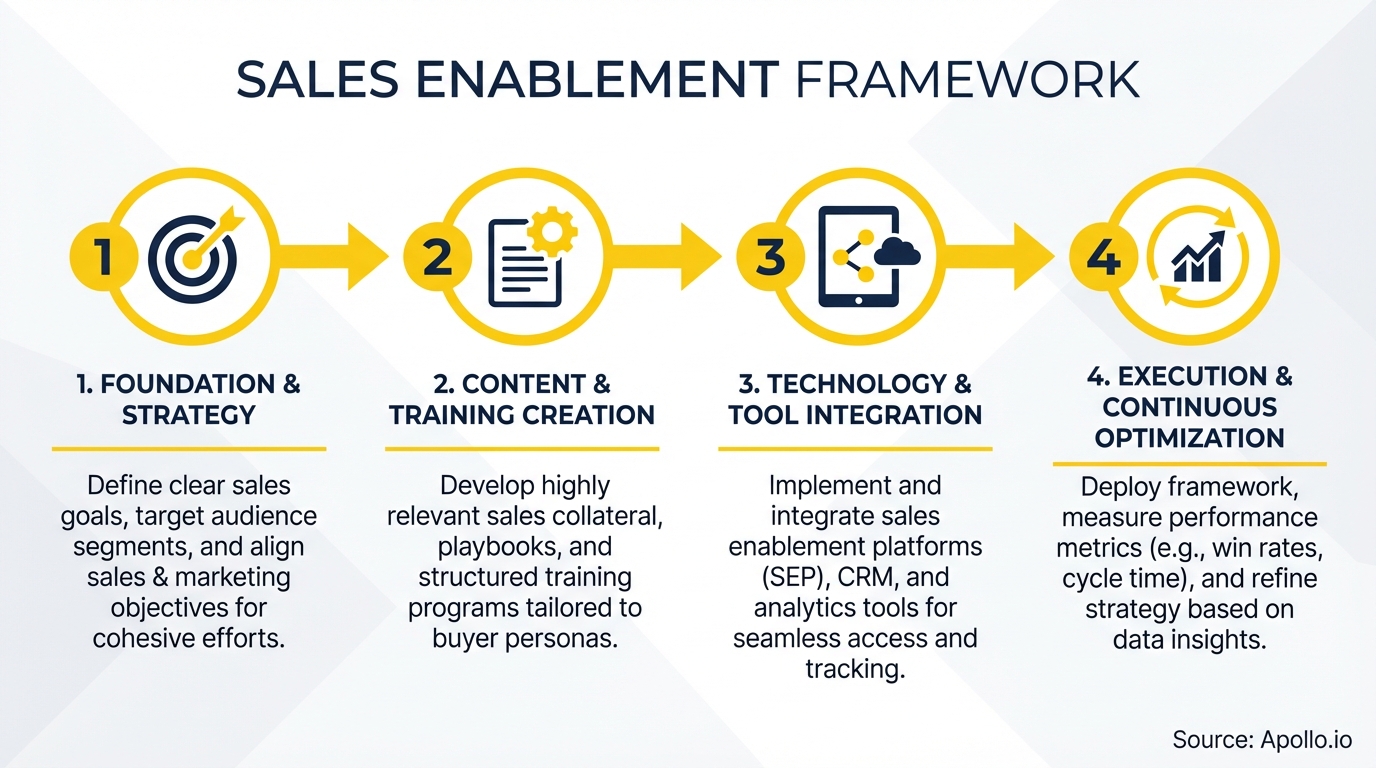
A sales enablement framework is a strategic system that provides revenue teams with the resources, training, and processes needed to engage prospects and close deals efficiently. It connects content management, skill development, technology infrastructure, and performance measurement into a unified approach that supports reps from onboarding through quota attainment.
The framework addresses a critical productivity gap. Research from Everstage shows reps spend only 28% of their time actually selling. A well-designed framework reclaims non-selling hours by surfacing the right playbook, case study, or competitive battle card exactly when needed.
Modern frameworks integrate AI sales enablement capabilities that personalize content recommendations based on deal stage, buyer persona, and industry vertical. This eliminates manual searches through shared drives and ensures SDRs, AEs, and customer success managers access current, approved materials.
Why Do Sales Leaders Implement Enablement Frameworks?
Sales leaders implement enablement frameworks to solve three urgent problems: inconsistent rep performance, unmanageable tech stack costs, and invisible ROI from training investments. The framework creates standardized processes that reduce variance in how teams prospect, qualify, and close opportunities.
Data from SmartWinnr demonstrates the impact. Companies with strong enablement programs achieve 32% higher team sales quota attainment, 24% better individual quota achievement, and a 23% higher lead conversion rate.
For RevOps leaders managing sales performance management across multiple tools, frameworks consolidate scattered resources into a single system of record. This reduces onboarding time, improves content governance, and provides attribution data connecting enablement activities to pipeline acceleration.

What Are the Core Components of an Enablement Framework?
Effective enablement frameworks contain five interconnected components that work together to drive measurable revenue outcomes.
| Component | Purpose | Key Elements |
|---|---|---|
| Content Management | Organize and govern sales assets | Asset library, versioning, retirement SLAs, AI tagging |
| Training & Onboarding | Develop rep skills and product knowledge | Certification paths, role-play scenarios, microlearning modules |
| Technology Infrastructure | Enable workflow integration and automation | CRM integration, content delivery, analytics dashboards |
| Messaging & Positioning | Standardize customer communication | Value propositions, competitive differentiation, objection handling |
| Performance Analytics | Measure impact and optimize programs | Usage metrics, win rate correlation, ramp time tracking |
The technology component is evolving rapidly. Highspot reports that 90% of organizations are either currently using AI to support go-to-market efforts or planning to start. This includes AI copilots embedded in Slack and Teams that surface content recommendations without leaving the conversation flow.
Struggling to keep reps aligned on messaging? Automate your multi-channel sequences with Apollo's sales engagement platform to ensure consistent outreach across email, phone, and social channels.
Turn Weak Leads Into Real Pipeline
Tired of watching marketing leads stall before they ever reach sales? Apollo surfaces verified, in-market buyers so your team stops guessing and starts converting. 550K+ companies trust Apollo to fill funnels with opportunities that close.
Start Free with Apollo →How Do SDRs and AEs Use Enablement Frameworks Daily?
SDRs rely on frameworks for prospecting efficiency and message personalization.
During list building, they access ICP-aligned playbooks that define target accounts, pain points, and qualifying questions.
When crafting outreach, they pull from approved templates and case studies tagged by industry and use case.
Account Executives use frameworks during deal progression to access competitive intelligence, pricing guidelines, and objection handling scripts. Before discovery calls, AEs review buyer personas and value propositions.
During negotiations, they reference ROI calculators and reference customer stories that match the prospect's company size and vertical.
The shift to just-in-time delivery changes how reps interact with content. Instead of searching a portal before every call, AI assistants surface relevant materials directly in the deal management interface based on opportunity stage, industry, and recent buyer interactions.
What Is Revenue Enablement and How Does It Differ?
Revenue enablement expands the traditional sales-only focus to include marketing, customer success, and partnerships. This cross-functional approach recognizes that buying committees span multiple roles and post-sale expansion drives significant revenue growth.
The scope includes modular content assets reusable across functions. A product demo recording created for sales can be repurposed by customer success for onboarding and by marketing for demand generation campaigns.
Shared metrics like customer lifetime value and net revenue retention replace siloed KPIs.
Organizations building revenue operations frameworks integrate enablement into broader go-to-market alignment efforts. This ensures consistent buyer experiences from first touch through renewal and eliminates gaps where prospects receive conflicting messages from different teams.
How Should Teams Implement Content Governance?
Content governance addresses a critical problem: asset decay. Enablement professionals report that over 80% of created content goes unused, and at least 40% of collateral becomes outdated.
Governance establishes ownership, review cycles, and retirement protocols.
Implementation starts with content audits that categorize assets by type, usage frequency, and last update date. Each asset receives an owner responsible for accuracy and a review schedule based on volatility.
Product sheets might require quarterly updates while evergreen methodology content reviews annually.
Retirement SLAs prevent outdated materials from circulating. When product features change or competitive landscapes shift, deprecated content moves to archive status and redirects point to current versions. Analytics track which assets drive engagement and pipeline contribution, informing creation priorities. Teams using sales analytics platforms can correlate content usage with deal velocity and win rates.
Start Building Your Revenue Enablement Framework in 2026
Sales enablement frameworks have evolved from content repositories into AI-powered revenue systems that consolidate tools, accelerate ramp time, and provide measurable ROI through usage analytics and pipeline attribution. The most effective frameworks in 2026 integrate governance protocols, cross-functional asset libraries, and just-in-time delivery that meets reps in their existing workflows.
For sales leaders and RevOps teams implementing frameworks, prioritize AI-ready content architecture, lifecycle management, and measurement systems that connect enablement activities to revenue outcomes. The frameworks that drive competitive advantage combine structured processes with intelligent automation.
Ready to consolidate your sales tech stack? Try Apollo Free to access 224M+ verified contacts, multi-channel sequences, and AI-powered insights in one unified platform. "We reduced the complexity of three tools into one," reports Collin Stewart from Predictable Revenue.
Prove Pipeline ROI With Apollo
Budget approval stuck on unclear metrics? Apollo gives sales teams measurable pipeline impact from day one. Leadium 3x'd their annual revenue — your ROI story starts here.
Start Free with Apollo →Don't miss these
Sales
Inbound vs Outbound Marketing: Which Strategy Wins?
Sales
What Is a Sales Funnel? The Non-Linear Revenue Framework for 2026
Sales
What Is a Go-to-Market Strategy? The 2026 GTM Playbook
See Apollo in action
We'd love to show how Apollo can help you sell better.
By submitting this form, you will receive information, tips, and promotions from Apollo. To learn more, see our Privacy Statement.
4.7/5 based on 9,690 reviews
