
Sales Dashboards: How to Turn Data Into Revenue Decisions
Sales dashboards transform raw data into actionable insights that drive revenue decisions. In 2026, the shift toward data-driven selling has accelerated, yet many teams struggle with dashboard sprawl, misaligned metrics, and poor data quality. According to BookYourData, 65% of B2B sales organizations are projected to transition from intuition-based to data-driven decision-making by 2026. This guide shows you how to build dashboards that sales leaders trust and teams actually use. Effective sales analytics starts with the right foundation.

Let Apollo Find Verified Leads Instantly
Tired of burning hours hunting down emails that bounce and numbers that go nowhere? Apollo surfaces verified business contacts so your team sells instead of searches. 550K+ companies have already made the switch.
Start Free with Apollo →Key Takeaways
- Sales dashboards visualize metrics like pipeline velocity, win rates, and quota attainment to guide revenue decisions.
- Data quality and cross-functional alignment matter more than visual design when building trustworthy dashboards.
- Decision-centric dashboards with clear next steps outperform static reporting tools.
- Unified platforms eliminate dashboard sprawl and give teams a single source of truth.
What Are Sales Dashboards?
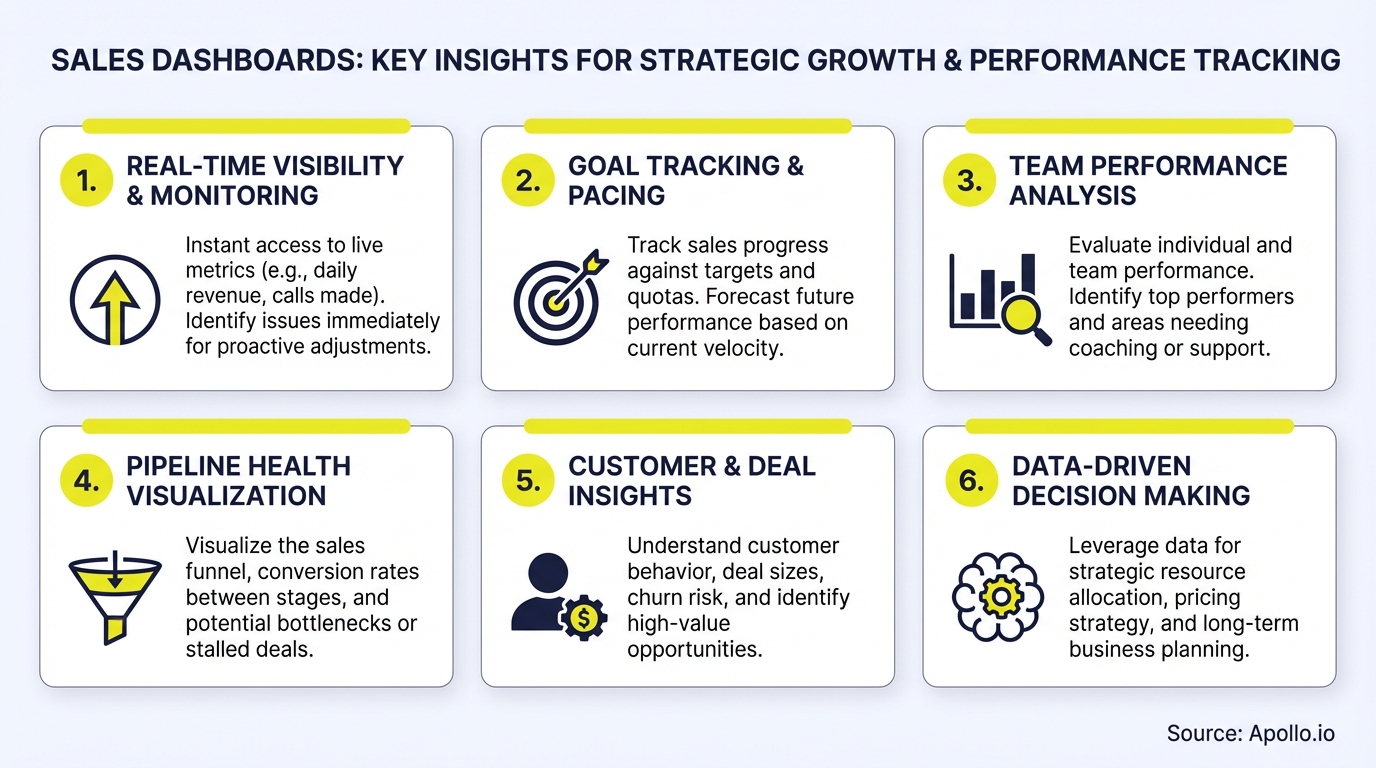
Sales dashboards are visual interfaces that consolidate key performance metrics into a single view. They track pipeline health, rep productivity, forecast accuracy, and revenue trends in real time.
Modern dashboards go beyond charts to include recommended actions, alerts, and workflow triggers.
The best dashboards answer specific questions: Are we on track to hit quota? Which deals need attention?
Where are reps spending time? They surface insights that drive immediate action rather than requiring hours of manual analysis.
Why Do Sales Teams Need Dashboards in 2026?
Sales teams need dashboards because decision velocity determines competitive advantage.
Research from Monday.com shows sales teams implementing a CRM system that includes sales dashboards can see an average increase of 29% in sales.
Dashboards compress decision cycles from days to minutes.
For RevOps leaders managing GTM alignment, dashboards provide the shared truth layer that prevents conflicting reports. Sales Leaders use them to identify coaching opportunities before deals slip.
SDRs track activity-to-meeting conversion rates to optimize their prospecting mix. The common thread: visibility drives accountability and faster iteration.

What Metrics Should Sales Dashboards Track?
Effective dashboards track metrics aligned to specific roles and decision points. Avoid vanity metrics that don't drive action.
| Role | Priority Metrics | Decision Enabled |
|---|---|---|
| SDRs/BDRs | Activities, meetings booked, response rates, pipeline created | Adjust outreach channels and messaging |
| Account Executives | Pipeline value, win rate, average deal size, sales cycle length | Prioritize deals and forecast accuracy |
| Sales Leaders | Quota attainment, forecast vs. actual, team velocity, coverage ratio | Resource allocation and coaching focus |
| RevOps Teams | Data quality scores, funnel conversion, cost per acquisition, tool adoption | Process improvements and tech stack optimization |
A study by Stephen Adeniran found that 63% of sales managers report their organization struggles with pipeline management. Dashboards solve this by making pipeline health visible across the entire team. Start with the sales KPIs that matter most to your team's goals.
Turn Funnel Guesswork Into Real Pipeline
Tired of watching marketing leads stall before they ever reach your pipeline? Apollo surfaces in-market buyers at the right moment, so your team acts on signal — not assumption. 550K+ companies stopped guessing and started closing.
Schedule a Demo →How Do Sales Leaders Build Decision-Centric Dashboards?
Decision-centric dashboards shift from "what happened" to "what should we do." Each metric ties to a specific decision trigger and recommended action. When pipeline coverage drops below 3x, the dashboard surfaces which segments need more prospecting activity.
Sales Leaders building these dashboards follow a three-step pattern:
- Define decision points first: List the five decisions your team makes weekly (example: which deals to prioritize, where to allocate resources, when to discount).
- Map metrics to decisions: Each decision needs 2-3 leading indicators. Deal prioritization requires stage velocity, engagement scores, and champion strength.
- Embed actions directly: Add workflow triggers like "Schedule pipeline review" or "Update forecast" next to at-risk indicators.
This approach transforms dashboards from passive reporting into active management systems. For Account Executives managing complex deals, this means less time hunting for data and more time selling. Struggling with pipeline visibility across your team? Apollo's deal management platform gives you complete pipeline transparency in one workspace.
What Data Quality Issues Break Sales Dashboards?
Poor data quality makes dashboards untrustworthy, leading teams to ignore them entirely. The most common issues: duplicate records, missing fields, inconsistent naming conventions, and stale contact information.
When AEs see conflicting pipeline numbers between their CRM and the executive dashboard, they stop trusting both.
Data quality problems compound across systems. Marketing uses one lead status taxonomy, sales uses another, and the dashboard shows garbage. Organizations that align their sales and marketing departments grow 19% faster and are 15% more profitable, according to Jifflenow research.
Fix data quality at the source:
- Standardize field definitions: Create a shared data dictionary that marketing, sales, and RevOps all reference.
- Automate enrichment: Use real-time data validation to catch errors at entry rather than cleanup later.
- Establish ownership: Assign specific teams to maintain data quality for each object type (contacts, accounts, opportunities).
- Monitor quality metrics: Track completeness scores, duplicate rates, and data age as dashboard KPIs themselves.
Tired of dirty data breaking your dashboards? Start free with Apollo's 224M+ verified contacts and automated enrichment.
How Can Teams Align on Dashboard Metrics?
Cross-functional alignment prevents the "two versions of truth" problem. When sales and marketing operate from different dashboards showing conflicting pipeline numbers, deals fall through the cracks. Businesses with aligned sales and marketing teams are 67% more efficient at closing deals, according to LXA Hub.
Create alignment through shared governance:
- Build a living KPI dictionary: Document how every metric is calculated, who owns it, and when it updates. Make this accessible to all teams.
- Establish review cadences: Monthly cross-functional sessions where sales, marketing, and RevOps review metric definitions and resolve conflicts.
- Use single data sources: Pull from one system of record rather than stitching together multiple tools with different refresh cycles.
- Assign metric owners: Each KPI needs one person accountable for accuracy and one team responsible for action when it trends wrong.
Unified platforms eliminate alignment friction. When your entire GTM team works from the same dataset, dashboards become collaborative decision tools rather than sources of debate. Learn more about how revenue operations frameworks drive this alignment.
What Dashboard Features Drive Adoption in 2026?
Dashboard adoption fails when tools feel like homework rather than helpful. In 2026, the highest-adoption dashboards share specific characteristics: they're embedded in workflow, provide AI-generated insights, and reduce cognitive load.
Key features that drive daily use:
- Embedded dashboards: Metrics appear inside collaboration tools like Slack or directly in CRM record pages, eliminating tab-switching.
- Narrative summaries: AI-generated text explains what changed and why, so reps don't decode charts manually.
- Smart alerts: Proactive notifications when metrics cross thresholds, replacing manual dashboard checking.
- Mobile optimization: Sales Leaders reviewing metrics between meetings need mobile-first interfaces.
- Personalized views: Role-based filtering that shows SDRs only their metrics, not company-wide data they can't act on.
The shift toward action-oriented interfaces means dashboards increasingly integrate with sales automation software to trigger workflows automatically. When a deal stalls, the dashboard doesn't just flag it; it suggests next steps and can even queue an automated sequence.

Start Building Dashboards That Drive Revenue
Sales dashboards in 2026 succeed when they prioritize decisions over decoration. Focus on data quality, cross-functional alignment, and action triggers rather than adding more charts.
Start with role-specific metrics that answer real questions your team asks daily.
The best dashboards live inside unified platforms that eliminate tool sprawl. When prospecting data, engagement metrics, and pipeline tracking exist in separate systems, dashboards become integration nightmares.
Apollo consolidates your entire sales workflow into one workspace, giving you trustworthy dashboards without the complexity. "Having everything in one system was a game changer," says a Sales Leader at Cyera.
Ready to build dashboards your team actually trusts? Start prospecting with Apollo's unified GTM platform and see how consolidated data creates better insights.
Prove Pipeline ROI From Day One
Budget approval stuck on unclear metrics? Apollo delivers measurable pipeline impact fast — so you walk into every budget review with proof, not promises. Leadium 3x'd their revenue. You're next.
Start Free with Apollo →Don't miss these
Sales
Inbound vs Outbound Marketing: Which Strategy Wins?
Sales
What Is a Sales Funnel? The Non-Linear Revenue Framework for 2026
Sales
What Is a Go-to-Market Strategy? The 2026 GTM Playbook
See Apollo in action
We'd love to show how Apollo can help you sell better.
By submitting this form, you will receive information, tips, and promotions from Apollo. To learn more, see our Privacy Statement.
4.7/5 based on 9,690 reviews
