
How to Refresh Stale Contact Records and Catch Key Changes
Every contact record in your CRM has a half-life. The moment someone changes jobs, gets promoted, or their company raises a funding round, that record starts decaying, even if every field still looks correct on screen. Kondo puts it plainly: stale contact records are no longer just an administrative nuisance, they're a structural barrier to revenue.
The fix isn't a once-a-year data cleanup. It's treating your CRM as a live change stream: detect the signal, verify it, score it, and route it to the right action before a competitor gets there first. Here's how to build that system, and how to use job change alerts and enrichment to run it continuously.

Apollo Ends Hours Of Manual Lead Digging
Still verifying emails and hunting contact info by hand. Apollo hands your reps verified business contacts instantly, with 98% email accuracy. Nearly 5M users skip the research grind and spend that time selling instead.
Start Free with Apollo →Key Takeaways
- Contact data doesn't decay evenly. It decays in bursts tied to job changes, new hires, and funding events, so refresh cadence should match risk, not a fixed calendar.
- Use Apollo MCP when you need to check a contact's current title, company, and funding status from inside ChatGPT, Claude, or Perplexity without opening a separate tab.
- Funding announcements are not buying intent by themselves. Pair them with hiring velocity or leadership changes before triggering outreach.
- Former champions who change jobs convert at a measurably higher rate than cold contacts, making job-change alerts a pipeline source, not just a hygiene tool.
- Use Apollo MCP when you need to enrich a stale contact list in bulk and immediately queue the updated records into a sequence.
Why Do Contact Records Go Stale So Quickly?
Contact records go stale because the labor market moves faster than most CRM update cycles. Median employee tenure fell to 3.9 years as of January 2024, the lowest level recorded since 2002, and dropped to just 2.7 years among workers age 25-34, according to the U.S.
Bureau of Labor Statistics. The same report noted 22% of wage and salary workers had been with their current employer for a year or less.
A single job change can invalidate six fields at once: company, title, work email, phone number, account association, and territory assignment. Estimates of how fast this compounds vary by source and industry. SparkDBI puts annual B2B contact decay between 22.5% and 70.3% depending on industry and data type, while Cleanlist estimates 35% annual decay specifically for startup and VC-backed contacts, the segment most prone to funding-driven reorganizations.
What Is the Signal-to-Action Matrix for Stale Contacts?
The signal-to-action matrix maps each type of change event to a specific, pre-defined response, so reps aren't deciding case-by-case what a job change or funding round means. Build it once and let it run automatically.
| Signal Type | What It Means | Recommended Action | Owner |
|---|---|---|---|
| Contact changed jobs (same industry) | Potential champion at new account | Re-engage with new-company context, notify AE of old account | SDR/BDR |
| New hire in target title | Fresh decision-maker, no prior relationship | Add to prospecting sequence with role-specific messaging | SDR/BDR |
| Company raised funding | Increased budget, not confirmed intent | Qualify against hiring/leadership signals before outreach | RevOps/Marketing |
| Funding + senior hire + hiring surge | High-confidence buying window | Prioritize for AE outreach immediately | AE |
| Contact left company, no replacement identified | Account orphaned, relationship at risk | Trigger replacement search, reassign account | RevOps |
This is where former relationships pay off. Former customers and champions who move to new companies are 5x more likely to convert than cold leads, according to Champify, making job-change tracking a pipeline-generation tactic, not just a cleanup task.
Is Funding Alone a Reliable Buying Signal?
No, funding alone is not a reliable buying signal. It's a capacity signal that shows a company has more budget available, but it doesn't confirm intent to buy your specific category of product.
Venture activity is accelerating:Dealroom reports global VC funding hit $444 billion in 2025 and is projected to approach $1 trillion by the end of 2026. But Forbes and Greenberg Traurig both note AI startups alone captured 65% of all venture deal value in 2025, meaning a huge share of 2026 funding events are concentrated in one vertical with its own buying patterns.
Build a composite score instead of reacting to funding headlines in isolation. Combine the funding event with hiring acceleration, a new VP or C-suite hire, and any recent website or job-posting activity in your category.
A company that raised money AND is hiring a VP of Sales AND posted three RevOps roles is a materially different opportunity than one that raised money and made no personnel moves.

How Do RevOps Teams Govern Data Overwrites?
RevOps teams govern data overwrites by defining, in advance, which source wins when two systems disagree, and logging every automated change for audit. Without this, automated enrichment creates as much confusion as it solves.
| Field | Source | Confidence Threshold | Overwrite Policy | Fallback Action |
|---|---|---|---|---|
| Job title | Verified enrichment provider | High | Auto-overwrite | Flag for manual review if confidence is low |
| Work email | Waterfall enrichment (multi-source) | High | Auto-overwrite | Retain last-known-good if verification fails |
| Company/account | Job change alert | Medium | Create task for rep confirmation | Do not auto-reassign account |
| Funding status | Firmographic signal feed | Medium | Notify, don't overwrite CRM field alone | Route to RevOps for scoring |
Assign a single owner (usually RevOps) for the governance rules themselves, even if SDRs and AEs act on the output. This prevents the common failure mode where three tools each think they own the "source of truth" for the same field.
Turn Cold Leads Into Sales-Ready Opportunities
Marketing leads dying before they ever reach sales. Apollo surfaces buying signals and intent data so reps know exactly who's ready to talk. Built-In improved win rates 10% using Apollo's scoring.
Start Free with Apollo →How Can SDRs and AEs Act on Job Change Alerts Faster?
SDRs and AEs act on job change alerts faster by connecting detection directly to their outreach workflow, instead of manually cross-referencing spreadsheets. For Account Executives managing a book of accounts, a champion's move to a new company is a warm, pre-qualified door into a net-new deal, if it's flagged the day it happens.
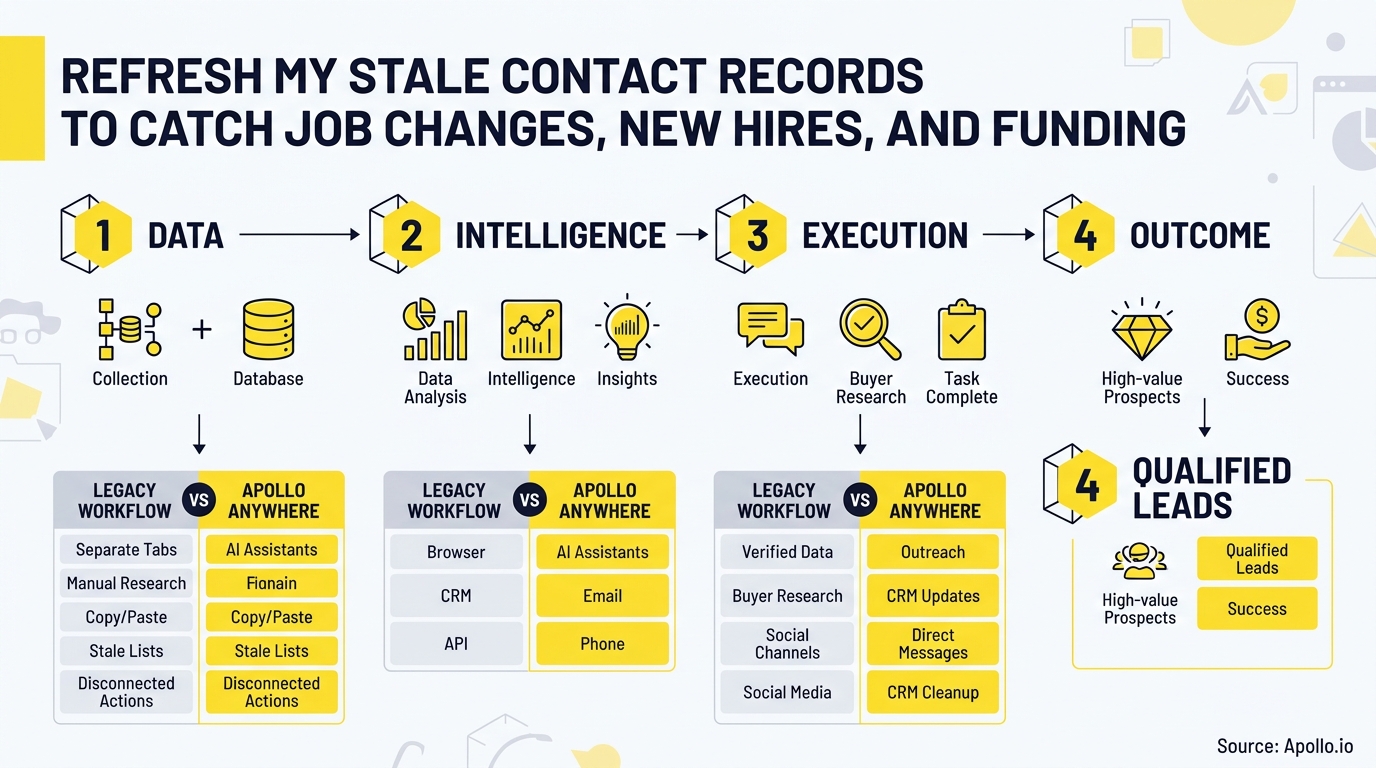
SDRs report that the biggest time cost isn't researching the signal, it's stitching together the tools needed to act on it: one tab to spot the change, another to find the new email, a third to launch the sequence. That's the toggle tax.
The old way can bounce a hot lead through roughly six tools and take about 45 minutes of manual work, export, clean, import, dedupe, re-enrich, then build a sequence, while a faster-moving competitor reaches the contact first.
Apollo's job change alerts detect the move, enrich the new contact record with a verified email and phone number, and can queue a personalized sequence in a single workflow. Tired of losing champions because your CRM didn't catch their move in time? Start free with Apollo's 240M+ verified business contacts to keep records current automatically.
How Do You Refresh Stale Contacts Directly From ChatGPT or Claude?
You refresh stale contacts directly from ChatGPT, Claude, or Perplexity by connecting Apollo MCP, which brings Apollo's data and actions into the AI tool you're already working in. Setup is no-code: connect Apollo via OAuth in the tool's connectors settings, and your data and action limits mirror your existing Apollo plan, including free.
Once connected, you can ask your AI assistant to check a contact's current title and company, pull a verified email for someone who just changed jobs, or enrich an entire stale list and push the updated records into a sequence, all from one conversation. For developer-heavy teams, the Apollo command-line interface (CLI) offers the same capability from the terminal.
Your best prospecting session shouldn't require opening a new tab. That's the point of running enrichment where you already work instead of forcing another login into your stack.
Scheduled Enrichment vs Event-Driven Refresh: Which Should You Use?
Event-driven refresh should be your default, with scheduled enrichment as a backstop, not the other way around. Scheduled enrichment (batch cleanup every 30, 60, or 90 days) catches records that slipped through, but it always lags reality.
New research complicates even that lag calculation. A 2026 analysis of roughly 148,000 records by Lusha found 12.6% of U.S.
VP- and C-suite sales leaders changed roles within 12 months, rising to 25.7% over 24 months, and identified a detection lag where recently refreshed records still missed the newest job changes. In other words, "recently refreshed" doesn't mean "currently accurate." Verification at the point of outreach, not just at the point of import, is what closes that gap.
This matters more given how loose CRM data already is: in a 2025 Validity survey of 602 CRM users, 76% said less than half of their CRM data was accurate and complete, and 37% said they'd directly lost revenue because of it. Struggling to keep pipeline moving while your data goes stale in the background? Automate verification and outreach in one sequence with Apollo instead of running them as separate steps.
What Does a Contact Refresh ROI Worksheet Look Like?
A contact refresh ROI worksheet quantifies the cost of inaction against the cost of a governed refresh system, using your own pipeline numbers rather than industry averages. Here's a simple version to run with your own data:
- Bounce and undeliverable rate on your current active list (pull from your email platform)
- Average deal size for contacts sourced from job-change or new-hire signals vs. cold outbound
- Rep hours per week spent manually verifying or re-researching contacts before outreach
- Number of orphaned accounts (primary contact left, no replacement identified) in the last quarter
- Time-to-first-touch after a job change or funding event is detected
Founders and revenue leaders building outbound from scratch should run this worksheet before adding another point tool. Consolidating detection, enrichment, and outreach into one system is usually the bigger lever than any single accuracy improvement. As Collin Stewart of Predictable Revenue put it, "We reduced the complexity of three tools into one."
What Does a Salesforce-Agnostic Implementation Checklist Look Like?
A Salesforce-agnostic implementation checklist works whether your CRM is Salesforce, HubSpot, or something else, because the logic sits above the database. Use this sequence:
- Detection: Connect a job-change and firmographic signal feed to your contact database, not just your CRM, so you catch changes before they're manually entered.
- Validation: Apply the field-level governance table above. Route low-confidence changes to a human, auto-apply high-confidence ones.
- Routing: Send job-change alerts to SDRs for re-engagement, funding-and-hiring composite scores to AEs, and orphaned accounts to RevOps.
- Measurement: Track time-to-first-touch after signal detection and conversion rate of job-change-sourced leads vs. cold outbound, monthly.
Need a single system to run detection, enrichment, and sequencing without stitching together multiple vendors? Apollo's prospecting and enrichment platform handles all four steps, and pairs with contact data enrichment to keep the underlying records accurate as they flow through the process.

Conclusion: Treat Your CRM Like a Live Feed, Not a Filing Cabinet
Stale contact records aren't a data problem you fix once a quarter. They're a continuous stream of job changes, new hires, and funding events that either becomes pipeline or becomes risk, depending on how fast you act.
The teams winning in 2026 are the ones who've turned detection, verification, scoring, and routing into one governed workflow instead of four disconnected tasks.
Apollo brings that workflow into one workspace: job change alerts, waterfall enrichment, and sequencing, plus MCP access so you can run the same tasks from ChatGPT, Claude, or Perplexity. Get Leads Now and start refreshing your stale contacts before your next competitor does.
Turn Tool Spend Into Tracked Pipeline
Struggling to prove ROI before budget season hits? Apollo shows exactly how many meetings, replies, and deals your outreach generates, so renewal conversations write themselves. Leadium tripled annual revenue after automating outbound with Apollo.
Start Free with Apollo →Don't miss these
Sales
Inbound vs Outbound Marketing: Which Strategy Wins?
Sales
What Is a Sales Funnel? The Non-Linear Revenue Framework for 2026
Sales
What Is a Go-to-Market Strategy? The 2026 GTM Playbook
See Apollo in action
We'd love to show how Apollo can help you sell better.
By submitting this form, you will receive information, tips, and promotions from Apollo. To learn more, see our Privacy Statement.
4.7/5 based on 9,690 reviews
