
How to Build a Pre-Call Brief on a Target Company
A pre-call brief that only lists one executive's professional profiles misses the point. Forrester's research found that an average of 13 people participate in a B2B buying decision, with 89% of purchases involving at least two departments, so a brief built around one contact leaves you unprepared for the meeting that actually happens.
Here's how to build a source-scored brief for the whole buying committee in about 30 minutes.
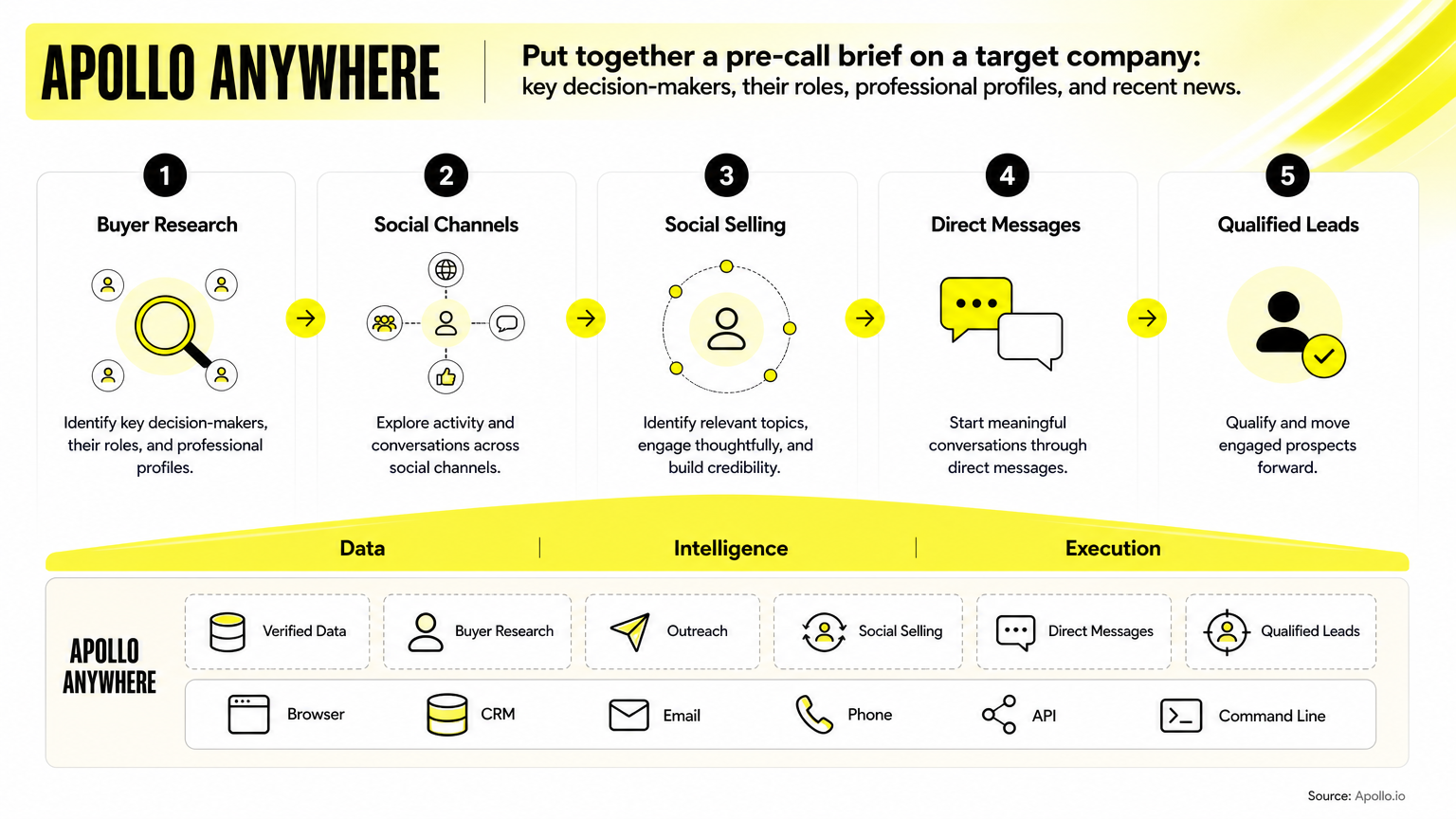

Apollo Ends Hours-Long Manual Lead Research
Still manually researching leads and verifying contact info one by one. Apollo hands you accurate business emails and numbers instantly, no digging required. 98% email accuracy means less guessing, more selling.
Start Free with Apollo →Key Takeaways
- A real pre-call brief maps the buying committee (economic buyer, champion, evaluator, blocker), not just one professional profiles.
- Use Apollo MCP when you need to pull verified contacts, roles, and company signals directly inside ChatGPT, Claude, or Perplexity without switching tabs.
- Score every claim by source and recency so you know what's a verified fact versus an inference before you walk into the call.
- Deals that engage four or more stakeholders close at nearly twice the rate of single-threaded deals, so your brief should be built for a group from the start.
- Use Apollo MCP when you need to turn a company name into a stakeholder map and trigger-event timeline in one conversation.
What Is A Pre-Call Brief?
A pre-call brief is a one-page summary of a target account that documents key decision-makers, their roles, verified professional profiles, recent company news, and specific reasons the timing is right for outreach. It is not a company overview or a list of firmographic data pulled from a website.
It exists to answer one question fast: why does this account matter right now, and to whom?
Gartner's 2025 survey found that 73% of B2B buyers actively avoid suppliers who send irrelevant outreach. A pre-call brief is the mechanism that prevents that: it forces you to convert research into a specific, credible reason for contacting this buyer today, not a generic pitch that could apply to any account on your list.
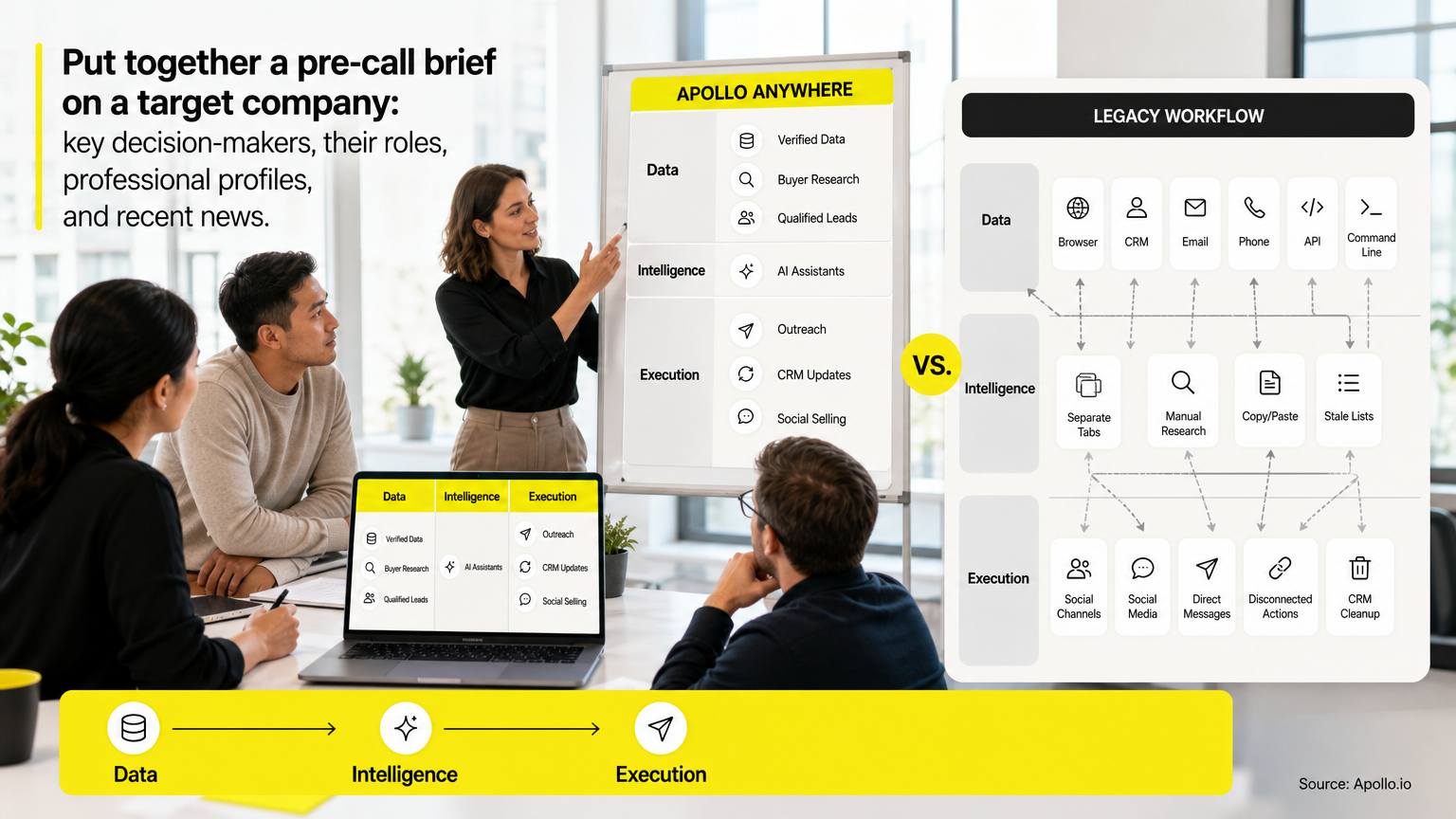
What Should A Pre-Call Brief Template Include?
A complete pre-call brief template includes seven sections: account snapshot, trigger timeline, stakeholder map, evidence table, hypotheses, discovery questions, and a proposed next step.
Each section should take two to five minutes to fill in if you're working from a good data source.
| Section | What Goes In It | Time to Complete |
|---|---|---|
| Account Snapshot | Industry, size, revenue signals, tech stack, funding stage | 3 min |
| Trigger Timeline | Leadership changes, funding, earnings, product launches (last 90 days) | 5 min |
| Stakeholder Map | Economic buyer, champion, evaluator, user, procurement, blocker | 10 min |
| Evidence Table | Fact, source, date, confidence level | 5 min |
| Hypotheses | Why this account, why now, what problem you'd solve | 3 min |
| Discovery Questions | 3-5 questions tied to committee-level priorities | 2 min |
| Next Step | Specific ask for this call | 2 min |
Building your target account list before you start briefs saves time, since you can batch-research accounts that share similar trigger events.
How Do You Map Decision-Makers And Their Roles?
Mapping decision-makers means identifying six functional roles across the buying committee, not just the most senior title. Gartner reports that B2B buying groups typically range from five to 16 people across up to four functions, and 74% experience internal conflict during the decision process.
Skipping this step means you're prepared for a conversation that may not include the people who actually decide.
- Economic buyer: controls budget, final sign-off authority
- Champion: internal advocate who benefits from the solution
- Technical evaluator: assesses fit, security, integration
- End user: will use the product daily
- Procurement: negotiates terms, manages vendor risk
- Blocker: has reason to prefer the status quo or a competitor
For each role, note name, title, tenure in role, and one recent signal (a post, a quote in an interview, a job change). Research from Omnibound shows the average B2B purchase now involves 11 to 13 stakeholders, reinforcing that a single-contact brief covers roughly a tenth of the committee you're actually selling to.
Struggling to find the right contacts fast? Search Apollo's 240M+ contacts with 65+ filters to identify every role on the committee, not just the top title.
How Do You Verify professional profiles And Recent News?
Verifying a professional profiles means cross-checking the name, title, and tenure against at least one independent source before you cite it in a brief. professional networks itself found that one in four sellers still send templated emails and more than one in three reach out with little or no knowledge of the person, company, or industry, which is exactly what a verification step prevents.
Use this source hierarchy, ranked by reliability:
- Company press releases, 8-K filings, or earnings call transcripts (public companies)
- Verified contact and company databases with recent update timestamps
- professional profiles activity (posts, job changes, comments)
- Third-party news coverage
- Social media outside professional networks (lowest confidence, use only to support other sources)
Flag anything older than 90 days as "may be outdated" rather than presenting it as current. For public companies, scan the most recent 8-K filing or earnings call transcript for leadership changes, restructuring, or new strategic priorities. New C-suite leaders are 68% more likely to review existing vendors within their first 90 days, according to Jolly Marketer, making a recent executive change one of the highest-value trigger events to surface.
Turn Cold Leads Into Sales-Ready Deals
Marketing leads that stall before becoming real opportunities. Apollo surfaces buying signals so reps engage prospects at the exact moment they're ready to talk. Built-In saw higher win rates using Apollo's scoring to prioritize the right accounts.
Start Free with Apollo →How Do SDRs And AEs Turn Research Into A Committee-Level Narrative?
SDRs and AEs turn research into a committee narrative by writing one shared value hypothesis that connects to each stakeholder's priorities, rather than five disconnected talking points. Gartner found that buying groups were 40% less likely to complete a high-quality purchase when messaging was tailored only to one person's role instead of addressing the group.
For example, an SDR prospecting a mid-market SaaS company might note that the champion (VP of RevOps) cares about data consolidation, while the economic buyer (CRO) cares about pipeline predictability. The shared narrative: "Reducing tool sprawl gives RevOps cleaner data and gives the CRO more reliable forecasting," with one discovery question aimed at each stakeholder.
AEs managing later-stage deals should update the stakeholder map after every call, noting who showed up, who didn't, and any new names mentioned. This turns the brief into a living document instead of a one-time exercise, which matters since The Smarketers found that deals engaging four or more stakeholders close at 1.9x the rate of single-threaded deals.
How Can You Build A Pre-Call Brief Inside Your AI Tools?
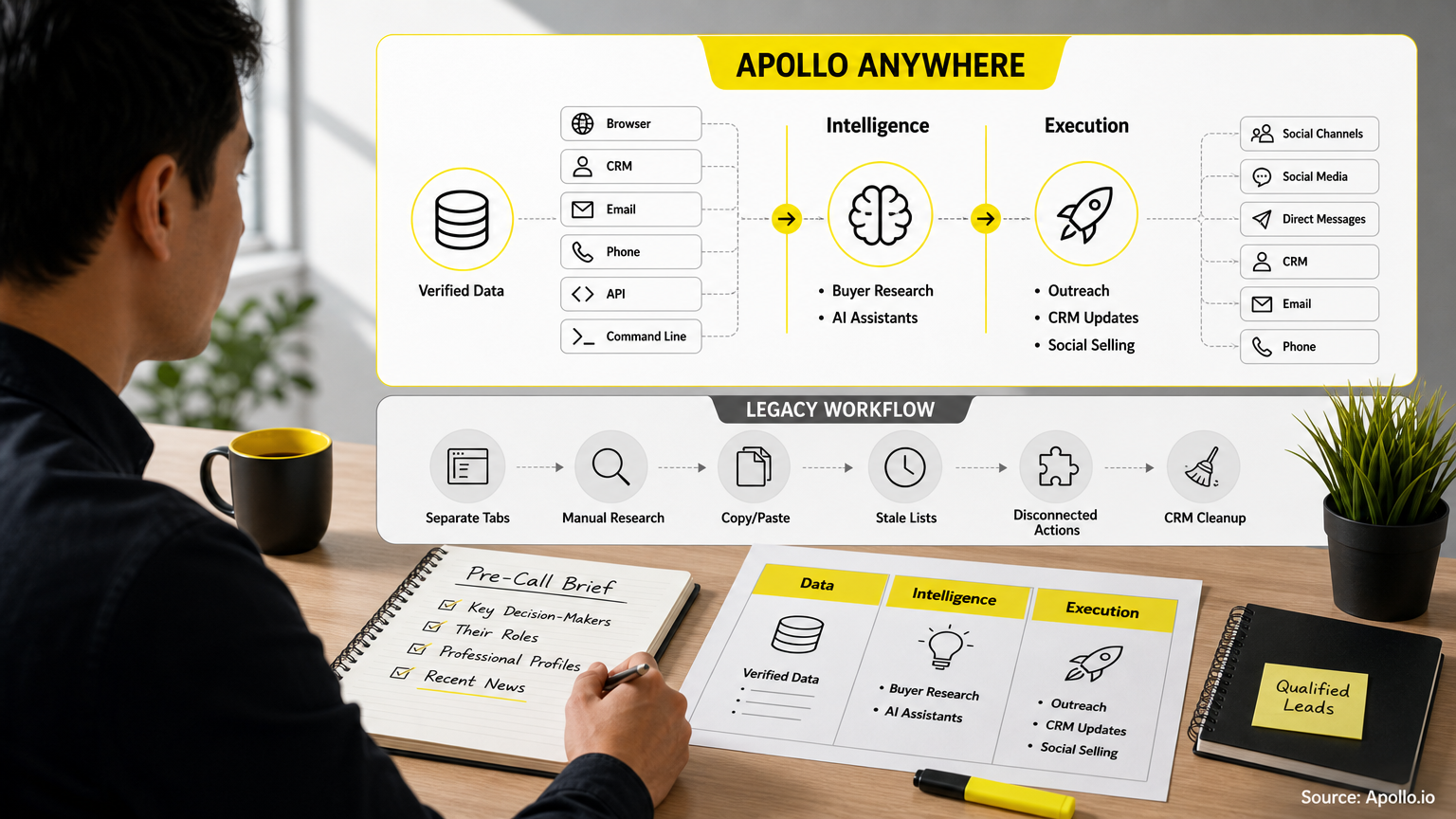
You can build a pre-call brief without leaving ChatGPT, Claude, or Perplexity by connecting Apollo directly inside those tools through Apollo MCP. Setup takes minutes: connect Apollo via OAuth in your AI tool's connectors settings on any Apollo plan, including free.
Once connected, you can ask your AI assistant to find everyone at a target company matching a role (like "VP of Sales" or "Head of RevOps"), pull verified emails and phone numbers, and check recent company activity, all in one conversation. Apollo also works through a Chrome extension for prospecting across the web, and developers can use the Apollo CLI for terminal-native workflows.
This mirrors a broader shift in the market: Salesforce reports that 87% of sales organizations already use some form of AI, and sellers expect fully implemented agents to cut prospect-research time meaningfully.
Your best research session shouldn't require opening five tabs and a spreadsheet. Spending hours manually compiling contact lists? Start free with Apollo's verified business contact data and skip the copy-paste research cycle entirely.
What Does A Completed Pre-Call Brief Look Like?
A completed pre-call brief shows fact and inference side by side, with a confidence label on every claim. Here's an anonymized example for a mid-market logistics company:
- Trigger (Fact, high confidence): New CFO started 45 days ago per company press release.
- Inference (medium confidence): New CFO likely reviewing vendor contracts given the 90-day vendor review pattern common after executive changes.
- Stakeholder note (Fact, high confidence): VP of Operations posted about "reducing manual reporting" on professional networks 12 days ago.
- Committee narrative: Frame the call around consolidating fragmented reporting tools, tying the CFO's cost scrutiny to the VP of Ops' stated pain point.
- Discovery question: "How is the team handling reporting consistency since the leadership transition?"
Notice the brief separates what's verified from what's assumed. That distinction is what makes a brief useful in the room instead of just impressive on paper. Reviewing your Apollo Chrome Extension notes alongside CRM history helps keep this fact/inference split consistent across every account.
Frequently Asked Questions
How do I find decision-makers at a target company?
Search by title and seniority within a verified contact database, then cross-reference against the company's leadership page or recent press releases to confirm the person is still in the role.
How do I verify a professional profiles is current?
Check the "last active" signal, compare the listed title against a company's official leadership page or a recent 8-K filing, and flag anything without a source update in the last 90 days.
How much time should a pre-call brief take?
A focused brief using the seven-section template above takes about 30 minutes for a new account, and under 10 minutes to refresh before a follow-up call.
Is it safe to use AI for pre-call research?
Yes, as long as every AI-generated claim is checked against a named, dated source. Treat AI output as a draft, not a verified fact, until you've confirmed it.
Start Building Sharper Pre-Call Briefs Today
A pre-call brief only earns its place in your process if it changes how the call goes. Map the committee, score your sources, and connect the research to a shared narrative instead of five separate pitches.
Teams that skip this step are guessing at who's in the room; teams that do it consistently close more of the deals that matter.
Predictable Revenue said it best: "We reduced the complexity of three tools into one" after consolidating their research and outreach stack with Apollo. Ready to stop stitching together spreadsheets tabs, and CRM notes for every call? Start a Trial with Apollo and build your next pre-call brief in one workspace.
Prove ROI Fast, Scale Reps Without Hiring
Struggling to justify tool spend before your pipeline shows results? Apollo replaces scattered manual outreach with automated workflows your whole team can run on day one. Leadium tripled annual revenue after automating outbound with Apollo.
Start Free with Apollo →Don't miss these
Sales
Inbound vs Outbound Marketing: Which Strategy Wins?
Sales
What Is a Sales Funnel? The Non-Linear Revenue Framework for 2026
Sales
What Is a Go-to-Market Strategy? The 2026 GTM Playbook
See Apollo in action
We'd love to show how Apollo can help you sell better.
By submitting this form, you will receive information, tips, and promotions from Apollo. To learn more, see our Privacy Statement.
4.7/5 based on 9,690 reviews
