A pre-demo checklist is a short, repeatable set of tasks that gets buyer questions, stakeholders, and evidence lined up before the meeting starts. Done well, the live session becomes a fit check instead of a feature tour. If you already run structured objection handling, this is the same discipline applied one step earlier.
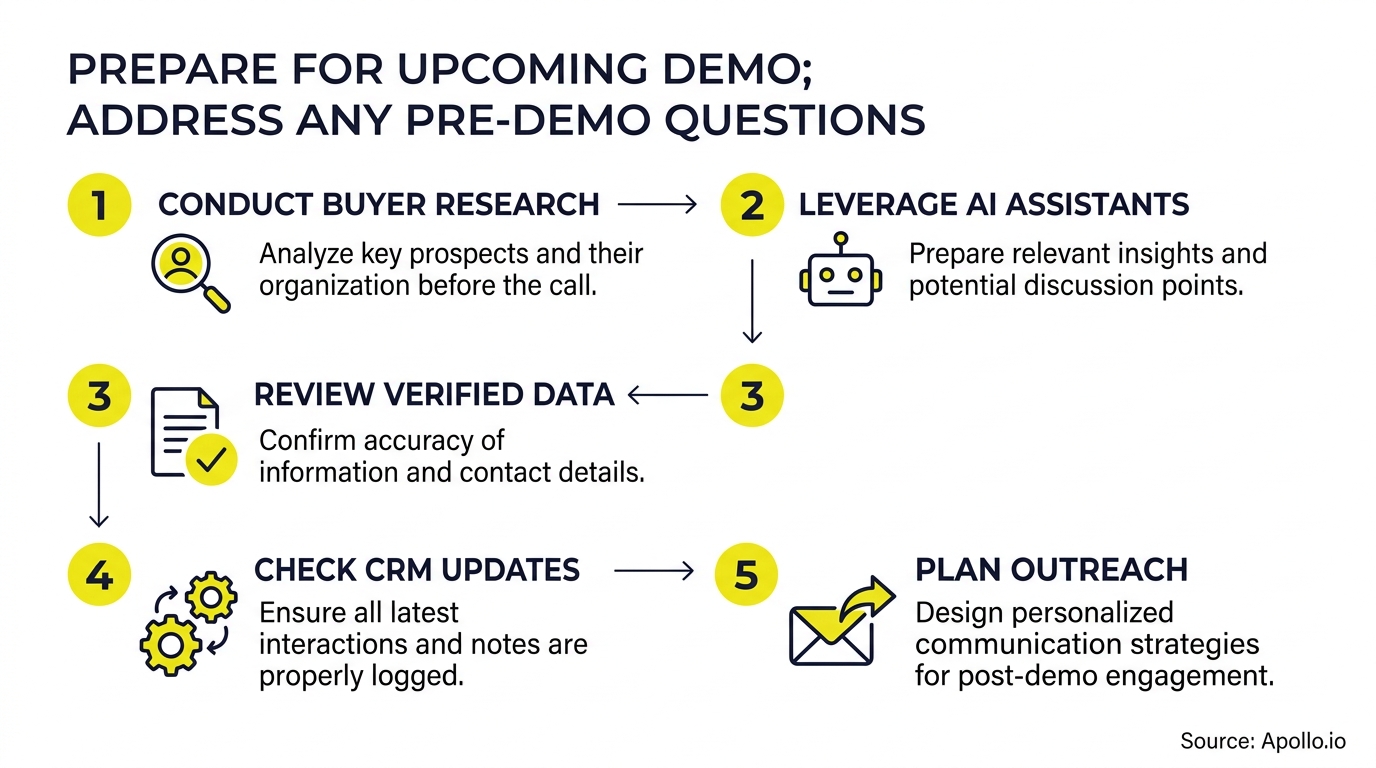

Apollo Hands Reps Their Selling Hours Back
Tired of reps burning hours researching leads and verifying contact info instead of selling? Apollo finds verified business contacts in seconds, with 98% email accuracy. Give every rep one proven workflow and watch pipeline build faster.
Start Free with Apollo →Key Takeaways
- Collect buyer questions and must-have requirements before the meeting, not during it.
- Assign every question an owner, an evidence source, and a due date.
- Map each stakeholder to the proof they need to say yes.
- Reconcile website, pricing, and seller claims so buyers hear one story.
- Measure attendance, unresolved questions, and decision progress, then test changes.
What Is a Sales Demo Preparation Checklist?
A sales demo preparation checklist is a task list that separates seller work (research, environment setup, evidence) from buyer work (stakeholders, requirements, questions). It exists because most buyers arrive informed.
Forrester's January 2026 analysis of its 2025 Buyers' Journey Survey found that 94% of business buyers reported using AI during their buying process, and 6sense's 2025 research found that 94% of buying groups ranked their shortlist before engaging sellers.
That changes the job.
The demo is now a validation session, so preparation should focus on proving fit rather than explaining every feature.
What Should Sellers Complete Before the Demo?
- Review the account, the attendee list, and any prior conversations.
- Confirm pricing, security, and integration answers match what is published on your website.
- Customize the demo environment and dataset to the buyer's use case.
- Draft likely questions and attach a verified evidence source to each.
- Decide the demo's next step: sandbox, trial, or technical validation.
What Should Buyers Prepare?
- Their top three must-have requirements and any deal-breakers.
- The names and roles of everyone who must approve the purchase.
- Budget range, timeline, and tools they already use.
- Claims they read or heard (including from AI tools) that they want confirmed.
Research from Careertrainer.ai reports that 78% of buyers expect reps to know their business needs prior to the call, so doing this homework is table stakes.
What Should a Pre-Demo Email Template Include?
A pre-demo email should confirm the time, state the goal, request two or three strategic answers, and offer a short self-service resource.
Keep the ask small. Salesprep.ai notes that pre-demo questionnaires should be highly targeted, at one or two strategic questions, rather than an exhaustive interrogation.
Copy-ready template:
Subject:
Quick prep for Thursday's demo
Hi [Name],
Looking forward to Thursday at [time]. To make the session useful for [Company], could you reply with:
- The one workflow you most want to see handled?
- Who else needs to be comfortable with this decision (and what will they ask)?
- Anything you've read or heard that you'd like us to confirm?
I've attached a short product preview and our pricing overview so we can spend live time on your specifics. If a question comes to mind before then, reply here and I'll bring the answer.
[Signature]

What Are the Best Questions to Ask Before a Demo?
The best pre-demo questions uncover requirements, stakeholders, constraints, and prior research. Use this short list and ask only what you cannot find yourself:
- Use case: Which process should this tool improve first?
- Success criteria: What would make this demo a success for you?
- Stakeholders: Who else will weigh in, and what do they care about?
- Constraints: What integrations, security reviews, or budget limits apply?
- Existing research: What have you already read, tested, or been told?
Forrester's 2026 findings note that incomplete or unreliable AI answers push buyers toward trusted human validation. That makes the last question the most valuable one on the list.
Fill The Funnel And See Every Deal Clearly
Tired of thin pipeline and forecasts that feel like guesses? Apollo helps you find the right buyers, build a full funnel, and track every deal in one place with 98% email accuracy. See where deals stand before the quarter slips away.
Start Free with Apollo →How Do You Build a Pre-Demo Question Intake and Answer Tracker?
You build an intake tracker by logging every buyer question in one shared table with an owner, evidence, and a status. This closes the gap most checklists miss: nobody owns the answer, and nobody verifies the evidence.
| Question | Priority | Evidence | Owner | Due Date | Unresolved Caveat |
|---|---|---|---|---|---|
| Does it integrate with our CRM? | High | Integration docs, live demo | Solutions engineer | 2 days before | Custom fields need scoping |
| What does implementation cost? | High | Pricing overview, scope sheet | Account executive | 2 days before | Depends on seat count |
| How is our data secured? | Medium | Security documentation | Security lead | 1 day before | Questionnaire may follow |
Reconcile every answer against your public site before the call. Gartner's June 2025 release found that 69% of surveyed buyers encountered inconsistencies between suppliers' websites and sellers' information.
A mismatch costs more trust than an honest "we'll confirm that."
Spending hours piecing together account context from scattered tabs? Search Apollo's 240M+ contacts with 65+ filters to identify attendees and their roles before the call.
How Do Account Executives Map Stakeholders to Demo Evidence?
Account Executives map stakeholders by listing each approver, their top concern, and the proof that resolves it, then assigning that proof to a demo segment or a follow-up asset. Forrester's 2026 research describes 13 internal stakeholders and nine external influencers in a typical buying decision, and reports procurement professionals act as decision-makers in 53% of business buying cycles.
One unaddressed stakeholder can stall the whole deal.
| Stakeholder | Must-Have Requirement | Demo Segment or Evidence |
|---|---|---|
| End user (SDR or rep) | Faster daily workflow | Live workflow walkthrough |
| RevOps | Clean data, CRM sync | Integration demo, CRM integration guide |
| Procurement | Price transparency, terms | Written pricing and scope summary |
| Security or IT | Data handling answers | Security documentation |
| Sales leader | Reporting and visibility | Dashboard segment, success metrics |
Then convert this table into a time-boxed agenda. Lead with the highest-priority requirement, not the product's most impressive feature.
According to TrustRadius's 2024 research, 66% of buyers chose their product because it met their needs at the best price, versus 13% who said the demo impressed them. Fit and economics beat polish.
How Can Sellers Use Pricing Transparency and Self-Service Before the Demo?
Sellers should send price guidance and a short product preview in advance, then reserve live time for buyer-specific questions. TrustRadius's 2026 research found that 59% of technology buyers wanted more transparent pricing, and Gartner reported in 2025 that 61% preferred an overall rep-free buying experience while still wanting seller input on organizational fit.
A practical split:
- Asynchronous: pricing overview, FAQ, security summary, product preview video.
- Live: workflow fit, integration specifics, rollout constraints, approval blockers.
AI can help draft account briefs and anticipated questions, but a human must verify every claim. For a deeper look at where AI helps and where it does not, see this experiment with AI writing for sales.
How Do SDRs and RevOps Teams Reduce Demo No-Shows?
SDRs and RevOps teams reduce no-shows by confirming the meeting, sending a value-focused reminder, and making the agenda visible in advance. RepMath reports demo show rates range between 65% and 75% without structured pre-demo nurturing, so every confirmation touch matters.
Is your team juggling separate tools for scheduling, outreach, and reminders? Book and confirm meetings inside Apollo alongside sequences and deal tracking, and cut your tech stack to one workspace. As Collin Stewart of Predictable Revenue put it: "We reduced the complexity of three tools into one."
How Do You Measure Whether Pre-Demo Preparation Works?
You measure it by tracking show rate, unresolved questions at the end of the demo, and decision progress after it, then testing one change at a time. Do not assume gains. Reprise reports that how teams prepare before a demo and how they address pre-demo discovery questions correlate with win rates and sales velocity, which supports measuring it rather than guessing.
| Metric | What It Tells You | How to Test |
|---|---|---|
| Show rate | Whether confirmation touches work | Compare reminder formats |
| Unresolved questions per demo | Quality of answer tracking | Count open items in the tracker |
| Next-step conversion | Whether the demo moved the deal | Track trial, sandbox, or technical review starts |
| Stakeholders engaged | Buying group coverage | Compare attendee list to the matrix |

Start Prospecting Before Your Next Demo
The strongest demos are won in the preparation: a short intake, an owned answer tracker, a stakeholder matrix, and an agenda built around the buyer's must-haves. Run the checklist on your next scheduled demo, track the four metrics above, and adjust one variable at a time.
For SDRs, AEs, and RevOps leaders who want research, outreach, and meeting booking in one place, Start Prospecting with Apollo today.
Prove Sales Tool ROI Within Weeks With Apollo
Budget review coming and no clean numbers to defend your sales stack? Apollo puts prospecting, outreach, and deal tracking in one place, so wins show up fast. Leadium tripled annual revenue by automating follow-up. Show your CFO real pipeline impact.
Start Free with Apollo →Don't miss these
Sales
Inbound vs Outbound Marketing: Which Strategy Wins?
Sales
What Is a Sales Funnel? The Non-Linear Revenue Framework for 2026
Sales
What Is a Go-to-Market Strategy? The 2026 GTM Playbook
See Apollo in action
We'd love to show how Apollo can help you sell better.
By submitting this form, you will receive information, tips, and promotions from Apollo. To learn more, see our Privacy Statement.
4.7/5 based on 9,690 reviews
